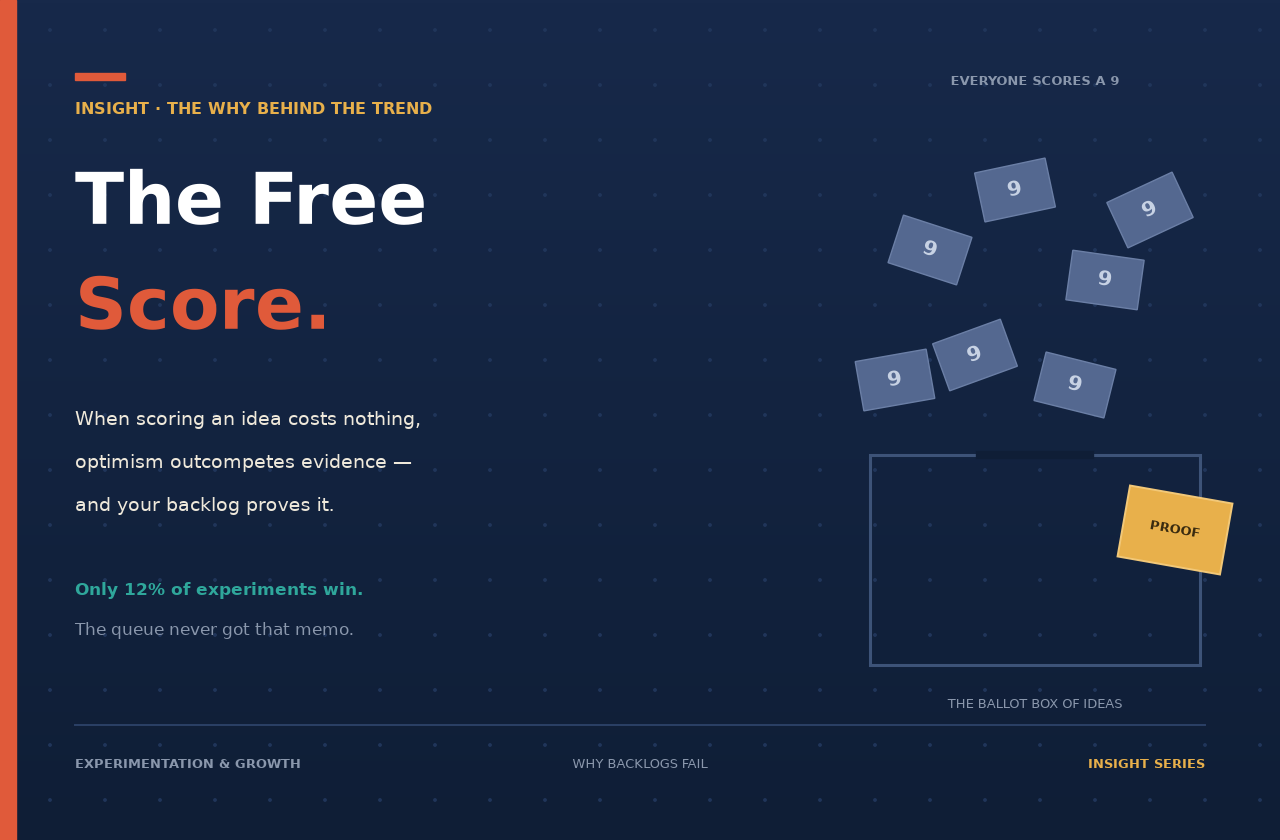
Here is a puzzle every growth team lives with but rarely names. Everyone knows most experiments fail — Optimizely’s analysis of 127,000 experiments found only about 12% win on the primary metric, and Booking.com’s reported experience is blunter: nine of ten ideas miss expectations. Everyone knows this. And yet every prioritization meeting produces a backlog where nearly every idea is rated 8 or 9 out of 10 for impact. If the base rate is common knowledge, why does the queue behave as if every idea is a winner?
The answer isn’t stupidity or even vanity. It’s price.
Scoring Is Free; Proof Is Not
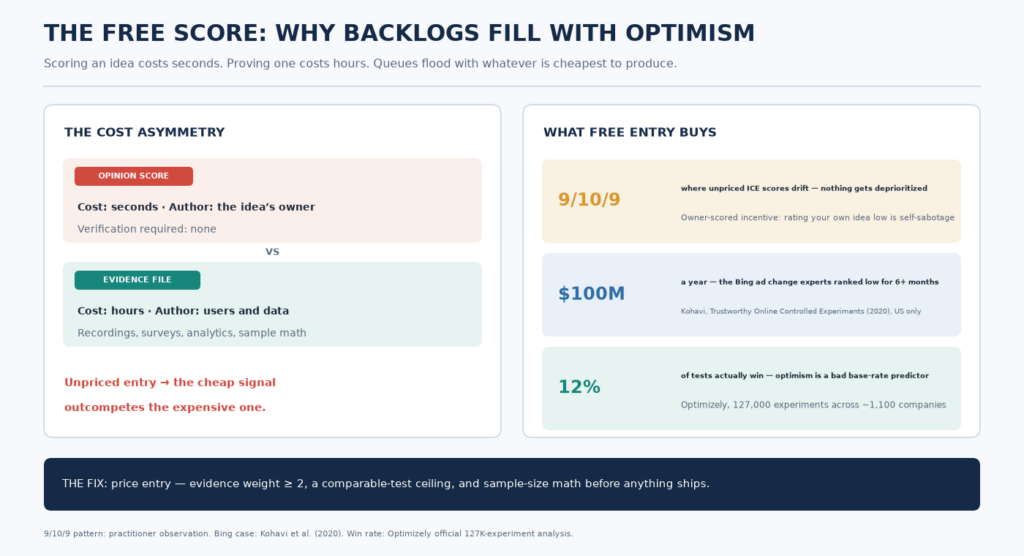
Consider what each input actually costs. An ICE score takes seconds: the idea’s owner picks three numbers, and no artifact is required. An evidence file takes hours: someone must pull session recordings, tag survey responses, run the funnel query, or dig up a comparable past test with its lift data. One input is free to produce; the other has a real labor cost.
Now add the incentive layer. The person scoring is usually the person proposing. Rating your own idea a 4 means arguing against your own workload, your own visibility, your own shot at a win. Rational actors inflate. Everything drifts toward 9/10/9 — not because anyone is lying, but because honest low scores are privately costly while inflated high scores are free.
This is the same mechanism economists call a lemons market, running in reverse: when quality is expensive to demonstrate and cheap to claim, claims flood the market. Your backlog isn’t a ranking of ideas. It’s a ranking of what was cheapest to assert.
What the Free Score Costs You
The damage isn’t abstract. At Microsoft, a small change to Bing’s ad headline display sat deprioritized for over six months because program managers rated it low — Ronny Kohavi recounts that when an engineer finally tested it, revenue rose about 12%, worth over $100 million a year in the US alone. The scoring system did exactly what it was incentivized to do: it ranked advocacy, and advocacy ranked the winner near the bottom.
Multiply that error across a year of queue decisions and you get the real cost of free scoring: not the tests that lost, but the tests that never ran.
The Fix Is a Price, Not a Plea
You cannot train people out of an incentive. You can only change what entry costs. That is the logic behind evidence gates: nothing enters the backlog without a signal that took labor to produce — a recording, a survey, an analytics finding, a comparable result. Suddenly the cheap claim and the expensive claim don’t compete on the same terms, because the cheap claim can’t get in.
Price the door, and the queue starts telling the truth.