Everyone noticed that both vendors raised prices this year. Almost nobody noticed what they quietly started metering — and that is the more interesting story.
Two numbers that should not sit in the same table
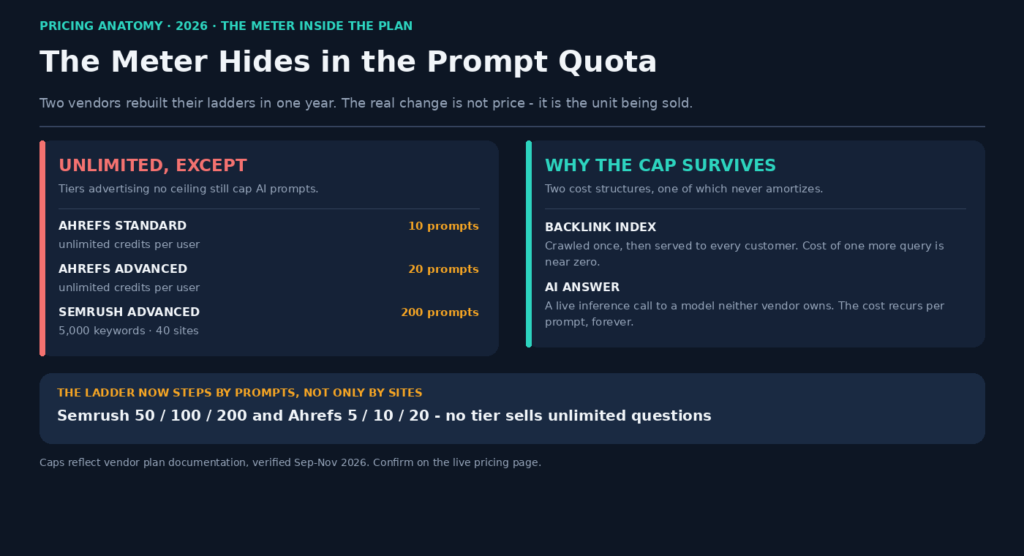
Open Ahrefs’ 2026 plan table and look at Standard and Advanced. Both say “unlimited credits per user.” Two lines further down, in the same rows, they say 10 AI prompts and 20 AI prompts.
Semrush runs the identical pattern. Advanced, at $549, sells 5,000 keywords and 40 sites with no ceiling in sight — and 200 AI prompts.
Unlimited for one thing. Rationed for another. Same tier, same customer, same page. That is not a marketing decision. That is an accounting one.
One asset amortizes. One never does.
Here is the mechanism, and it is almost embarrassingly simple.
A backlink index is crawled once and then served to every customer who asks. The millionth query against it costs the vendor close to nothing, because the crawler already paid for the data months ago. That is why “unlimited credits” is a promise a vendor can actually keep.
An AI answer is not an asset. It is a transaction. Every time you ask a tracking tool what ChatGPT says about your brand, that tool makes a live inference call to a model it does not own — OpenAI’s, Google’s, Anthropic’s — and pays for it in tokens. The bill arrives again tomorrow. And the day after. There is no amortization curve, no cached corpus, no fixed cost you can spread across ten thousand customers.
A prompt therefore behaves like electricity: consumed at the instant of use, recurring, metered. A backlink behaves like a map: surveyed once, sold many times. Vendors cap prompts because they cannot cap their own bill.
Why the ladder now steps by questions
The prompt quotas tell the story better than the prices do. Semrush climbs 50, 100, 200. Ahrefs climbs 5, 10, 20. Semrush is roughly twenty times more generous at comparable tiers, and that gap is a real, documented reason to prefer it for AI work. But both ladders climb the same direction, and neither lands on infinity.
Which finally answers the question buyers keep asking: why does GEO cost extra, when “it’s just tracking”? Because it is the only feature in the entire stack whose marginal cost is positive, and permanent.
The strategic consequence
Three things follow, and the third is the one worth acting on.
Prompt quotas are the new seat count. Budget them as variable cost, not as a feature checkbox, and expect them to move every renewal.
Any vendor promising genuinely unlimited AI tracking is either subsidizing it — unsustainable — or sampling lightly enough that “unlimited” means a small, cheap prompt set. Ask how many distinct questions the quota actually buys.
And Adobe bought Semrush in April 2026. An inference-metered, recurring-cost asset fits the computing narrative far better than it fits the data-licensing one. That is a thesis about where margin now lives in this category — not just consolidation.
What this means for your next renewal
When you compare $199 against $249, you are no longer comparing two price tags. You are comparing two meters. Convert both to cost per tracked question per month, and the comparison becomes honest for the first time.
The tool is not expensive because it is clever. It is expensive because it asks a model a question, every single day, on your behalf — and someone has to pay for the answer.