Data Studio’s paid tier sells custody, not capacity — and the lever that would lift your ceiling sits on somebody else’s budget.
The invoice said nine dollars. You expected it to buy room. That is the most reasonable wrong assumption in marketing analytics right now.
Google renamed Looker Studio back to Data Studio in April 2026. The paid edition, Data Studio Pro, is still listed at $9 per user per project per month. Notice the unit: not per property, not per query. That is the first clue about what is being sold.
What the nine dollars does buy
Mostly custody and delivery. Reports and data sources belong to your organization through a Google Cloud project instead of to whoever made them. Team workspaces with role-based permissions. Up to 200 delivery schedules per report instead of one, hourly sends, Chat and Slack destinations, chart alerts. Customer-managed encryption keys, data residency, support — itself requiring a Cloud support plan.
Every item answers a governance question: who owns this, who sees it, who receives it, what happens when its creator resigns. Not one answers a capacity question.
What it does not buy, and why
Three ceilings, three owners
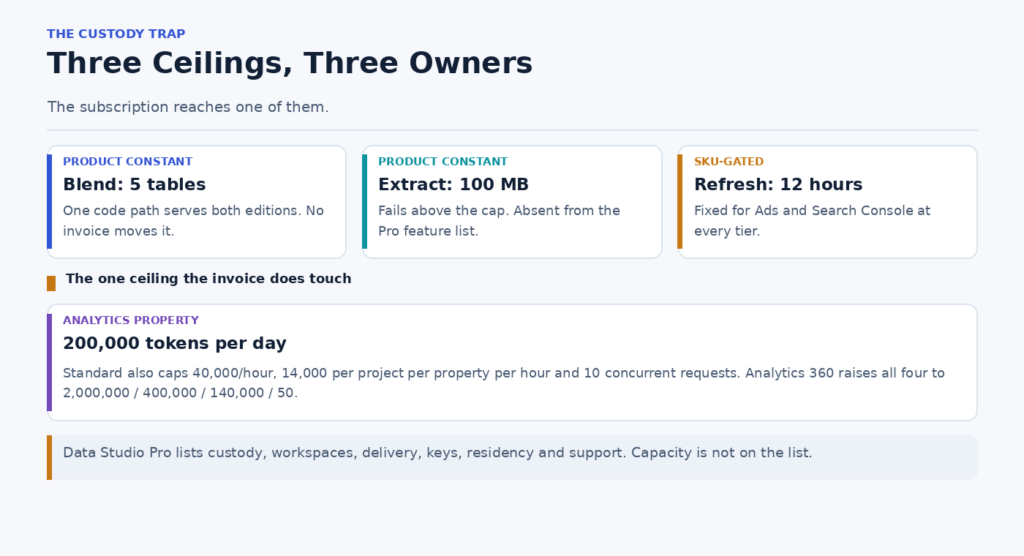
The limits that break a dashboard ignore your subscription: they are set in three places, and nine dollars reaches one.
A blend still holds five tables. An extract still fails outright above 100 MB. Ads and Search Console still refresh every twelve hours, fixed, with no setting to shorten it. A standard GA4 property still gets 200,000 core tokens per day, 40,000 per hour, 14,000 per project per property per hour, and 10 concurrent requests.
Look at who owns each one. Blend and extract appear nowhere in the Pro feature list; they are product constants, so no invoice moves them. The token ceilings live on the Analytics property, and only the Analytics SKU moves those: Analytics 360 raises the same four limits to 2,000,000, 400,000, 140,000 and 50. The subscription you were about to buy is not on that ledger.
That is the mechanism. The constraint and the product that removes it are sold by two different vendors inside one vendor.
The ladder has a hole in it
Nine dollars a month is $108 a year per user per project. The next rung that genuinely raises a ceiling is not eighteen dollars, it is an Analytics 360 contract. Google publishes no list price; resellers report a start near $50,000 a year for 25 million events per month — reported, not official.
So the ladder does not climb; it jumps, landing in another budget. The analyst who meets the quota error on Monday sits in marketing. Whoever can sign an Analytics 360 contract is usually an analytics lead, an IT budget owner, or a procurement committee. Cheap seats, expensive ceiling, different signatures. The bottleneck has no upsell because it is not the seller’s to fix.
What that means on Monday
Stop buying Pro to cure a quota error. The documentation never promises it, and now you know why it cannot. Buy it for what it sells: assets that outlive their creator, and delivery volume one schedule cannot carry.
If the ceiling is the problem, the fix is architectural and needs nobody’s signature. Pre-aggregate in BigQuery, point the report at a summary table, and the token quotas stop applying — you are no longer asking the Data API. The blend cap stops mattering, because the join happened upstream. You trade a ceiling you were never allowed to raise for query costs you control.
Nine dollars is not a small version of the enterprise contract. It is a different product wearing a similar name, and the ceiling stays exactly where it was.