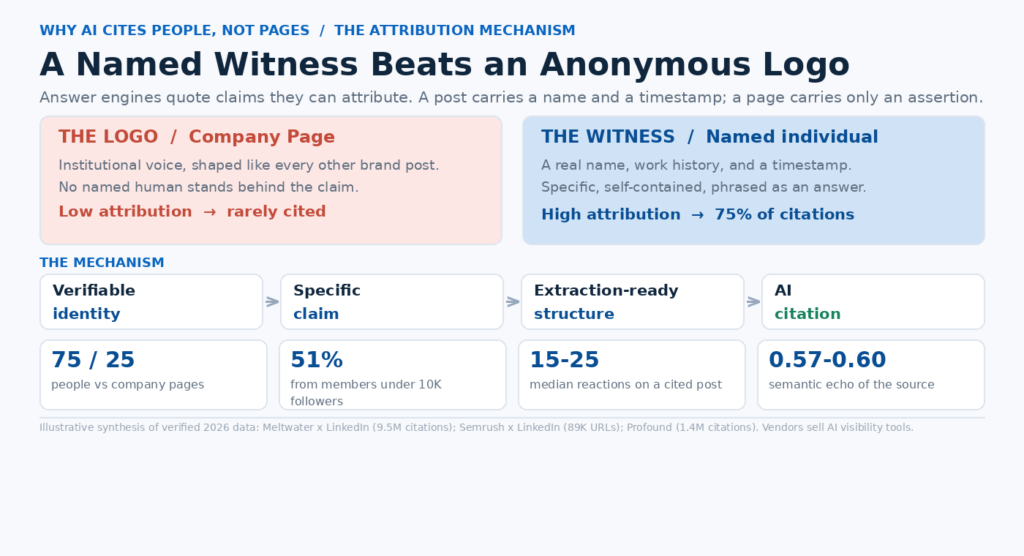
Here is a finding that looks like a marketing anomaly until you notice the mechanism underneath it. Meltwater and LinkedIn analysed 9.5 million AI citations across six models and 16 B2B categories in 2026. Roughly 75% of LinkedIn’s citations pointed to individual members. Company pages took the other 25%. In a separate study of 89,000 cited LinkedIn URLs, Semrush found that ChatGPT Search and Google AI Mode each drew 59% of their LinkedIn citations from individuals — while Perplexity, the outlier, favored company pages at 59%.
Most write-ups stop at the ratio. The more interesting question is why it exists at all.
A Citation Is an Attribution Decision
Answer engines do not quote text the way a search engine ranks a page. They assemble an answer and attach a name to each claim — and a name is a liability. A statement signed by a named practitioner can be checked, quoted back, and, if wrong, argued with. An anonymous brand page makes no such promise. It speaks in the institutional voice every company page has learned to imitate, which is precisely why it carries so little attribution weight.
The data fits that reading almost too neatly. Cited LinkedIn content scores 0.57 to 0.60 on semantic similarity — how closely the AI answer echoes the source. Reddit scores 0.53 to 0.54, Quora 0.435. When an engine quotes a named person, it repeats that person’s framing almost verbatim. Identity is not decoration here. It is the credential that lets a sentence travel into an answer.
The Premium Has a Low Price of Entry
If the mechanism were simply authority, the winners would be the famous accounts. That is not what the studies show. In Meltwater’s sample, 51% of citations came from members with fewer than 10,000 followers. Semrush found that authors with under 500 followers were cited just as often as larger accounts. The median cited post had only 15 to 25 reactions and no more than one comment — and about 95% of cited posts were original, not reshares.
That is the discovery worth sitting with: the asset being rewarded is not reach but witness-like specificity. A solutions engineer with 380 followers who writes “here is what broke when we migrated” is doing something an eleven-person brand team cannot fake at scale. She is a person who could be wrong in public. Her post has a date, a name, and a point of view. The logo has a tone-of-voice guide.
Why the Logo Keeps Losing
Company pages are not useless. They remain the structured reference layer that Perplexity favors. But they are built for publishing, not for witnessing — and they are now flooded with machine-generated filler that reads like every other page. Generic content is exactly what retrieval skips.
The practical consequence is uncomfortable for brand teams. You cannot buy this premium with media spend, and you cannot manufacture it by ghostwriting under someone else’s name, because the whole mechanism depends on a real person standing behind the claim. The most cited asset in B2B search today is not a page you control. It is a reputation you have to earn, one honest post at a time.