Here is a puzzle that should keep every growth marketer awake. Review platforms are the second most-cited source category in AI answers, at about 14% — an order of magnitude ahead of news media. Yet in the study that made the rounds in 2026, review count and star rating correlated with ChatGPT ranking position at essentially zero (−0.21 to +0.02). So reviews decide everything and nothing. How does that happen?
The answer is a mechanism, not a mystery: retrieval reads page text, not a star average. When ChatGPT answers “best project management tool for a 12-person team” with search on, it runs targeted queries and builds the answer from pages that come back. A G2 or Capterra category page is usually among them. What the engine can extract from that page is the description, category tags, integrations list, pricing fields and reviewer prose. A flattened 4.7 out of 5 carries almost no information — it is a number stripped of the conditions that produced it. The prose is where the meaning lives, and the prose is what gets reused.
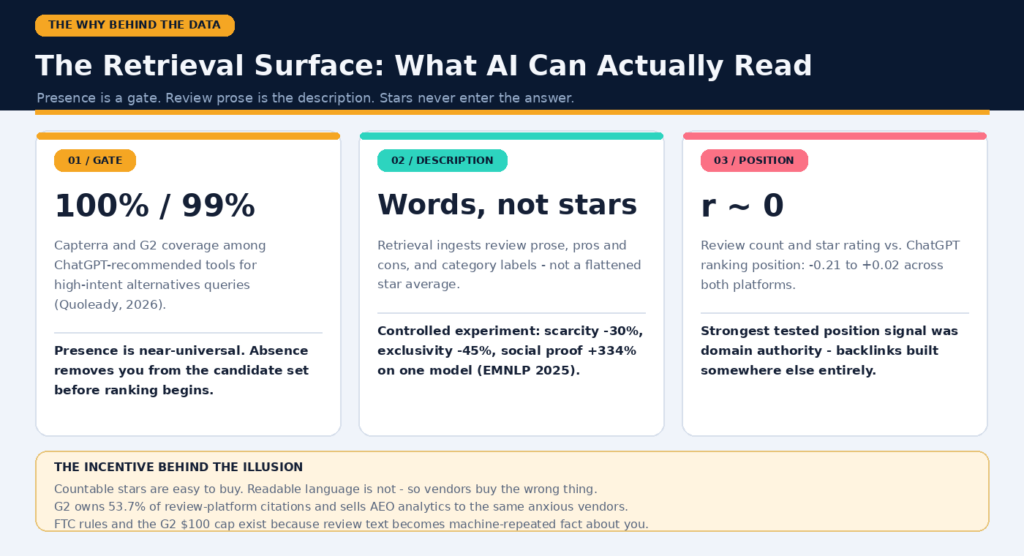
That explains the first half. Presence is so universal among recommended tools — 100% had Capterra reviews, 99% had G2 reviews — because it is an entry ticket, not a differentiator. A category page is the machine’s index of who belongs. When your profile is missing, you are not outranked; you are never enumerated. And because an engine reads your row and your competitors’ rows in the same pass, the category page is a comparative surface you enter but do not control.
The second half is an incentive story. Countable stars are easy to buy; readable language is not. So vendors keep buying the wrong thing — a campaign for 500 five-star reviews attacks the one metric with no measured relationship to position. Meanwhile, controlled evidence points the other way: scarcity framing cut LLM recommendation rates by 30%, exclusivity framing by 45%, while social proof lifted one model’s rate by 334%. Marketing tone propagates into answers. Plain, specific, evidence-bearing prose is the asset the machine can actually quote.
Then there is the referee selling coaching. G2’s own 2026 buyer survey says half of B2B software buyers now start with an AI chatbot and that review citations are the top trust signal. G2, which owns roughly 53.7% of review-platform citations through its Capterra and Software Advice acquisitions, also sells the analytics sold to vendors anxious about those answers. That is not a reason to discard the data. It is a reason to read the mechanism, not the marketing.
The discovery is this: review platforms do not rank you. They describe you, and the description is assembled from text your customers wrote and the fields your team filled in. Spend accordingly — on the gate, on the fields, on the language. Then measure across weeks, because a single answer proves nothing.