Here is what tipped me off. I was checking the 2025–26 Performance Max release notes line by line, expecting a story about control finally catching up with automation. Instead the list had a shape to it. Channel reports. Search terms. Placement reports by network. Budget projections. Full audience breakdowns. Self-serve lift studies. Window after window — and almost no doors.
That is not a roadmap. That is a bargain.
What was actually in the gift bag
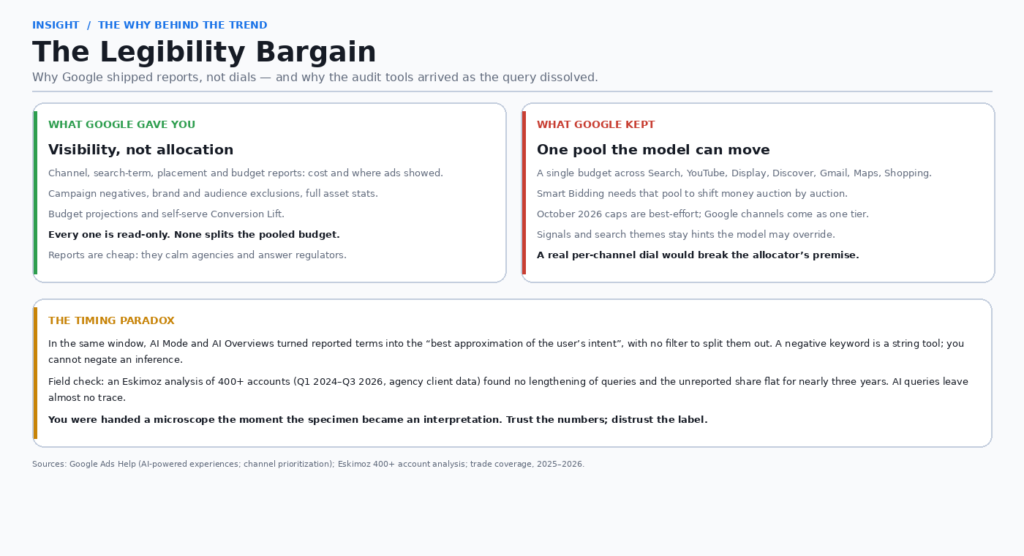
Google shipped roughly a dozen ways to see a PMax campaign in two years and about one way to steer it. The steering is mostly negative: exclude a brand, exclude a customer list, exclude a URL, exclude a placement. October 2026 added channel prioritization, but its caps are best-effort and its “Google channels” tier bundles Search, YouTube, Discover, Gmail and Maps into one indivisible lump. You can push money away from partners or the Display Network. You cannot tell the allocator to prefer Search over YouTube.
So the honest label for 2025–26 is not transparency. It is legibility: the account became readable without becoming governable.
Why reports are cheap and dials are expensive
Follow the incentive, not the press release. A report is nearly free to build — it is a view over data Google already holds. It buys a lot: it calms agencies, answers awkward questions from regulators about automated ad systems, and lowers churn among advertisers who were threatening to pull budget. None of it touches the engine.
A real per-channel dial does touch the engine. Smart Bidding’s entire premise is one pooled budget that moves auction by auction across every surface Google owns. Let an advertiser hard-split that pool and you have broken the allocator — and the yield the allocator was built to produce. Google will rent you a window into that pool all day. It will not sell you the wall.
That asymmetry is the insight. Visibility is a concession Google can afford; allocation is the asset it cannot give away.
Then the timing got strange
The uncomfortable part is not the controls. It is the calendar.
In the same 2025–26 window, Google’s own help pages began saying that for searches in AI Mode, AI Overviews, Lens and autocomplete, the term in your search terms report represents the “best approximation of the user’s intent”, not what the person typed. These rows arrive in aggregate, with no filter to separate them. Exact-match keywords may not get their usual priority, because an inferred query is not technically identical to any keyword.
Sit with that. A negative keyword is a string tool. It blocks a sequence of characters a human entered. You cannot negate an inference. The one artifact every optimization ritual was built on — the literal query — quietly became a paraphrase, in exactly the years Google handed everyone a microscope.
Was this coordinated? Almost certainly not, and I have no evidence to claim it was. But the outcome is structural, not conspiratorial: the platform made itself audit-readable at the precise moment its inputs stopped being auditable. AI-shaped queries are long, conversational, multi-part, sometimes an image with no text at all. They cannot map back to the string-based matching model Google Ads was built on. The dissolution was a prerequisite for AI ads, not a side effect of the reporting rollout.
Field notes: the queries left almost no footprints
A field check makes it concrete. Rémi Kerhoas at Eskimoz analysed more than 400 Google Ads accounts from Q1 2024 to Q3 2026 — agency client data, with his role disclosed — grouping terms by word count and estimating unreported volume. Despite Google saying AI Mode queries run two to three times longer, US accounts showed no shift toward longer queries in either Search or PMax, no conversion shift, and the unreported share stayed fairly flat for close to three years. UK and France looked the same. His own highest-confidence explanation was the mundane one: the report does not show prompts as typed.
Read the ledger, not the label. Cost, clicks and conversions on a row are still real money and real outcomes even when the text is a guess. Patterns across dozens of rows survive approximation; a single line does not. That is why the practical response is n-gram negatives, cost-ranked clusters, and account-level incrementality — Conversion Lift or a geo holdout — rather than one more literal negative keyword.
The tell
If you want to know who holds power in an automated system, do not count the switches. Ask which layer stayed untouched. Here, the budget pool and the intent inference both stayed on Google’s side of the glass. We got the windows, the reports, and a very good view of a specimen that is no longer there.