Here is a strange way to start a buying guide: open the terms of use first. Scroll near the bottom of the Microsoft Clarity Terms and you will find Section 17, which caps the direct damages you can recover from Microsoft and its suppliers at U.S. $5.00. Five dollars. A rounding error in most marketing budgets, and the entire liability ceiling on a tool that may be recording every click on your checkout page.
That single number is the honest hook for the 2026 session-replay market. We spent a decade comparing heatmap tools by their feature grids. In 2026, the more useful question is what you are actually signing. Microsoft Clarity is free, genuinely free, with no paid tier and no traffic cap — and the price is paid in rights, not dollars. Hotjar, the tool that defined this category for small teams, no longer exists as a product you can buy; it has been folded into Contentsquare, and its old self-serve simplicity has been replaced by a tiered enterprise suite.
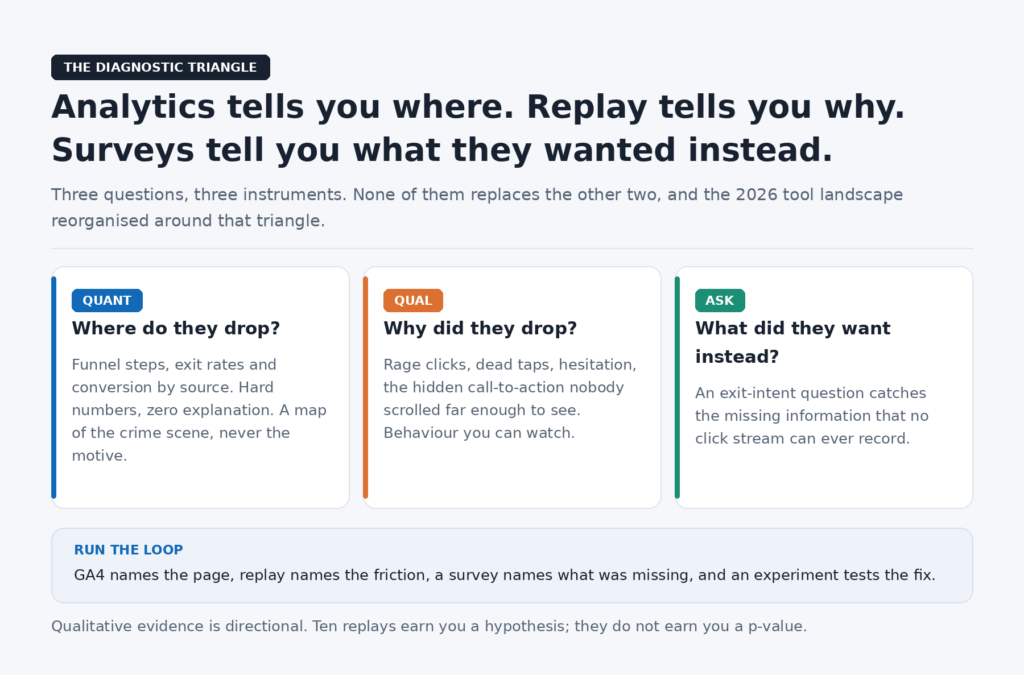
So let us reframe the whole thing. Analytics tells you where users drop. Replay tells you why. Surveys tell you what they wanted instead. The tools reorganised around that triangle, and the smartest buyer in 2026 is not the one with the longest feature list — it is the one whose data protection officer can actually sign the contract.
Why the triangle beats any single tool
Nobody replaces Google Analytics 4 with a heatmap. That would be like replacing a map with a witness statement. GA4 gives you the funnel: 4,000 people hit the pricing page, 600 reached the form, 91 submitted. Clean, countable, and completely silent on the question that matters. What happened in the 509 sessions that died between the form and the submit button?
Replay answers that. You watch a visitor hammer a toggle that does nothing, scroll past a hidden call-to-action three times, or hesitate for eleven seconds on a shipping-cost field. The behaviour is visible. But replay has its own blind spot: it shows you what people did, never what they came for. A visitor wanted a comparison table, found none, and left — no click stream in the world can record a thing that was not there. That is what an exit survey catches.
Keep the triangle intact. Quant points at the page, qual names the friction, ask names the missing information, and an experiment measures whether your fix was worth anything. Drop one leg and you are guessing with extra steps.
The reshuffle nobody announced loudly enough
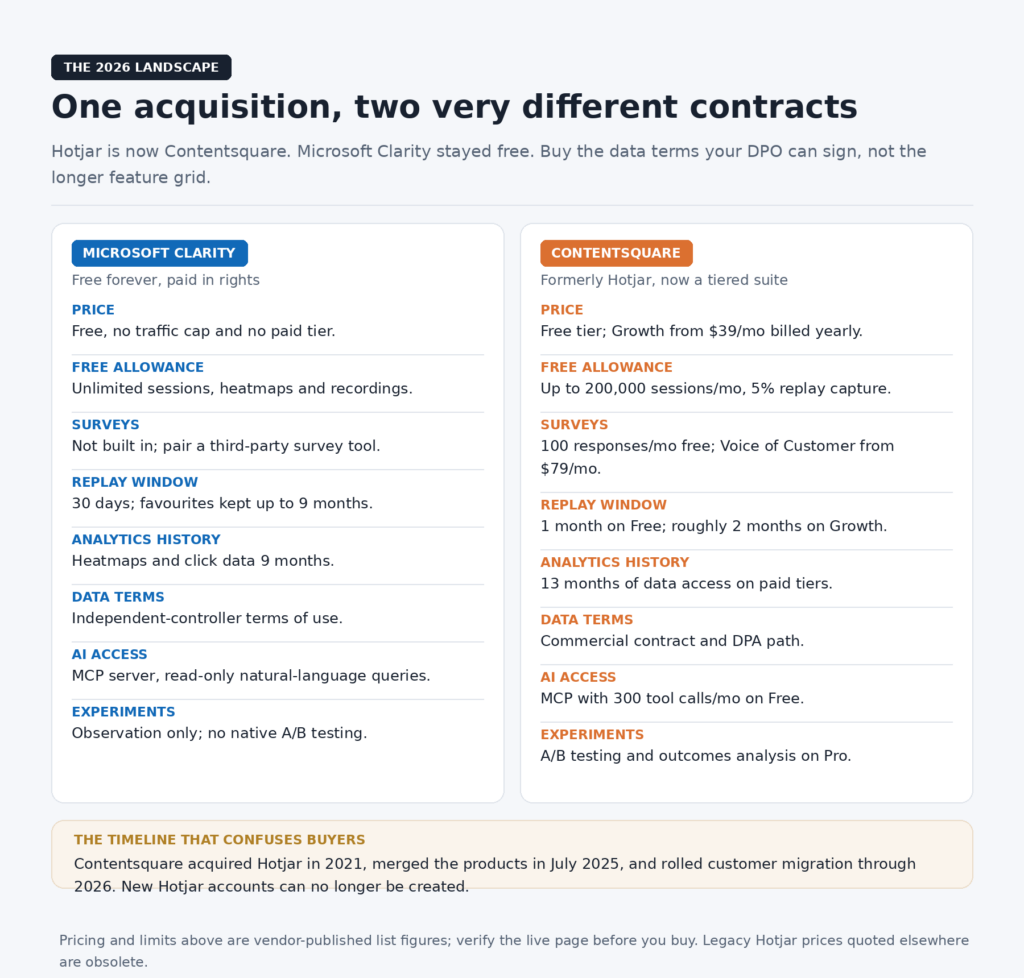
Let us clear up a timeline that trips up almost every buyer. Contentsquare announced its acquisition of Hotjar in September 2021, and said at the time that the two companies would keep operating independently for the foreseeable future. That foreseeable future lasted about four years. The products merged in July 2025, new customers had already been routed to the Contentsquare platform from late 2024, and 2026 is when the migration became real for existing accounts.
Here is what that means in practice. You cannot create a new Hotjar account anymore. The Hotjar pricing page redirects to Contentsquare. The old Observe, Ask and Engage products have been reorganised into separately billed lines — Experience Analytics, Voice of Customer and Product Analytics. If you are an existing Hotjar customer, the migration FAQ describes a 30-day transition window, after which your subscription moves to the Contentsquare Growth plan unless your account owner actively opts out. Your old Hotjar data stays available read-only, then disappears. Heatmaps, recordings, funnels and saved analyses do not transfer. Export anything you care about before that clock runs out.
If you are shopping fresh, you are shopping Contentsquare. Which is a fine product, just a different relationship than the one a five-person growth team signed up for.
What you get on each side of the fence
Compare the two contracts rather than the feature grids. Clarity is free forever, with no traffic limits and no sampling according to Microsoft’s own FAQ: unlimited sessions, heatmaps, recordings, automatically flagged frustration signals, code-free funnels, Copilot summaries and a native GA4 tie-in. It has no built-in surveys — you pair a third-party feedback tool. Its replay window is 30 days; favourites and a small random sample are kept up to nine months, and heatmap and click data are accessible for nine months.
Contentsquare runs on a freemium ladder. The published Free plan covers up to 200,000 monthly sessions on one project, captures replays from 5% of them, keeps one month of data access, and includes 100 survey responses a month, funnels, error monitoring and an MCP connection to AI assistants with 300 tool calls a month. Growth starts at $39 a month billed yearly ($49 monthly) from 7,000 sessions and extends data access to 13 months; Voice of Customer, where surveys now live, starts at $79 a month billed yearly. Pro and Enterprise are sales-led, and Pro is where A/B testing and outcomes analysis appear.
One honest caveat on those figures: they are vendor-published list prices captured from pricing pages in late 2026, and they move. Treat them as the shape of the decision, not a quote, and verify the live page before a purchase order.
Read the terms of use before the feature list
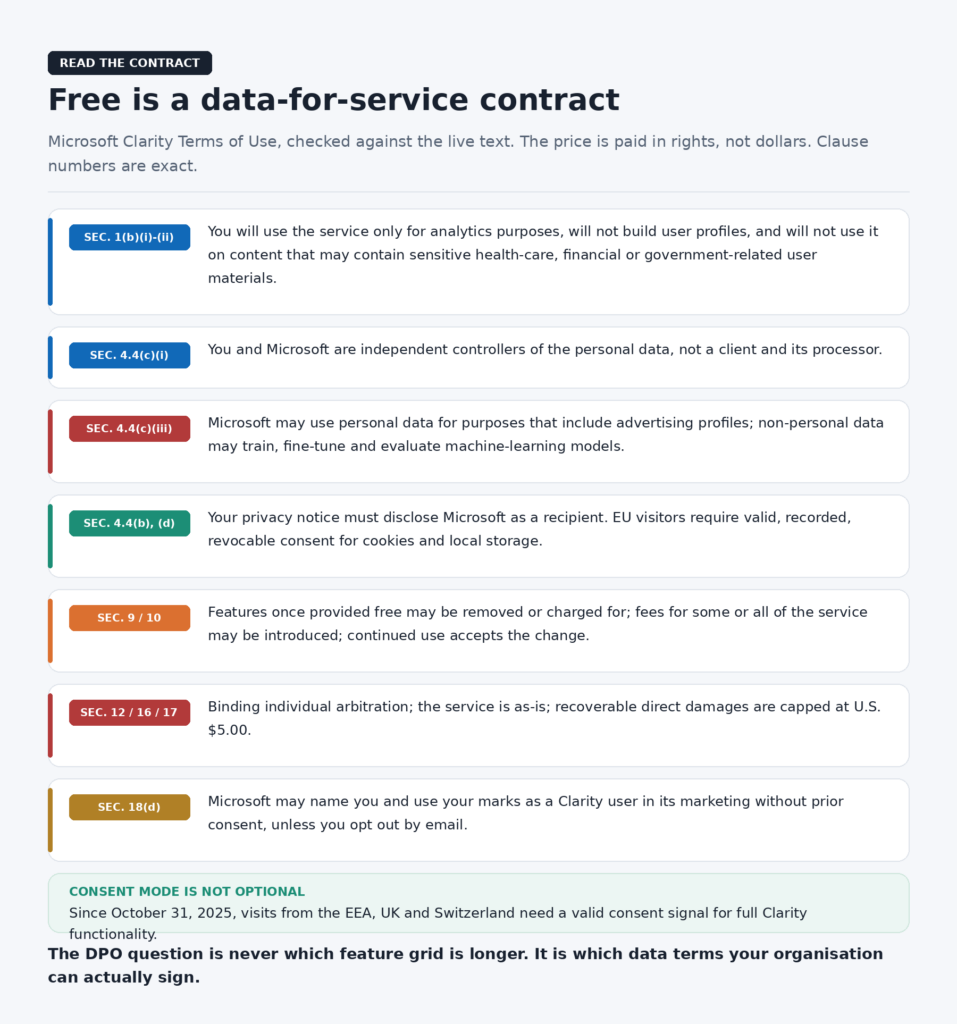
Clarity’s Terms of Use is a short document and a long list of consequences. We checked it against the live text. Section 1(b) limits you to analytics purposes, forbids building user profiles, and prohibits use on content that may contain sensitive health-care, financial-services or government-related user materials. If you run a clinic portal, a banking flow or a government service, that clause alone should end the evaluation.
Section 4.4(c)(i) then states that you and Microsoft are independent controllers of the personal data — not a client and its processor. That distinction is the whole ballgame for a DPO, because it changes who is answerable for what. Section 4.4(c)(iii) is the one privacy teams circle: Microsoft may use personal data it collects for purposes that include creating advertising profiles, and may use non-personal data to train, fine-tune and evaluate machine-learning models. Section 4.4(b) requires your privacy notice to disclose Microsoft as a recipient and to link to the Microsoft Privacy Statement; Section 4.4(d) requires valid, recorded, revocable consent for EU visitors.
Then the commercial clauses. Section 9 lets Microsoft remove features or charge for ones that were previously free, and Section 10 allows fees for some or all of the service. Section 7 says no support obligation. Section 12 is binding individual arbitration with a class-action waiver. Section 16 is as-is. Section 17 is the five-dollar cap. Section 18(d) even lets Microsoft name you and use your marks as a Clarity user in its marketing without prior consent, unless you opt out by email.
None of this makes Clarity a bad tool. It makes free a contract with a price. Whether that price is acceptable is a compliance decision, not a growth-hacking one. And there is a dated operational trap: since October 31, 2025, visits from the EEA, UK and Switzerland need a valid consent signal for full Clarity functionality. Get the consent category wrong — file it under analytics when the data use is a marketing purpose — and you are both non-compliant and, quietly, collecting nothing useful from those regions.
The retention economics nobody budgets for
Thirty days of replay history sounds generous until you try to do retrospective work. A customer emails in October about a broken experience in August. That specific session is gone, unless it happened to land in the small sample Clarity keeps. The habit this forces is simple and slightly annoying: favourite anything interesting the moment you see it, because favouriting is what promotes a session out of the 30-day bucket into the nine-month one.
Contentsquare splits the same idea across two clocks. Paid tiers advertise 13 months of analytics data access, while replay access on the Growth tier is roughly two months. Those are different assets — aggregate trends survive, individual sessions do not. Plan seasonal analysis accordingly: if you want to compare this year’s holiday checkout behaviour against last year’s, the heatmaps and funnel trends will be there, but the individual recordings behind a December anomaly will not. Build the habit of exporting or favouring the sessions that matter during the event, not three months later.
Make frustration a standing dashboard, not a one-off audit
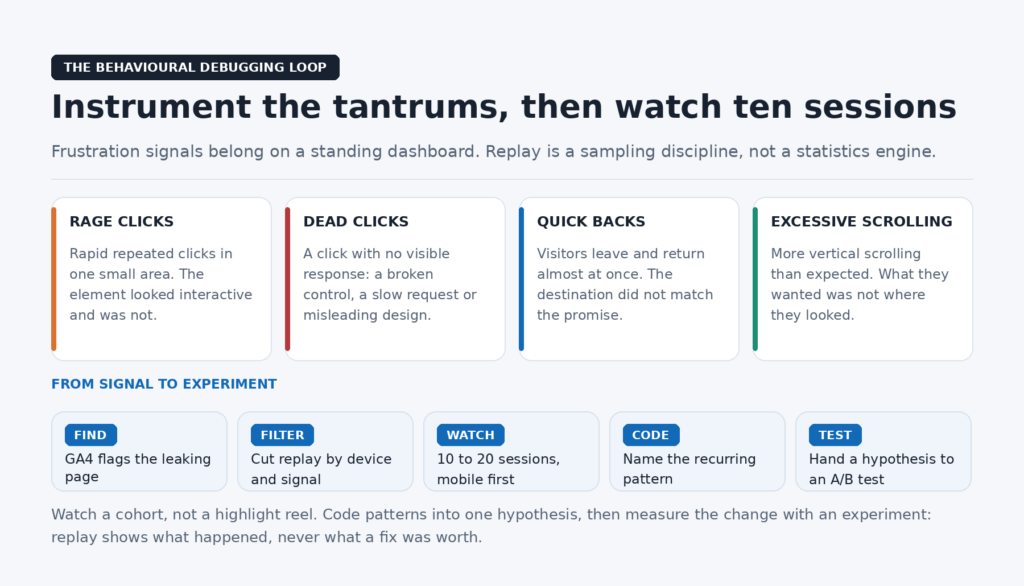
The single most underused feature in this category is the frustration signal. Clarity’s semantic metrics flag rage clicks — rapid repeated clicks in one small area — dead clicks, where a click produces no visible response, quick backs, where visitors leave and return almost immediately, and excessive scrolling, where someone scrolls far more than expected to find something. Microsoft’s own documentation treats these as indicators of frustration, broken elements, misleading design and content people cannot locate.
Put all four on a dashboard you actually look at weekly, segmented by device and by page. A rising dead-click rate on mobile after a template change is not a hypothesis, it is a bug report written by your visitors. Triage by page value first: a small spike on a pricing or checkout page outranks a large spike on a blog sidebar. Pair the signal with JavaScript errors, since a script that dies right after a click often explains both.
The replay workflow, with sample-size discipline
Here is the loop we keep coming back to. Find the leaking page in GA4. Filter its recordings by device and by one frustration signal. Watch ten to twenty sessions, mobile first. Code the recurring patterns into one sentence — “the fee table looks clickable but is not” — and hand that sentence to an A/B test as a hypothesis.
The discipline is in the number. Replay is qualitative evidence. Ten sessions earn you a hypothesis; they do not earn you a p-value, and they are no basis for declaring a winner. Watch a cohort, not a highlight reel — the three most dramatic recordings are usually the least representative. When you have a candidate fix, measure it with an experiment, because replay can show you what happened but will never tell you what a change was worth.
Heatmap literacy and the false-click trap
Three maps, three questions. Click maps show where people tap; scroll maps show how far they get; move maps approximate attention. Read them together. A click map with a hot cluster on an element that is not a link is not engagement — it is a design error, the false-click trap. Contentsquare adds zone-based heatmaps on Growth, which attribute clicks to page modules rather than raw coordinates, useful when a responsive layout moves elements around between devices.
One trap worth naming: a scroll map that fades halfway down does not prove your content is bad. It proves most people did not reach it. Move the key call-to-action above that line and the same content starts working. The map is a placement tool, not a quality score.
Surveys: timing, allowances and response bias
Ask at the moment of failure. An exit-intent or on-page “what stopped you today?” prompt catches visitors while the reason is still in Working Memory, and one open text field often outperforms a five-question score grid. Contentsquare gives you 100 responses a month on the free tier; Clarity has none natively, so you pair a separate feedback widget. Either way, sit with the bias: the people who answer surveys are the ones who cared enough to stay, and the angriest leavers are systematically absent. Survey answers are colour on the replay, not the verdict.
Funnels and errors: the mobile hidden-CTA case
Both ecosystems will build a funnel without code — Clarity via Settings → Funnels, dragging smart events or page visits into steps. Correlate funnel drop-off with JavaScript errors on the same page and the same device. The classic pattern is a mobile checkout where the continue button sits below the fold, scroll maps show most visitors never reach it, and a script error fires on the same step. You will not see that story in a conversion-rate report. You will see it in ten replays filtered by mobile and quick backs.
Choosing by stage and by posture
Forget “the best tool.” Buy against your risk posture.
- Bootstrapped or early-stage: start on Clarity. Free, unlimited, and connected to GA4 in a few clicks. Add a third-party survey widget when you need the third leg of the triangle.
- Survey-heavy teams: Contentsquare’s Voice of Customer keeps heatmaps, replay and surveys under one login. Accept that you are now buying into a tiered, sales-led platform.
- Regulated industries: the Clarity Section 1(b) ban on sensitive health-care, financial and government content, combined with the independent-controller data terms, makes a commercial contract with a negotiated DPA the sane route. This is a legal decision before it is a tooling one.
- Enterprise forensic work: if you need cross-session journeys, revenue attribution and governed retention, that is what the Pro and Enterprise tiers — and specialised forensic suites — are for.
- Do not pay before you need to. A generous free tier is more than enough traffic for most sites; the moment to upgrade is when you genuinely need 13 months of history, multiple projects, or experimentation.
Privacy and consent operations, in practice
Auto-masking is a starting point, not a policy. Clarity masks sensitive content by default, but you should still review masking levels and exclude account, payment and order-summary pages explicitly. Wire the Clarity Consent API or Google Consent Mode to your consent platform, and — as the enforcement since October 31, 2025 makes clear — fire the signal only from the correct consent category. Before go-live, hand your DPO a short list: what is collected, who is the controller, is there a signed DPA, how long is it kept, can one person’s data be deleted, and does the privacy notice name Microsoft as a recipient. If that list produces uncomfortable answers, you have just saved yourself a very expensive free tool.
The agent era: both vendors ship MCP, neither lets the agent change a thing
Both vendors now expose Model Context Protocol servers, which means you can ask an assistant, in plain English, which pages had the most rage clicks on mobile this week. Microsoft’s Clarity MCP server arrived in June 2025 as one of the first of its kind; Contentsquare includes an MCP connection on every tier, capped at 300 tool calls a month on Free.
Temper the excitement. These integrations are read-only. They can name the page, the segment and the friction signal, but they cannot change your page, ship a fix or measure what that fix earned. The useful pattern is to pair the agent-readable behaviour layer with an experiment backlog: let the assistant triage, let a human prioritise, let an A/B test adjudicate. And if you also operate in China, the mirror image is worth a look — Baidu Tongji heatmaps and Ptengine-style tools play the same qualitative role there, under a different data regime entirely.
The short version
Free is not a price, it is a contract. Clarity will give you unlimited behavioural data in exchange for rights that include advertising use and model training, a restricted-site ban, a five-dollar liability cap and terms that can change. Contentsquare will give you a governed, tiered suite with surveys and real history, in exchange for a budget line and an enterprise relationship. Neither is the answer to where your funnel leaks — GA4 already told you that. The answer to why it leaks is ten well-chosen replays, one honest survey, and an experiment that tells you whether your fix worked.
Instrument the frustration signals as a standing dashboard. Favourite the sessions you will want in October. Ask your DPO to read Section 17 before your growth lead reads the feature grid. That is the whole playbook.