
There is a particular kind of quiet that settles over a trade when the money stops arriving on schedule. Walk into a home-furnishing showroom in a second-tier Chinese city in early 2026 and you can feel it: the sales staff outnumber the customers, the model kitchens are pristine, and everyone is watching the door. A year earlier, that door led to a queue. The national trade-in subsidy had turned a slow category into a fast one.
Then two things happened at once. The demand engine underneath the market changed shape, and the policy crutch was pulled away.
For the first time, Jason Furniture — the soft-furniture maker most of you know through its Kuka Home brand — posted higher annual revenue than Oppein, the custom-furniture giant that had defined the category for two decades. Jason closed 2025 at ¥20.06 billion, up 8.53%. Oppein came in at ¥17.23 billion, down 8.94%. Read that twice. The challenger grew while the incumbent shrank, in the same year, in the same market.
Add the policy shock. The first ¥62.5 billion tranche of 2026 consumer trade-in funding redrew the uniform national scheme in a way that left custom and soft home furnishing outside its original scope. The 2024–25 sugar high was over. If your media plan still assumes a state-funded tailwind, you are planning against a market that no longer exists.
Here is the thesis: home marketing in China is shifting from capturing the new-home buyer once to serving the renovating household repeatedly. That sounds like a semantic quibble. It is not. It rewrites your channel mix, your creative brief, your delivery promise, and the one question your content must answer: can you fix just my kitchen?
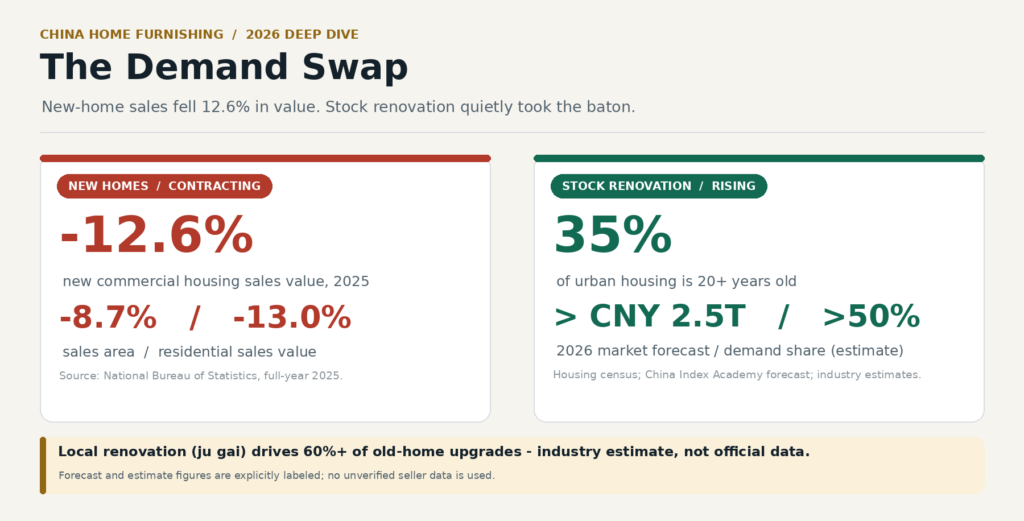
The Demand Swap: New Homes Fall, Stock Renovation Takes the Baton
Start with the hard number, because it is the cleanest one. According to the National Bureau of Statistics, new commercial housing sales value fell 12.6% in 2025 to ¥8.39 trillion, with floor area down 8.7%. Residential sales value dropped 13.0% and residential area 9.2%. That is not a blip; it is the fourth consecutive year of contraction, and it is the river from which a lot of home-furnishing demand used to flow.
Now look the other way. Roughly 35% of China’s urban housing stock is at least 20 years old, a figure widely traced to the seventh national census. A China Index Academy forecast puts the 2026 stock-renovation market above ¥2.5 trillion with an 8%-plus compound growth rate. Industry bodies estimate that renovated homes now account for more than half of demand, and that partial renovation — ju gai, the small, surgical job — makes up over 60% of old-home upgrades.
Be careful with those last three sentences. They are forecasts and industry estimates, not government statistics, and different institutions publish competing figures — some put the total old-home market closer to ¥4 trillion. Quote the range and name the source type. If you present an estimate as an official number, you lose the argument the moment a sophisticated buyer checks it.
What Local Renovation Actually Means for Your Brief
A new-home buyer purchases a whole set of decisions at once: kitchen, wardrobe, doors, flooring, lighting. A renovating household purchases a problem: a leaking cabinet, a dated bathroom, a kitchen too small for two people. One is a project; the other is an injury. The brief changes accordingly.
You are no longer selling a catalogue. You are selling a small team that shows up on a Tuesday, measures, removes, and installs, then leaves the household intact. That is a service promise with a clock attached, and it is the single most underused creative asset in this category.
The Number to Quote, and the One to Avoid
Quote the National Bureau of Statistics figures. Avoid the confident single percentage for stock-demand share. When you need one, say industry estimates put it above 50%, and move on. Precision theater helps nobody.
Three Thermometers, Three Different Readings
Here is where the story gets interesting, and where most write-ups get it wrong. Three official or near-official datasets for 2025 point in three different directions.
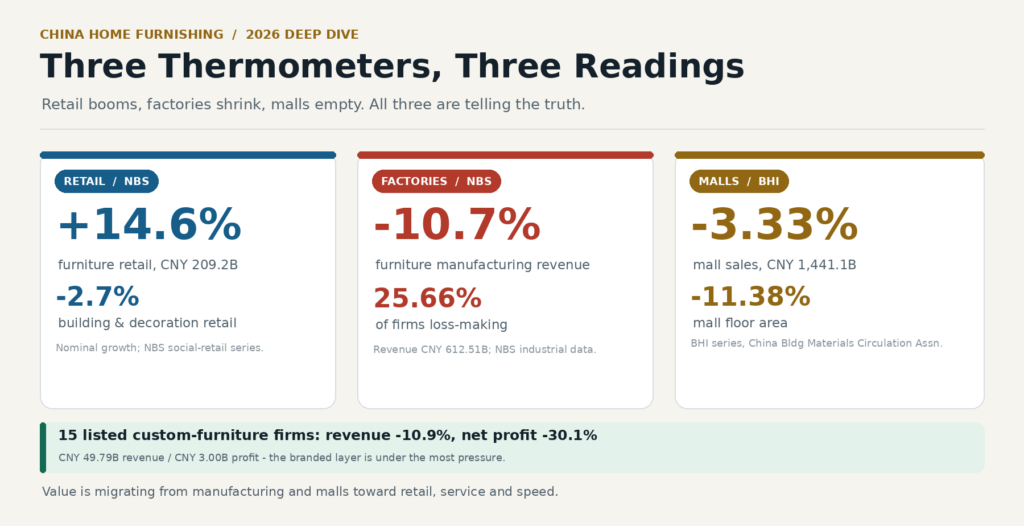
Retail +14.6%: What That Growth Measures
Furniture retail reached ¥209.2 billion in 2025, up 14.6%, according to National Bureau of Statistics social-retail data. Building and decoration materials retail, by contrast, fell 2.7% to ¥167.1 billion. On the surface, that looks like a boom.
It is a nominal, retail-end figure. Part of the lift comes from unit prices and the trade-in program, not from a flood of new households. Note also that the December reading was already negative at −2.2% year on year, which tells you the curve had turned before the year ended. A headline annual number can hide a fourth-quarter reversal — a useful reminder to read the monthly series, not just the December press release.
Manufacturing −10.7%, and One Firm in Four in the Red
The same agency’s industrial data shows furniture manufacturing revenue of ¥612.51 billion, down 10.7%, with 25.66% of firms loss-making. Retail up, factory down. How?
Because more of the consumer yuan now goes to channels, installation, delivery and service rather than to the piece of furniture itself. The product is becoming a smaller slice of a larger job. If you are a brand that only measures ex-factory shipments, you are measuring the wrong thing.
The Showroom Floor Is Shrinking Faster Than Sales
Building-material and home-furnishing malls recorded ¥1,441.1 billion in sales, down 3.33%, with floor area down 11.38%, per the Building Materials Circulation Index series compiled by the industry association under a Ministry of Commerce project. Area fell more than three times faster than sales. Fewer square meters are producing a larger share of output.
For media planners this is a direct signal. The showroom is no longer the inevitable center of the funnel. It is one touchpoint among several, and a shrinking one.
The Subsidy Era: What 2024–25 Actually Bought
How the Dual-Subsidy Machine Worked
In 2024 and 2025, home furnishing benefited from a stack: national trade-in funding plus brand and retailer top-ups. The Ministry of Commerce reported over 120 million home-decoration, kitchen and bathroom renewal items in 2025. Red Star Macalline disclosed ¥7.31 billion in trade-in sales in the first half of 2025. Furniture retail’s 14.6% growth cannot be separated from that machinery.
The mechanism also had a dark side that got far less coverage. Retailers frequently advanced the subsidy out of pocket and waited months for reimbursement, which strained cash flow at the small-store level. Qualification thresholds favored larger operators. And because everyone had the same discount to offer, price became the only axis of competition. A subsidy that looks like demand is sometimes just a discount with a government logo on it.
The Claim Nobody Can Verify
You may encounter a figure claiming one leading custom brand generated over ¥7 billion in trade-in orders and converted ¥3.5 billion into revenue. We could not locate that figure in the company’s annual report or in the securities research we reviewed. Do not use it. If a number cannot be traced to a filing or a named research institution, it does not belong in a serious brief — no matter how well it supports your story.
The 2026 Exit: The Uniform Subsidy Narrowed
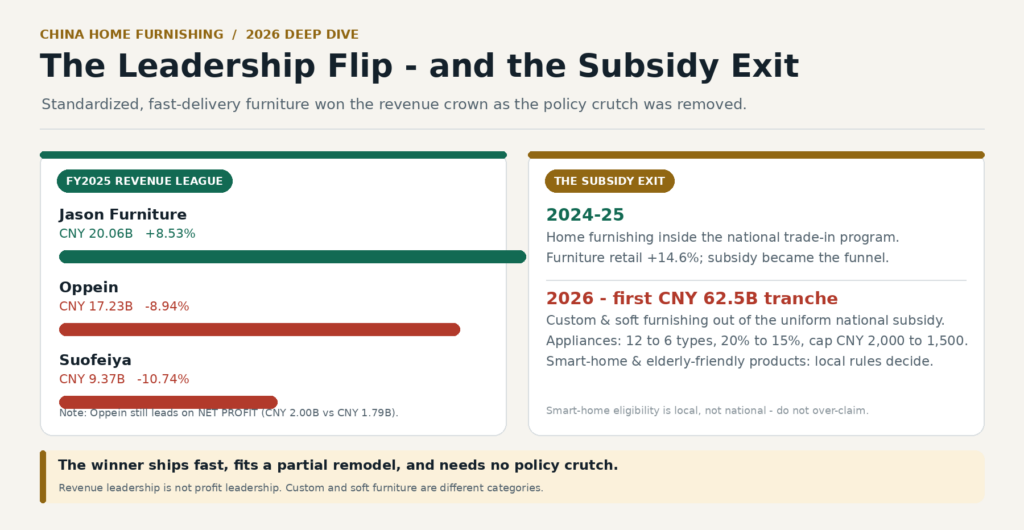
What Changed, Precisely
A joint notice from the National Development and Reform Commission and the Ministry of Finance advanced ¥62.5 billion in ultra-long special treasury bonds as the first 2026 tranche. Three changes mattered:
- Home appliances were cut from 12 categories to six — refrigerator, washer, television, air conditioner, computer and water heater — and only top-efficiency models qualified.
- The subsidy rate fell from 20% to 15%, and the per-item cap from ¥2,000 to ¥1,500.
- Home-decoration, kitchen and bathroom support was retargeted to smart-home products, including elderly-friendly products, with the detailed rules left to local authorities.
That third point is why home furnishing is excluded from the 2026 subsidy is a lazy headline. Custom and soft furniture fell outside the uniform national catalog. Smart-home and age-friendly products remained eligible through locally determined rules, and several provinces added smart furniture to their lists later in the year. The accurate phrase is narrowed and localized, not abolished.
Narrowed Is Not the Same as Abolished
One leading custom brand publicly offered a 15% self-funded match within days. Others studied the rules and waited. That split — who moves immediately and who hesitates — is now a useful lens on which competitors actually own their demand.
Why Standardized Soft Furniture Won the Crown
Speed Is the New Product Feature
Jason’s 8.53% revenue growth was driven substantially by overseas sales, with domestic profit improving on the back of better product mix. But the structural lesson is broader: standardized, ready-to-deliver furniture fits a renovation timeline that a custom order cannot.
A custom cabinet typically involves measurement, design confirmation, production and installation — often a two-month path. A renovating household with a half-finished kitchen does not have two months. Sofas, mattresses, chairs and standardized storage can leave the factory this week and arrive on Thursday. Renovation rewards speed, and speed is baked into the product architecture of soft furniture. This is not a marketing advantage you can copy with a campaign. It is an operating advantage.
A Leadership Flip With an Asterisk
Jason’s ¥20.06 billion revenue did overtake Oppein’s ¥17.23 billion. Oppein’s net profit of ¥2.00 billion, however, still exceeded Jason’s ¥1.79 billion. Write that qualifier every single time. Two additional caveats: the two companies lead different categories — custom versus soft — so this is a listed-home-company revenue comparison, not a like-for-like category result; and not every soft-furniture name is winning. Mattress maker Xilinmen swung to a first-quarter loss and carries a special-treatment warning. Category tailwinds do not rescue weak balance sheets.
Custom Furniture’s Reckoning
468 Doors Closed, for the Third Year Running
Oppein closed 1,586 stores and opened 1,118 in 2025, a net loss of 468, taking its total to 7,345. It was the third straight year of net closures. The first quarter of 2026 removed another 339. Revenue fell 23.03% and net profit 49.73% in that quarter.
Look at the channel mix to understand why. The bulk or project channel — tied to new-home deliveries — fell 14% in 2025. Retail fell 9.3%. When the new-home pipeline shrinks, the channel built to serve it becomes a liability. A huge installed base of showrooms that relied on natural foot traffic is now a cost structure, not a moat.
When Operating Cash Flow Turns Negative
Suofeiya’s numbers make the same point more sharply. Revenue fell 10.74% to ¥9.37 billion, net profit dropped 34.26% to ¥0.90 billion, and operating cash flow turned negative for the first time since listing. The first quarter of 2026 produced a net loss of ¥38.43 million. Across 15 listed custom-furniture companies, combined revenue fell 10.9% to ¥49.79 billion and combined net profit fell 30.1% to ¥3.00 billion. Ten companies were profitable; five were not.
One brutal detail: the leading player’s profit still equals roughly twice the combined profit of the other 14. This is not a normal competitive market. It is a market where scale concentrates faster than demand grows.
The Community Pivot
One Hub, Many Small Rooms
Oppein’s answer is a renovation-specific brand operating a one regional hub plus N community satellite stores model, with more than 150 locations reported in securities research. The idea is deliberately light: a small store inside the neighborhood, close enough to be the first call when a kitchen fails, backed by one regional center for design and fulfillment. Zhibang has launched a similar refreshed home community format. Meanwhile IKEA closed seven China stores in early 2026, including Shanghai Baoshan.
Read those two moves together. Big destination boxes are contracting. Small, proximate service points are expanding. The map of home retail is being redrawn from cathedral to chapel.
The Acquisition-Cost Math of Local Renovation
Why does proximity win? Because a renovation lead is local, urgent and hard to plan. Nobody searches for a kitchen remodel six months ahead; they search the week the cabinet swells. A store within walking distance converts a problem into a consultation the same day. The acquisition cost is lower not because the store sells better, but because it is physically closer to the moment of need.
For you, this means the media plan should follow the geography of aging housing, not the geography of new developments. Community-level targeting, local search and neighborhood social groups become primary, not experimental.
Whole-Home Decoration: The Trillion-Yuan Funnel
Industry reports put the whole-home decoration track above ¥1.6 trillion, making it the one visibly expanding chunk of the market. Treat that as an estimate, not an official series. The strategic point stands regardless: one contractor coordinating design, construction and furnishing is becoming the new gatekeeper.
Who Owns the Customer?
In the old funnel, the furniture brand owned the customer through a showroom and a sales consultant. In the new one, the decoration contractor often meets the household first and controls the schedule. If you arrive after the plan is fixed, you are a line item. If you arrive during planning, you are a specification.
That changes the partnership model. Brands that build contractor relationships, train installers and offer digital specification tools will be present at the moment the decision is made. Brands that rely on consumer awareness alone will arrive too late, with better ads.
Channel Reset: Fewer Showrooms, More Screens
With mall area down 11.38%, the showroom is being rebalanced. Online home-furnishing penetration is often cited above 35%, though published figures range from high-20s to high-30s depending on whether they count decoration materials, finished furniture or the whole category. Pick one definition and stay with it.
Content Commerce for a Category You Cannot Impulse-Buy
Nobody buys a kitchen on an impulse. Yet content platforms now shape the decision long before a store visit. The pattern is straightforward: discovery on short-video and note-sharing platforms, saved boards of real apartments, a private conversation, then a showroom appointment. The screen does the imagining; the room does the trusting.
Your content budget should not be judged by direct attribution. It should be judged by whether the household arrives at your store already knowing what your product looks like in a room that resembles theirs.
Content That Converts in the Renovation Era
Before-and-After Is the New Product Page
The highest-performing format in this category is not a glossy product shot. It is a real apartment, a tired room, a number of days, and a finished room. Before-and-after pairs answer the two questions a renovator actually has: will this fit my space, and how long will my life be disrupted?
Build a case library organized by constraint, not by product: small kitchens, aging parents, one-bathroom homes, rental upgrades. Each case is a mini-proof of competence. This is content that sells a service promise while appearing to sell furniture, which is why it converts.
Price Transparency, Aging in Place and Smart Home
Three new poles are showing up in serious content plans. Transparent, itemized quotes reduce the fear of hidden costs. Aging-in-place design — grab points, step-free thresholds, better lighting — addresses a household decision driven by a parent’s mobility, not aesthetics. And smart-home eligibility, even with local and conditional subsidy rules, gives you a concrete reason to advertise a specific price this month.
None of these are flashy. All of them answer the question behind the question: will this actually work in my home?
Global Mirrors: Aging Housing Everywhere
China is not alone. Europe, Japan and the United States all carry large stocks of aging housing, and renovation-first marketing has a longer pedigree there. IKEA’s kitchen measurement and installation services turn a product retailer into a project contractor. Home Depot’s pro desk treats the tradesperson as a customer with different needs from the do-it-yourselfer, and builds an entire service layer around that distinction.
What IKEA and the Pro Desk Get Right
Both recognize that the person making the decision and the person doing the work are often different people. Both sell certainty about a process, not just a thing. And both use physical locations as service nodes rather than pure display floors. Those three moves travel well.
The Playbook: Five Moves for the Post-Subsidy Brief
If you are rewriting a China home-furnishing plan for 2026, here is the short version.
Sell the project, not the product. Lead with the complaint and the outcome, not the SKU.
Buy proximity. Budget for community-level presence and local-search coverage near aging stock, not just for destination showrooms.
Promise a clock. State delivery and installation windows explicitly. Speed is the feature competitors cannot fake with a campaign.
Become subsidy-independent. Build a baseline plan that assumes no national support. Treat local smart-home programs as upside, not as the foundation.
Label your numbers. Separate official statistics, forecasts and industry estimates in every deck. Your credibility is the asset competitors cannot buy.
Where This Leaves You
The year Jason overtook Oppein is not a trivia question. It is a marker. A market that sold furniture to people buying homes has become a market that solves problems for people living in homes. The winners are not necessarily those with the most beautiful showrooms or the biggest subsidy budget. They are the ones who can get to a kitchen on Tuesday, quote it honestly, and finish it before the household loses patience.
If your brief still begins with a property launch calendar, it is written for 2024. Rewrite it for the apartment that is already occupied.






