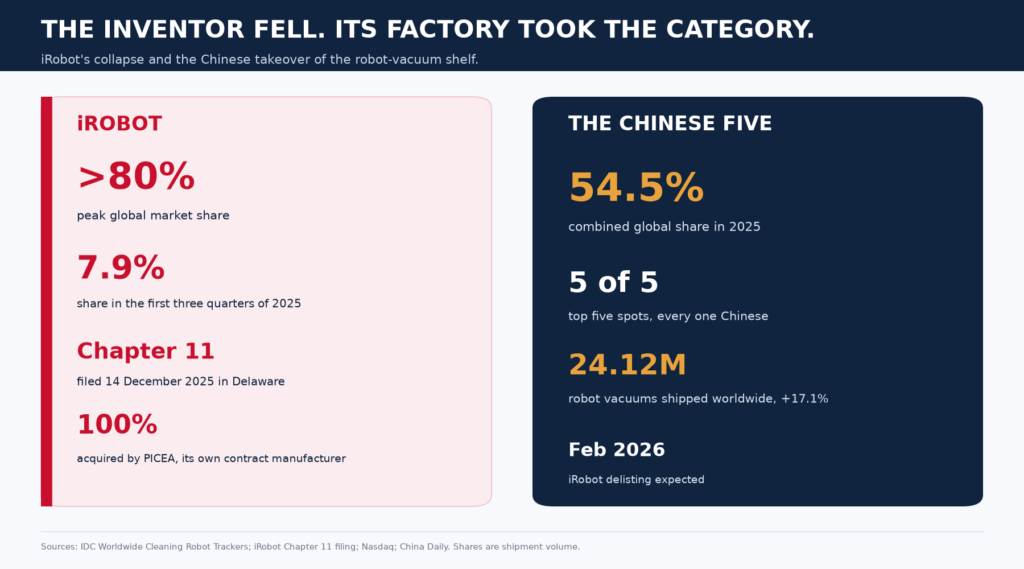
Picture the scene. A company that invented an entire household category, a brand whose name became a verb in living rooms from Boston to Berlin, files for Chapter 11 in a Delaware court on 14 December 2025. Then the twist: the buyer is not a rival, not a private-equity fund, not even a technology giant. It is the company’s own contract manufacturer — Shenzhen-based PICEA Robotics together with Santrum Hong Kong — which converts more than US$350 million of debt into 100 per cent ownership. Existing shareholders are wiped out, the Nasdaq listing goes away, and the completion is expected in February 2026.
That company is iRobot, the maker of Roomba. At its peak it held more than 80 per cent of the global robot-vacuum market. By the first three quarters of 2025, its share had collapsed to 7.9 per cent, and it had fallen out of the top five entirely. It did not launch its first vacuum-and-mop combo until 2022, roughly five years after Chinese rivals had made the format standard. Its flagship models stayed above US$1,000, about three times the price of comparable Chinese machines. When its chief executive called the supplier ‘the only viable option’, he was describing a transfer of power, not a rescue.
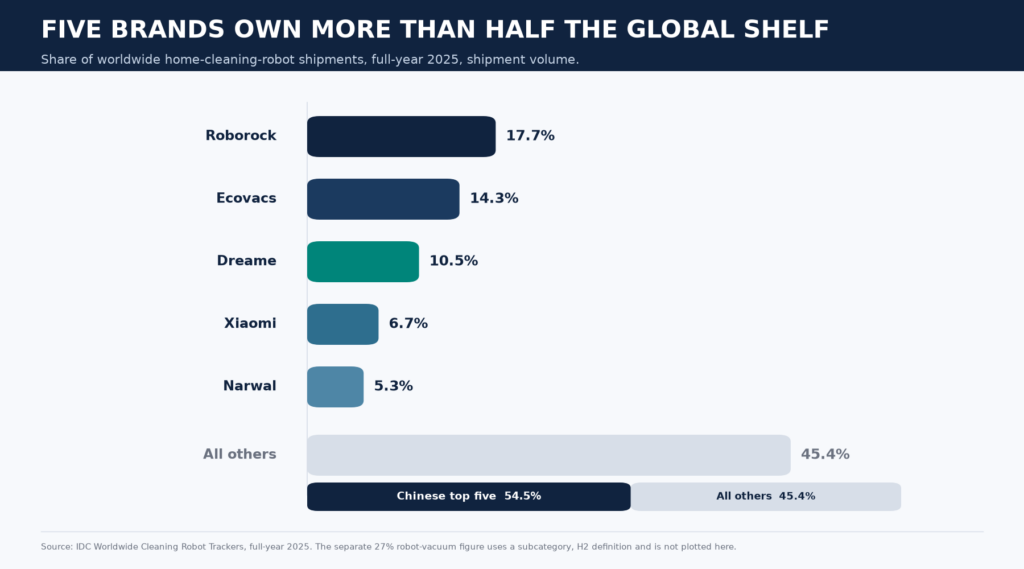
Here is the number that actually matters. In IDC’s full-year 2025 data, the five largest home-cleaning-robot makers worldwide are Chinese — every one of them. Together they account for 54.5 per cent of global shipments. Thephone war may be settled; the interesting marketing is now happening on shelves Chinese brands invented and then proceeded to own.
The non-phone map: where Chinese brands set the rules
Look beyond smartphones and a pattern appears. In robot vacuums, action cameras, drones, wearables and learning devices, Chinese companies are not merely competing — they are defining what the categories even are. Roborock and Ecovacs turned a floor-cleaning gadget into a self-emptying home-services platform. Insta360 made the action camera a software-and-storytelling product as much as a piece of hardware. DJI did the same for consumer drones. These are adjacent cases worth studying separately; what binds them here is a repeatable system, not a single product story.
The distinction matters because most Western hardware marketing still assumes the category already exists. The job, in that model, is persuasion: convince the buyer that your version is better. The Chinese playbook starts one step earlier. The job is education: convince the buyer that they need the thing at all. That single difference changes everything — the content, the channel, the pricing, even the definition of a sale.
Category creation 101: why low penetration is the opportunity
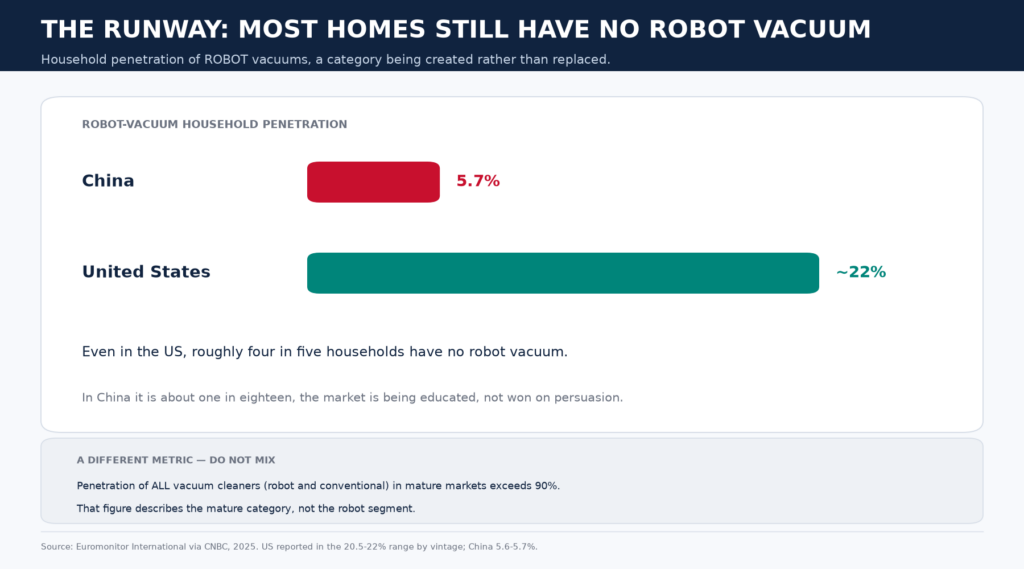
Consider the runway. Euromonitor puts robot-vacuum household penetration in China at roughly 5.6 to 5.7 per cent, and in the United States at around 20.5 to 22 per cent depending on the data vintage. Even in the more mature US market, roughly four in five households still have no robot vacuum. In China it is about one in eighteen.
Now here is the trap that catches careless strategists. The often-quoted figure that ‘mature markets exceed 90 per cent’ refers to vacuum cleaners in general — conventional uprights and canisters included — not to robot vacuums. Mixing the two produces a wildly misleading growth story. Keep the metric clean: the robot segment is young almost everywhere, and in China it is barely born.
For a marketer, low penetration is not a problem to be solved. It is the entire opportunity. Education beats persuasion when most of the addressable market does not yet know that the product exists, or doubts that it works.
The demo-content engine: seeing is believing
How do you sell a product people did not know they needed? You stop describing it and start showing it. The demo-content engine is the first gear of the machine.
Chinese brands built it out of three layers. First, livestream proof: a real room, real mess, real time, with the machine negotiating a cable or a pet bowl on camera. Second, KOC seeding — thousands of ordinary users, not glossy celebrities, posting unpolished clips of the device doing its job. Third, short-form ‘seeing is believing’ formats engineered around a single, repeatable demonstration: the hair that does not tangle, the corner the arm reaches, the mop pad that washes itself. The content is not aspirational; it is evidentiary.
This is why category creation and content operations are inseparable. When the audience lacks a mental model for the product, a specification sheet means nothing. A ten-second clip of a muddy paw print disappearing means everything. The lesson for global DTC teams is uncomfortable but simple: if your launch depends on feature comparison charts, you are fighting a battle on the wrong terrain.
The price ladder: flagship halo, volume middle, defensive floor
Once the category is understood, the next move is to build a ladder and descend it faster than anyone else.
Roborock’s own framing — often translated as ‘technology democratization’ — describes a deliberate structure. A flagship carries the halo: the robotic arm, the latest navigation, the premium price. A broad mid-tier converts attention into volume. Then a defensive floor protects the entry point. Xiaomi, for its part, ranked first in China in the sub-¥2,500 band according to Runto’s November online data, while the fastest-growing price band sat higher, around ¥3,500—¥4,499, with an average online selling price near ¥3,344 in the third quarter.
The strategic logic is brutally clear. Establish technical leadership at the top, then pull the price down the ladder before competitors can occupy the middle. You get the credibility of a premium brand and the volume of a mass brand, and you deny rivals a comfortable place to stand. It is less a pricing strategy than a form of chess.
Global-first launches: Amazon Black Friday as proving ground
The fourth gear is geography. Chinese gadget brands frequently launch abroad before they saturate home soil. The logic is not prestige; it is proof. If a product can win a Black Friday on Amazon in North America and Europe, it has passed a brutal, objective test — and that credibility travels back home and into other markets.
Roborock’s own Black Friday report puts its Amazon robot-vacuum share at 40 per cent in North America and 42 per cent in Europe, with first-place finishes in several countries. Treat those as company-reported figures rather than independently audited data, but the directional claim is well supported by IDC’s broader finding: Chinese brands lead the category in the US, Germany and across Western Europe. Trade shows such as IFA and CES play a supporting role, giving a new category a stage on which to be taken seriously.
The margin bill: growth bought, then paid for
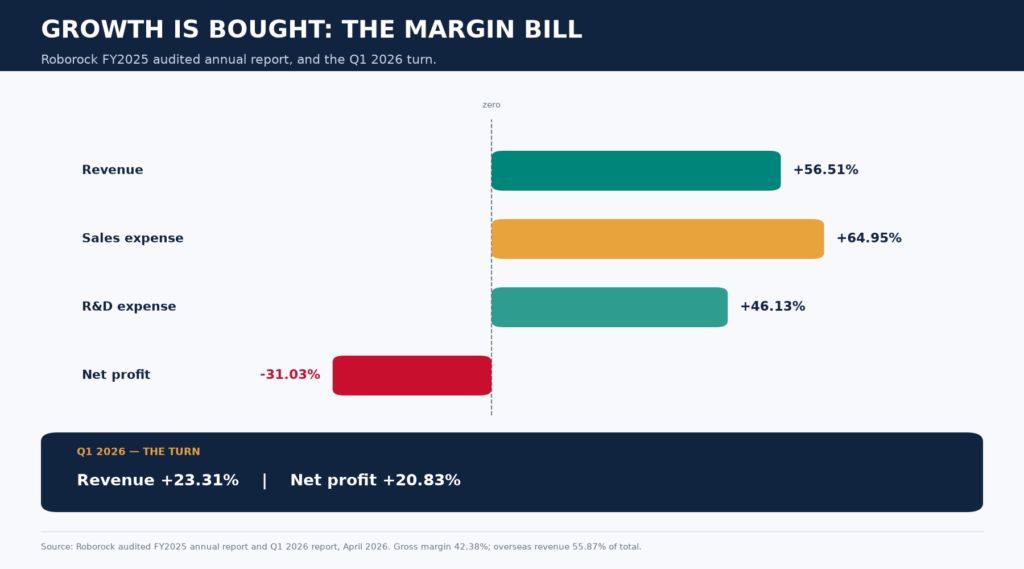
Here is where the story stops being a victory lap. Roborock’s audited 2025 annual report shows revenue of ¥18.695 billion, up 56.51 per cent. Net profit fell 31.03 per cent to ¥1.363 billion. Sales expense jumped 64.95 per cent to ¥4.894 billion, lifting the sales-expense ratio to 26.18 per cent. Research and development rose 46.13 per cent to ¥1.42 billion. Gross margin slipped to 42.38 per cent, down nearly eight points. Overseas revenue reached ¥10.442 billion, up 63.46 per cent and, for the first time, more than half of the total.
Read those numbers together and a clear message emerges. Category creation, demo content, global launches and a full price ladder are not free. They are paid for in marketing spend, in research, in the Temporarily in the near-term dilution that comes from filling out a product matrix. Roborock itself described the pressure as a phase of expansion.
There is a promising coda. In the first quarter of 2026, revenue grew 23.31 per cent and net profit returned to growth, up 20.83 per cent to ¥323 million. The turn suggests the bill is being absorbed rather than compounding. For Western DTC hardware brands, this is the most important paragraph in the piece: the playbook works, but it consumes margin first and returns it later. Boards that demand both hypergrowth and immediate profitability are asking for a machine that does not exist.
The five-brand shelf: what the share table really says
Step back to the full-year picture. IDC’s 2025 tracking puts Roborock at 5.8 million units and 17.7 per cent of all home-cleaning robots, Ecovacs at 4.7 million and 14.3 per cent, Dreame at 3.4 million and 10.5 per cent, Xiaomi at 2.2 million and 6.7 per cent, and Narwal at 1.7 million and 5.3 per cent. One precision note: Roborock’s separately quoted 27 per cent refers to the robot-vacuum subcategory in the second half of the year, on a shipment-volume basis — not the same denominator as 17.7 per cent.
That 54.5 per cent combined share is not a neolithic accident. It is the compound result of category education, distribution density and price coverage executed in parallel. It is also, increasingly, a moving target.
New invaders: what happens when the category gets crowded
By early 2026 the picture had shifted again. Dreame took 1.555 million units and a 23.7 per cent volume share in the first quarter, with a 28.0 per cent value share — its first single-quarter double No.1. Chinese brands held all five top spots and more than 70 per cent of the market. Dreame is unlisted, so its shipment figures come from IDC and company disclosures rather than audited financials; that caveat aside, the trajectory is unmistakable. The ladder is now being climbed by someone else.
Into this mix stepped two famous outsiders. DJI launched its ROMO robot vacuum in August 2025, at ¥4,699—¥6,799 for tank versions and up to ¥7,399 with the auto water-line configuration, and moved more than 10,000 units in its first month, entering China’s top ten according to Runto. The logic is brand extension: the vision, lidar and path-planning algorithms that made drones successful transfer neatly to a machine that must navigate a living room. Dyson followed in December with the Spot+Scrub AI at ¥5,499, recognizing roughly 200 household objects.
Their arrival is a stress test for the playbook. When the category creator and the fast follower are joined by a drone company and a vacuum company, the demo-content war intensifies and the price ladder gets steeper. The winner will not be whoever has the best robot; it will be whoever can still teach, prove and price at scale.
Adjacent spillover: the same playbook on new lawns
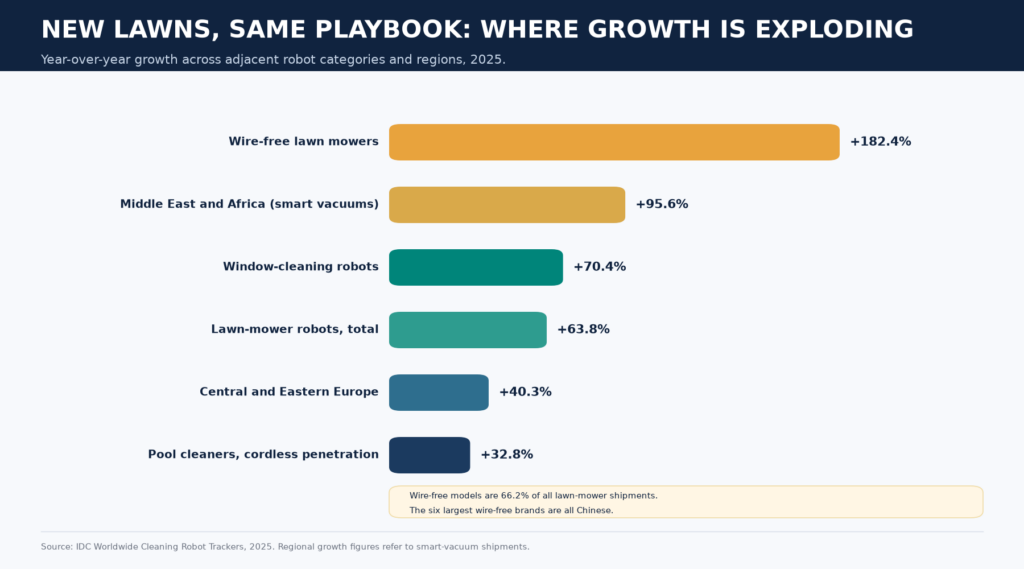
The most revealing data is not about indoor cleaning at all. Lawn-mower robots reached 1.99 million units in 2025, up 63.8 per cent. Wire-free models jumped 182.4 per cent to 1.32 million units — and, critically, 66.2 per cent is the share of lawn-mower shipments that are wire-free, not a China market share. The six largest wire-free brands are all Chinese, including Segway-Ninebot, Dreame and Ecovacs. Conventional boundary-wire models fell 10.1 per cent.
Window-cleaning robots grew 70.4 per cent to 2.37 million units, with Ecovacs holding more than half the market. In-ground pool cleaners reached 2.75 million units, with cordless penetration at 55 per cent, up 32.8 points. Regionally, smart-vacuum shipments grew 95.6 per cent in the Middle East and Africa and 40.3 per cent in Central and Eastern Europe.
Read that as a strategy, not a statistic. The moment a new adjacent category becomes intelligent and cordless, the same team can apply the same system: define the category, demonstrate it relentlessly, seed it socially, ladder the price, then export it. The lawn is literally and figuratively a new lawn.
Channel mix, trust and the limits of travel
The channel architecture is a balancing act. Explicit trade-in subsidies under China’s national programme supported 2025 shipments across 28 provinces and lifted the share of higher-priced machines, but the taper later in the year exposed how much demand had been pulled forward. Meanwhile the mix widens: instant retail, DTC sites, Amazon marketplaces and offline experience stores each play a different role. Experience stores matter precisely because the product still benefits from being touched.
Trust is the retention layer that hardware people often forget. Firmware updates, app ecosystems and warranty handling are not afterthoughts; for an unfamiliar device, they are the proof that the purchase was rational. In a category built on education, the relationship continues long after the unboxing video.
Does the playbook travel? Partly. It travels to markets with low penetration, dense e-commerce and receptive middle classes — the growth pockets in the Middle East, Africa and Eastern Europe are the evidence. It stalls where penetration ceilings loom, where local brand loyalty is entrenched, and where tariffs reshape the price ladder’s bottom rung. Global-first is a tactic, not a law of physics.
The playbook, in five moves
For global gadget marketers, the sequence is now visible enough to copy:
- Create the category. Find the job consumers cannot yet name, then name it for them.
- Prove it in public. Livestreams, KOC clips and single-idea demos beat specification sheets.
- Build the ladder. Flagship halo, volume middle, defensive floor — descend it before rivals do.
- Launch globally, early. AmazonBlack Friday and the big shows are credibility machines.
- Retain through trust. Firmware, apps and warranty turn a first purchase into a category habit.
And remember the fine print: each move spends margin before it earns it. The bill arrives on a delay. Budget for the delay.
Conclusion
The bankruptcy of iRobot is a great headline, but it is a small fact inside a large one. The real story is that a group of Chinese brands created a category, educated the world into wanting it, covered every price point, exported it first, and now hold more than half of global shipments — while learning, the hard way, what that kind of speed costs. Phone marketing taught the world how to compete for attention. Beyond phones, the lesson is how to manufacture the attention in the first place.