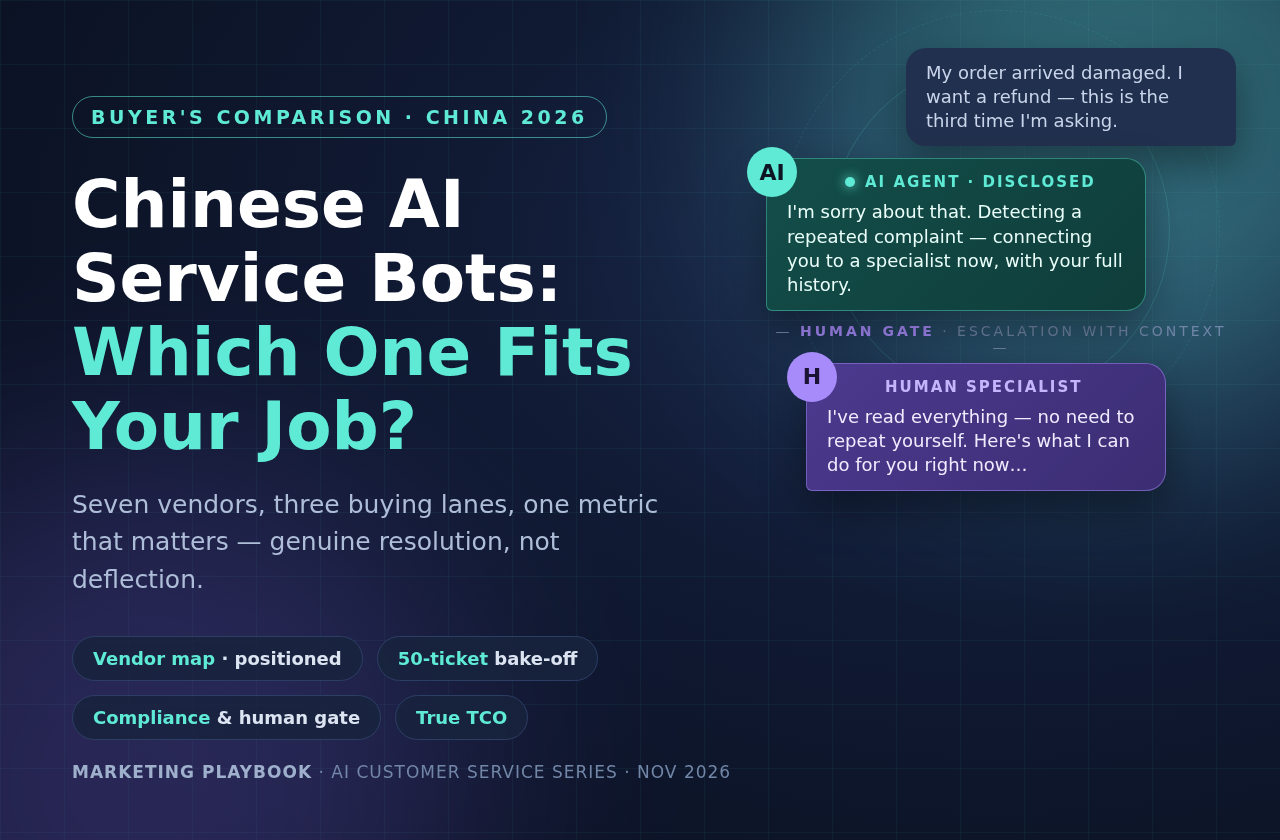
Picture this: it’s 11 p.m. during a mega-sale, your flagship store is drowning in chat requests, and a customer whose parcel arrived crushed is asking for a refund — for the third time. Your bot answers with a cheerful FAQ link. Twice. By morning, that customer has filed a platform complaint and posted a one-star review with screenshots.
That’s the bot-loop disaster, and no vendor demo will ever show it to you.
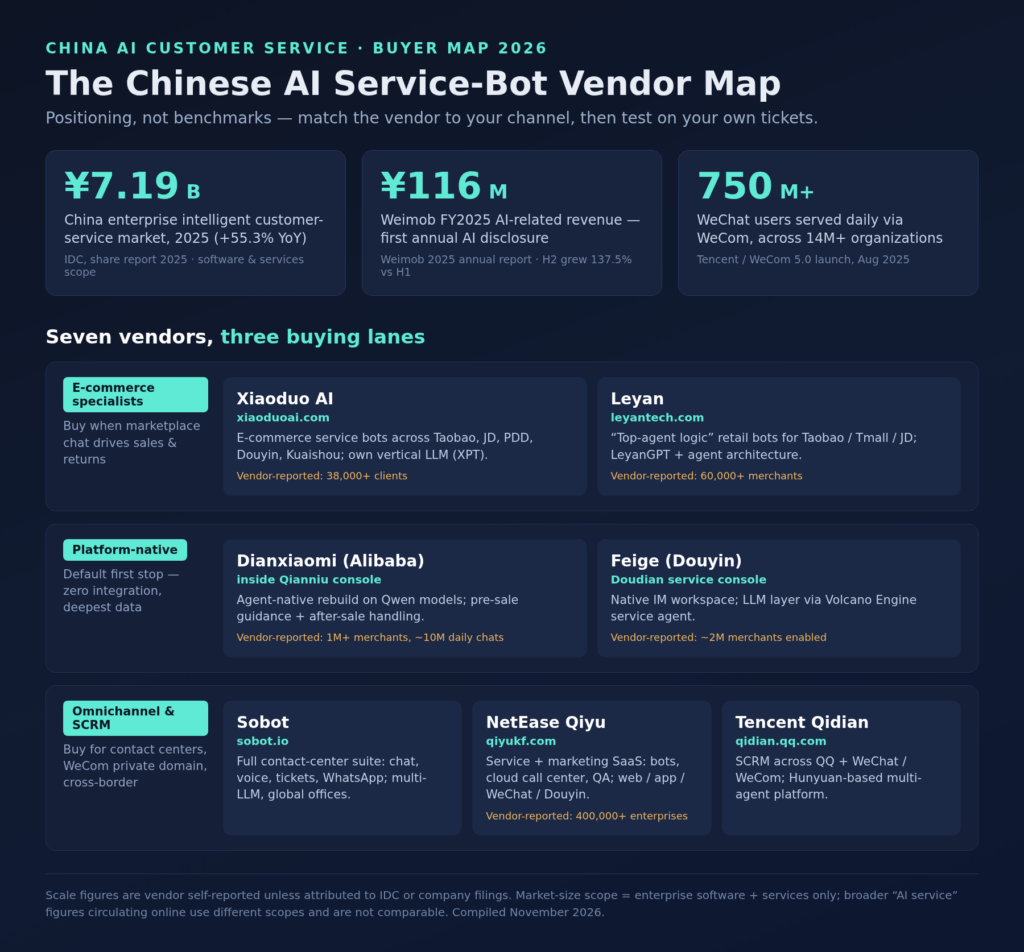
Here’s the thing: AI customer service in China is no longer an experiment. Weimob’s 2025 annual report disclosed AI-related revenue of RMB 116 million — its first-ever annual AI line item, with second-half revenue up 137.5% over the first half. IDC puts China’s enterprise intelligent customer-service market (software and services only) at RMB 7.19 billion for 2025, growing 55.3% year over year. The money is real. The question is whether your bot earns it — or quietly burns your customer trust while your dashboard shows green.
So let’s skip the “which AI is smartest” debate. The buyer’s real question is simpler and harder: which bot fits my channel, my category, and my escalation design? This guide gives you the vendor map, a job-based comparison, an evaluation protocol you can run next week, and the compliance layer you can’t afford to ignore.
The Stakes: Why This Purchase Decides Itself — Badly
Most teams buy a service bot the way they buy office furniture: a shortlist, a demo, a price negotiation. But a service bot isn’t furniture. It’s a frontline employee that never sleeps, never asks for a raise, and — if you configure it badly — never knows when to shut up and get a human.
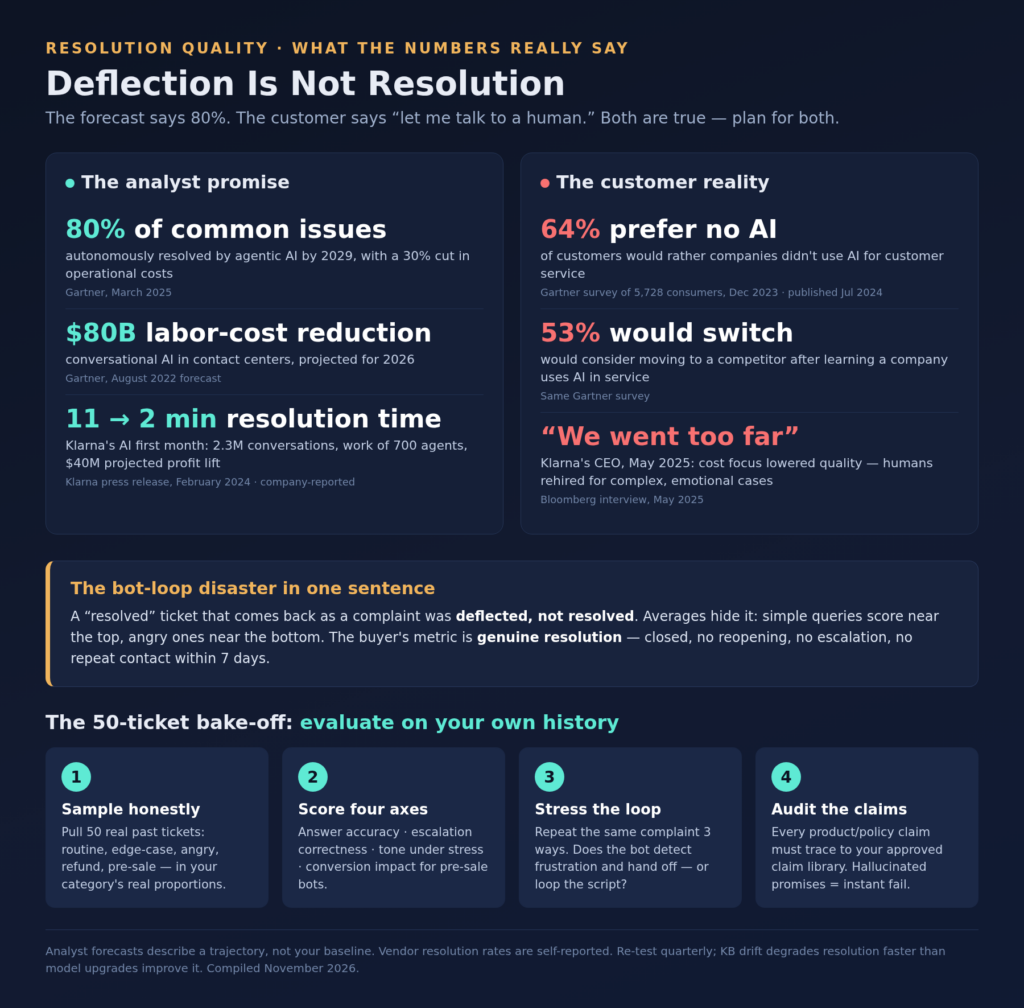
Gartner’s March 2025 forecast says agentic AI will autonomously resolve 80% of common customer service issues by 2029, cutting operational costs by 30%. Seductive number. But the same firm’s consumer survey (5,728 respondents, December 2023, published July 2024) found that 64% of customers would prefer companies didn’t use AI for customer service at all — and 53% would consider switching to a competitor after learning a company uses it.
Read those two findings together and the strategy writes itself: automate aggressively, but design for the customer who hates being automated. The bot that wins isn’t the one that resolves the most tickets. It’s the one that knows which tickets it must never touch.
The Vendor Map: Three Lanes, Seven Names
Chinese service-bot vendors cluster into three buying lanes. Positioning first, benchmarks never — vendor resolution rates are self-reported marketing, not audited science.
Lane one: e-commerce specialists. Xiaoduo AI and Leyan built their reputations inside marketplace chat windows — Taobao, Tmall, JD, Pinduoduo, Douyin, Kuaishou. Xiaoduo runs its own e-commerce vertical LLM (XPT) and claims 38,000+ clients; Leyan’s pitch is replicating “top agent” sales logic at scale, with 60,000+ merchants claimed. These bots speak fluent retail: sizing questions, coupon stacking, shipping anxiety, return policies.
Lane two: platform-native tools. Alibaba’s Dianxiaomi lives inside the Qianniu merchant console; in late 2025 it was rebuilt as an agent-native product on Qwen models, and Alibaba reports roughly 10 million daily conversations across 1M+ merchants. Douyin’s Feige is the Doudian service console itself — note the distinction buyers often miss: Feige is the IM workspace, while the LLM capability layer comes from Volcano Engine’s service agent. Platform-native tools have unbeatable data access (orders, logistics, coupons) because they’re already inside the transaction system.
Lane three: omnichannel and SCRM suites. Sobot sells a full contact-center stack — chat, voice, tickets, WhatsApp — with multi-LLM support and overseas offices, which makes it the cross-border default. NetEase Qiyu positions as service-plus-marketing SaaS across web, app, WeChat and Douyin touchpoints. Tencent Qidian is the SCRM play, wiring service into QQ, WeChat and WeCom relationships on a Hunyuan-based agent platform. And WeCom itself now ships a native AI bot: at the 5.0 launch in August 2025, Tencent disclosed 14M+ organizations on the platform serving 750M+ WeChat users daily. For simple private-domain FAQ duty, the free native bot may be all you need.
The LLM Shift: From Script Trees to Agents That Act
Something structural changed in 2025–2026. The old bots matched keywords to canned answers; the new ones retrieve from your knowledge base, reason across turns, and — increasingly — execute: check the order, modify the address, initiate the standard return.
IDC’s read of the 2025 market is blunt: competition has moved from “can it answer” to “can it get the job done.” Alibaba rebuilt Dianxiaomi as agent-native. Xiaoduo paired its vertical model with DeepSeek. Tencent Qidian moved from RAG knowledge bases to multi-agent orchestration. Even WeCom’s native bot runs on DeepSeek plus Hunyuan, with a design principle worth copying: when the knowledge base has no answer, it says so instead of hallucinating one.
For buyers, this shifts the evaluation weight. Model fluency is now table stakes — every vendor demos beautifully. What separates them is action safety: what can the bot actually do in your order system, and what happens when it’s wrong?
Job One: Pre-Sale Conversion — Buy a Sales Tool, Not a Cost Tool
Here’s a distinction most procurement sheets miss entirely: a pre-sale bot and an after-sale bot are different species.
The after-sale bot is a cost center. You measure it on resolution quality and cost per ticket. The pre-sale bot is a revenue tool — it answers “will this fit me,” “is this authentic,” “what’s the real price after coupons” at the exact moment purchase intent peaks. Alibaba claims its AI-plus-human pre-sale flow lifts inquiry-to-order conversion by over 10% versus humans alone (vendor-reported, so verify on your own traffic).
If conversion is the job, your bake-off must score conversion, not just accuracy. A pre-sale bot that answers correctly but kills the sale with robotic tone is a failed hire, however cheap it is. Xiaoduo and Leyan deserve the shortlist here precisely because their training data is retail conversation — and the platform-native option deserves a serious look because it can see the cart.
Job Two: After-Sale and Returns — Where Policy Discipline Beats Eloquence
Returns and refunds are where bots earn their keep — and where they cause lawsuits-in-miniature. The work is procedural: check eligibility, quote policy, initiate the standard flow. LLM-hybrid bots handle this well if your policy knowledge is clean.
Two guardrails are non-negotiable. First, the bot must never improvise compensation. An LLM that “generously” promises a refund outside policy has just created a contractual-looking commitment your ops team must honor or fight. Bound the answer space: approved policy text only, everything else escalates.
Second, know the regulatory ground. China’s platform-rules regulation (SAMR and CAC Order No. 116, published December 2025, effective February 1, 2026) prohibits platforms from forcing merchants into refund-without-return (“refund-only”) policies. Your bot’s refund logic must reflect current platform rules — which now vary by platform and merchant settings — not a hard-coded 2024 playbook.
Job Three: WeCom Private Domain and the Contact Center
If your retention motion runs on WeCom — community groups, one-to-one service chats, repurchase nudges — the buying logic changes again. You need conversation archiving with proper consent, CRM tagging, and handoff to the human account owner who holds the relationship. Tencent Qidian is the ecosystem-native choice; Sobot and Qiyu integrate as third-party layers; the native WeCom bot covers the FAQ floor for free.
For a classic omnichannel contact center — phone, web chat, email, tickets, QA sampling — Sobot and Qiyu are the purpose-built suites, and cross-border sellers should weight Sobot’s WhatsApp Business coverage and overseas infrastructure heavily. Multilingual support is a real differentiator when your buyers span Southeast Asia and beyond; ask for a live test in your actual target languages, not a feature checkbox.
The Metric That Matters: Genuine Resolution, Not Deflection
Vendors love “resolution rate.” Be careful: deflection and resolution are not the same thing.
A deflected ticket is one the bot closed. A genuinely resolved ticket is one where the customer’s problem actually ended — no reopening, no repeat contact within seven days, no complaint, no angry review. Klarna’s famous 2024 announcement (2.3 million conversations in month one, the workload of 700 agents, resolution time from 11 minutes to under 2, a projected $40 million profit lift) was real — and so was the sequel. By May 2025, CEO Sebastian Siemiatkowski told Bloomberg the company had gone too far: the cost focus had driven quality down, and Klarna began rehiring humans for complex, emotional cases.
The lesson isn’t “AI failed.” Klarna still runs AI at enormous scale. The lesson is that averages hide the disaster: simple queries score near the top, furious customers near the bottom, and the mean looks fine while your worst customers churn. Measure the tails. Track repeat-contact rate and complaint-after-bot rate as first-class metrics, and treat any vendor’s headline resolution number as a hypothesis to test, not a fact to trust.
The 50-Ticket Bake-Off: Your Evaluation Protocol
Never buy on the vendor’s demo data. Run this on your own history:
- Sample honestly. Pull 50 real past tickets in your category’s true proportions: routine FAQ, order status, edge cases, angry complaints, refunds, pre-sale questions. Include the ugly ones.
- Score four axes. Answer accuracy (against your approved policy), escalation correctness (did it hand off when it should — and not when it shouldn’t), tone under stress, and conversion impact for pre-sale flows.
- Stress the loop. Feed the same complaint three different ways. Does the bot detect frustration and escalate with context, or repeat its script? The loop test alone eliminates half the shortlist.
- Audit every claim. Each product or policy statement must trace to your approved claim library. One hallucinated promise is an instant fail, no matter how good the other 49 answers were.
Two vendors survive? Run a two-week live pilot on a traffic slice, with humans reviewing every escalation. Then decide.
Knowledge Base Discipline: The Bot Is Only as Good as Its Library
Here’s the uncomfortable truth behind every resolution-rate gap: the model is rarely the bottleneck. The knowledge base is.
Treat your bot’s KB as a strict subset of your approved claim library — the same governed source your product copy, ads and livestream scripts draw from. Every entry gets an owner, an effective date and a review date. Promotions expire; policies change; a bot quoting last quarter’s coupon rules is worse than no bot.
Build the update loop from tickets: weekly, someone reads the failed and escalated conversations, fixes the underlying KB entries, and re-tests. This is editorial work, and it never ends. Budget for it before you sign, because it’s the recurring cost vendors never put on the pricing page.
Compliance and Identity: The Layer You Cannot Skip
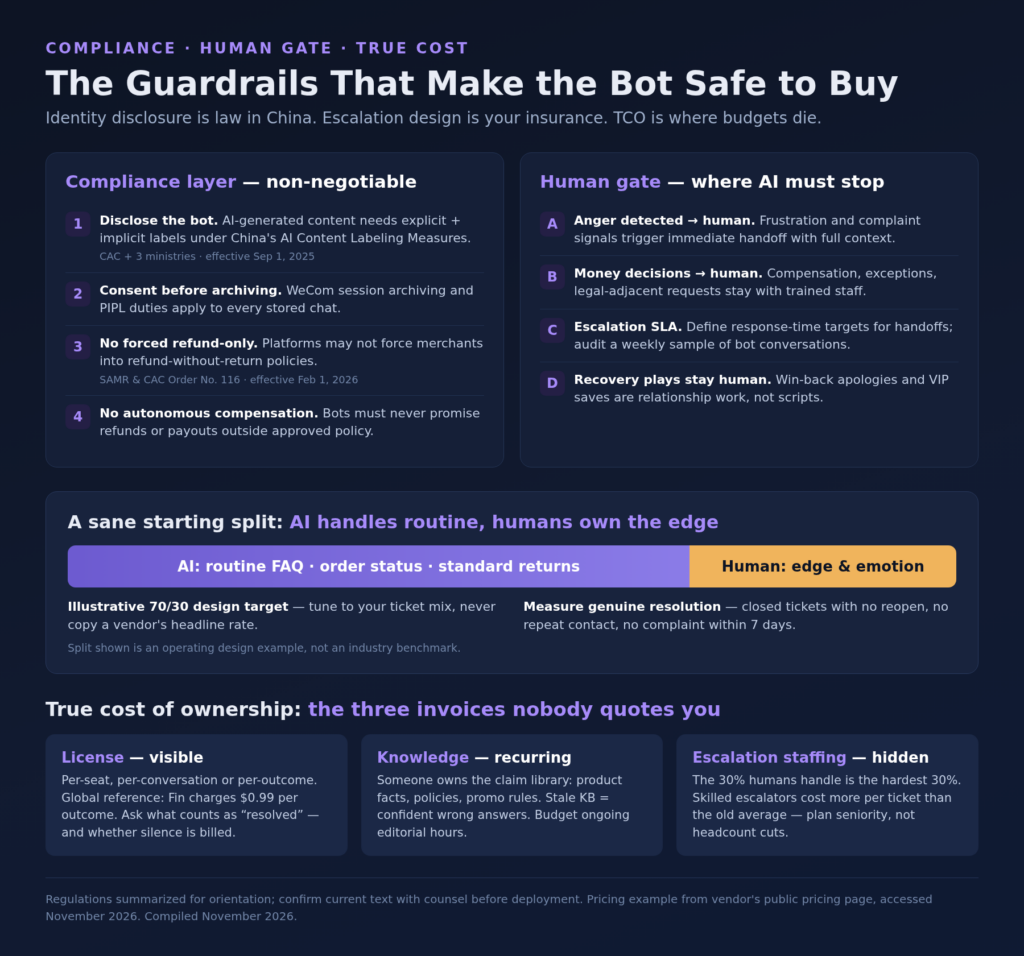
China’s AI content-labeling regime took effect September 1, 2025: the Measures for Labeling AI-Generated Synthetic Content, issued by four departments (CAC, MIIT, MPS, NRTA), require explicit labels users can perceive plus implicit labels in file metadata, backed by a mandatory national standard. For a text service bot, the practical duty is transparency — customers should know they’re talking to AI, and interactive interfaces need clear prompting. Design your bot’s identity disclosure in from day one; don’t bolt it on after legal reads the rules.
Layer on the rest: PIPL obligations for chat data, consent flows for WeCom session archiving, platform-specific disclosure rules, and the hard internal red line — no autonomous compensation promises, ever. Compliance isn’t the enemy of automation here. A clearly labeled bot with a fast human escape hatch is exactly what that skeptical 64% says it could tolerate.
Integration and True TCO: Three Invoices, Not One
The license is the invoice you see. Pricing models vary — per seat, per conversation, per resolution — and definitions matter enormously. The global reference point is Fin (formerly Intercom, now being acquired by Salesforce): $0.99 per outcome, where an outcome includes “assumed resolution” — the customer simply stopped replying. Ask any vendor the same question: does silence count as success? What happens to billing when a “resolved” customer returns angry the next day?
The second invoice is knowledge maintenance — the editorial hours from the previous section. The third is escalation staffing, and it’s the sneaky one: when AI takes the routine 70%, the human queue becomes concentrated difficulty. Your remaining agents need to be more senior, not fewer juniors. Klarna’s pivot in one sentence: they didn’t abandon AI, they upgraded the humans around it.
Platform-native tools invert the math: near-zero license cost and integration friction, in exchange for lock-in to one ecosystem. Third-party suites cost more but follow you across channels. Neither is universally right — your channel mix decides.
The Human Gate: An Operating Model, Not a Fallback
Write the escalation contract before launch, not after the first complaint storm:
- Triggers: frustration signals, repeated contact, refund exceptions, anything legal-adjacent, any request for a human — instant handoff, full context attached, customer never repeats themselves.
- SLA: a named response-time target for escalated conversations, staffed to honor it at peak.
- Audit: a weekly random sample of bot conversations scored by a human QA owner, feeding the KB update loop.
- Reserved plays: win-back apologies, VIP saves, public-complaint recovery — relationship work that stays human, permanently.
The bot handles volume. The humans handle trust. Design the boundary deliberately and the two reinforce each other; leave it undefined and you get the loop disaster with extra steps.
Honest Boundaries
Three disclosures this guide owes you. First, every vendor scale figure cited (client counts, merchant counts, conversation volumes) is self-reported; none is independently audited. Second, positioning descriptions reflect official sources as of November 2026 — features and pricing change fast, so verify current terms before signing. Third, there is no universal winner. A bot that’s brilliant for a Tmall fashion store may be wrong for a cross-border electronics brand on WhatsApp. The map narrows your shortlist; only your own bake-off can pick the winner.
The Verdict
Buy in this order: platform-native first if one ecosystem dominates your sales; e-commerce specialists (Xiaoduo, Leyan) when marketplace conversion is the job; omnichannel suites (Sobot, Qiyu) for contact centers and cross-border; ecosystem SCRM (Qidian, or the free native WeCom bot) for private-domain retention. Then run the 50-ticket bake-off, wire the human gate, staff the KB, and measure genuine resolution — not deflection.
The vendors are selling you a resolution rate. What you’re actually buying is a frontline colleague. Hire it the way you’d hire a person: check references on your own problems, define what it must never do, and never leave it alone with your angriest customer.