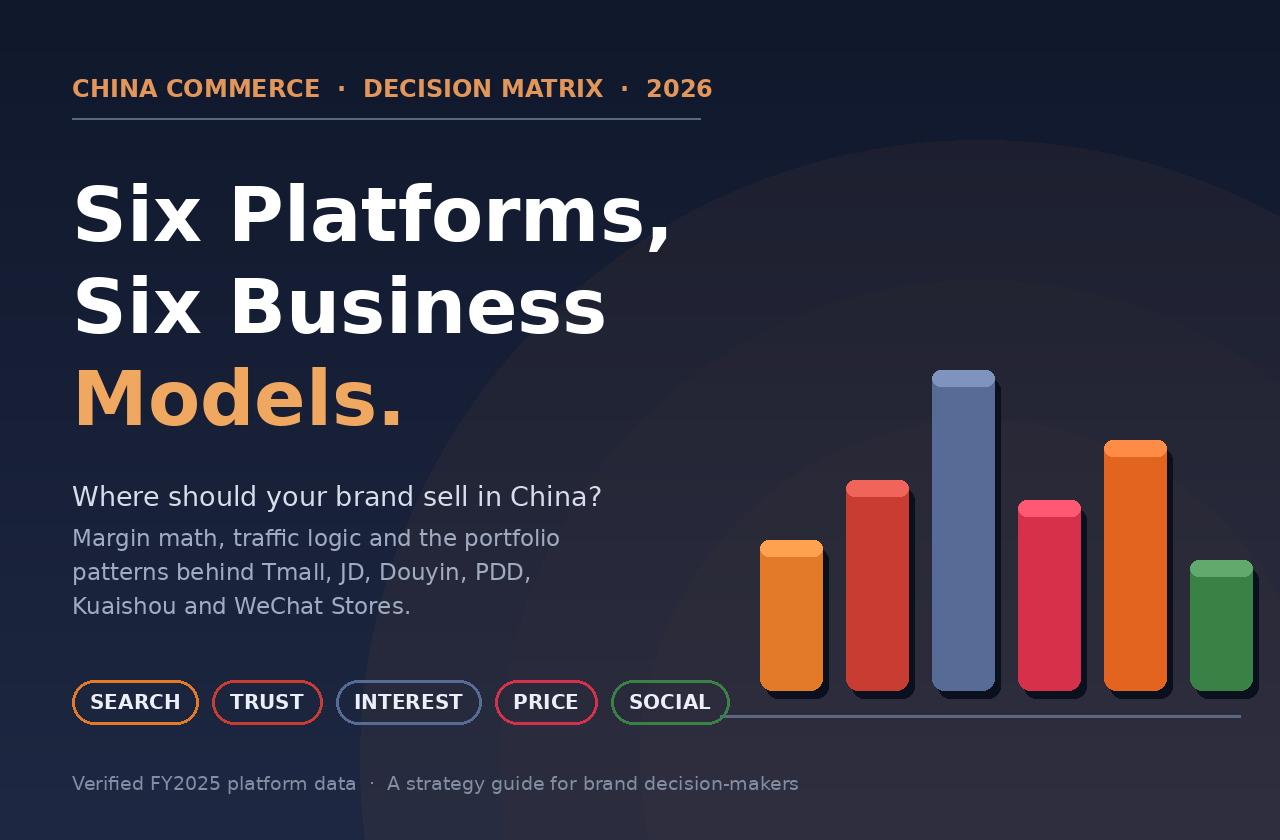
Ask a room of brand managers which Chinese platform is “the biggest” and you’ll get a shouting match. Ask which one makes them money and the room goes quiet. That silence is the whole problem. China’s six major commerce platforms are not six sizes of the same store. They are six different business models — different traffic physics, different fee stacks, different definitions of who owns the customer — and a brand that picks by GMV ranking is choosing a spouse by height.
This guide rebuilds the decision the way your CFO would: model first, margin second, capability third. Every anchor number below comes from FY2025 filings, official platform reports, or published fee rules, checked twice. Where the data is an estimate, we say so.
The Wrong Question and the Right One
The market context makes the stakes clear. China’s online retail of physical goods reached RMB 13.09 trillion in 2025, per the National Bureau of Statistics — but growth slowed to 5.2%, and e-commerce’s share of total retail has now declined two years straight: 27.6% in 2023, 26.8% in 2024, 26.1% in 2025. The rising tide that once lifted every storefront is gone. Platform choice is now a zero-sum allocation of your scarcest resources: cash, content capacity, and management attention.
So stop asking “which platform is biggest.” Ask three better questions: What business model am I actually renting space in? What does that model charge me in total, not just in commission? And what capabilities must I bring for the model to work at all?
Six Models in One Paragraph Each
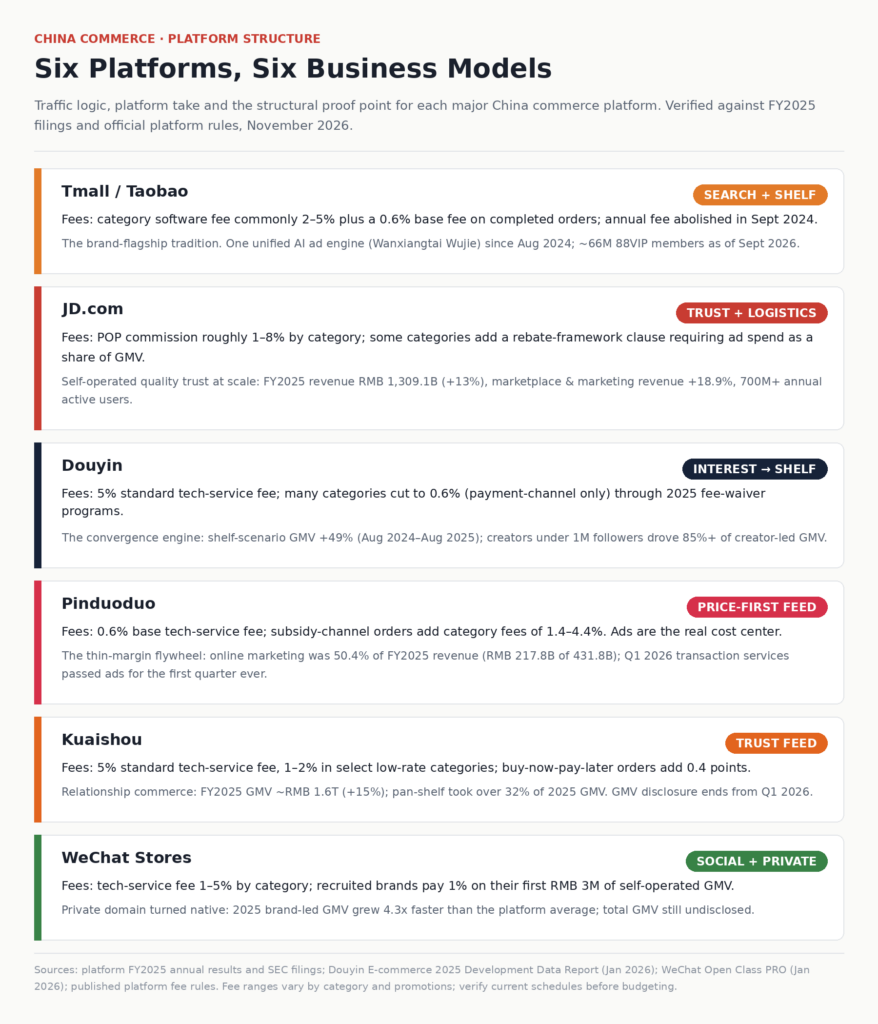
Tmall/Taobao is the search-and-shelf landlord. Shoppers arrive with intent; the flagship store is the brand’s embassy. Since September 2024 the old annual fee is gone, replaced by a 0.6% base software fee on completed orders plus category software fees that commonly run 2–5%. Alibaba folded its ad tools into one AI-run engine, Wanxiangtai Wujie, in August 2024. The model still works: roughly 66 million 88VIP members as of September 2026 form the richest loyalty pool in Chinese commerce.
JD is the trust-and-logistics operator. Its self-operated backbone — authentic goods, fast delivery, real after-sales — is why high-ticket categories convert there. FY2025 revenue hit RMB 1,309.1 billion, up 13%, with over 700 million annual active users. Its marketplace-and-marketing revenue grew 18.9%, a reminder that even the trust operator increasingly monetizes through ads.
Douyin is the interest engine becoming a mall. The feed creates demand you didn’t know you had; the shelf then captures it. Shelf-scenario GMV grew 49% between August 2024 and August 2025, per the platform’s official 2025 data report. Two details matter more than the headline: the number of merchants growing revenue through their own store livestreams rose 45% (merchant count, not GMV), and creators with under a million followers drove over 85% of creator-led sales. This is no longer a superstar-livestream casino; it’s distributed retail.
Pinduoduo is the price-first flywheel. The base tech-service fee is just 0.6%; subsidy-channel orders add 1.4–4.4% by category. But read the income statement: online marketing was 50.4% of PDD’s RMB 431.8 billion FY2025 revenue. The fee is cheap because the auction is the product. In Q1 2026, transaction-services revenue passed advertising revenue for the first quarter ever — the mix is shifting, but the logic hasn’t: you win on price and supply-chain cost, or you don’t win.
Kuaishou is the trust feed. Commerce rides on para-social relationships between creators and loyal followers, concentrated in lower-tier cities. FY2025 GMV was about RMB 1.6 trillion, up 15%, with shelf-style scenarios taking over 32% of full-year GMV. Notably, Kuaishou stops disclosing GMV from Q1 2026 — the industry’s GMV beauty pageant is officially ending.
WeChat Stores is private domain gone native. The store lives inside the chat app where your customers already talk to you. Most categories pay a 1–5% tech-service fee; recruited brands pay 1% on their first RMB 3 million. At January 2026’s WeChat Open Class, the platform said brand-led GMV grew 4.3 times faster than the platform average in 2025 — a growth-rate multiple, and total GMV remains undisclosed. Treat WeChat as a compounding layer, not a scale claim.
The Margin Math Nobody Puts in the Pitch Deck
Here is the only formula that matters: contribution = GMV − fees − ad spend − returns − fulfillment − content cost. Every platform changes a different term, and the cheap-fee platform is often the expensive one.
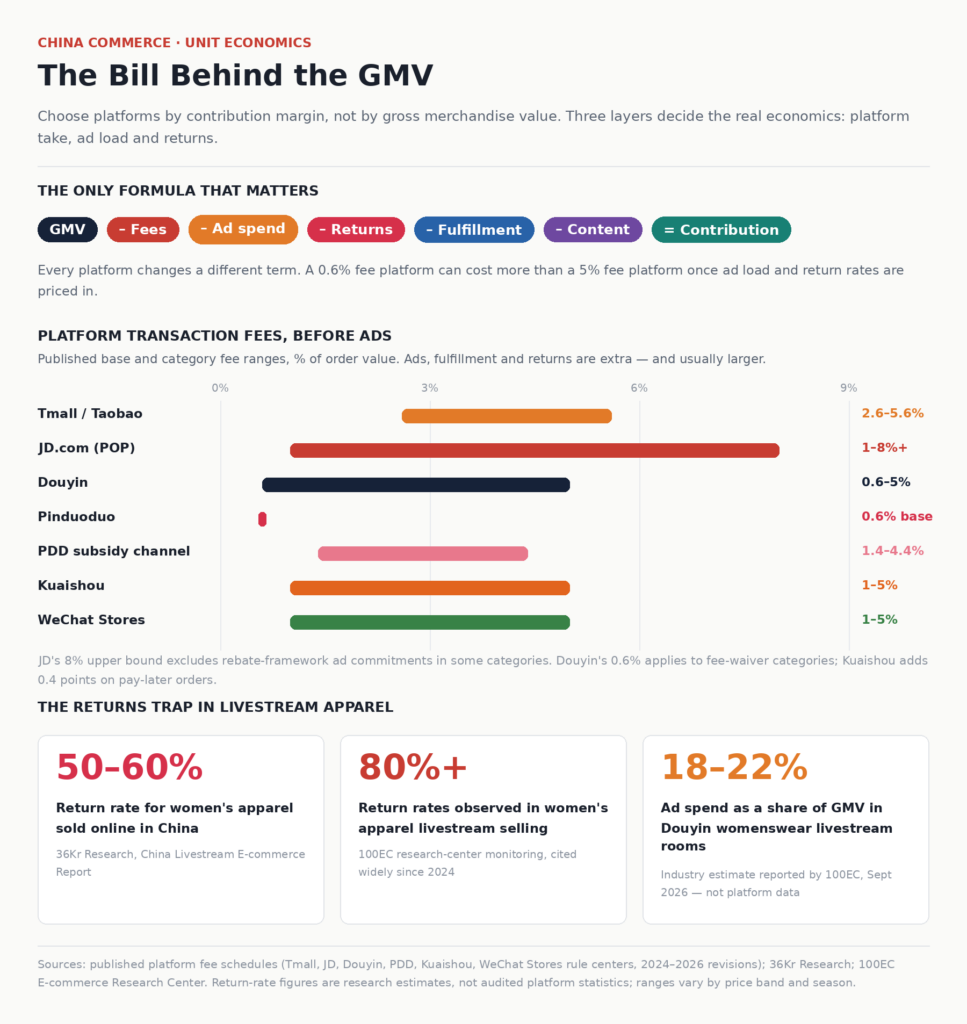
Take the returns trap seriously. 36Kr Research puts online womenswear return rates at 50–60%; the 100EC research center has documented livestream womenswear returns above 80%. Separately, 100EC reported in September 2026 an industry estimate that ad spend in Douyin womenswear livestream rooms runs 18–22% of GMV — an estimate, not platform data, but directionally consistent with what sellers report. Stack those terms and a “5% commission” channel can quietly cost you a third of every yuan before your product cost is counted.
The decision rule: rank platforms by contribution margin per order at your realistic return rate — not by GMV, not by fee table, and never by a viral case study.
The Brand-Type Decision Matrix
Now the core of the guide. Six brand archetypes, six different answers.
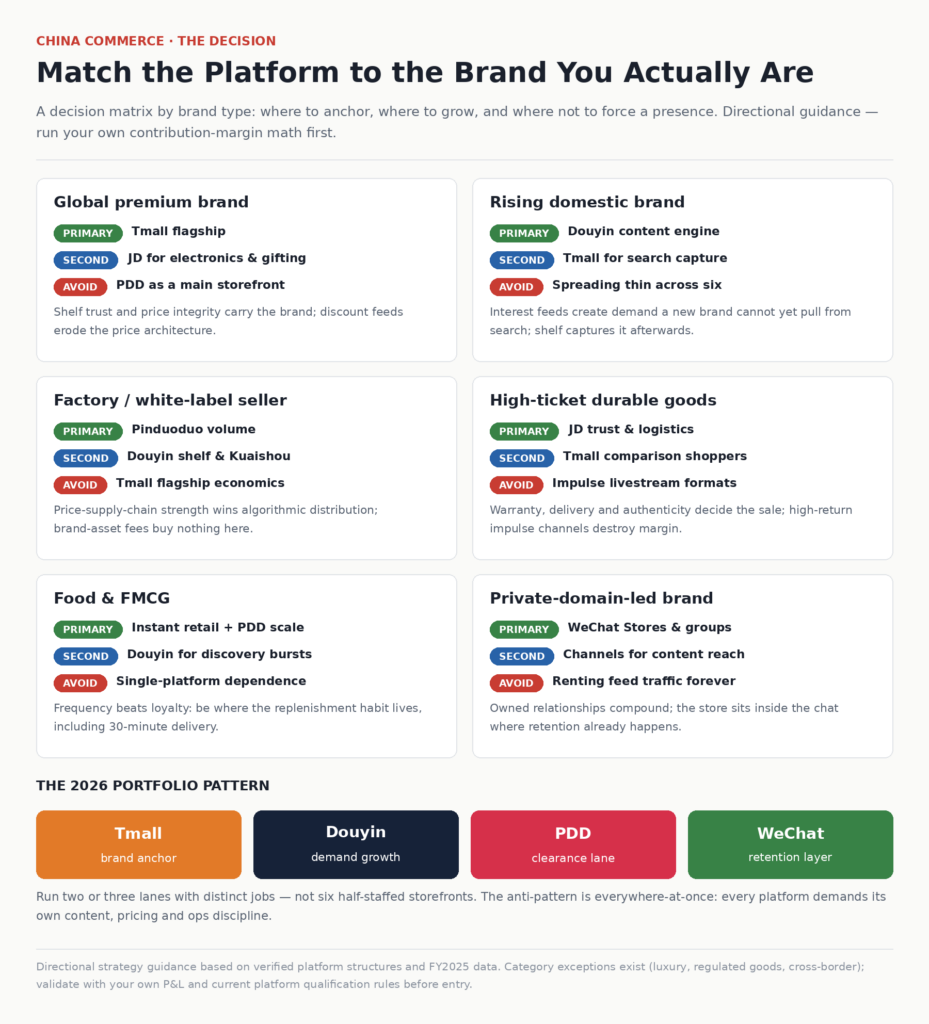
Global premium brands anchor on Tmall’s flagship, add JD where electronics, gifting and logistics trust matter, and keep PDD at arm’s length as a main storefront — a price-first feed erodes the price architecture your brand equity depends on. Rising domestic brands invert the order: Douyin’s interest feed manufactures demand a young brand can’t yet pull from search, then Tmall harvests the search traffic the content creates. Factories and white-label sellers belong on PDD’s volume machine and Douyin/Kuaishou shelf lanes; paying Tmall’s brand-asset costs buys them nothing.
High-ticket durables follow trust: JD first, Tmall’s comparison shoppers second, impulse livestream formats almost never — the returns math destroys the margin. Food and FMCG should chase frequency, not loyalty: instant retail and PDD scale for replenishment, Douyin bursts for discovery, and never single-platform dependence. Private-domain-led brands build on WeChat Stores and groups with Channels for content reach; renting feed traffic forever is the anti-pattern when your entire advantage is owning the relationship.
The Honest Capability Audit
Before you sign anything, answer four questions without flattery. Can you produce short-video and livestream content weekly, in-house, at quality? That’s the Douyin/Kuaishou entry ticket, and buying it from agencies at scale bankrupts mid-size brands. Can you survive a price war at factory cost? That’s PDD. Can you fund brand-asset building — flagship design, search ads, membership ops — for years before payoff? That’s Tmall/JD. Can you staff community operators who answer real humans daily? That’s WeChat. Every platform’s “low barrier” marketing describes opening the store, not surviving the model.
Portfolio Patterns That Actually Work
The mature 2026 stack looks like this: Tmall as the brand anchor where price integrity lives, Douyin as the growth engine, PDD as a controlled clearance lane (distinct SKUs, never your flagship line), WeChat as the retention layer. Two or three lanes, each with a distinct job and its own P&L. The anti-pattern is everywhere-at-once — six half-staffed storefronts, each too weak to trigger any platform’s flywheel. Concentration beats presence.
The Four Shifts Rewriting the Map in 2026
Shelf convergence. Every feed platform is building a mall — Douyin’s shelf GMV +49%, Kuaishou’s pan-shelf past 32% — while every mall is bolting on content. The traffic-logic differences remain real, but the endpoints are converging; plan for a world where each platform demands both content and shelf competence.
Interop. The walls fell faster than anyone expected: Taobao accepted WeChat Pay in September 2024, JD Logistics entered Tmall/Taobao and Alipay entered JD that October, and the NDRC confirmed in January 2025 that platform barriers were coming down. Xiaohongshu’s ad notes now deep-link straight into Tmall and JD with closed-loop attribution. Customer journeys cross platforms; your measurement must too.
Instant retail. The 2025 subsidy war — JD’s February entry, Taobao Shangou’s April launch, Meituan’s 150-million-order peak day in July, two SAMR summonses, and August’s joint pledge against below-cost selling — ended with a structural fact: 30-minute delivery is now a first-class commerce lane. Alibaba’s China instant-commerce segment alone did RMB 58.8 billion in the September 2026 quarter, up 22%. FMCG brands without an instant-retail plan are absent from the fastest-growing shelf in the country.
AI-answer commerce. Assistants are becoming merchants’ new front door. The platform that answers the question owns the recommendation; brands need structured, retrievable product truth everywhere, not just pretty detail pages.
Entry, Compliance and the Permanent Record
Qualification chains differ by platform and category — business licenses, trademark status, category permits (food, cosmetics, medical devices each add layers). Deposits range from token sums on PDD and Kuaishou to five figures on JD and Tmall. And assume every violation is permanent: platform governance scores now follow your entity across years. Budget compliance as a fixed cost, not an afterthought.
Honest Boundaries
Fee schedules change quarterly — verify current rate cards before budgeting. GMV figures are platform-reported and increasingly undisclosed (Kuaishou and WeChat have both stepped back). Return-rate and ad-load figures here are research estimates with sources named, not audited statistics. And the matrix is directional strategy, not a substitute for your own P&L.
The Verdict
There is no “best platform” — there is only the platform whose business model matches your margin structure and your actual capabilities. Run the contribution math at your real return rates, pick two or three lanes with distinct jobs, audit your capabilities honestly, and revisit the mix as shelf convergence and instant retail redraw the map. The brands that win China in 2026 aren’t everywhere. They’re deliberately somewhere.