Open ten tabs for ten AI visibility tools and you’ll see ten prices, from $29 a month to contracts nobody will quote you in writing. What you won’t see is ten different products. Under the dashboard chrome, every one of them runs the same loop. The real question isn’t which tool is best — it’s what your money actually buys, and what no amount of money can buy at all.
This guide walks through the mechanics, the verified 2026 price matrix, the hidden billing unit, and the measurement gap that turns expensive subscriptions into expensive flat lines. Every price below was checked against the vendor’s own pricing page in November 2026, because in this category, even three-month-old reviews are already wrong.
One Loop to Rule Them All: Prompts × Engines × Frequency
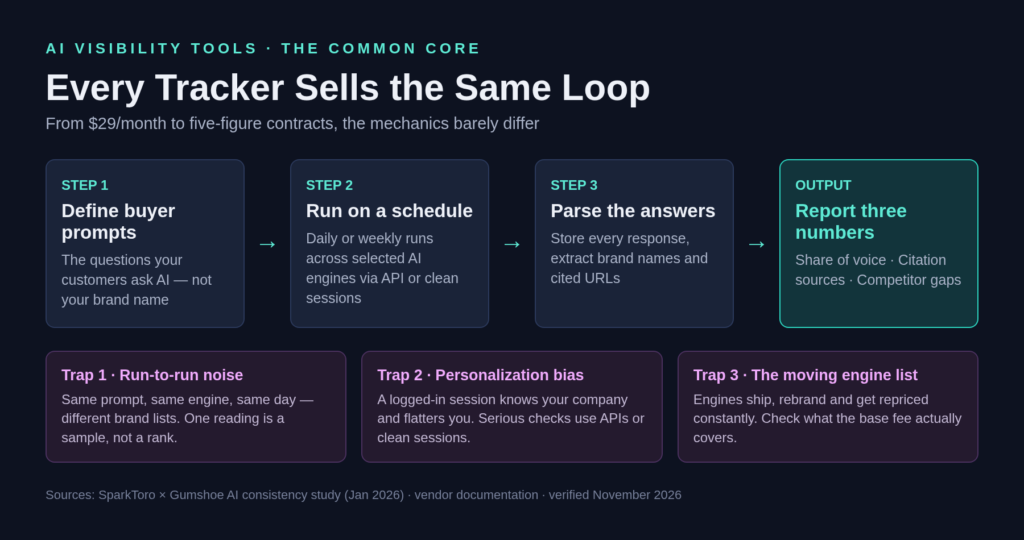
Strip away the branding and every tracker does four things. You define a set of buyer questions — the ones customers ask before they know your name, not your brand keywords. The tool runs those prompts against selected AI engines on a schedule, mostly daily on paid plans. It parses and stores every answer. Then it reports three numbers: how often you’re named (share of voice), which sources the engines cited, and which competitors appear where you don’t.
That’s it. A $29 tracker and a five-figure enterprise platform differ on prompt volume, engine coverage, reporting depth, governance and support — not on the underlying loop. Once you see this, pricing pages get much easier to read. You’re not buying intelligence. You’re buying sampling capacity.
Three Traps the Sales Pages Underplay
Trap one: answers are noisy. Ask the same engine the same prompt twice and you’ll often get different brand lists. This isn’t anecdote. SparkToro and Gumshoe ran 12 prompts through ChatGPT, Claude and Google’s AI 2,961 times with 600 volunteers in late 2025. The chance of getting the identical brand list twice was under 1 in 100; identical list in identical order, roughly 1 in 1,000. Rand Fishkin’s verdict on tools selling an AI ranking position was blunt: baloney. The same study found the encouraging flip side — visibility percentage across many prompts and runs is reasonably stable. Top headphone brands appeared in 55–77% of 994 responses even when 142 humans phrased the question 142 different ways. Trends over weeks are signal. Single readings are noise.
Trap two: personalization flatters you. Query an engine from your logged-in browser and it already knows your company. Serious tools query via API or clean sessions; any manual spot-check you run should too.
Trap three: the engine list is a moving target. Engines ship, rebrand and get repriced constantly. What counts as base coverage versus a paid extra changes quarter to quarter — Otterly rebuilt its entire pricing model in November 2026, as we’ll see below. Check what the entry fee covers today, in writing.
The 2026 Price Matrix: $29 to Five Figures, Verified
Here’s the landscape as the vendors themselves published it in November 2026.
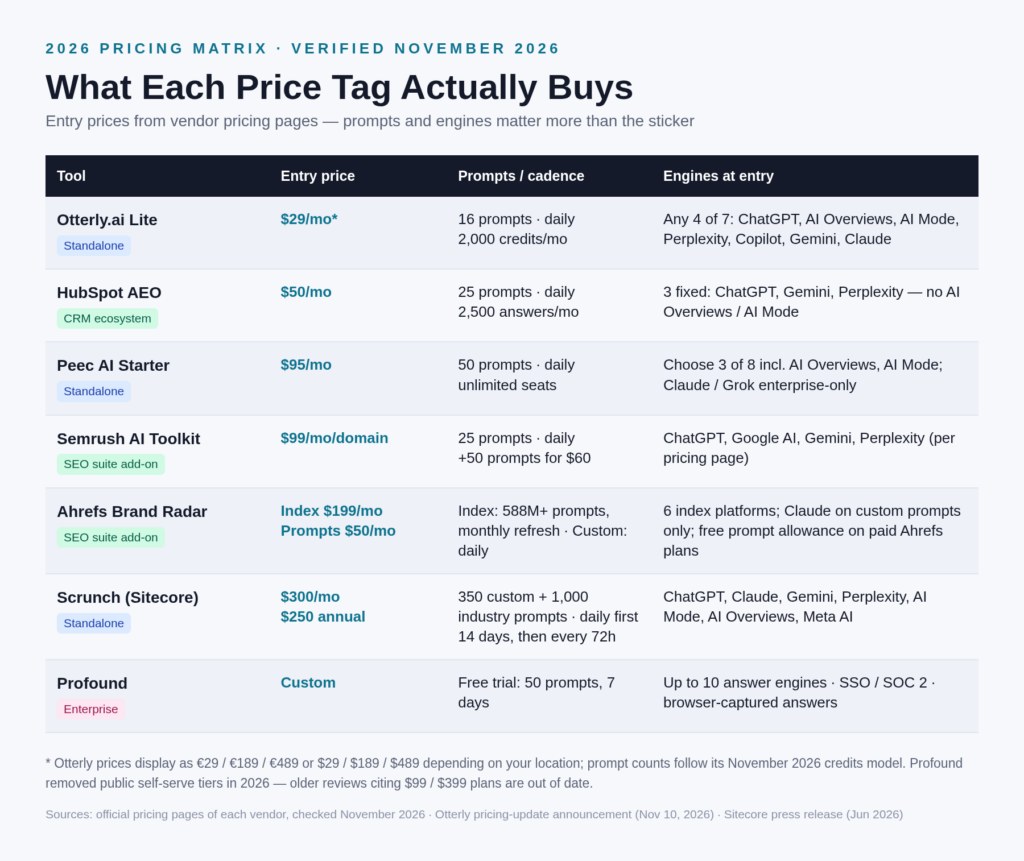
A few readings worth slowing down for:
- Otterly now runs a credits model (launched November 10, 2026): $29 buys 16 prompts and 2,000 monthly credits, with any 4 of 7 engines included — ChatGPT, AI Overviews, AI Mode, Perplexity, Copilot, Gemini and Claude. Older reviews describing Claude and Gemini as paid add-ons are out of date. Prices display in USD or EUR depending on your location.
- HubSpot AEO at $50 is the cheapest way into 25 daily prompts with a 28-day, no-card trial — but its three engines are ChatGPT, Gemini and Perplexity. It does not track AI Overviews or AI Mode. If your buyers meet AI inside Google Search, this tool is blind to that surface.
- Peec starts at $95 for 50 prompts on 3 chosen models with unlimited seats — a pricing shape agencies love. Claude, Grok and DeepSeek sit behind enterprise API terms.
- Semrush’s AI Toolkit is $99 per domain per month on annual billing for 25 prompts. Extra domains, extra seats (from $45) and extra prompts (50 for $60) each meter separately.
- Profound removed its public self-serve tiers in 2026. Any article still quoting a $99 Starter is describing a product that no longer exists; today it’s custom enterprise contracts, up to 10 answer engines, SSO and SOC 2.
Index vs. Tracker: Two Products Wearing One Category Name
Ahrefs Brand Radar quietly sells two different things. Its AI Visibility Index (from $199/month) lets you look up any brand’s presence across a pre-collected pool the vendor currently puts at 588 million-plus search-backed prompts — no setup, refreshed monthly on a 90-day window. Its custom prompt tracking (from $50/month, with a free allowance on paid Ahrefs plans) runs your own buyer questions as often as daily.
The distinction matters more than the price. An index is built from real search demand, so it works beautifully for established brands and badly for niche ones with no search volume — there’s simply nothing about you in the pool. A tracker starts empty and fills with exactly the questions you care about, which is what new and niche brands need. Buy the wrong one and you’ll conclude the tool is broken when it’s merely answering a question you didn’t ask. Semrush’s toolkit blends both shapes: a large prompt database for any-domain reports plus 25 tracked prompts of your own.
The Real Billing Unit: Prompts × Engines × Runs
Sticker prices lie by omission. The honest comparison is cost per unit of sampling — and the simplest version is price per 100 tracked prompts.
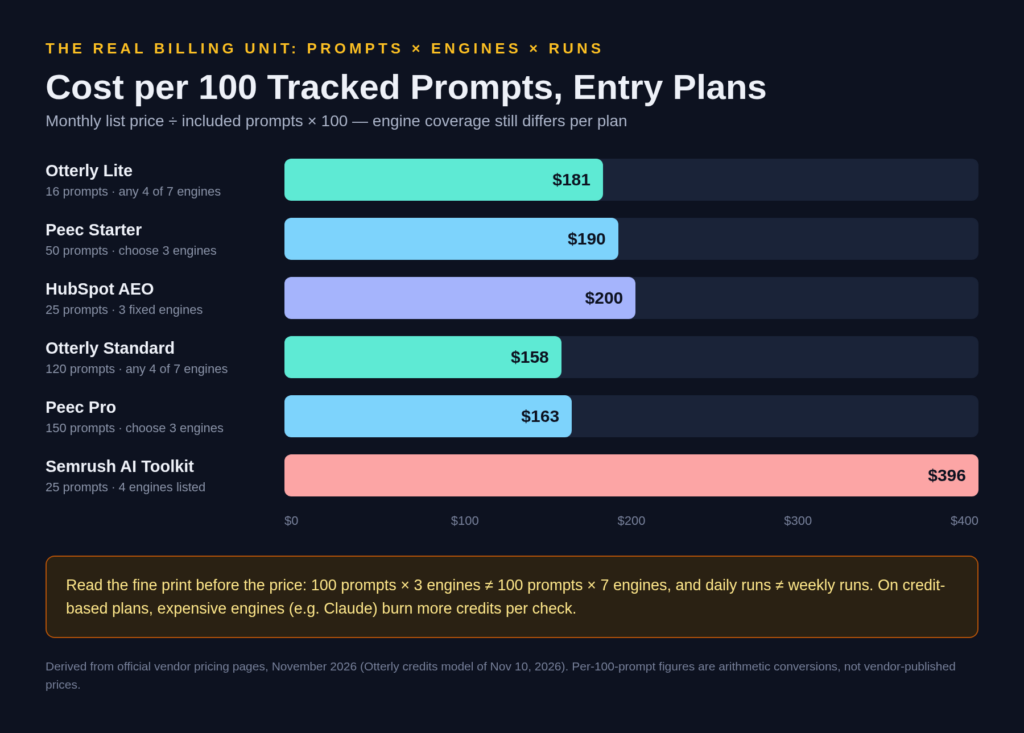
Do this arithmetic yourself before every demo: monthly price ÷ included prompts × 100. On current entry plans it ranges from roughly $158 (Otterly Standard) to $396 (Semrush). But keep three asterisks taped to the chart. First, 100 prompts on 3 engines is not 100 prompts on 7 — coverage per prompt differs. Second, daily runs and weekly runs are different products at the same prompt count; Scrunch, for instance, runs new prompts daily for 14 days, then every 72 hours. Third, credit-based plans charge more for expensive engines: a Claude check costs 3 credits on Otterly and 8 checks per update on Ahrefs custom prompts. The engines you pick silently reprice your plan.
And one more wrinkle nobody prints on the pricing page: the scores themselves aren’t comparable across tools. Vendors use different denominators. Profound’s visibility score counts only answers that name at least one brand; Peec divides by all answers. Take 100 answers where 50 name no brand and 25 name yours: one formula says 50%, the other says 25%. Same reality, double the score. If you switch tools mid-year, your trend line breaks even when your brand didn’t move.
The Four-Layer Measurement Stack
Here’s the structural limit of the whole category: a paid tracker owns exactly one layer of a four-layer problem.
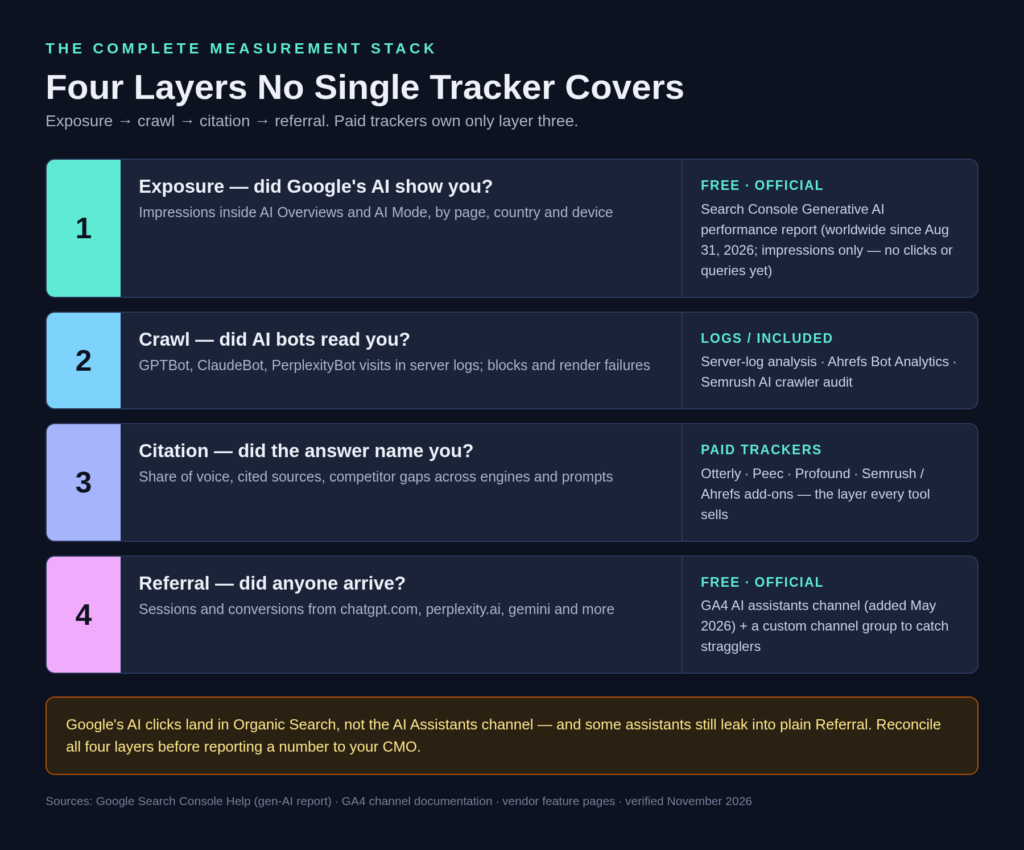
Layer 1, exposure: Google’s Search Console now ships a Generative AI performance report, rolled out worldwide by August 31, 2026. It shows impressions inside AI Overviews and AI Mode by page, country and device. It’s impressions only — no clicks, no queries, no position yet — but it’s official, free, and it answers a question no tracker can: what does Google’s own AI show from my site?
Layer 2, crawl: did AI bots even read you? GPTBot, ClaudeBot and PerplexityBot visits live in your server logs; Ahrefs includes Bot Analytics and Semrush an AI crawler audit. A robots.txt block looks identical to a content failure in a visibility dashboard — zero is zero — but one is fixed by a line of config and the other by months of work.
Layer 3, citation: the layer every paid tool sells. Share of voice, cited sources, competitor gaps.
Layer 4, referral: did anyone actually arrive? GA4 added AI-assistant traffic classification in 2026, but it’s incomplete — some assistants still land in plain Referral, and crucially, clicks from AI Overviews and AI Mode count as Organic Search, not AI. Most teams still maintain a custom channel group matching chatgpt.com, perplexity.ai, gemini and claude.ai referrers to see the full picture.
Stack the four layers and you can diagnose. Buy only layer three and you can merely watch.
The 45-Query Experiment: Why Measurement Doesn’t Improve Anything
The cleanest demonstration comes from a first-hand August 2026 study by Continuum. They took 45 queries a site already ranked for on Google at position 12 or better and asked three questions. Did live web search surface the site? Yes, on 60% of queries — ranking mostly wins the retrieval gate. Did a browsing AI cite it? Only 7 of 45 times, 15.6%. Pages ranked #2 and #3 went uncited while lower-ranked competitors got quoted. Did a non-browsing model recall the site from training memory? Zero times in a separate 9-query check.
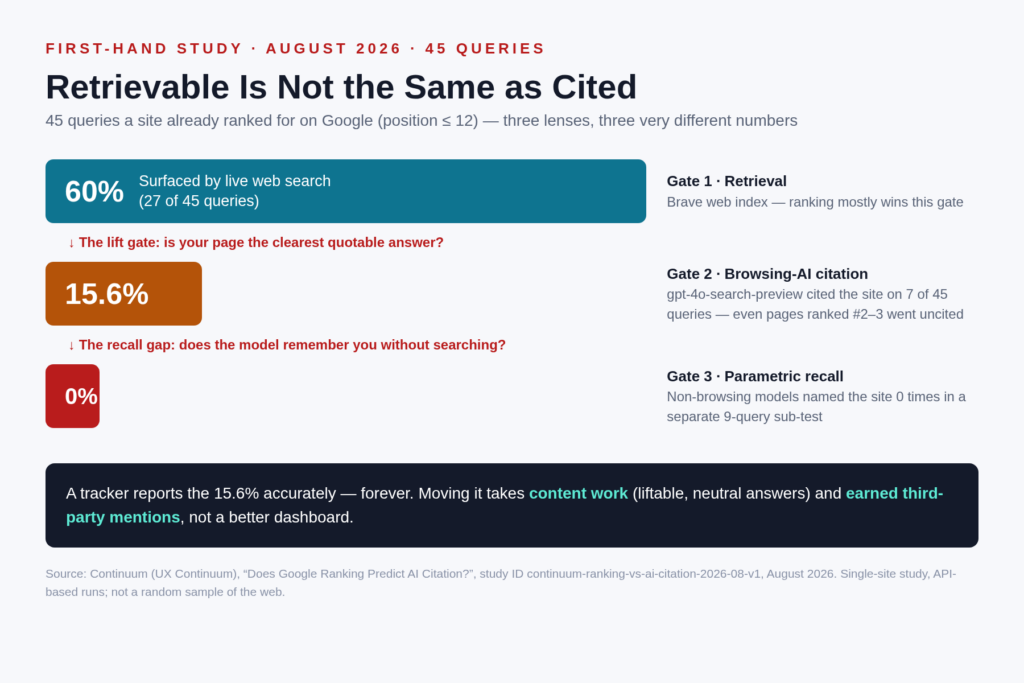
It’s a single-site study run through APIs, not a random sample of the web — treat it as a mechanism demonstration, not a universal rate. But the mechanism is the point. Visibility is lost at gates no tracker touches: the lift gate (is your page the clearest, most quotable answer?) and the recall gate (has the model absorbed enough third-party mentions to remember you without searching?). A tracker would have reported that 15.6% accurately, every day, forever. Moving it required rewriting pages so key numbers read as neutral facts rather than vendor pitches, and earning authentic mentions elsewhere on the web. That’s content and PR work. Budget for it, or your subscription becomes an expensive way to watch a flat line.
The volatility data says the same thing from another angle. BrightEdge tracked ecommerce prompts across three engines for 12 weeks in mid-2026: brand mention share moved about 25% week over week, but citation share moved 39–41%. On Gemini, 37% of cited URLs were new each week while only 3% of mentioned brands were. Brands hold; evidence churns. A single week’s citation dip is baseline noise, not a finding — which is exactly why you need enough prompts, enough runs and enough patience to tell churn from loss.
The Decision Tree: Five Teams, Five Answers
There is no best tool. There is a best fit.
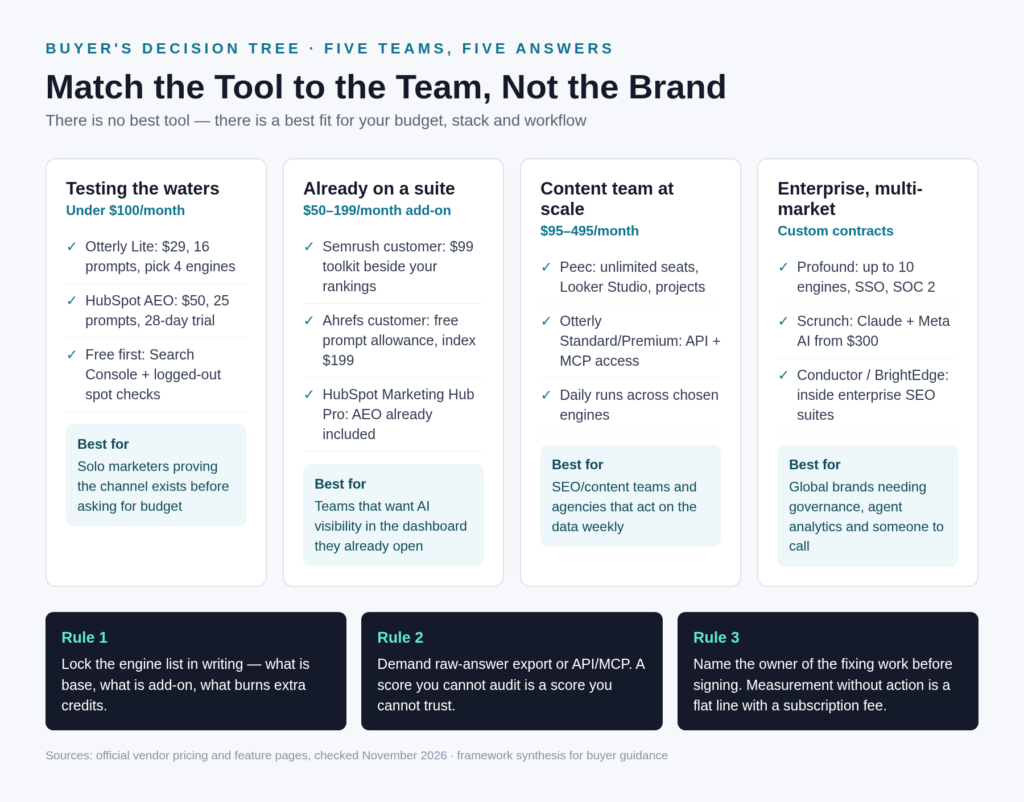
Testing the waters, under $100? Start free — Search Console’s AI report plus a handful of logged-out manual checks — then Otterly Lite at $29 or HubSpot AEO at $50 with its 28-day trial. You’re proving the channel exists before asking for budget.
Already paying for a suite? Open the add-on first. Semrush’s $99 toolkit puts AI visibility beside the rankings you already track; Ahrefs customers have a free prompt allowance sitting unused. Same data category, one login, no new procurement cycle. Just watch the per-domain and per-seat stacking if you’re an agency.
A content team that acts on data weekly? Peec’s unlimited seats and Looker Studio integration, or Otterly’s Standard tier with API and MCP access, give you the depth-to-price sweet spot. This is where a tracker earns its keep — when someone actually changes pages in response to it.
Multi-market enterprise? Profound, Scrunch (from $300, with Claude and Meta AI at entry), or AI tracking inside Conductor or BrightEdge. You’re paying for governance, agent analytics, multi-country runs and someone to call. That’s legitimate — just name it honestly in the business case.
MCP and Exports: Your Data Must Escape the Dashboard
One question separates serious purchases from expensive ones: can the raw answers get out? Demand answer-level export, API access or an MCP server — Otterly includes API and MCP from Standard, Peec gates API behind enterprise, Semrush’s standalone toolkit has neither. A score you can’t audit is a score you can’t trust, and a dataset locked in one vendor’s UI is a switching cost disguised as a feature. If your team runs its own reporting, pipe the data into your warehouse or Looker Studio and compute your own mention rate with your own denominator. Yours won’t match the vendor’s. That’s fine — it will match itself over time, which is what a trend needs.
The Meta-Irony: The Tools Themselves Are Being Ranked
Here’s the twist the category rarely says out loud. The measurement layer is consolidating into the platforms it measures against. Adobe completed its roughly $1.9 billion acquisition of Semrush in April 2026. Sitecore acquired Scrunch in June 2026. HubSpot prices AEO at team-lunch money because it exists to keep you inside Marketing Hub. Meanwhile, most comparisons you’ll read while evaluating these tools are written by the tools themselves — vendor-authored roundups where every author somehow ranks its own product favorably.
So apply the same skepticism to tool shopping that the tools apply to AI answers: sample multiple sources, discount self-interested ones, and run your own test. Fifteen of your real buyer questions, two finalist tools, one week, same engines and countries — then compare raw answers, not headline scores. The tool whose data matches what you see in logged-out sessions is the tool closest to what your buyers see.
The Pre-Contract Checklist
Before signing anything, get written answers to six questions. Which engines are in the base fee, and which cost extra credits or add-ons? What’s the actual run frequency per prompt — daily, every 72 hours, weekly? How do seats, domains and projects meter? Can you export raw answers, and is there API or MCP access? What history do you keep, and what happens to it when you cancel? And how is the visibility score calculated — what sits in the denominator? If a vendor won’t answer the last one plainly, that tells you everything.
The 90-Day Pilot: Start With 15 Buyer Questions
Don’t boil the ocean. Days 1–15: write 15 non-branded questions your buyers actually ask, pull them from sales calls and Search Console queries, and baseline them in a trial plus logged-out manual checks. Days 16–45: pick one tool from your decision-tree branch, lock the prompt set and competitor list, and let weekly trends accumulate — resist reacting to any single day. Days 46–75: assign the fixing work. Rewrite the three pages with the worst lift-gate problem into direct, neutral, quotable answers; pitch two genuine third-party inclusions. Days 76–90: compare trend against baseline, reconcile all four measurement layers, and decide whether to scale the spend. If the number moved, you’ve proven the loop closes. If it didn’t, you’ve saved yourself an annual contract — which is also a win.
Summary
Every AI visibility tool sells the same loop: prompts × engines × frequency, reported as share of voice and citations. Prices verified in November 2026 span $29 to custom enterprise, but the honest unit is cost per 100 prompts with engine coverage attached — roughly $158 to $396 at entry. Scores aren’t comparable across vendors because denominators differ, and single readings are noise: identical brand lists recur less than 1% of the time. Paid trackers cover one of four measurement layers; Search Console, server logs and GA4 cover the other three for free. And measurement never improves visibility by itself — the 45-query study’s 60% retrieval versus 15.6% citation gap lives at gates only content work and earned mentions can open. Match the tool to your team, lock the terms in writing, name the owner of the fixing work, and pilot before you commit.