You did everything right. The comparison page ranks on Google’s first page. The docs are clean, the schema is valid, the content team ships every week. Then a developer asks Claude to shortlist tools in your category — and your brand simply doesn’t exist in the answer.
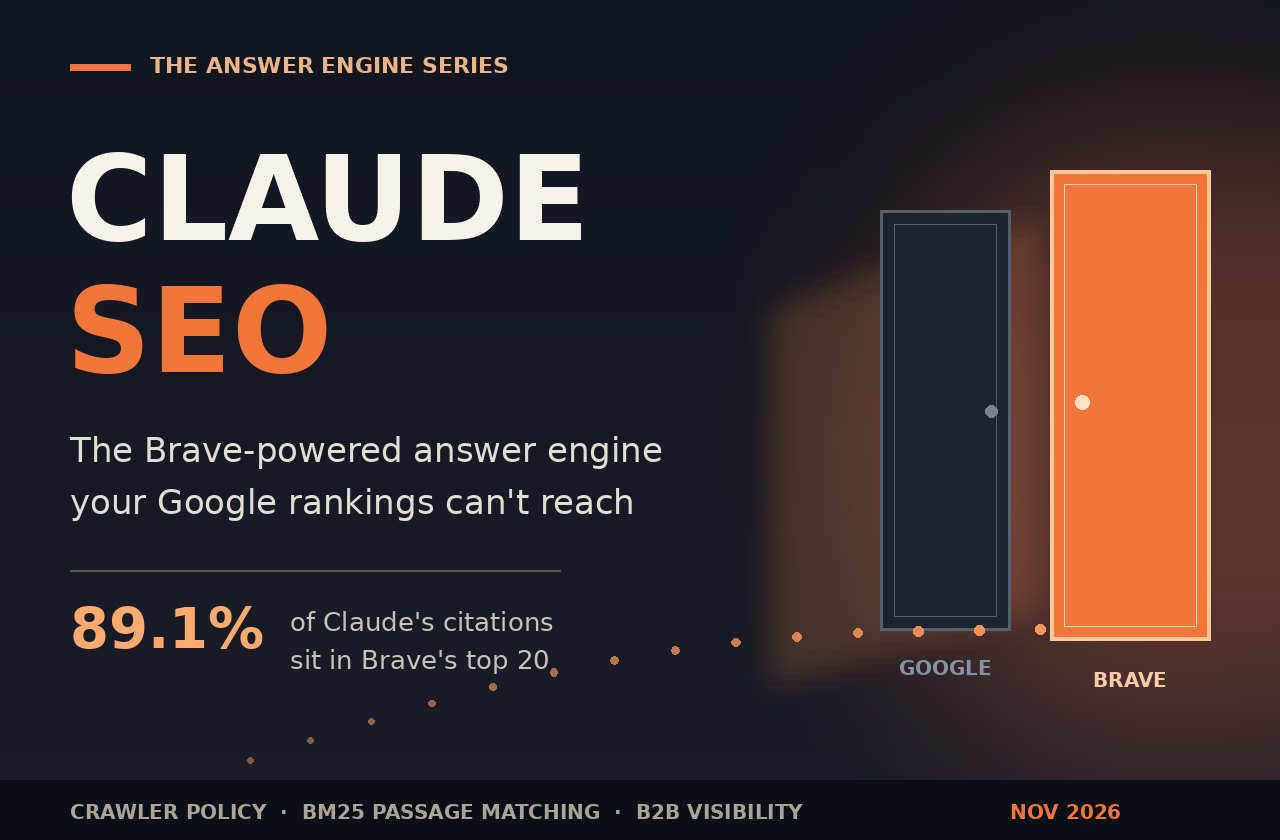
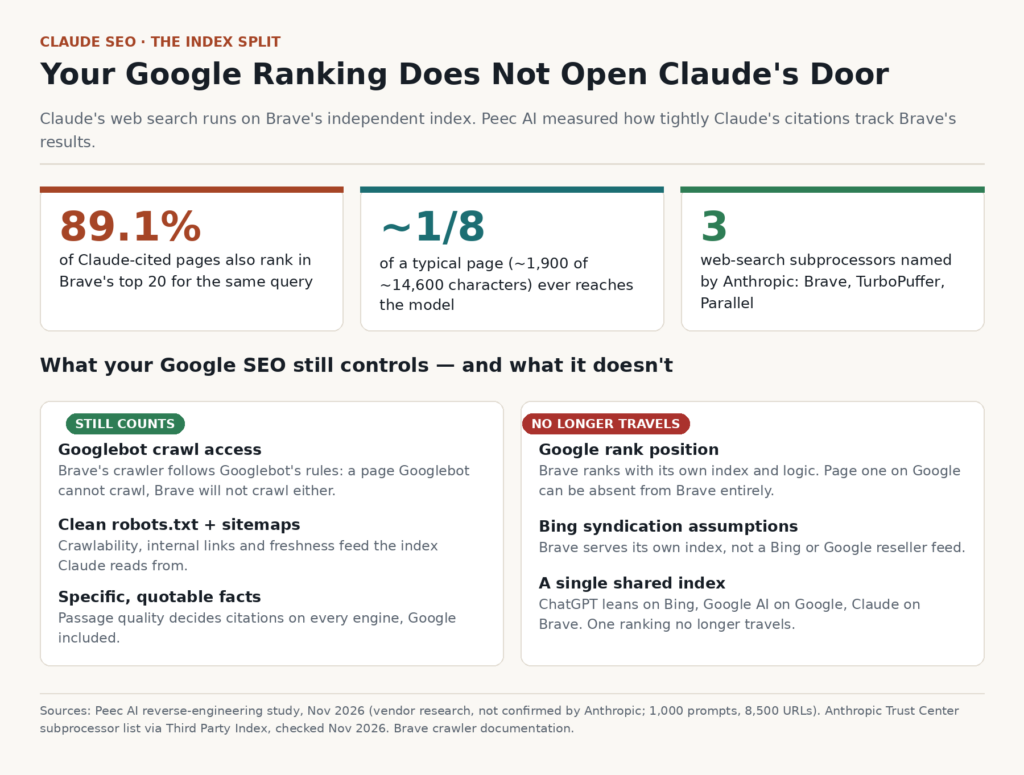
That’s not a content problem. It’s an index problem. Claude’s web search doesn’t read Google’s index. It runs primarily on Brave Search, an independent index with its own crawler and its own ranking logic. When Peec AI, a vendor that sells AI-visibility tracking, tested 1,000 prompts and 8,500 URLs, it found that 89.1% of the pages Claude cited also appeared in Brave’s top 20 results for the same queries. Your Google ranking, in other words, is a ticket to a different concert.
Here’s how to get into the right venue — and what to do once you’re inside.
Step Zero: Check Whether Brave Even Knows You Exist
Before you rewrite a single headline, open search.brave.com and run site:yourdomain.com. Then run your three most commercial queries — the ones a buyer would actually type — and see whether you appear at all.
This is the check no other answer-engine playbook needs. ChatGPT leans on Bing; Google’s AI surfaces lean on Google. If you rank there, you’re at least in the candidate pool. Claude starts from a smaller, independent index, and plenty of perfectly healthy sites are simply absent from it.
If key pages are missing, Brave offers a direct URL submission form at search.brave.com/submit-url. One honest caveat: independent testers describe its practical effect as closer to a forced re-fetch of known URLs than a guaranteed indexing request. Treat it as a nudge, not a magic button. The durable fix is crawlability — and here’s the twist that saves your existing SEO work: Brave’s crawler follows Googlebot’s access rules. A page Googlebot can’t crawl, Brave won’t crawl either. Your robots.txt hygiene and sitemap discipline still pay off. Your rank position doesn’t travel; your access layer does.
What Brave Is — and Why Anthropic’s Own Paperwork Gives It Away
Brave isn’t a Bing reseller with a privacy skin. It builds its index from its own crawler plus the Web Discovery Project, an opt-in program where Brave browser users contribute anonymized browsing data. Brave says it has served its default results entirely from its own index since 2023, with zero dependency on Google or Bing.
How do we know Claude uses it? Not from a press release — from Anthropic’s own compliance paperwork. On March 19, 2025, one day before Claude’s web search launched for paid US users, Anthropic added Brave Search to the subprocessor list in its Trust Center: the legal disclosure of vendors that process customer data. Developer Simon Willison spotted the listing, then asked Claude to search for pelican facts — the ten citations were an exact match for the same query on Brave. He also found the internal tool definition contained a parameter literally named BraveSearchParams. TechCrunch reported the finding that week. This is about as close to official confirmation as vendor disclosures get.
The 2026 Update: Brave Is No Longer the Only Door
If your Claude strategy was written in spring 2025, it’s already stale. The Trust Center now lists three web-search subprocessors: Brave Search (March 2025), TurboPuffer (May 2026), and Parallel Web Systems (October 2026), which runs its own web-scale index crawled by a bot called ShapBot. TurboPuffer is a vector and full-text search database — it crawls nothing, which suggests Anthropic stores an index of its own there, plausibly fed by its Claude-SearchBot crawler. That last connection is inference, not disclosure.
Anthropic hasn’t published the routing: which provider answers which question, or how results get merged. Anyone claiming to know the split is guessing. Anthropic’s help pages do confirm one detail — image search is powered by Bing. The practical read: Brave remains the best-evidenced door, the 89.1% overlap was measured against it, but a complete strategy keeps every door open rather than betting the brand on one vendor relationship.
Three Anthropic Bots, Three Independent Switches
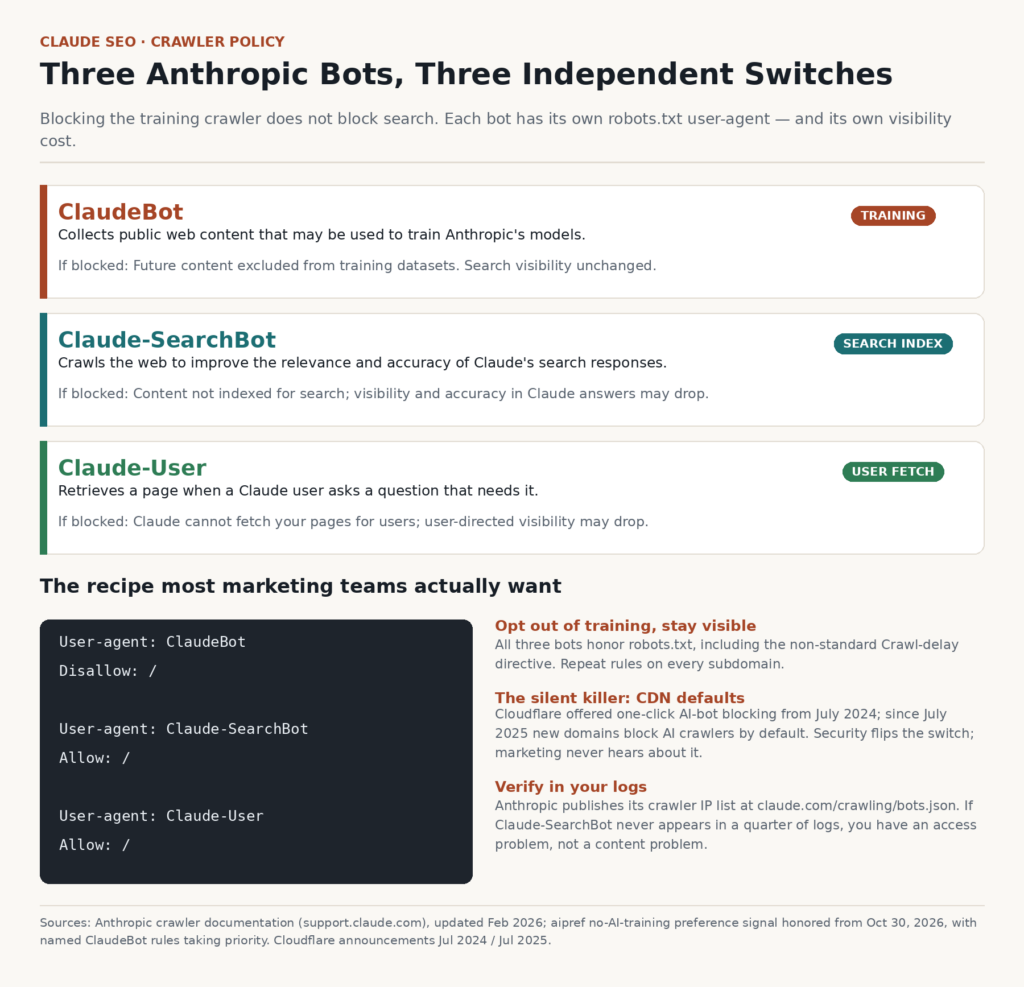
Here’s where most sites quietly disqualify themselves. Anthropic runs three separate crawlers, each with its own robots.txt user-agent, and blocking one does nothing to the others:
- ClaudeBot collects content that may be used for model training. Block it, and your future content stays out of training datasets — with zero effect on search visibility.
- Claude-SearchBot crawls to improve the relevance and accuracy of Claude’s search responses. Block it, and Anthropic says your content won’t be indexed for search, which may reduce your visibility in Claude-powered answers.
- Claude-User fetches pages when a user’s question needs them. Block it, and Claude can’t retrieve your pages for users.
Unlike OpenAI and Perplexity — which warn that robots.txt may not govern their user-triggered fetchers — Anthropic states all three of its bots honor robots.txt, including the non-standard Crawl-delay directive. Rules apply per subdomain: docs.yourdomain.com reads its own robots.txt, not yours. And since October 30, 2026, Anthropic also honors the IETF aipref draft’s machine-readable no-AI-training signal, with named ClaudeBot rules taking priority over the general setting.
The recipe most marketing teams actually want — out of training, visible in search — is simply: disallow ClaudeBot, allow Claude-SearchBot and Claude-User.
The Cloudflare Trap: The Block Nobody on Your Team Chose
The most common failure isn’t a deliberate robots.txt decision. It’s a CDN default. In July 2024, Cloudflare launched one-click AI-bot blocking — an opt-in button. Then, from July 1, 2025, new domains registered through Cloudflare got AI-crawler blocking on by default. A security admin flips a switch during setup; marketing never hears about it; the brand vanishes from AI answers without a single content change.
The scale of self-exclusion is real. A BuzzStream study covered by Search Engine Journal in January 2026 found 79% of top news sites block at least one AI training bot — a defensible choice. But 71% also block at least one retrieval or search bot, which is often an accident with a visibility cost.
Your diagnostic: pull a quarter of server logs and check them against Anthropic’s published crawler IP list at claude.com/crawling/bots.json. If Claude-SearchBot has never appeared, you don’t have a content problem. You have a door problem.
Reverse-Engineering the Quote: What BM25 at 74/100 Tells Us
Getting fetched isn’t the finish line. Peec AI’s reverse-engineering study — vendor research using the Claude API, explicitly not confirmed by Anthropic — found that a typical page of about 14,600 characters gets reduced to roughly 1,900 characters before the model ever sees it. About an eighth of your page survives. The other seven-eighths might as well not exist.
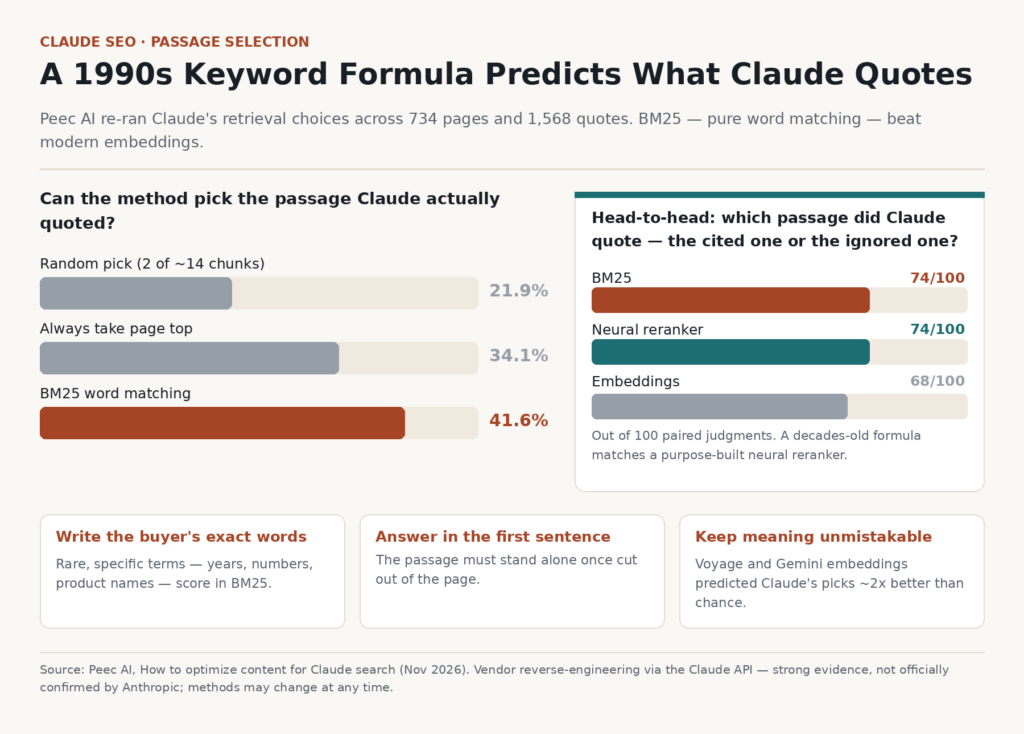
So which eighth gets through? Peec reconstructed the selection across 734 pages and 1,568 actual quotes, then tested which algorithm best reproduces Claude’s choices. The winner was embarrassing for modern AI: BM25, a keyword-counting formula from the 1990s with no neural anything in it. Picking two chunks out of roughly fourteen, BM25 landed on Claude’s quoted passage 41.6% of the time — versus 21.9% for random picks and 34.1% for always taking the top of the page. In head-to-head judgments of cited-versus-ignored passages, BM25 scored 74 out of 100, beating embeddings at 68 and matching a purpose-built neural reranker at 74.
Meaning still matters. Of twelve public embedding models tested, Voyage and Gemini came closest to Claude’s real choices — Gemini Embedding 002 predicted citations about 2.1 times better than chance at tight budgets. But a model Peec fine-tuned on Claude’s own citations beat every public model, which suggests Anthropic uses something custom. None of this is official; Anthropic can change the pipeline tomorrow. Yet it lines up with Anthropic’s published contextual-retrieval research from September 2024, where combining contextual embeddings with BM25 and a reranker cut retrieval failure rates by 67% relative to baseline. It would be strange for the company’s search product to ignore its own findings.
Writing for the Double Match: Words and Meaning
The practical synthesis: your money passage has to pass two tests at once. Does it contain the specific words a search query will use? And does it still answer the question when cut out of the page?
That means writing headings in your buyer’s exact phrasing — not your brand’s polished synonym. It means putting the direct answer in the first sentence under the heading, then supporting detail after. It means favoring rare, specific tokens: numbers, years, product names, audience labels. BM25 rewards distinctive words and barely rewards repeating your main keyword. And it means writing self-contained passages: a chunk that says “it depends on the plan” without naming the plan is a chunk that answers nothing once severed from its context.
One more wrinkle: Claude doesn’t search your user’s literal question. It fans the question out into several rewritten queries, adding years and specifics the user never typed. Optimize for the query the engine actually runs, not the prompt the human typed.
The Conservative Citer: Claude Would Rather Say “I Don’t Know”
Claude has a distinct citation personality, and BrightEdge’s guide to Claude search — a vendor publication built on the company’s own query testing — documents it well. In a local-query test asking about Tuesday restaurant specials near Elmhurst, Illinois, Claude couldn’t find structured data on the specials. Instead of inventing a deal, it transparently flagged the gap and suggested related events. BrightEdge’s summary of Claude’s behavior across e-commerce, education, and local tests: it only cites what it can verify, and it flags incomplete information rather than filling holes with plausible fiction.
The same guide shows the flip side: asked a stable definitional question, Claude answered from internal knowledge without triggering search at all — even with search enabled. Fresh, specific, comparative questions trigger retrieval; evergreen definitions often don’t.
For marketers, both behaviors point the same direction. Publish structured, dated, verifiable facts — pricing tiers, spec tables, comparison data with timestamps. Vague authority prose gives a conservative citer nothing safe to quote. And target the question types that actually trigger search: comparisons, changes, “what’s new,” regional and use-case variants.
31.6% vs 60.9%: Why Claude Leans on the Press
Here’s the number that should reorder your budget. Searchable, another AI-visibility vendor, reported that ChatGPT used brands’ own websites 60.9% of the time versus 31.6% for Claude — roughly double. And once sources were read, national press accounted for 19.2% of ChatGPT’s citations versus 52.0% of Claude’s. In the same sample, TechRadar alone made up 22% of ChatGPT’s cited sources, while no single site passed 9% on Claude.
Read those with the right eyebrows raised: this is vendor-reported data, the report doesn’t spell out the exact basis for the rates, and the figures reached us through secondary coverage. Single-month citation mixes are also volatile. But the direction matches everything else we know about Claude’s conservative character — it corroborates through independent voices before it trusts your own marketing.
The implication is uncomfortable for content teams: for Claude specifically, earned media and independent reviews carry more leverage than another owned blog post. PR is not a nice-to-have here. It’s a retrieval strategy.
The B2B Battleground: Docs, G2/Capterra, and the Comparison Page You Don’t Own
Claude’s user base skews toward developers, technical evaluators, and knowledge workers — precisely the people who build software shortlists. That concentration makes it disproportionately valuable for B2B and SaaS brands regardless of its consumer market share.
The source types this audience’s queries surface are predictable: documentation hubs, structured comparison pages, and review platforms like G2 and Capterra. Which raises a strategic question most teams haven’t asked: when a buyer asks Claude “your product vs competitor,” whose page supplies the answer? If your category comparison exists only on third-party sites, those sites — not you — own the narrative Claude repeats. Publish transparent, factual comparison and alternatives pages on your own domain, keep your G2 and Capterra profiles accurate and current, and treat your documentation center as a search-visibility asset, not just a support cost.
Enterprise Distribution: Every Bedrock and Vertex App Inherits the Same Logic
Claude’s reach extends far beyond claude.ai. The web search tool entered Anthropic’s API on May 7, 2025, and Claude is distributed through Amazon Bedrock and Google Cloud Vertex AI into internal enterprise tools and customer-facing products. Every application that enables Claude’s web search inherits the same source-selection behavior.
The scale is documented from an unexpected angle: Third Party Index, which monitors vendor disclosures, tracks 851 companies that name Anthropic as their own subprocessor — companies whose products process customer data through Claude. When your buyer’s procurement team researches vendors inside their own AI-powered tools, the same Brave-first retrieval logic is quietly working. Fixing your Claude visibility once fixes it across that entire distribution surface.
Measurement: Three Layers Before You Claim Victory
Most analytics stacks are blind here, so build the minimum viable observability yourself, in three layers:
- Index presence. Monthly site: checks and commercial-query checks on search.brave.com for your priority pages. This is your leading indicator.
- Crawler access. Quarterly log review against claude.com/crawling/bots.json, filtered for Claude-SearchBot and Claude-User. No visits means an access problem, full stop.
- Answer presence. A fixed panel of 10–20 buyer-style prompts, run monthly in clean sessions, logging three things: whether you’re mentioned, whether you’re cited, and which pages get cited instead of yours. Single runs mislead; the trend line is the asset.
Watch the gap between engines, too. If ChatGPT cites you and Claude doesn’t, that asymmetry usually points straight at Brave indexation rather than content quality.
The 30-Day Claude SEO Checklist
Week 1 — Access. Run the Brave site: audit. Review robots.txt on every subdomain: disallow ClaudeBot if you want out of training, explicitly allow Claude-SearchBot and Claude-User. Check CDN and WAF rules for inherited AI-bot blocks. Submit priority URLs to Brave as a nudge.
Week 2 — Passages. Pick your ten most commercial pages. Rewrite one passage per page for the double match: buyer-phrased heading, direct answer in sentence one, specific numbers and names, self-contained meaning. Move it above the fold.
Week 3 — Corroboration. Audit what third parties say about you. Refresh G2/Capterra profiles. Publish the comparison page you’ve been avoiding. Pitch one independent review or trade-press placement — Claude’s press lean makes this retrieval work, not vanity PR.
Week 4 — Instrumentation. Stand up the three measurement layers. Log your baseline. Calendar the monthly prompt panel and the quarterly log review.
None of this requires abandoning Google work. It requires admitting that “ranked” and “retrievable” are now different words.
The Bottom Line
The single-shared-index era is over. Claude reads Brave’s independent index, filters pages through three separately controlled crawlers, forwards about an eighth of what it fetches, selects passages with word-level matching that a 1990s formula predicts disturbingly well, and cites like a cautious analyst who’d rather admit a gap than fill it. For B2B brands whose buyers live in technical tools, that’s not a fringe channel — it’s the shortlist machine. Check the index, open the right doors, write the passage that survives the cut, and let the press corroborate you. Your Google rankings got you here. They can’t get you in.