Something strange is happening in China’s ad economy, and most coverage misses it by treating the two halves as separate stories.
Story one: the platforms are giving creative production away. Qianchuan, Douyin’s ad system, ships AIGC generation free inside the buying interface — its Qianyi module auto-produces one to two million marketing assets a day. ByteDance’s Seedance API sells premium video at roughly one yuan per second. Kuaishou’s Kling turned that demand into more than 850 million yuan of quarterly revenue by mid-2026. Volume has never been cheaper.
Story two: the same platforms are punishing creative output harder than ever. Douyin’s delivery systems detect homogeneous near-duplicate assets and throttle them. Qianchuan’s violation-points ladder escalates through suspensions to permanent bans, extending to affiliated accounts. And since September 2025, national rules mandate AI labels that no one is allowed to strip — enforced by a regulator that removed over 3,500 non-compliant AI products in a single campaign phase.
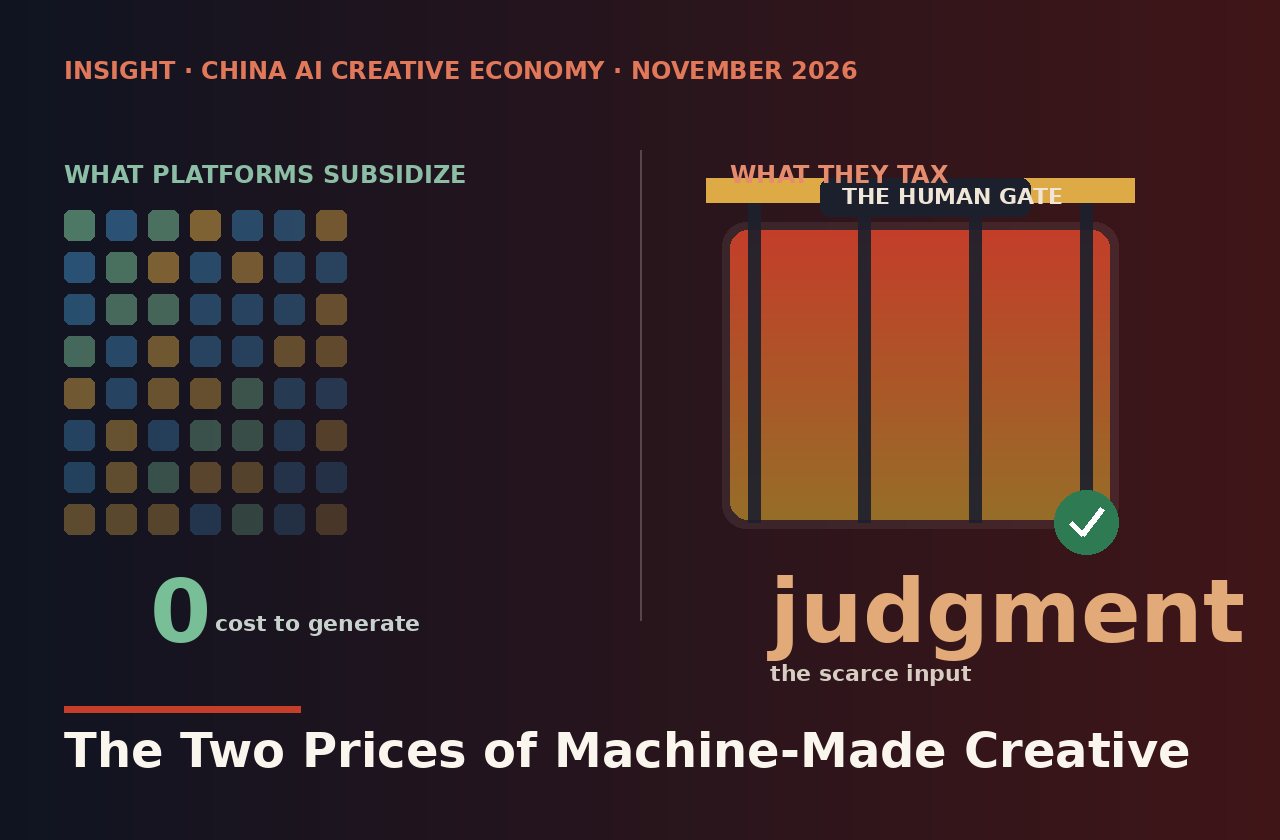
Free factory, harsh tollbooth. Why would the same company build both?
Because they’re not in the creative business. They’re in the attention business, and creative is an input cost to their real product: the auction. Every merchant who can afford to advertise is another bidder per impression. When a small seller couldn’t produce video ads, that seller’s budget never entered the auction at all. Free AIGC removes the last production barrier — it doesn’t subsidize your marketing, it recruits your bid.
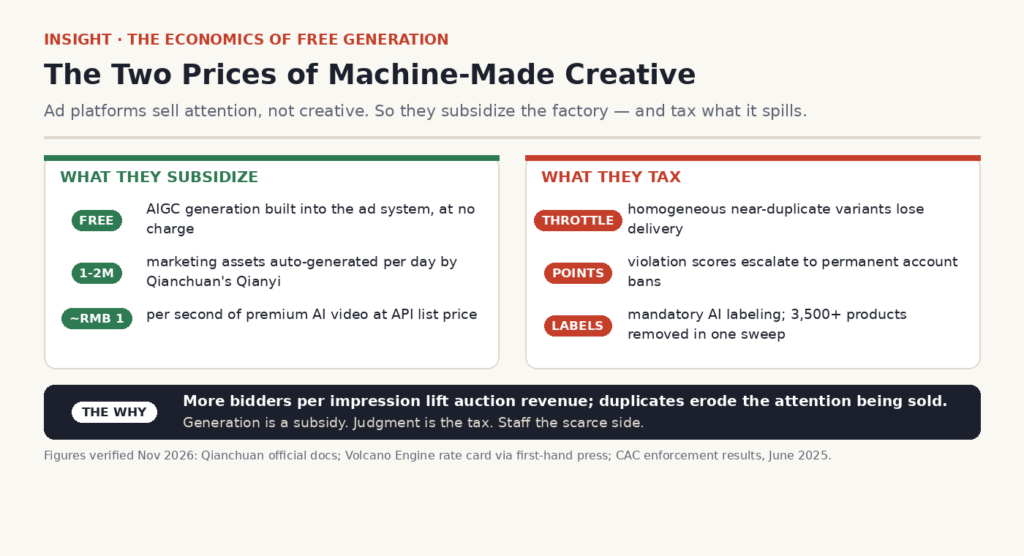
The penalties follow from the same ledger. What’s actually being sold in that auction is user attention — a depletable, trust-sensitive inventory. A feed flooded with identical, unlabeled, hallucinated-claim videos doesn’t just annoy users; it depreciates the asset every bidder is paying for. Duplicate creative is pollution of the commons the platform monetizes. So the enforcement pattern that looks contradictory — “use our AI tools, but we’ll ban you for sloppy AI output” — is perfectly coherent: they punish the externality, not the technology.
Here’s the part that should change your staffing sheet. When generation price collapses toward zero, the complementary inputs appreciate. Economic logic is blunt about this: cheapen one input and value flows to whatever remains scarce. In creative advertising, the scarce remainder is judgment — which claim is true, which promise is provable, which direction deserves another fifty variants, which human signs the release. The platform can generate your video. It cannot underwrite your claim, and it has deliberately structured its rules so that it never has to: liability stays with the advertiser.
So the two prices are really one price system. Generation: free, because your bid is the product. Verification: expensive, because their inventory depends on it. Teams that read only the first price build fountains of sameness and wonder why delivery collapses. Teams that read both hire reviewers before they hire prompt operators — and let the free factory run behind a gate someone’s name is on.