Apple Gives Alibaba’s Qwen a Front-Row Seat on iOS. Here’s What Marketers Need to Know
Apple Puts Alibaba’s Qwen on the iPhone. For Brands, the Real Battle Is Being Named by AI.
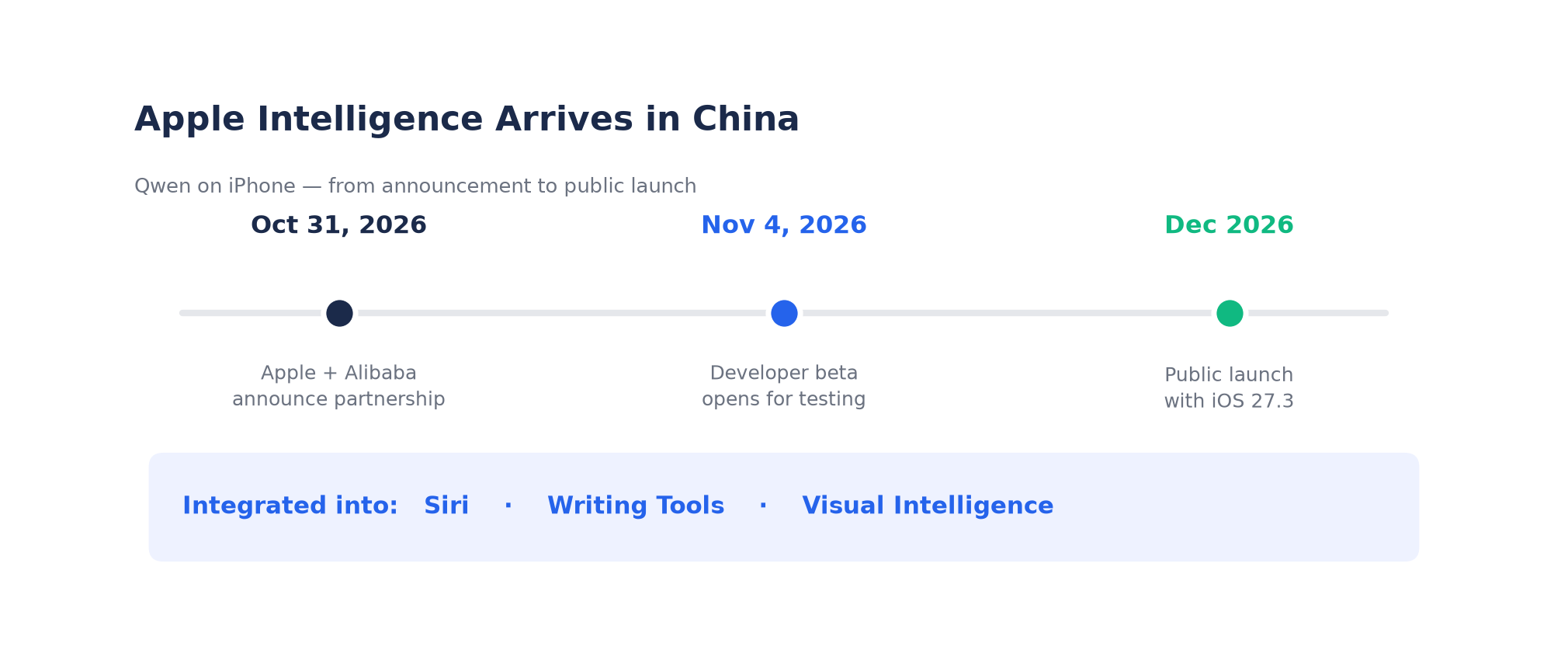
Shanghai, Nov. 1, 2026 — On October 31, Apple confirmed what the industry had speculated about for months: Alibaba’s Qwen large-language model will be built into Apple Intelligence for users in mainland China. Developer beta testing opens November 4, and the full public launch arrives in December with the iOS 27.3 update. For Apple, the deal is a practical path to delivering AI features in a market where foreign models face regulatory hurdles. For Alibaba, it turns Qwen from a cloud product into something embedded deep inside iOS — and turns the iPhone into a daily gateway for AI-driven discovery.
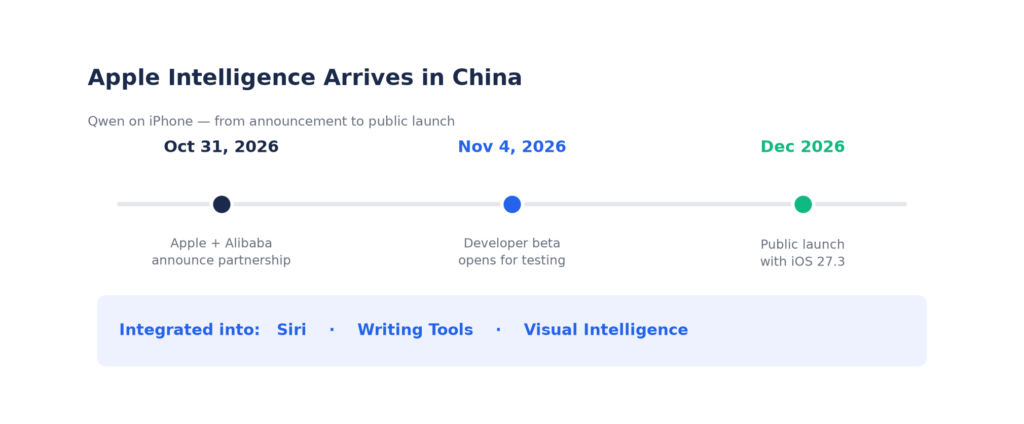
The partnership lets iPhone users in China invoke Qwen directly inside Siri, Writing Tools, and Visual Intelligence — three system-level touchpoints that command daily usage across hundreds of millions of devices. When Siri encounters a request it cannot handle on its own, it can draw on Qwen’s broader knowledge to answer. Users can ask questions about photos and documents including PDFs and presentations. A Compose feature, built into the system-wide Writing Tools, lets Qwen generate original content from scratch. The integration is opt-in: Apple asks for consent before any question, document, or image is sent to Qwen, and Alibaba has stated that user requests and generated replies will not be used to train its models.
The devices that will support the first wave of Apple Intelligence in China include iPhone 16 and later models, iPhone Duo, iPhone 15 Pro, iPhone 15 Pro Max, and iPhone Air, with Siri and device languages set to English and Simplified Chinese. Support for additional Apple platforms is expected to follow once necessary approvals are obtained.
What the deal actually signals
This is not Apple handing its AI stack to a Chinese company. The core Apple Intelligence features coming to China — Writing Tools, Genmoji, notification and email summaries, photo Clean Up, Live Translation, natural language photo search, and Priority Messages — are powered by Apple’s own generative models. Qwen is additive, a local-knowledge layer that extends the system’s reach rather than replacing it. The next-generation Siri AI Apple previewed at WWDC 2026 is not part of this release.
But the optics matter more than the architecture. When an iPhone user in Shanghai long-presses the side button and asks for a dinner recommendation, the brand that gets named is whichever one the model surfaces. That is the economics of the deal, and it is what marketers should be studying closely.
The move also sits within a broader regulatory context. In July 2026, Apple Intelligence appeared among the mobile generative AI services that completed filing procedures with China’s cyberspace administration. In September, an Apple device’s network access permit information was updated to include reference to Qwen-related registrations. The pieces were falling into place well before the October 31 announcement.
The click is disappearing — and the evidence is mounting
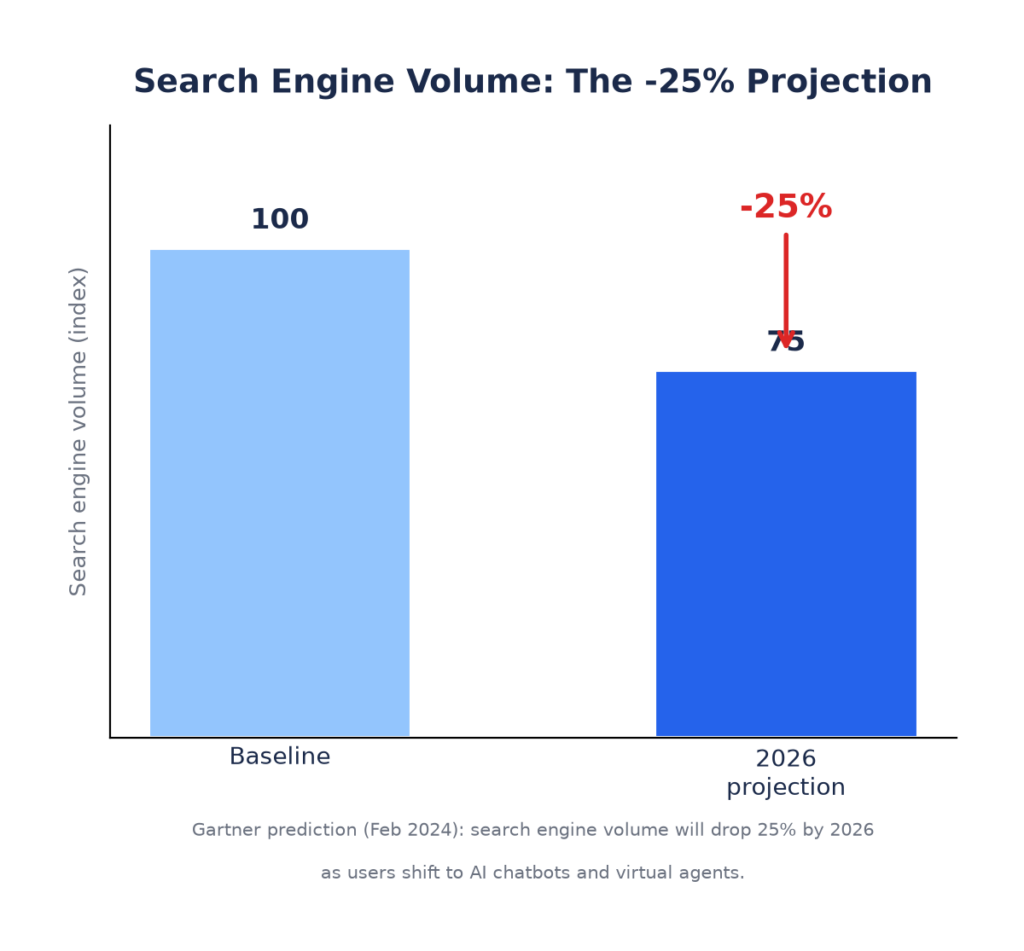
In February 2024, research and advisory firm Gartner published a prediction that has since earned the status of an established reference point: by 2026, traditional search engine volume would drop 25%, driven by users migrating to AI chatbots and virtual agents. Two years on, the data is beginning to catch up with the forecast.
A separate 2026 academic study published on arXiv and presented at the International Conference on Computational Social Science (IC2S2 2026) examined one month of web browsing data from a representative panel of 900 U.S. adults. Its headline finding was stark: when a Google search results page featured an AI Overview, clicks to sources cited inside that overview occurred in only about 1% of visits. The researchers also found that AI Overviews were associated with fewer clicks overall and higher rates of users ending their browsing sessions entirely — meaning users found their answer in the summary and moved on.
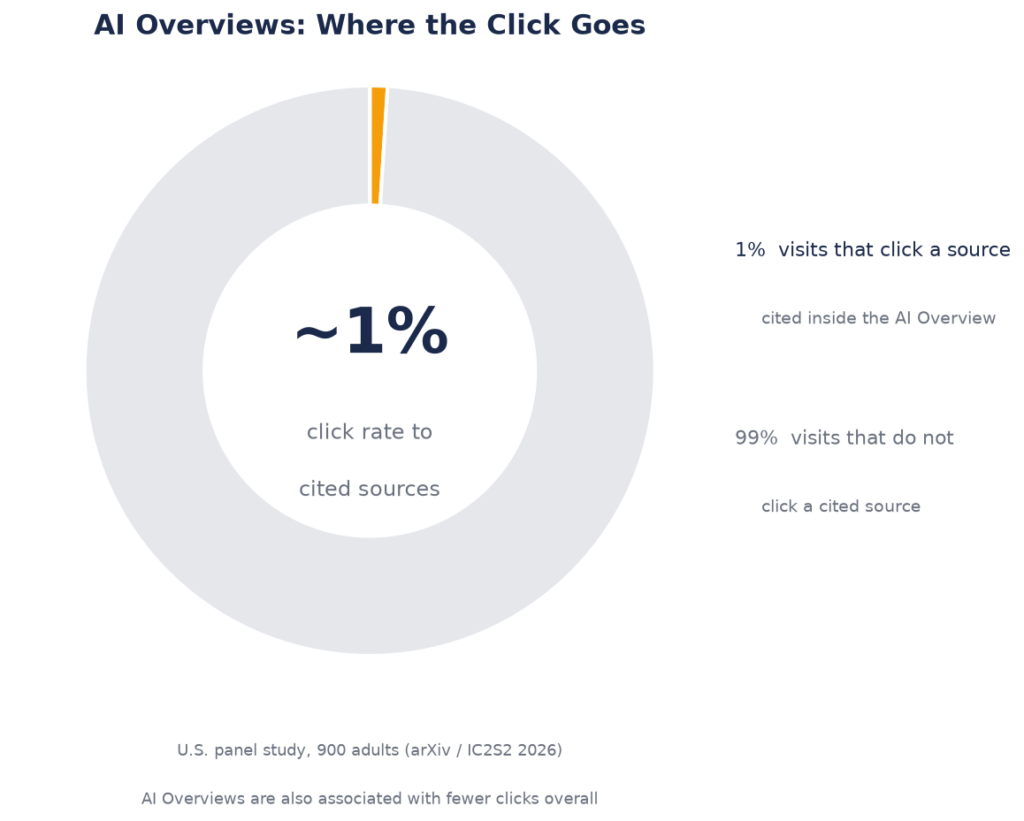
These are not marginal shifts. They describe a structural reordering in which the search results page is no longer the destination — the answer is. For brands, visibility is migrating from a ranked list that users scan to a synthesized reply that users treat as a finished product.
From ranking economy to citation economy
What makes the Qwen-on-iPhone deal worth watching is that it extends this reordering to the operating system. Desktop and mobile search is one channel; a deep OS-level integration — where the assistant is one long-press or voice command away — operates at a different order of magnitude.
China is a market of more than 1.1 billion internet users, as recorded in the most recent available report from the China Internet Network Information Center. It is also the market where WeChat, with a combined monthly active user base of roughly 1.4 billion, has trained an entire population to treat a single app as a portal to payments, commerce, messaging, and discovery. OS-level AI assistants are not a novelty in this environment; they are the natural next step in a user behavior pattern that is already well established.
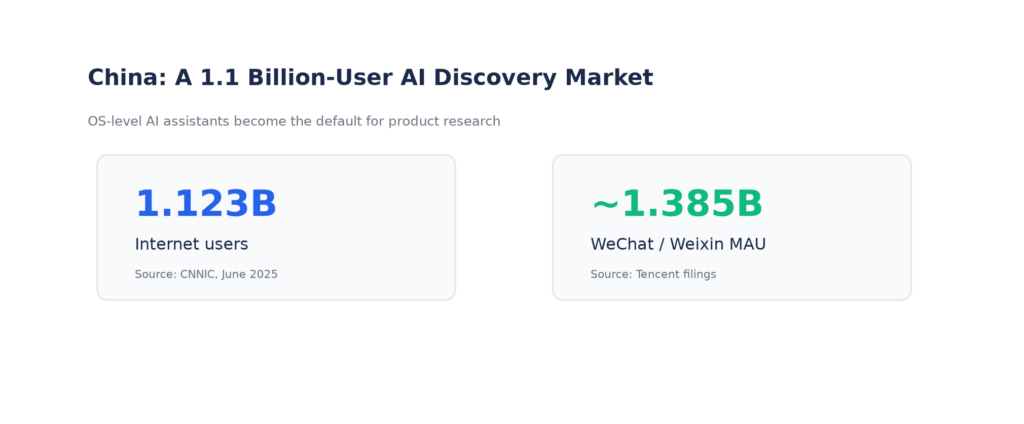
For global brands with China operations, the convergence is significant. When the default entry point for product discovery inside iOS becomes an AI assistant powered by a domestic large-language model, the question is no longer theoretical: does the answer it generates name your brand, or your competitor’s?
What brands should be doing now
The core playbook is shifting from “rank on page one” to “be the name the model says.” That is easy to write and difficult to operationalize, but the direction of travel is clear enough to act on.
First, brands need to know whether AI models are citing them today — and in what context. Citation tracking, the practice of monitoring whether and how a brand appears in AI-generated answers across Google AI Overviews, ChatGPT, Perplexity, and now OS-level assistants, is not yet standard operating procedure for most marketing teams. It needs to become one. You cannot optimize what you do not measure.
Second, the content that earns citations is not the same as the content that earns rankings. AI models favor material that is structured, declarative, and authoritative — the kind that makes for a clean, quotable sentence in a generated answer. This is a writing and formatting problem as much as a technical one. Content designed for the ranking economy is optimized for the crawler, the snippet, and the click. Content designed for the citation economy must be optimized for the model: clear claims, precise facts, and the kind of authority that makes an AI system treat a source as worth repeating.
Third, the China-specific opportunity is under-examined in Western marketing discourse. As Qwen ships inside iOS, Chinese brands — and global brands operating in China — will confront the same question Western marketers are only beginning to take seriously: when a shopper asks an assistant for a recommendation, does the answer name you? The brands that start treating that as a measurable KPI today will be the ones with a structural advantage when the transition reaches scale.
Bottom line
The Apple-Alibaba partnership is the clearest signal yet that AI-mediated discovery is arriving in the world’s largest smartphone market. The ranking economy — in which the business goal was to appear on page one of a search results list — is giving way to a citation economy, in which being the name a model repeats matters more than being the link a user clicks. For brands operating in China, the transition begins in earnest this December.