The Combinatorial Price Problem: Why AI Can’t Solve China’s Promotion Math
China’s biggest sale is the hardest stress test in retail. The failure is not that the model is unintelligent. It is that the problem was never designed to be solved.
The promise, from the companies best positioned to deliver it
Alibaba moved early and moved big. By October 2026, the company had readied Qwen Go, a consumer-facing assistant that trials a spread of service tasks — shopping refunds, service bookings, and sports-venue bookings — while leaning on Alibaba’s broader connections to shopping, transport, and delivery. A 36Kr report published as Double 11 opened traced the integration further back: as early as May 2026, the Qwen app was connected with Taobao, letting users move through product discovery, comparison, and ordering via natural language.
Read that again. The infrastructure is real. The intent is unmistakable. So why does the average shopper still end up doing the maths by hand?
In Chinese e-commerce, a price is not a number
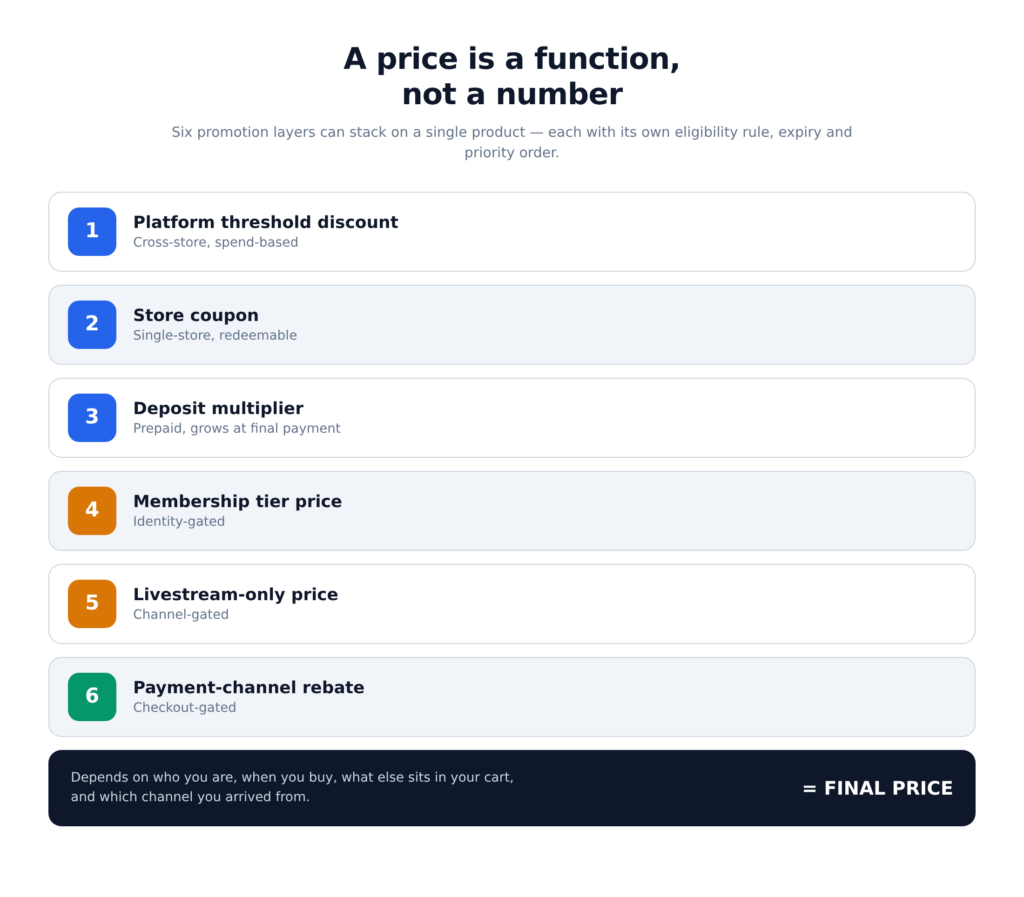
A price on a Chinese marketplace is a function, not a constant. It depends on who you are, when you buy, what else sits in your cart, and which channel you arrived from.
A single order can stack a platform-wide threshold discount, a store coupon, a deposit that multiplies at final payment, a membership tier price, a livestream-only price, and a payment-channel rebate. Each has its own eligibility rule, its own expiry, and its own priority order when two promotions collide.
None of those rules are secret. They are simply numerous, conditional, and revised constantly.
The four breaks
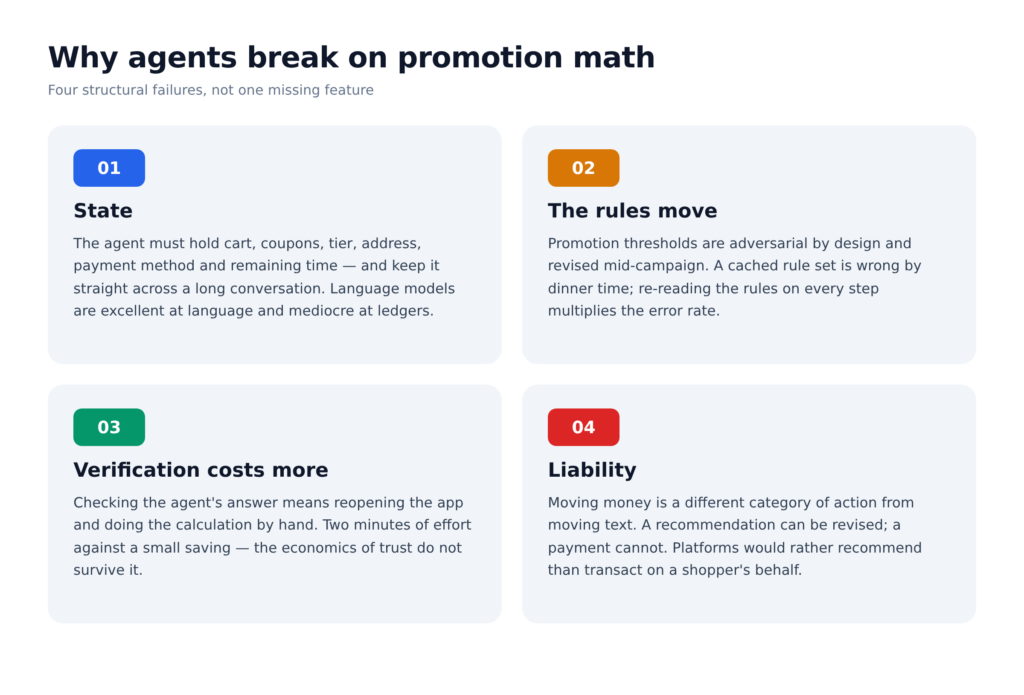
The first break: state. An agent has to hold an enormous amount of state to answer a simple question: cart contents, coupon inventory, membership tier, address, payment method, and time remaining in the sale window. Language models are excellent at language and mediocre at keeping a ledger straight across a long conversation. Ask one to compare three near-identical products with overlapping promotions, and you will usually get a confident, fluent, slightly wrong answer.
The second break: the rules move. Promotion logic is adversarial by design. Platforms write thresholds to steer behaviour, then adjust them mid-campaign. Any agent that caches a rule set is wrong by dinner time. Any agent that re-reads the rules on every step multiplies its own error rate.
The third break: verification costs more than the purchase. For a shopper, checking an agent’s answer means opening the app and doing the calculation manually. That takes two minutes. The saving on a mid-priced item might be a few dollars. The economics of trust do not survive that comparison — which is why so many AI shopping demos end with the user checking anyway.
The fourth break: liability. Money leaving an account is a different category of action from text appearing on a screen. A recommendation can be revised; a payment cannot. Platforms are far more comfortable recommending than transacting on someone’s behalf, which is why the most publicised agent features stay safely upstream of the checkout button.
What the benchmarks have been saying all along
The caution is not editorial. It is recorded in the benchmarks.
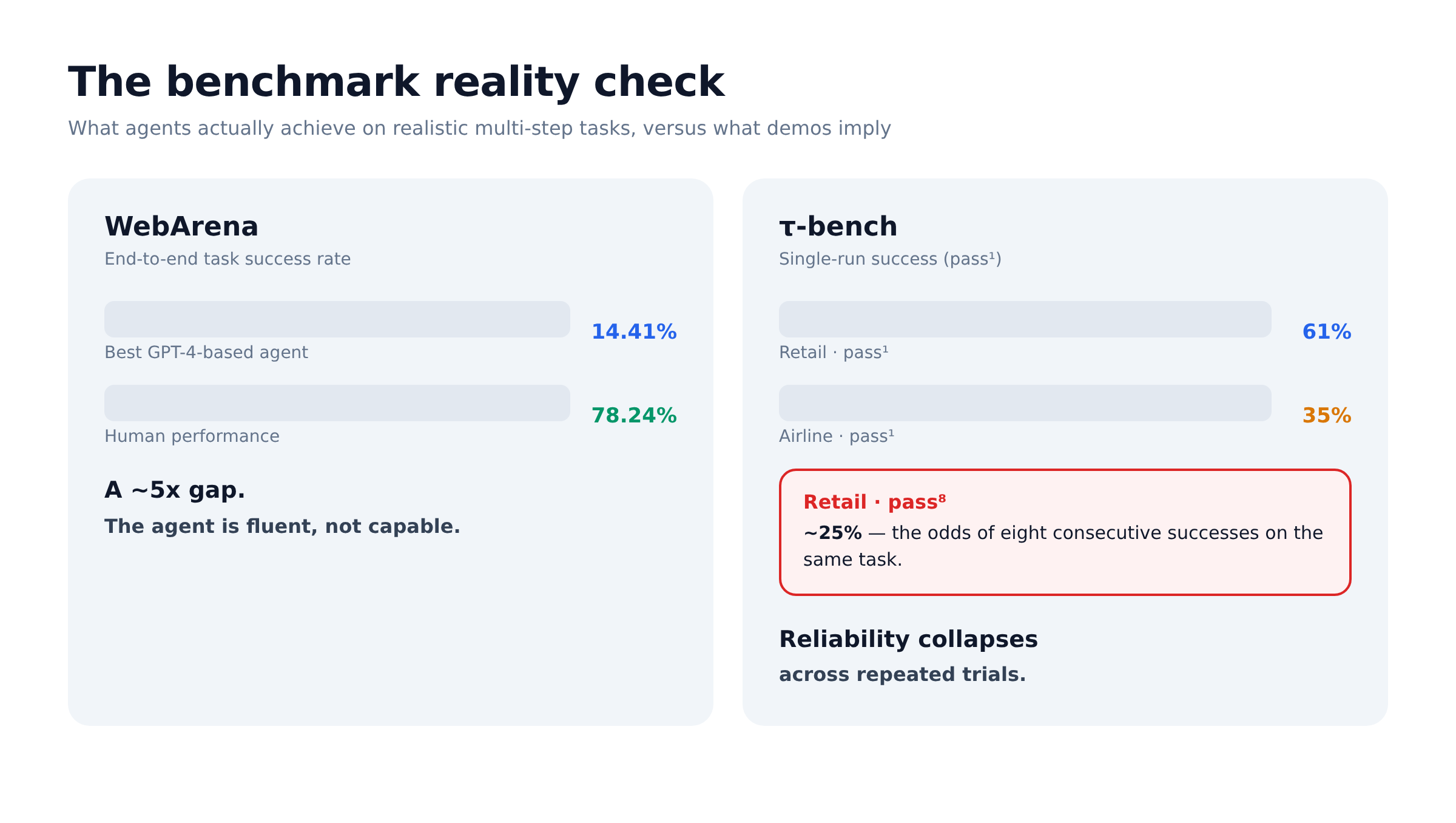
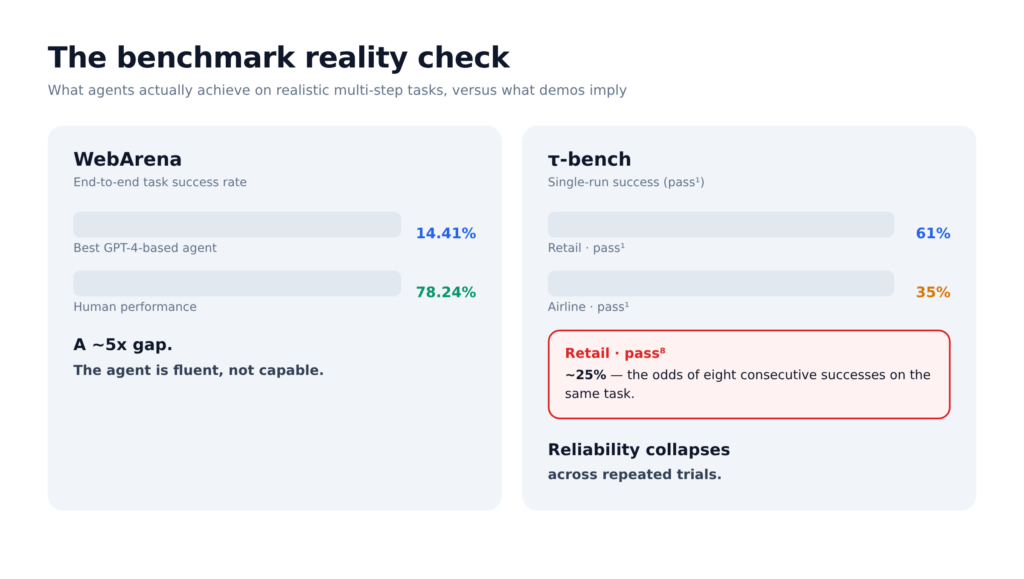
WebArena, a realistic environment for web agents, found the best GPT-4-based agent completing 14.41% of end-to-end tasks, against human performance of 78.24%. τ-bench, which tests agents against domain rules and a simulated user, exposes the reliability problem in sharper focus. GPT-4o’s function-calling agent reached a single-run success rate of roughly 61% in retail and 35% in airline tasks — strong on a first pass. But reliability collapses across repeats: in retail, demanding eight consecutive successes (pass⁸) drops the success rate to about 25%.
Combine that with The Illusion of Thinking, a 2025 paper by Shojaee et al. — whose authors include Apple researchers — accepted at NeurIPS 2025. Reasoning models gain an edge as problem complexity rises to a moderate level, then, at high complexity, accuracy can collapse for both reasoning and standard models. More tokens do not buy a way back. Promotion mathematics is combinatorial by construction, which places it on the wrong side of that cliff.
The merchant side is not celebrating either
In October 2026, as the Double 11 season opened, the pressure moved to the supply side. On 14 October, Alibaba launched an e-commerce version of its Qwen Work assistant for merchants, bundling a cross-platform operations dashboard, trend insights, marketing-material generation, and cross-platform ROI optimisation.
Merchants responded by weighing the cost of those tools against measurable results. In the same weeks, AI model tokens appeared on sale as Double 11 merchandise — vendors including Zhipu, MiniMax, Alibaba Cloud, and Qwen’s own office opened Tmall stores — and, by most accounts, the plans were barely discounted.
That last detail is the most honest signal in the whole campaign. AI is still being sold as a product. It has not yet become an input that quietly improves the outcome.
Where agents already work, and where they will not
| Task type | Structured data? | Price stable? | Agent viability |
|---|---|---|---|
| Flights, hotels, ride-hailing | Yes | Yes | High, in production |
| Reordering known staples | Yes | Mostly | High |
| Live-event ticketing | Partial | Volatile | Medium, fraud-prone |
| Cross-platform promotion stacking | No | No | Low |
| Negotiated B2B procurement | No | No | Low |
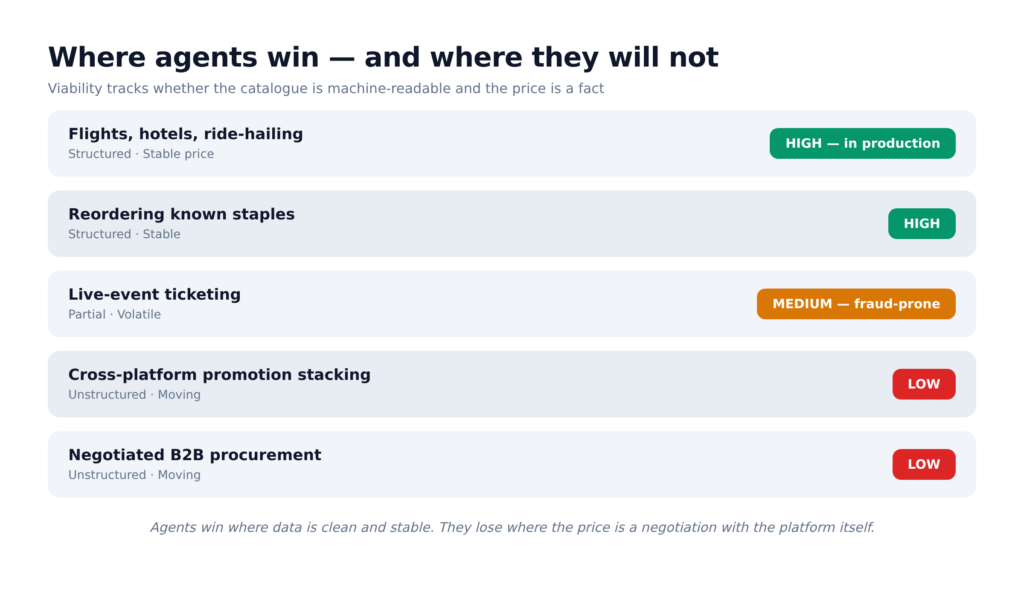
The pattern is consistent. Agents win where the catalogue is machine-readable and the price is a fact. They lose where the price is a negotiation with the platform itself.
The 95% problem sitting behind the 5% demo
Enterprise generative AI has been wrestling with the same gap. The GenAI Divide, a 2025 study from MIT’s NANDA initiative — popularised by MIT Sloan Management Review under the line “95% of generative AI pilots are failing” — found that, within its sample, roughly 95% of pilots had yet to produce measurable business returns.
The mechanism is familiar by now. A demo succeeds on ten curated examples. A deployment has to succeed on ten thousand messy ones, every day, with money attached.
AI shopping agents are currently very good demos.
What marketers should actually build
- Publish machine-readable truth. Price, stock, eligibility, exclusions, and shipping terms belong in structured data an agent can consume without guessing.
- Treat the agent as a channel, with its own attribution model — not as a feature bolted onto a human funnel.
- Offer a verifiable price guarantee. When the agent and the app disagree, the brand that is provably correct wins the trust.
- Measure agent-referred conversion separately from human conversion. They will not behave alike, and averaging them will hide both.
The strategic point most teams miss
Agentic commerce moves the interface from the app to the model. If a shopper asks an assistant what to buy and never opens your app, then the model’s default answer is your new shelf position. That is a distribution fight, not a user-experience upgrade.
Which means the marketing question of the next three years is not how to make a better shopping chatbot. It is who gets to be the default answer.