Ask three Chinese growth teams which analytics platform they use and you’ll hear three names: Sensors Data, GrowingIO, Umeng+. Ask them why they chose it, and the answers get murkier. Most selection advice still repeats a story from 2016 — one tool for engineers, one for marketers, one for developers who want something free. A decade later, that story is wrong in ways that cost real money.
Here’s what changed, what didn’t, and how to pick by the job you actually need done. China now has 1.125 billion internet users at 80.1% penetration, according to CNNIC’s 57th statistical report released in February 2026. Measuring that audience is not optional. Measuring it with the wrong tool — or with a tool nobody uses — is the expensive part.
The Myth That Refuses to Die
The stale version goes like this: “Sensors Data means code tracking and private deployment; GrowingIO means lightweight no-code SaaS; Umeng means free app counters.” Every clause was roughly true around 2016. None survives contact with the vendors’ current documentation.
Sensors Data supports full auto-tracking and visual tracking alongside code instrumentation — its SDK documentation lists all three modes. GrowingIO, the company that pioneered no-code autocapture in China, now sells commercial private deployment, a customer data platform, and marketing automation. The two commercial players have converged on hybrid collection and dual deployment. The real differences today are who the product is built for, what it’s deepest at, and what your team can actually operate.
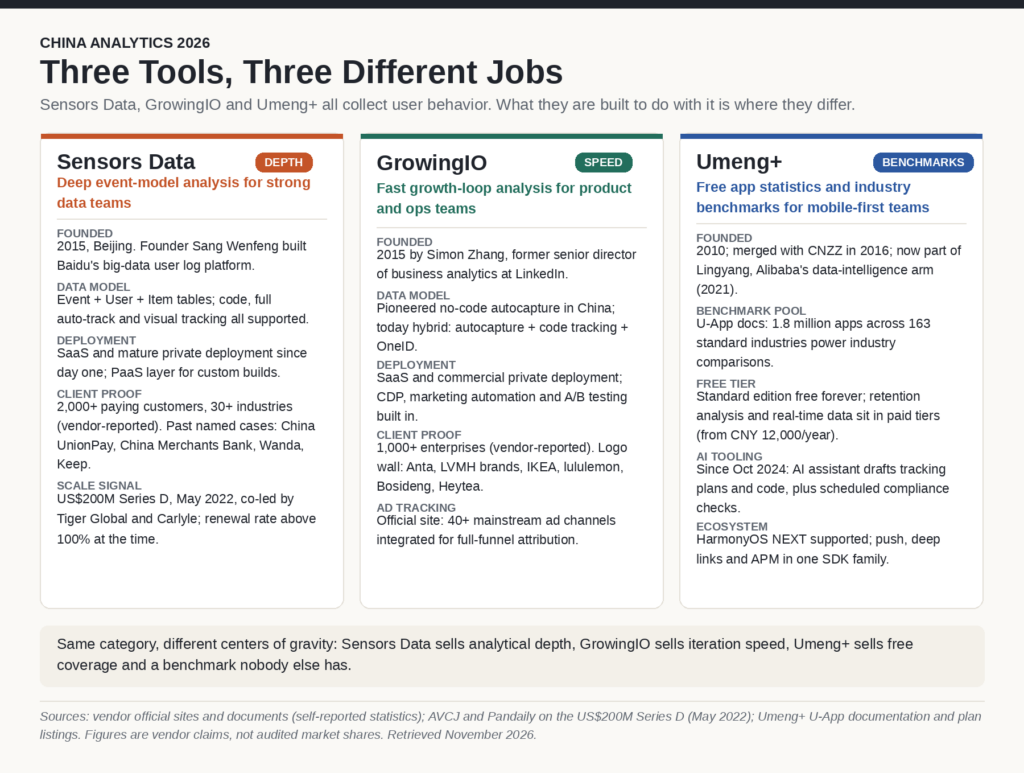
Sensors Data: Depth for Teams That Have Analysts
Founded in 2015 by Sang Wenfeng, who built Baidu’s big-data user log platform before leaving, Sensors Data was engineered around one conviction: behavioral data should live in a rigorous, queryable model that the enterprise owns. Its Event + User + Item table structure lets you attach business dimensions — order value, SKU, membership tier — at event time, including from server-side SDKs. Private deployment was a founding design choice, not a later add-on, which explains its grip on finance and other regulated sectors.
The scale signals are vendor-reported but consistent across sources: 2,000+ paying customers across 30+ industries, and a US$200 million Series D in May 2022 co-led by Tiger Global and Carlyle — confirmed by AVCJ and Pandaily at the time — with a renewal rate the founder described as “more than 100%.” Past official disclosures named China UnionPay, China Merchants Bank, Wanda and Keep as customers. The caveat: depth this deep needs a named analyst to operate it. More on that failure mode below.
GrowingIO: Speed for Teams That Ship Weekly
Simon Zhang, formerly senior director of business analytics at LinkedIn, founded GrowingIO in May 2015 and raised a US$2.2 million angel round that August, followed by a US$20 million Series A in June 2016 from Matrix Partners China, NEA and Greylock. The founding pitch was radical for its time: drop in a few lines of code, capture every click and page view automatically, and let business people define events by pointing at the screen — no engineering queue required.
Today that autocapture heritage sits inside a much bigger suite: hybrid collection with OneID identity resolution, a CDP, marketing automation, A/B testing, and ad tracking that its official site says connects 40+ mainstream ad channels. Deployment is SaaS or commercial private. The vendor claims 1,000+ enterprise customers; its logo wall shows Anta, LVMH brands, IKEA, lululemon, Bosideng and Heytea. The center of gravity is the growth loop: find the leak, segment the users, trigger the fix, measure again — without exporting a CSV between steps.
Umeng+: Free Coverage and a Benchmark Nobody Else Has
Umeng started in 2010, merged with CNZZ in 2016 to become Umeng+, and since 2021 sits inside Lingyang, Alibaba’s wholly-owned data-intelligence subsidiary. Its U-App product is the default first SDK for a huge share of Chinese apps — and its documentation describes the asset that no rival can copy: a benchmark pool of 1.8 million apps across 163 standard industries. When U-App tells you your day-7 retention is below your industry’s median, that comparison draws on a data network two orders of magnitude larger than any single company’s own users.
The free tier is real but bounded — details in the cost section. Since October 2024, an official AI assistant drafts tracking plans as spreadsheets, generates tracking code for Android, iOS and HarmonyOS, and runs scheduled compliance checks on custom events. It’s the pragmatic choice for mobile-first teams that need answers this week, not a data warehouse this quarter.
The Decision Matrix: Pick by the Job, Not the Feature List
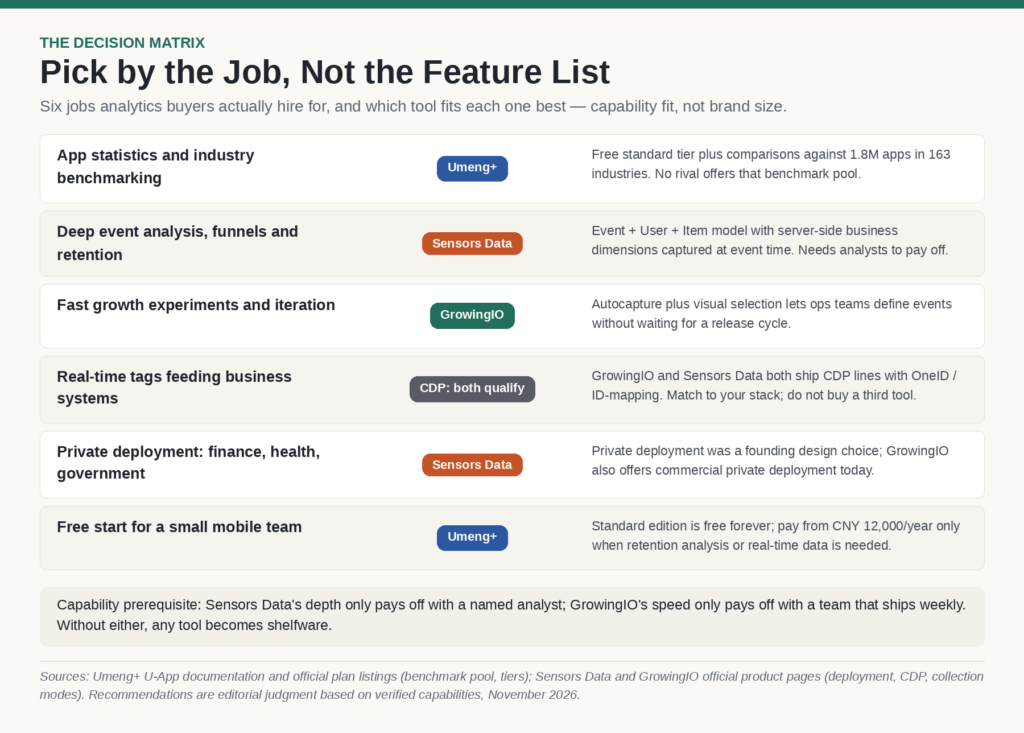
Feature-list comparisons fail because all three vendors tick most of the same boxes. Job-based comparison works because each product’s architecture optimizes for a different buyer. Here are the six jobs analytics buyers actually hire for:
| The job | Best fit | Why |
|---|---|---|
| App statistics + industry benchmarking | Umeng+ | Free tier plus the 1.8M-app, 163-industry benchmark pool |
| Deep event analysis, funnels, retention | Sensors Data | Event + User + Item model, server-side business dimensions |
| Fast growth experiments and iteration | GrowingIO | Autocapture + visual event definition, no release-cycle waits |
| Real-time tags feeding business systems | Either CDP line | GrowingIO OneID and Sensors Data ID-mapping both qualify |
| Private deployment (finance, health, gov) | Sensors Data | Founding design choice; deepest regulated-industry track record |
| Free start for a small mobile team | Umeng+ | Standard edition free forever; paid tiers only when needed |
Notice what’s absent: a single overall winner. That’s deliberate. The question “which is best?” has no answer; “which is best for this job, with this team?” has a clear one.
The Capability Prerequisite Nobody Puts in the Contract
Sensors Data’s depth only pays off if someone owns the analysis — a named analyst who defines metrics, guards event quality, and turns queries into decisions. GrowingIO’s speed only pays off if the team actually iterates weekly; autocapture in a company that ships quarterly is a warehouse of unread clicks. Selection literature from 2026 keeps surfacing the same failure pattern: the tool got installed, the dashboards got built once, and nobody looked again. Match the tool to the operating rhythm you have, not the one you wish you had.
Collection Architecture: The Truth About Tracking
Autocapture, Code Tracking, Hybrid
Autocapture records what the interface can see: page views, element clicks, form submissions. It’s fast to deploy and retroactive — you can define an event today and analyze behavior from last month. Its blind spot is business truth: a click on “Pay now” is not a successful payment, and autocapture can’t tell you the order amount unless the front end happens to expose it.
Code tracking records what the business confirms: order created, payment succeeded, with SKU, amount and channel attached. It costs engineering time up front and can’t see backward — events you didn’t instrument are gone forever. Hybrid, which both commercial vendors now recommend in their own documentation, uses autocapture for breadth and code tracking for the events that money depends on. Anyone still selling you “autocapture versus code tracking” as an either/or is describing the last decade.
The Backend Advantage
The quiet differentiator is server-side collection. When payment success is reported from your backend with full business dimensions at event time, your funnel survives front-end refactors, ad blockers and multi-device journeys. Sensors Data built its reputation here; GrowingIO’s server SDKs and OneID close much of the gap. Umeng+’s custom events can carry business attributes too, but its center of gravity remains client-side app statistics. If your revenue events must reconcile with your finance system to the decimal, weight server-side maturity heavily.
The CDP Boundary: When Analytics Isn’t Enough
Analytics answers questions. A CDP feeds answers into other systems — real-time tags and audiences flowing into your CRM, push platform, or ad accounts. You need one when identity rules, customer tags and audience exports are scattered across systems and repeatedly break collaboration. You don’t need one when your data is already unified and you just want better funnels.
Both GrowingIO and Sensors Data sell CDP lines, and GrowingIO’s own selection guidance from November 2026 makes a refreshingly honest point: write your requirements as testable tasks with owners and acceptance criteria, not feature checklists — and don’t buy a CDP for a problem your existing analytics or CRM process should solve. One market fact keeps the hype in check: IDC’s China CDP tracker for the second half of 2025, reported by multiple financial outlets in June 2026, puts Tencent’s Qidian marketing cloud first at 21.5% share. The CDP market leader is none of the three vendors in this comparison. Buy the CDP that fits your stack, not the logo on the analytics dashboard.
Compliance and Deployment Under PIPL
What the Law Actually Requires
China’s Personal Information Protection Law, effective November 2021, treats your analytics vendor as an entrusted processor: you need processing agreements, purpose limitation, and consent-gated collection. Cross-border transfer is the sharp edge — Article 39 requires separate consent for sending personal information abroad, and the CAC’s March 2024 provisions set the thresholds: transferring non-sensitive personal information of more than one million individuals, or sensitive personal information of more than 10,000 individuals, cumulatively since January 1 of the current year, triggers a mandatory security assessment. Below those lines, standard contractual clauses filed with the regulator or certification are the usual mechanisms.
For a global brand, this is why “we’ll just pipe China events into our global stack” is a legal project, not an integration task.
When Private Deployment Earns Its Premium
Private deployment keeps data inside your perimeter and simplifies the cross-border question to “it doesn’t.” Finance, healthcare and government buyers often require it outright. Sensors Data has offered it since 2015; GrowingIO offers commercial private deployment today. Umeng+ is a cloud service — appropriate when standard consumer-app data with proper consent fits your risk profile, wrong when your regulator says data cannot leave your machines.
Cost and TCO: The License Is the Small Number
The Free Tier’s Fine Print
Umeng+ U-App’s Standard edition is permanently free — official documentation and plan listings confirm it covers basic statistics with two years of log retention, but excludes retention analysis and real-time data, with tight daily quotas on funnel queries. The Professional tier starts at CNY 12,000 per year for apps under 50,000 daily active users, scaling by DAU band. That’s honest, published pricing — rare in this category.
Sensors Data and GrowingIO are quote-based. Budget three lines, not one: license, implementation (event design, SDK integration, data validation), and the analyst or ops headcount who will operate the thing. In most failed deployments, the third line was never budgeted — and it dwarfs the first.
Preventing the Installed-but-Unused Failure
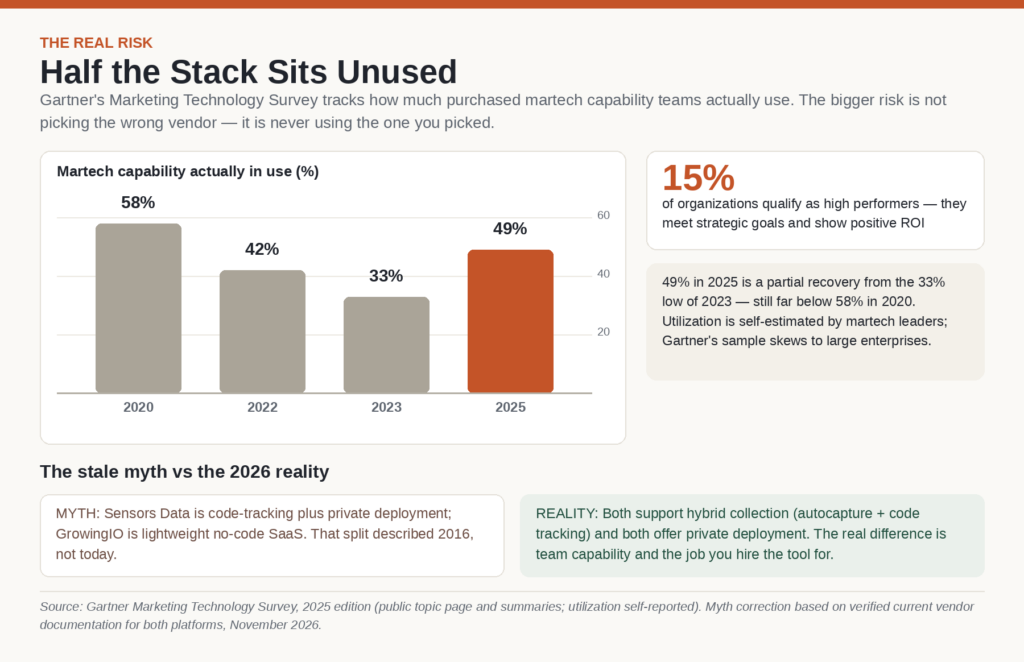
The utilization data should humble every buyer. Gartner’s 2025 Marketing Technology Survey found teams using just 49% of purchased martech capability — a partial recovery from 33% in 2023, still below 58% in 2020 — and only 15% of organizations qualifying as high performers that meet strategic goals and show positive ROI. Two caveats travel with those numbers: utilization is self-estimated by martech leaders, and Gartner’s sample skews to large enterprises. The direction is unambiguous.
Three prevention rules before you sign anything. First, name the owner — one analyst or ops lead whose job description includes this tool. Second, define your metrics before your events: what counts as activation, a qualified conversion, a retained user. Third, pilot one funnel end-to-end on real traffic before an enterprise contract; a vendor confident in fit will accept a proof-of-concept scoped to a single journey. If a demo can’t survive your ugliest real funnel, no license discount will save the rollout.
What About GA4 in China?
Keep GA4 for the rest of the world; don’t make it your China plan. GreatFire’s reachability tests, cited in independent guides published in October and November 2026, found the classic google-analytics.com collection host intermittent, the regional GA4 endpoint blocked, and the Tag Manager loader generally reachable — meaning your tag loads while your China hits quietly vanish. The Analytics dashboard itself has been blocked since 2014, so your mainland colleagues can’t read the reports anyway. These verdicts change over time and deserve re-testing, but the structural point stands: a report that shows almost no China traffic usually reflects collection failure, not absent demand. Run a China-reachable collector — any of the three tools here qualifies — and treat GA4’s China numbers as a known blind spot, documented as such.
Honest Boundaries
Every customer count in this article is vendor self-reported; none is audited. Named client references come from official disclosures, some dating to 2018–2020, and may not reflect current contracts. Pricing for the two commercial platforms is opaque by design — the only published tiers cited here are Umeng+’s. And no IDC or Gartner public report ranks market share for the behavioral-analytics sub-market these three compete in; the IDC CDP tracker is the nearest audited-adjacent reference, and it measures a different category. Treat this as a capability map verified against primary sources, not a league table.
The Verdict
Choose Sensors Data when you have analysts, revenue events that must reconcile, and regulators who ask where data lives. Choose GrowingIO when product and ops teams drive growth, iteration is weekly, and you want the loop from insight to action inside one platform. Choose Umeng+ when you’re mobile-first, need industry benchmarks more than bespoke models, and want to start free before committing a budget. And whichever you choose, budget the operator before the license — the graveyard of Chinese martech is full of excellent tools that nobody was hired to use.