Here is a scene you have probably lived through. A listening vendor walks your team through a gorgeous dashboard — sentiment curves, word clouds, a crisis alert blinking politely in the corner. Someone asks the only question that matters: “Does this see Xiaohongshu?” The account manager smiles and says the system covers the “full network.” Six weeks after signing, you discover your brand’s liveliest conversation — the comment section under a RedNote review — never appears in the tool at all.
Nobody lied, exactly. But nobody told you the truth either: in China, what a listening tool can see is decided by platform API policy, not by vendor ambition. The dashboard is the easy part. The data pipe is the hard part, and it runs through territory the platforms control.
This guide maps that territory. You will get the platform-coverage truth table, a tool-by-tool positioning map, the new AI-era listening job most suites still ignore, and a build-versus-buy rule you can apply this week. Every coverage claim below is either verified against official developer documentation and court records, or explicitly labeled as a vendor claim. Where we could not verify something, we left it out.
Why Coverage Is an Access Problem, Not a Software Problem
Think of Chinese social platforms as a row of buildings. News sites and forums have open doors. Weibo has a front desk that hands out visitor passes — and a separate commercial entrance for paying partners. WeChat keeps the doors locked and checks invitations. Xiaohongshu employs, by developer consensus, the most aggressive security guards of the lot.
A listening vendor is a courier. However clever its routing software, it cannot deliver mail from a building it cannot enter. So when two vendors show you similar dashboards, the real difference is which doors they hold keys to — licensed feeds, sampled crawling, or model-based estimates dressed up as data. That is the question to ask in every demo, and we will give you the exact wording at the end.
The Platform-Coverage Truth Table
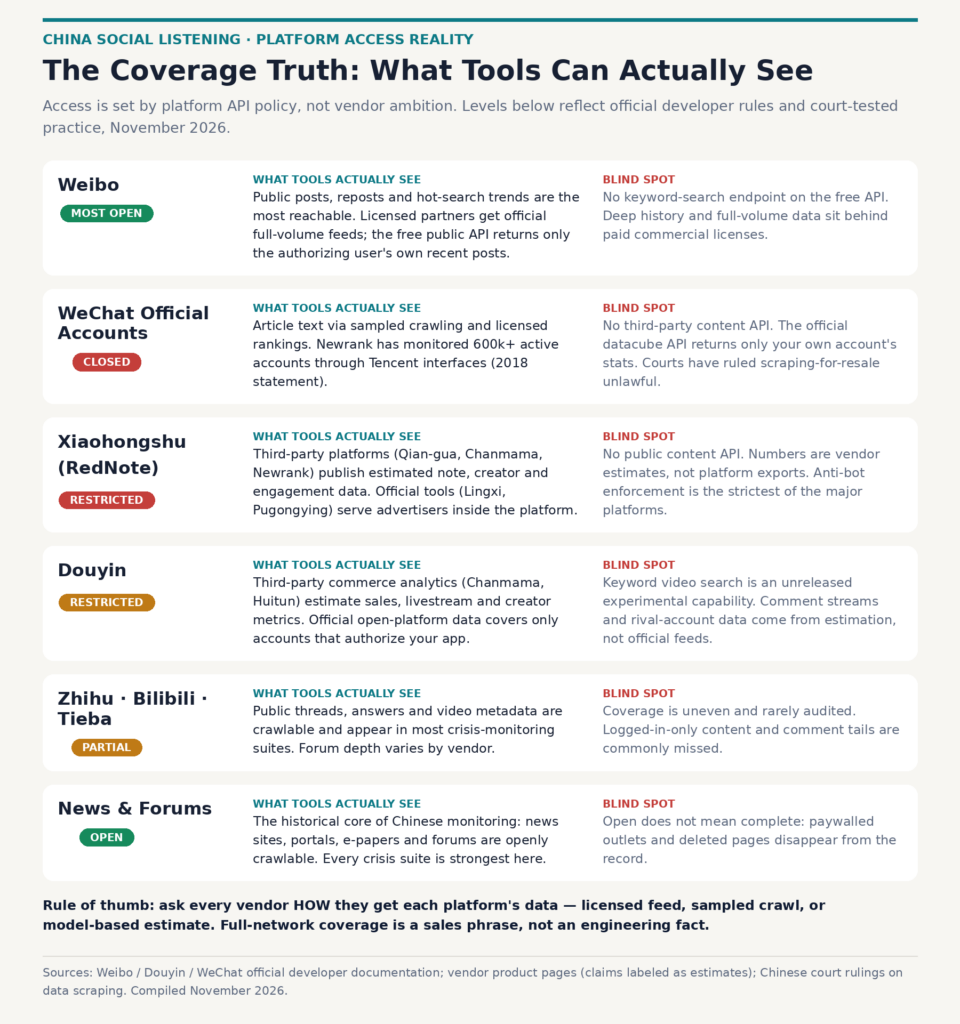
The map below reflects official developer rules and court-tested practice as of November 2026. Treat the access levels as structural, not seasonal: platforms tighten far more often than they loosen.
Weibo: The Most Open Door Has a Toll Booth
Weibo remains the most listenable major platform — 551 million monthly active users as of September 2026, per its third-quarter earnings, and still the place where brand crises trend first. But “open” needs an asterisk. Weibo’s free public API, per its own developer documentation, returns only the authorizing user’s own recent posts; there is no keyword-search or hot-search endpoint on the free tier. Real listening depth comes through commercial data licenses arranged with Weibo’s business team.
This is why Midu — the Shanghai company behind Sina Yuqingtong and the WRD (Weiredian) platform — occupies a special seat. Sina Weibo invested in it back in 2014-15 and granted official data access; the vendor claims licensed full-volume Weibo data. That claim is the vendor’s own, but the investment relationship and official-data basis are documented on its corporate pages. If Weibo is your crisis frontline, licensed depth is worth paying for.
WeChat: The Walled Garden Everyone Pretends to Monitor
WeChat Official Accounts have no third-party content API. Full stop. The official datacube interfaces return statistics only for accounts that authorize your application — your own account, not your competitor’s. Everything else in the market is sampled crawling, licensed arrangements, or estimation.
Newrank, the veteran content-data house, said in a 2018 public statement that it monitored more than 600,000 active accounts through Tencent interfaces — a historical figure, but it shows what a licensed relationship looks like. The courts have also drawn the boundary in ink: in 2021 the Hangzhou Internet Court ordered a company that scraped Official Account data to run a search-and-ranking site to pay Tencent RMB 600,000 for unfair competition. If a vendor’s WeChat story sounds too complete, ask which courtroom it would survive.
Xiaohongshu and Douyin: An Economy of Estimates
Xiaohongshu — roughly 300 million monthly users by the company’s own count, reported by Bloomberg in September 2025 and never independently audited — offers no public content API at all. Third-party platforms like Qian-gua publish estimated note, creator and engagement metrics; the platform’s own tools, Lingxi for insight and Pugongying for creator partnerships, serve advertisers inside the walled garden. Douyin is similar: its open-platform data covers only accounts that authorize your app, and keyword video search sits in the documentation as an experimental capability that is not publicly released.
None of this makes third-party data useless. Chanmama and Huitun run serious commerce-analytics operations on estimated Douyin metrics, and brands make good decisions with them daily. But an estimate is a photograph of a building through frosted glass: useful for shape, unreliable for counting windows. Validate against your own campaign data before you bet budget on it.
Family A: Crisis and Reputation Suites
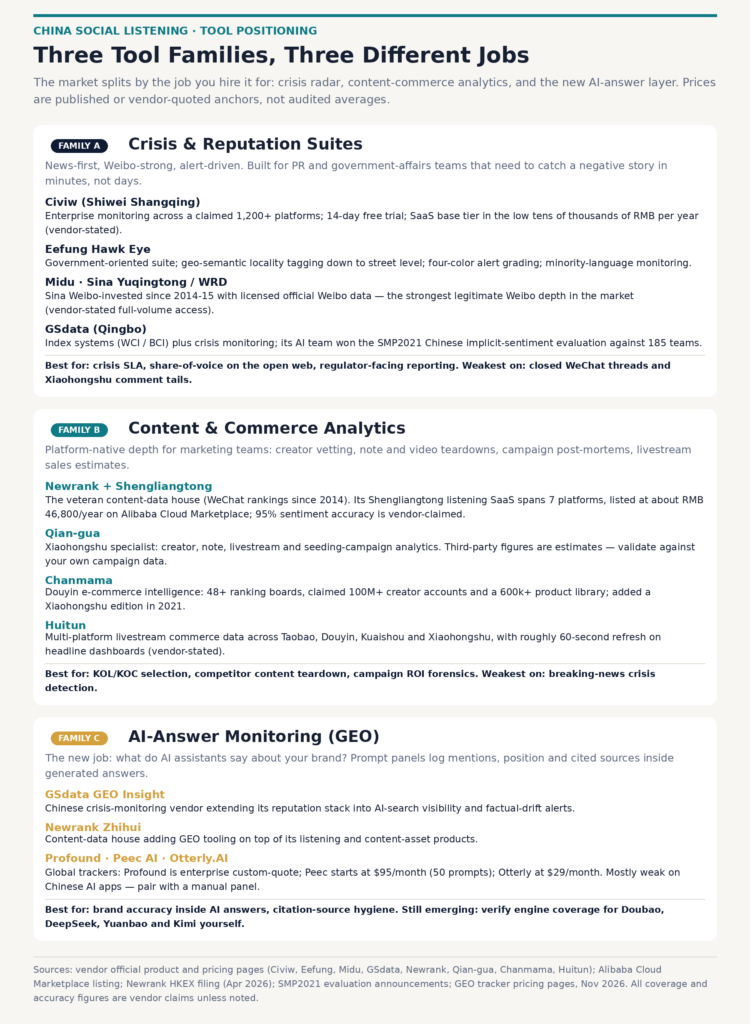
The market’s oldest family sells speed: catch the negative story in minutes, archive the evidence, brief the boss before the boss forwards you a screenshot. Four names anchor it.
Civiw (Shiwei Shangqing), from Hunan, claims coverage of 1,200-plus platforms and offers a 14-day full-feature trial, with a base SaaS tier priced in the low tens of thousands of RMB per year — vendor-stated figures, but the trial lets you test them. Eefung’s Hawk Eye suite leans government: geo-semantic tagging down to street level, four-color alert grading, minority-language monitoring. Midu’s Sina Yuqingtong brings the licensed Weibo depth described above. And GSdata (Qingbo), the house behind the WCI and BCI influence indexes, pairs crisis monitoring with genuine NLP credentials — its AI team won the SMP2021 Chinese implicit-sentiment evaluation against 185 competing teams.
Notice what this family is best at: news, Weibo, forums — the open web. Notice what it is weakest at: closed WeChat threads and Xiaohongshu comment tails. A crisis suite is a smoke detector for the streets, not a listening device inside private homes.
Family B: Content and Commerce Analytics
The second family sells depth on one platform instead of breadth across all of them. Newrank straddles both worlds: its rankings defined WeChat influence measurement, and its Shengliangtong listening SaaS now spans seven platforms — Douyin, Xiaohongshu, Weibo, Official Accounts, Channels, Kuaishou and Bilibili — listed at about RMB 46,800 per year on Alibaba Cloud Marketplace. Its claimed 95 percent sentiment accuracy is a vendor number; treat it as a hypothesis to test in your trial.
Qian-gua is the Xiaohongshu specialist: creator vetting, note teardowns, seeding-campaign post-mortems. Chanmama owns Douyin e-commerce intelligence, with 48-plus ranking boards and vendor-claimed coverage of over 100 million creator accounts and a 600,000-product library; it added a Xiaohongshu edition in 2021. Huitun spreads across Taobao, Douyin, Kuaishou and Xiaohongshu livestream commerce, claiming roughly 60-second dashboard refresh.
Here is a detail worth pausing on. Newrank’s April 2026 HKEX filing shows 94.2 percent of its 2025 revenue (RMB 1.95 billion in total) came from content-marketing services at a 9.6 percent gross margin, while the high-margin software business — the listening tools — was just 5.8 percent of revenue at 73.4 percent margin. The filing also discloses a pending unfair-competition and data-use lawsuit from a social-platform supplier seeking RMB 10 million, fully provisioned. Translation: even the best-known data house operates close to the legal edge, and the tool you buy may be a side business to its vendor. Ask who maintains the data pipe when the incentives point elsewhere.
The AI-Era Layer: Listening to Answers, Not Just Posts
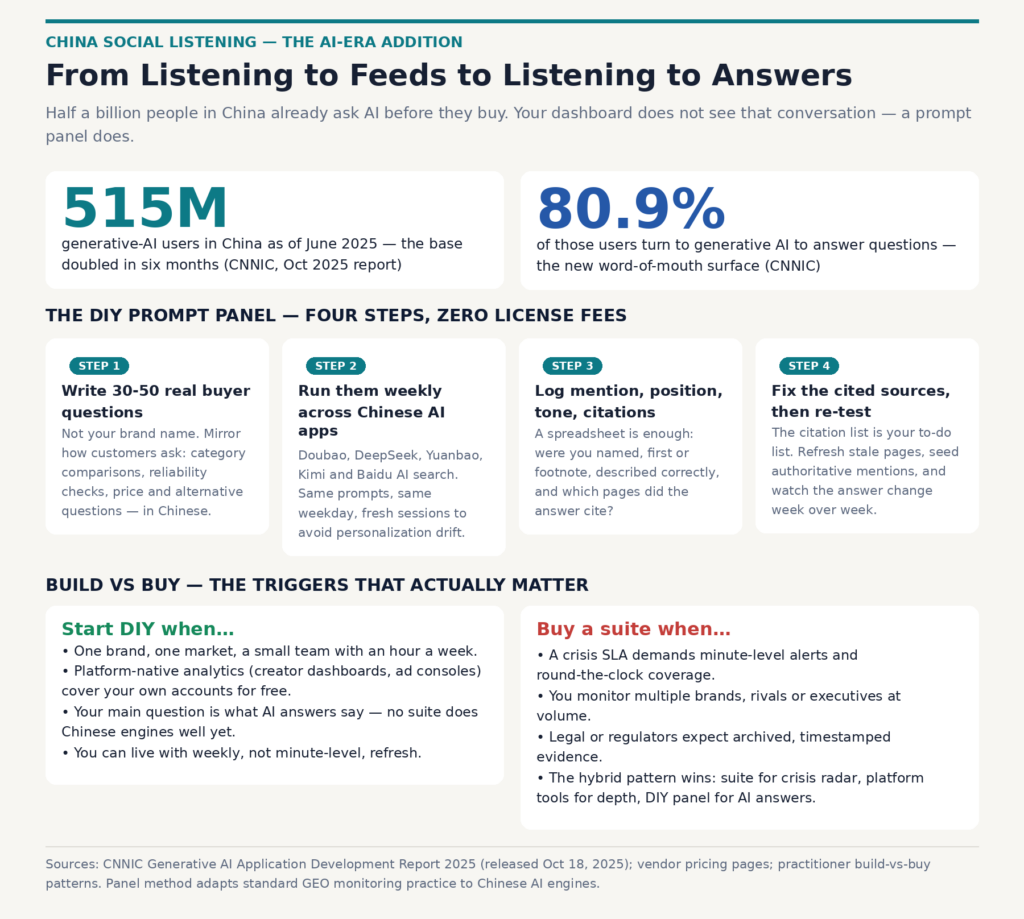
Now the plot twist. CNNIC’s October 2025 report counted 515 million generative-AI users in China as of June 2025 — a base that doubled in six months — and 80.9 percent of them use it to answer questions. When a shopper asks Doubao or DeepSeek “which air purifier brand is reliable,” the answer shapes a purchase, and your listening dashboard sees none of it.
This is the GEO monitoring job: run a fixed panel of buyer questions through AI engines on a schedule, and log whether your brand is mentioned, where it ranks, how it is described, and which sources the answer cites. Global trackers exist — Profound sells enterprise custom quotes, Peec AI starts at $95 a month for 50 prompts, Otterly.AI at $29 — but their engine coverage skews Western. Domestically, GSdata has extended its reputation stack into a GEO insight system, and Newrank offers GEO tooling under its Zhihui line. Both are early; verify coverage of Doubao, DeepSeek, Yuanbao and Kimi yourself before paying.
Sentiment Analysis: Where Chinese NLP Still Sweats
Even perfect coverage would not give you perfect sentiment. The organizers of the SMP2021 implicit-sentiment evaluation estimated that 15-20 percent of emotional sentences in their annotated corpus carry no explicit sentiment word at all — sarcasm, rhetorical questions, factual statements that drip with judgment. Chinese internet speech is a sarcasm factory: the comment “amazing, crashed again” reads positive to a keyword model and furious to any human.
Vendors now claim 95-percent-plus accuracy with large language models. Some of that progress is real; none of it is independently audited on your brand’s vocabulary. The practical rule: let the machine sort the haystack, but have a human read every negative that triggers action, and spot-check the positives after any campaign — ironic praise inflates exactly the metric your report celebrates.
The Compliance Line: PIPL and the Court Record
Listening at scale brushes against real law. China’s Personal Information Protection Law allows processing of lawfully disclosed personal information only “within a reasonable scope” (Article 27, with Article 13’s lawful-basis framework), and serious violations carry fines up to RMB 50 million or 5 percent of prior-year turnover. The court record is not theoretical: the Hangzhou WeChat-scraping case in 2021, and the iDataAPI case decided by the Guangdong High Court in January 2024 — RMB 20 million in damages after a vendor made 2.179 billion unauthorized API calls to Weibo servers and resold the data.
For a buyer, the takeaway is due diligence, not paranoia. Ask vendors for their data-processing agreement, their lawful basis per platform, and where data is stored. A listening contract should never quietly import a scraping lawsuit into your supply chain — as Newrank’s own provisioning shows, platform risk is real even at the top of the market. Prefer vendors with licensed relationships, and keep your own use aggregated and de-identified.
Build vs Buy: The Triggers That Actually Matter
Small teams overbuy listening the way people overbuy gym memberships. If you run one brand in one market, platform-native analytics cover your own accounts for free, and a spreadsheet prompt panel covers the AI layer for an hour a week. Buy a suite when a trigger fires: a crisis SLA that demands minute-level alerts, multi-brand or executive monitoring at volume, or a legal requirement for archived, timestamped evidence. The mature pattern is hybrid — a suite for crisis radar, platform-specialist tools for content depth, a DIY panel for AI answers. Each layer does the job it is actually good at.
Measuring the Listening Itself
A listening stack needs its own report card, or it becomes the dashboard nobody reads. Track four numbers: alert precision (what share of alerts deserved action), time-to-detect on seeded test incidents, insight-to-action rate (how many flagged themes changed a decision), and coverage recall from your trial keywords. Run a quiet fire drill twice a year: publish a controlled mention on each key platform and time how long each tool takes to surface it. Tools that cannot find your test post will not find your crisis.
The Honest Boundaries
Three confessions before the decision table. First, no public, audited coverage statistics exist for this market — every percentage a vendor quotes is self-reported, including the ones we labeled above. Second, access rules change without notice; this map is a November 2026 snapshot, and a platform policy update can redraw it overnight. Third, the only coverage test that counts is your own: run your real brand keywords, on your real platforms, during a full-feature trial, and count what comes back. Civiw’s 14 days or a competitor’s equivalent costs nothing but attention — cheap insurance against a year of blind spots.
The Decision Table
| Your primary job | First choice | Add-on | Caveat to verify in trial |
|---|---|---|---|
| Crisis early warning | Midu / Civiw / Eefung / GSdata | Manual WeChat watchlist | Recall on your keywords, alert latency |
| Weibo share of voice | Midu (licensed depth) | GSdata indexes | Historical depth, export rights |
| Xiaohongshu campaigns | Qian-gua | Official Lingxi / Pugongying | Estimates vs your campaign actuals |
| Douyin commerce intel | Chanmama / Huitun | Native creator dashboards | Sales-estimate error margin |
| WeChat content strategy | Newrank | Own-account datacube API | Sample breadth, update lag |
| AI-answer reputation | DIY prompt panel | GSdata GEO / Peec / Otterly | Chinese engine coverage |
Summary
Chinese social listening is an access market wearing a software costume. Weibo is the most open door with a commercial toll booth; WeChat is locked and court-guarded; Xiaohongshu and Douyin run on licensed tools inside and estimates outside. Pick your family by the job — crisis speed, platform depth, or AI-answer accuracy — demand the data-pipe story behind every demo, respect the PIPL line the courts have already drawn, and validate coverage with your own keywords before signing. Then bolt on a prompt panel, because half a billion people now ask AI about you, and no classic dashboard hears a word of it.