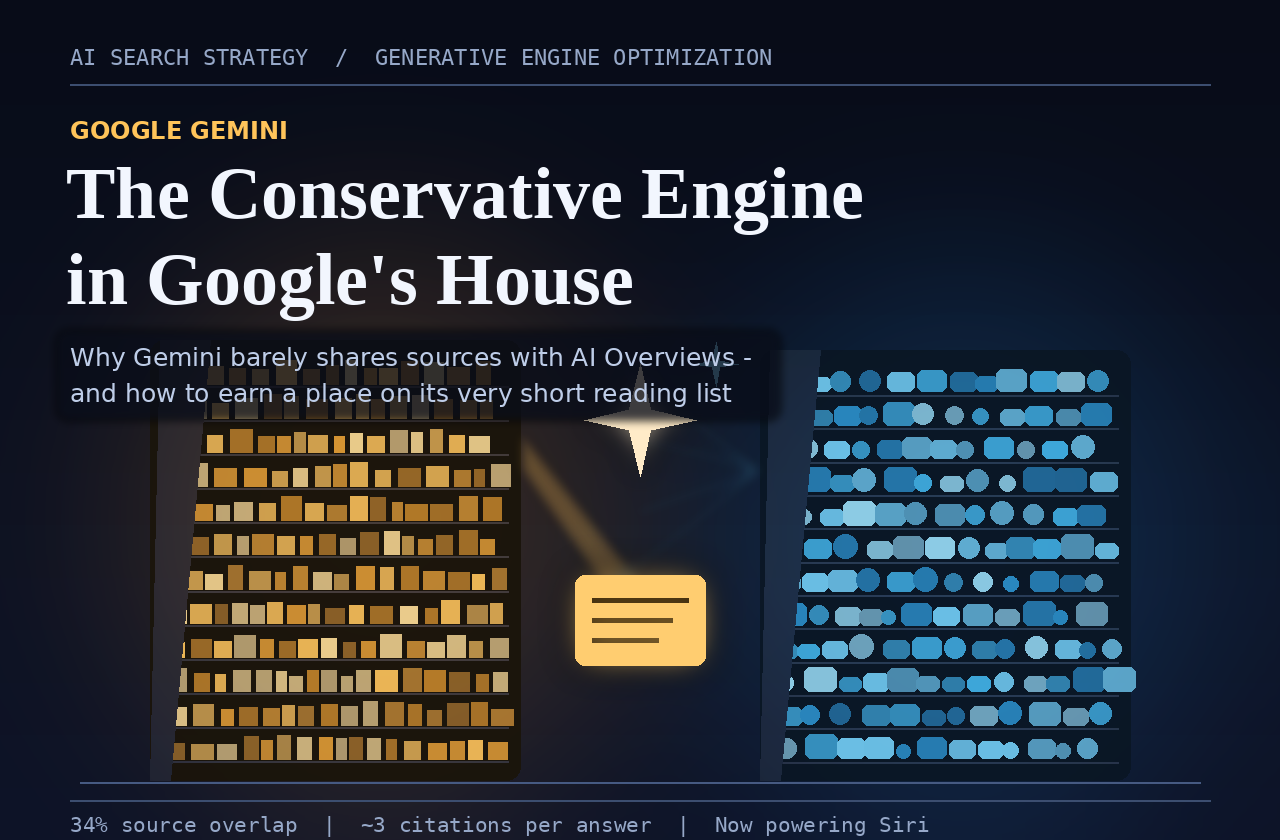
Ask most marketing teams whether their Google SEO work already covers Gemini, and you’ll get a confident yes. Same company, same index, same crawler — how different could it be? Then someone runs the test. They ask Gemini the questions their buyers actually ask, compare the sources it cites against the ones appearing in AI Overviews, and the confidence evaporates. The two surfaces barely read from the same bookshelf.
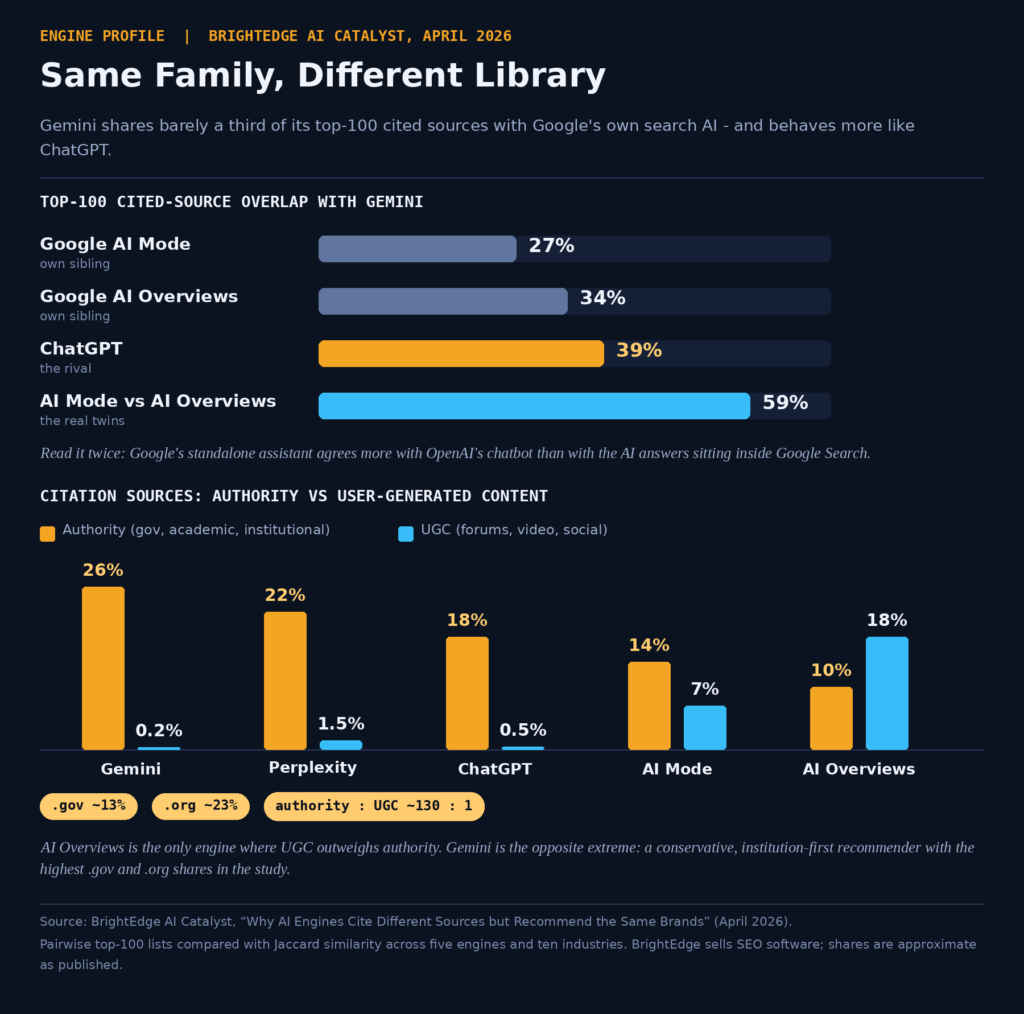
BrightEdge — an SEO software vendor that sells AI-visibility tracking, which is worth knowing before you weigh its numbers — ran exactly this comparison in April 2026 across five engines and ten industries. Gemini’s top-100 most-cited sources overlap with Google AI Mode’s by just 27%, and with AI Overviews by 34%. Its overlap with ChatGPT, the rival across town, is higher: 39%. Meanwhile AI Mode and AI Overviews, the two surfaces actually embedded in Google Search, share 59% of their top sources with each other.
Read that again. Inside Google’s own house, the search-embedded twins agree with each other far more than either agrees with the standalone assistant carrying the family name. Gemini is the relative who moved out, read different books, and comes home quoting government reports. If your AI-search plan treats all three Google surfaces as one channel, you are optimizing for a family resemblance that the data says isn’t there.
The Engine Profile: Institutional, Short-Listed, Hard to Enter
So what does Gemini actually read? The same BrightEdge analysis gives it the most institutional palate of the five engines studied. Roughly 26% of its citations come from government, academic and major institutional domains — the highest authority share in the dataset, against about 10% for AI Overviews. User-generated content, the forums and videos and social posts that power so much of AI Overviews, accounts for a rounding error on Gemini: 0.2%. That’s an authority-to-UGC ratio of roughly 130 to 1.
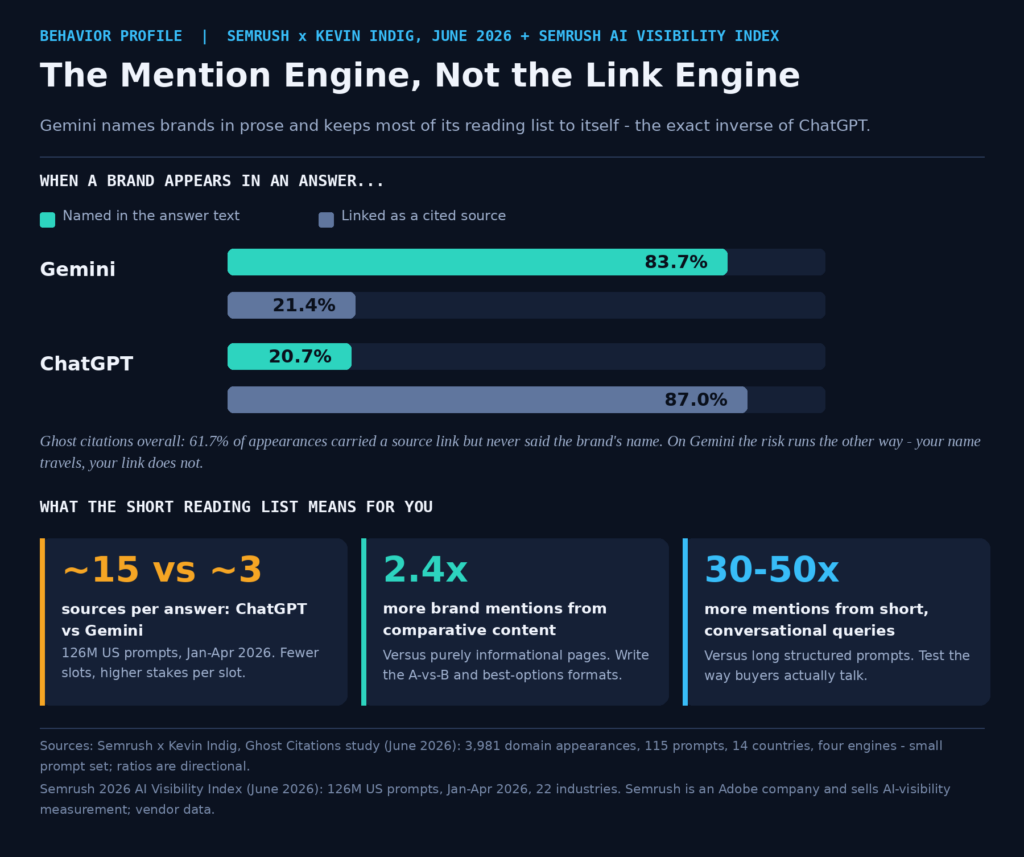
The citation diet is also strikingly short. Semrush, now an Adobe company, analyzed 126 million US AI-search prompts collected between January and April 2026 for its AI Visibility Index — one of the largest datasets of its kind, though it remains a vendor study from a company that sells the very measurement it reports. ChatGPT pulls in about fifteen sources per answer. Gemini makes do with about three. Same question, radically different reading lists.
Put those two findings together and a personality emerges. Gemini is the conservative examiner who consults a short stack of trusted references before committing to an answer. Fewer slots means each one matters more — and the bar for earning a slot looks more like institutional credibility than volume of coverage. A brand drowning in forum mentions may be invisible here, while a brand cited by one standards body and two trade associations gets named.
A .gov and .org World: Where UGC Goes to Zero
The domain-level detail sharpens the picture. In BrightEdge’s data, Gemini shows the highest .gov share of any engine at roughly 13%, paired with a .org share around 23%. AI Overviews is the only engine in the study where UGC citations outweigh institutional ones — about 17.5% versus 9.5%. The two products are near-opposites wearing the same logo.
Before you panic about lacking a .gov backlink, remember that authority is category-relative. BrightEdge’s own framing makes this point: your category’s authoritative layer might be trade associations, analyst firms, standards bodies or specialist publishers, not federal agencies. The strategic question is which institutions anchor AI citations in your vertical — and whether those institutions have ever described you in public.
One more nuance keeps this from being a pure prestige contest. Yext, a listings-and-structured-data vendor, analyzed 6.8 million citations from 1.6 million answers in mid-2025 using a location-aware methodology, and found that 52.1% of Gemini’s citations came from brand-owned websites — the highest first-party share of the engines it studied. Read the two studies together, not against each other: for contextualized, commercial and local questions, Gemini leans on your own factual pages; for open-ended category questions, it leans on institutions. Your site is the affidavit. The institutional coverage is the character witness. You want both on file.
Two Answer Paths: Live Grounding vs Training Memory
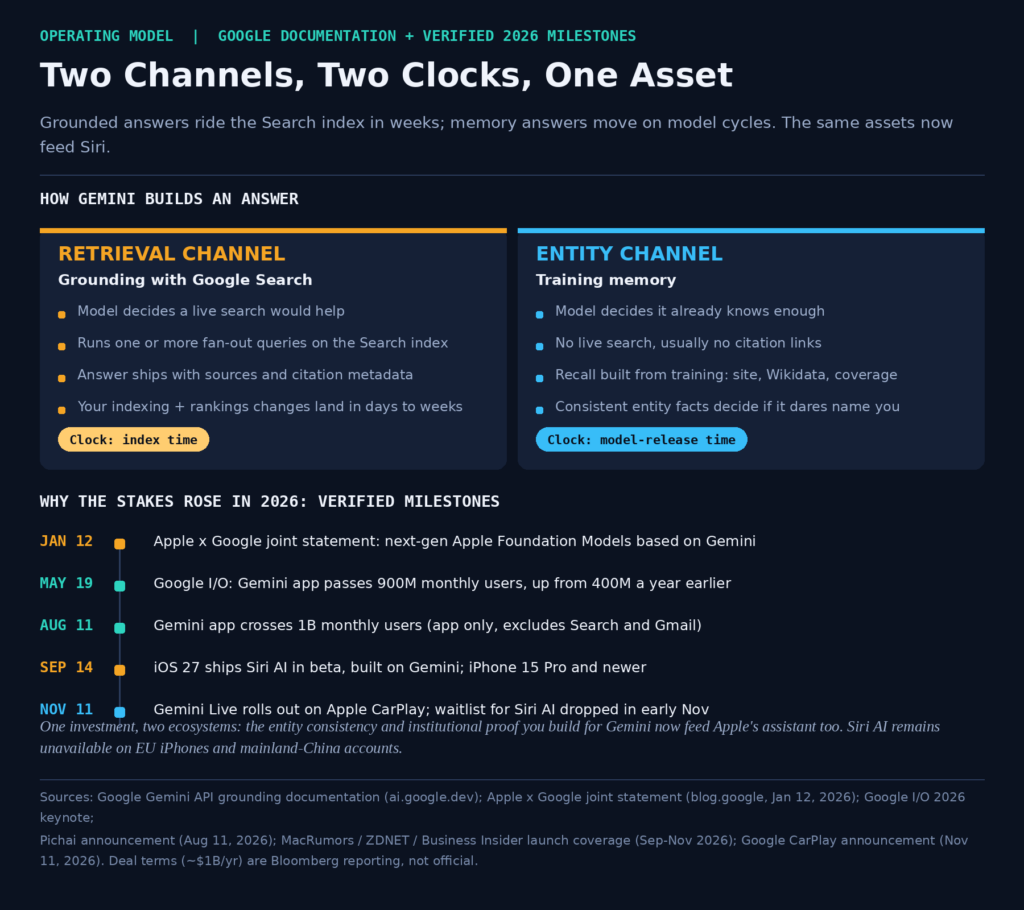
Here is the mechanic that explains why Gemini optimization sometimes works in weeks and sometimes does nothing for months. Gemini answers from two different places.
When it decides a question needs fresh information, it grounds the answer in Google Search. This isn’t speculation — Google’s Gemini API documentation describes the flow explicitly: the model analyzes the prompt, decides whether searching would improve the answer, generates one or more search queries, processes the results, and returns an answer wired to its sources. Grounded responses carry structured metadata listing the queries run and the pages used. The retrieval underneath rides Google’s core ranking systems, which means durable changes in your search visibility can propagate into Gemini’s answers on a later check.
When it decides it already knows enough, it answers from training memory. No live search, no fresh pages, no citations — just what the model absorbed before its knowledge cutoff, filtered through whatever version is serving traffic today. Publish a brilliant fact page on Tuesday and the memory-path answer won’t know about it until a future model update, if ever.
Same assistant, two clocks. The retrieval channel runs on index time — days to weeks. The entity channel runs on model-release time — months. Any agency promising a fixed timeline for “Gemini ranking” without distinguishing the two is selling you a stopwatch that measures nothing.
How to Tell Which Path Just Answered You
You don’t need API access to run this diagnostic. Three tells, in order of reliability:
- Citations present. If the answer links sources, it searched. Google’s own consumer help notes sources appear when available — not every response includes them, and an answer without links is often a memory answer.
- A freshness probe. Ask about something that happened this week in your category. A grounded answer can know it; a memory answer either dodges or suddenly sprouts citations.
- Repeat the question. Grounded answers shift as the index shifts; memory answers tend to repeat themselves with eerie consistency, like a colleague retelling the same story word for word.
Log which path served each of your test questions. It changes what “not visible yet” means: on the retrieval path it means keep building; on the memory path it means wait for the model cycle and strengthen the entity signals the next training run will absorb.
The Mention Engine: Names Without Links
Now the twist that reframes the whole assignment. Getting cited by Gemini and getting named by Gemini are different games — and Gemini plays the second one far more than the first.
In June 2026, Semrush partnered with growth advisor Kevin Indig on a “ghost citations” study: 3,981 domain appearances logged across 115 prompts, 14 countries and four engines. A small prompt set, so treat the ratios as directional rather than gospel. The engine-level split was stark. When a brand appeared in a Gemini answer, it was named in the answer text 83.7% of the time — but linked as a cited source only 21.4% of the time. ChatGPT ran the exact inverse: cited 87%, named 20.7%. Across the whole dataset, nearly 62% of citations were ghosts — a source link with no brand name in the prose.
Gemini, in other words, is a conversationalist, not a bibliographer. It tells you the answer and expects you to trust it; the reading list stays mostly in its pocket. For a brand, being mentioned is the visibility that survives the conversation. A user who hears “the usual options are A, B and C” remembers three names, not three URLs.
The study also surfaced two levers worth stealing. Comparative content — the “A versus B” and “best options for X” formats — earned 2.4 times more brand mentions than purely informational content. And short, conversational queries produced dramatically more mentions than long, structured prompts, by a factor of thirty to fifty. Write the way buyers ask, and test the way buyers ask. A visibility audit built from formal, keyword-stuffed prompts is measuring a conversation nobody is having.
Winning the Retrieval Channel: Make Google Work Its Shift
For the grounded half of Gemini’s answers, Google’s own documentation is refreshingly boring — and that’s the point. The company’s guide to optimizing for generative AI features says the eligibility floor is the one you already know: pages must be indexed and eligible to show with a snippet, and the site must be included in Search’s generative AI features in Search Console. No special AI files. No llms.txt. No magic schema. No mandatory chunking of content into bite-size pieces. Google explicitly lists these as myths, and warns that spinning up page variants to chase every fan-out query is scaled content abuse — a spam policy, not a strategy.
What is documented is query fan-out: the model issues several related sub-queries and stitches the results together. Ask it how to fix a weed-choked lawn and it may quietly search for herbicides, chemical-free removal and prevention. The practical response isn’t forty thin pages; it’s making sure your genuinely useful pages answer the sub-questions a real buyer would branch into, with the answer stated plainly near the top.
Two housekeeping items are Gemini-specific. First, audit robots.txt for Google-Extended — the token that governs whether your content may be used for Gemini training and grounding. It does not affect your Search rankings, so some “block all AI” templates adopted in 2024 quietly opted brands out of Gemini while leaving SEO intact. If you want Gemini visibility, that line item deserves a deliberate decision, not an inherited default. Second, for anything commerce-shaped, feed the ecosystem: Google’s guide points to Merchant Center feeds and Business Profiles as inputs to AI product and local answers. Semrush’s index found Gemini’s most-mentioned brands skew toward the commerce ecosystem — Amazon, eBay, Walmart, Apple — with Wikipedia and YouTube dominating its external reference pool. You can’t become Amazon, but you can make your product data as machine-legible as theirs.
Winning the Entity Channel: Be the Same Company Everywhere
The memory half of Gemini rewards a different asset: a clean, consistent, corroborated entity. When the model answers without searching, it is effectively asking itself what it knows about your brand — and the confidence of that recall was built from everything it absorbed: your site, your Wikipedia and Wikidata presence, trade coverage, directory listings, the consistency of your name, category and claims across all of them.
This is where contradictory facts cost you. Founding year differs between your About page and your LinkedIn? Product category described three ways across three profiles? The model resolves entities by agreement, and disagreement reads as uncertainty — the state in which a conservative engine declines to name you at all. The fix is unglamorous: one canonical description, one set of facts, mirrored everywhere, with structured data on your own site matching the visible text. Think of it as making your brand easy to remember correctly.
And measurement got sharper this year, with a catch. Google began rolling out generative-AI performance reports in Search Console in June 2026, reaching all sites worldwide by the end of August — impressions from AI Overviews and AI Mode, broken down by page, country and device. Useful, finally. But read the scope line: the report covers Search surfaces only. The Gemini app is not in it, and the report carries no click data. Your Gemini-app visibility still has to be measured the old-fashioned way — by asking it questions and writing down what happens.
The Right Health Check: Ten Buyer Questions, Three Runs Each
Which brings us to the audit itself. The most common mistake is also the most flattering one: typing “what do you know about [our brand]” into Gemini, getting a tidy paragraph back, and declaring victory. That test measures whether the model can describe you when handed your name on a plate. It will usually produce something — from memory, from a quick search, from sheer politeness. It tells you almost nothing about whether a buyer will ever hear your name.
The real test is the unbranded category question, the one a buyer with no loyalty asks: what are the best options for X? Which providers do people use for Y? Is Z worth it compared to the alternatives? Run ten of these, chosen from actual sales conversations, and run each one three times — answer engines are non-deterministic, and a single run is an anecdote. For every answer, log four things: whether you’re named, how early in the list, what the model says about you, and which sources it cites — including which competitors get the slots you wanted.
Do Multilingual Markets Need Separate Programs? Platform Beats Language
If you sell in several languages, you’ve probably been told each language needs its own AI-visibility program. An independent audit published on Zenodo in September 2026 complicates that advice usefully. The researcher tested four answer surfaces across six European languages with natively authored prompts — not translations, which measure the translator rather than the market — issuing every prompt three times per platform, for over five thousand observations across two studies.
The finding that replicated across both brand sets: the platform you ask dominates the language you ask in. Citation rates ranged from 16.2% to 91.2% across platforms in the first study, while the spread across six languages was far narrower, with confidence intervals overlapping almost throughout. The audit also showed how easily small tests manufacture fake language gaps: an eight-prompt, single-run study reported a twenty-point language difference 16.4% of the time when the true corpus-wide gap was eight points. Caveats apply — it’s a single-author preprint, and the author discloses operating some of the focal brands — but the design is open and the lesson matches the vendor data: measure per platform first, per language second, and never trust a one-shot test.
One Investment, Two Ecosystems: Siri Now Speaks Gemini
If Gemini visibility still feels like a niche pursuit, check the phone in your pocket. On January 12, 2026, Apple and Google published a joint statement confirming a multi-year collaboration: the next generation of Apple Foundation Models is based on Gemini models and cloud technology, powering future Apple Intelligence features including a more personalized Siri, running on Apple devices and Private Cloud Compute. Bloomberg reported the deal at roughly a billion dollars a year for a custom model — reporting, not official terms, but the strategic direction is on the record.
And it shipped. iOS 27 arrived on September 14, 2026 with Siri AI in beta — a conversational, context-aware assistant gated at first behind a waitlist that Apple removed in early November. It runs on iPhone 15 Pro and newer, launched in English with five more languages following in October, and remains unavailable on iPhones in the EU and for mainland-China accounts. Meanwhile the Gemini app itself crossed one billion monthly active users in August 2026 — an app-only count that excludes Gemini inside Search and Gmail, so the real footprint is larger — and on November 11 Google rolled out Gemini Live on Apple CarPlay, eight months after ChatGPT got there.
The marketing implication is simple arithmetic. The institutional credibility, entity consistency and comparative content you build for Gemini now feed two of the largest answer surfaces in tech: Google’s ecosystem and Apple’s assistant. One investment, two distributions. Few line items in a 2026 budget compound like that.
The 90-Day Gemini Visibility Plan
Four tracks, run in parallel, reviewed monthly.
- Days 1–15, plumbing. Confirm indexing and snippet eligibility; check the Search Console generative-AI inclusion setting; audit robots.txt for an inherited Google-Extended block; claim and complete Merchant Center and Business Profile data if commerce applies.
- Days 1–30, entity. Write one canonical brand description — category, founding facts, differentiators — and mirror it across your site, Wikidata, LinkedIn and directories. Reconcile every conflicting fact you find. Add Organization schema that matches the visible page.
- Days 15–60, corroboration. Identify the five institutions your category’s AI answers actually cite (run the buyer questions and look). Pursue coverage where you’re absent: trade press, association memberships, analyst mentions, review platforms. Rewrite two priority pages in comparative format with the answer up top.
- Days 1–90, measurement. Ten unbranded buyer questions, three runs each, monthly, logged for name, position, claims and cited sources. Track mentions and citations as separate numbers — on Gemini they diverge four to one. Add Search Console’s generative-AI report for the Search surfaces, and remember it never sees the Gemini app.
Notice what’s absent: no Gemini-only content silo, no special markup files, no keyword-stuffed prompt pages. The engine rewards the same fundamentals as the rest of AI search — with the dial turned toward institutional proof.
The Takeaway
Gemini is Google’s conservative child: fewer sources, squarer institutions, longer brand lists, and a habit of naming brands without linking them. Optimizing for AI Overviews does not cover it — a third of shared sources is not coverage. What works is boring in the best way: clean indexing, one consistent entity, institutional corroboration, comparative content that answers buyer questions, and a monthly audit that counts names rather than links. Do that, and the same work quietly compounds inside Siri. The narrow door is still a door. Walk through it with your paperwork in order.