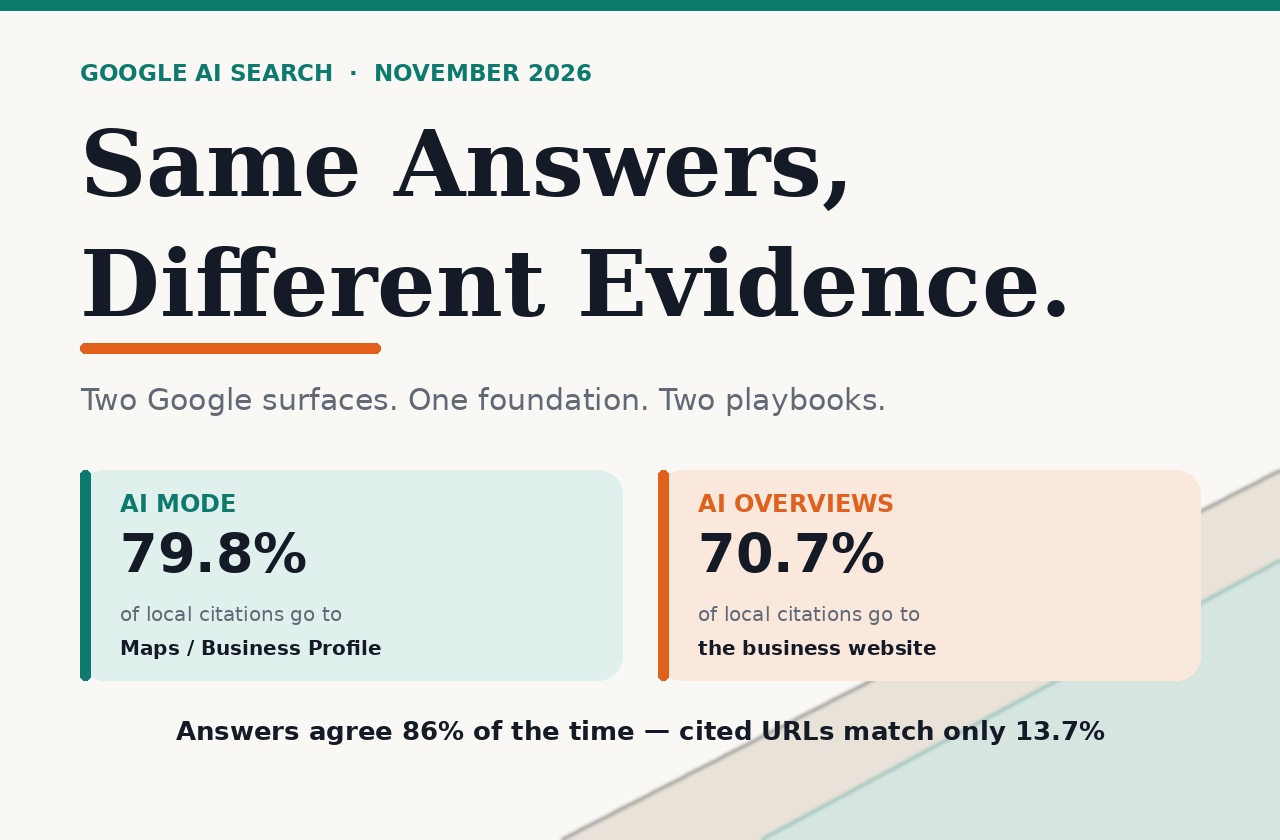
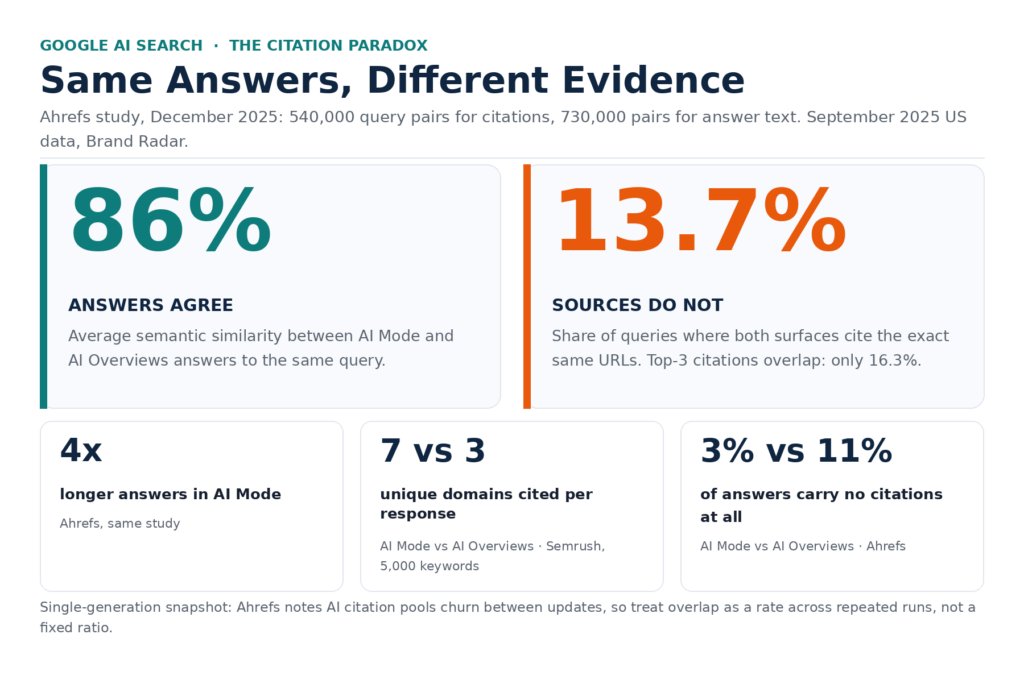
Ask Google the same question twice — once in AI Overviews, once in AI Mode — and you will usually get the same advice. What you will not get is the same reading list. Ahrefs compared hundreds of thousands of matched query pairs and found the two answers agree on meaning 86% of the time, yet cite the exact same URLs only 13.7% of the time. Nine times out of ten, the machines nod in agreement. Then they point at different witnesses.
If your team treats “Google AI” as one optimization target, that single number should stop you. A win on one surface does not automatically travel to the other. And in local search, as we will see, the two surfaces behave like mirror images of each other. This piece walks through the evidence, the caveats that come with it, and a practical way to run one content foundation with two thin, surface-specific playbooks on top.
What the Two Surfaces Actually Are
AI Overviews are the generated summaries that appear above the classic results when Google decides an AI answer adds value. They are short, selective, and citation-light. AI Mode is the conversational tab: it answers every query you send it, writes roughly four times longer responses, and spreads its references across about seven unique domains per answer, versus roughly three for AI Overviews, according to Semrush’s study of 5,000 keywords and more than 150,000 citations.
Google’s own documentation confirms the two features may use different models and techniques, so their responses and links will vary. It also confirms both use query fan-out — splitting your question into related sub-searches and pulling supporting pages from across them. Different triggers, different lengths, different retrieval breadth. Same brand on the box, different machines inside.
Scale makes this worth your attention. At Google I/O in May 2026, Google said AI Mode had passed one billion monthly users, with AI Overviews reaching 2.5 billion. These are not side experiments anymore.
The Ahrefs comparison — 540,000 query pairs for citations, 730,000 for answer text, drawn from September 2025 US data — adds texture. Only 16% of unique words overlap between the two answers. Identical first sentences appear just 2.5% of the time. AI Mode carries no citations in only 3% of responses; AI Overviews go citation-free 11% of the time. And 61% of the time, AI Mode names every entity the Overview named, then adds more. One caveat to carry everywhere: this is a single-generation snapshot, and Ahrefs’ own research shows citation pools churn between updates. Treat overlap as a rate you measure repeatedly, not a fixed constant.
The Eight Months That Loosened the Ranking Bond
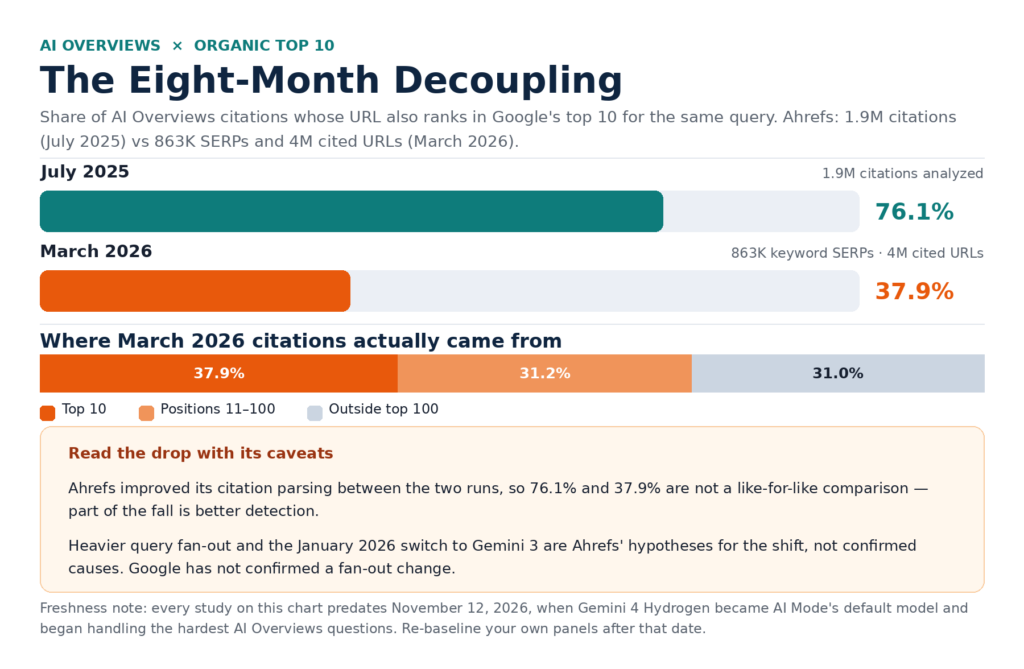
There was a time when ranking well was a near-guarantee of an AI Overview citation. In July 2025, Ahrefs found 76.1% of cited pages sat in the organic top 10 for the same query. Then it re-ran the study — 863,000 keyword SERPs and four million cited URLs, published in March 2026 — and the number came back 37.9%. Positions 11–100 supplied 31.2%; pages outside the top 100 supplied another 31%.
Two honest caveats before anyone panics. First, Ahrefs improved its citation parsing between runs, so the datasets are not like-for-like; part of the drop is better detection, not changed behavior. Second, Ahrefs offers heavier fan-out and the January 2026 switch to Gemini 3 as hypotheses, not confirmed causes — and Google has confirmed no fan-out change. The direction is corroborated by other trackers; the precise slope is not settled. What survives every caveat: your rank for the exact query is no longer a reliable proxy for your citation. Your page can win a sub-question you never tracked.
A Measurement Warning: URL Overlap Is Not Domain Overlap
Here is where teams misread the data. Semrush measured domain-level overlap with Google’s top 10 at about 86% for AI Overviews and 54% for AI Mode. Those numbers look reassuring next to 37.9% — but they answer a different question. Domains, not pages. The two surfaces largely agree on which publishers matter, then pick almost entirely different pages inside them. Winning the neighborhood is not winning the house. Never blend URL-level and domain-level figures into one “AI visibility” score; the average describes neither surface.
The Local Mirror World: 79.8% vs 70.7%
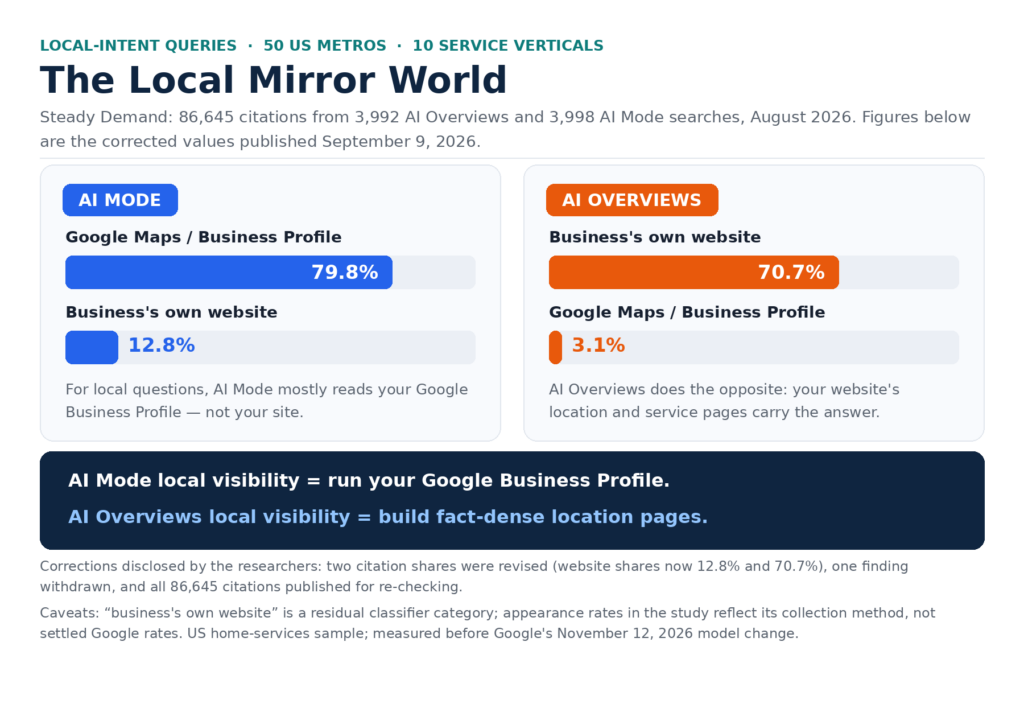
The most actionable divergence is in local search. Steady Demand — a Google Business Profile agency, so note the commercial interest — ran 3,992 AI Overviews queries and 3,998 AI Mode queries across 50 US metros and 10 home-service verticals in August 2026, classified all 86,645 citations, and crawled 26,358 unique pages.
On local-intent queries, AI Mode sent 79.8% of its citations to Google Maps or Business Profile data, and only 12.8% to the business’s own website. AI Overviews did the reverse: 70.7% to the business’s website, 3.1% to Maps or the profile. Same query, same town, opposite front doors.
Rigor note, because it matters: the study was independently reviewed after publication. Two citation figures were corrected (the website shares are the revised 12.8% and 70.7% — older coverage quoting 19.7% and 73.5% is stale), one finding was withdrawn, and all citations were published for re-checking. The appearance rates in the report reflect its collection method, not settled Google rates, and “business’s own website” is a residual classifier category. Also, everything was measured before Google’s November 12, 2026 model change. Directionally striking, precisely provisional — which is exactly how you should quote it.
The AI Mode Local Checklist: Your Profile Is the Landing Page
For “best plumber near me” style questions, AI Mode is largely reading your Google Business Profile, not the service page you paid to rewrite. So work the profile like a landing page: correct primary and secondary categories, complete services with descriptions, current hours including holidays, fresh photos, answered Q&A, and a steady cadence of genuine reviews with owner responses. Google’s own guidance tells businesses to keep profile information current for visibility in AI features. A website redesign will not move these citations. Profile hygiene will.
The AI Overviews Local Checklist: Fact-Dense Location Pages
For the same town’s informational queries — costs, timelines, “do I need a permit” — AI Overviews reads your site. Build location and service pages that state facts plainly: prices or price ranges, service areas, licensing numbers, phone number in the HTML, and a short direct answer under each question heading. Among already-cited pages, Steady Demand found schema markup, an HTML phone number, and concrete numbers slightly more common on AIO-cited pages — differences of 5.3, 4.5 and 3.7 percentage points. Correlation within a cited pool, not proof of causation; there was no uncited control group. Cheap to implement, honest to frame.
Content Tastes: UGC-First vs the Commercial Aggregator
BrightEdge’s cross-engine study (April 2026, nine industries) profiles the two surfaces like rival editors. AI Overviews is UGC-first: about 17.5% of its citations come from user-generated platforms — roughly 2.5 times AI Mode’s share — with a single video platform contributing about 10.6% on its own. It is the only engine in the dataset where UGC outweighs authoritative sources. Ahrefs independently found YouTube is the most-cited domain in AI Overviews.
AI Mode reads like a broad commercial aggregator: the widest domain catalog, the most even mix of review aggregators, finance data and news, and a top-10 citation concentration of just 19.4%. Ahrefs adds that AI Mode cites Wikipedia in 28.9% of citations versus 18.1% for Overviews, and Quora 3.5 times more often. Even the two siblings’ top-100 cited sources overlap only about 59%. For your content mix: Overviews rewards video evidence and community corroboration; Mode rewards depth, comparison facts and long-tail sub-question coverage.
Fan-Out and the November Reset
One official sentence explains the mechanism: both surfaces issue multiple related searches across subtopics while generating an answer. That is why a page can be cited without ranking for the headline query — it won a sub-question. And the ground just moved again. On November 12, 2026, Google made Gemini 4 Hydrogen the default model in AI Mode worldwide and began using it for the hardest questions in AI Overviews, promising improved fan-out and “a broader range of helpful links.” It landed mid-rollout of the November core update. Every study quoted in this article predates that switch. Re-baseline your panels now; attribute nothing until the dust settles.
One Foundation, Two Patches: The Working Matrix
Google’s guidance is identical for both surfaces: no special markup, no AI text files, no chunking tricks. Indexable, snippet-eligible pages are the entry ticket, and the Search Console generative-AI inclusion setting must not exclude you. The gap is extractability. An open 400-query audit deposited on Zenodo by a marketing research team found 80.5% of top-three organic pages were absent from the first three AI citation cards — and in 53.8% of queries, none of the top three ranked pages was cited. Small, single-snapshot, observational: directional, not gospel. But the cited pages shared a shape — short direct answers under question headings, pricing tables, checklists.
So: one fact base, two patches. Foundation — crawlable pages, clean entities, self-contained answer blocks with real numbers. AIO patch — passage structure, video and community corroboration, fact-dense location pages. AI Mode patch — sub-question coverage (pricing, integrations, comparisons), commercial fact pages, and a fully worked Business Profile for local. You are not writing two content libraries. You are aiming one library through two different lenses.
Measuring Both Surfaces Without Fooling Yourself
Search Console’s generative AI performance report, rolled out worldwide on August 31, 2026, is a real step forward — and a trap for the impatient. It reports impressions only, with AI Overviews and AI Mode combined. No per-surface split, no clicks, no queries. It tells you that you appeared, not where or whether anyone came.
So build the split yourself: fix a panel of 30–50 real buyer questions, run each through both surfaces on a schedule, and log cited URLs — not domains — per surface. Report the share of runs where your URL appears, per surface, never averaged. A single check is a snapshot; citation pools churn. Read the Console report beside your standard performance report: rising AI impressions with flat clicks means you are being quoted, not visited — useful, but a different KPI.
Conclusion: Stop Optimizing for “Google AI”
“Google AI” is a brand, not a target. Under it sit two surfaces that agree on answers 86% of the time and on evidence 13.7% of the time, decouple from rankings at different speeds, and invert each other on local queries. Keep one foundation of extractable facts. Patch it twice: UGC, video and passage structure for Overviews; sub-question depth, commercial facts and profile hygiene for Mode. Measure each surface separately, at URL level, as a rate — and re-baseline after November 12. The teams that split the target now will own the answers later.