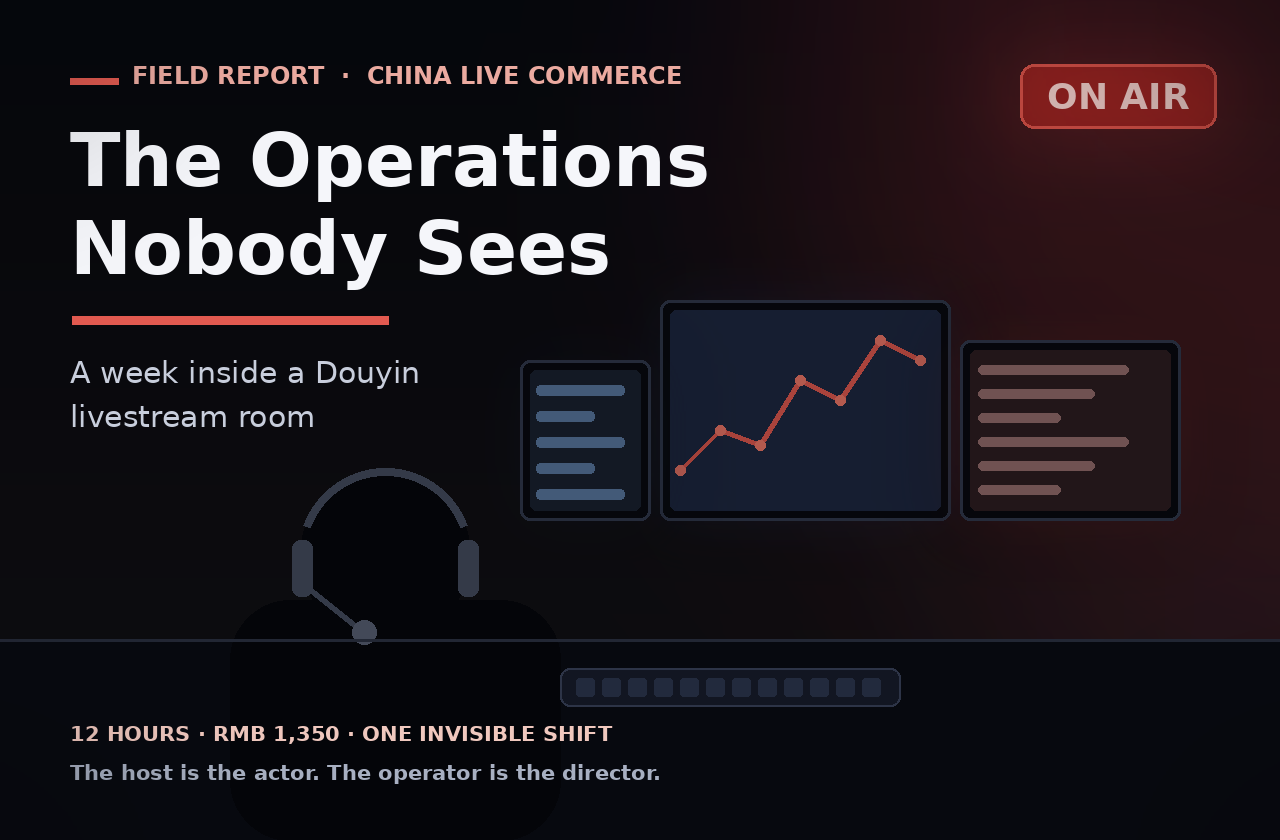
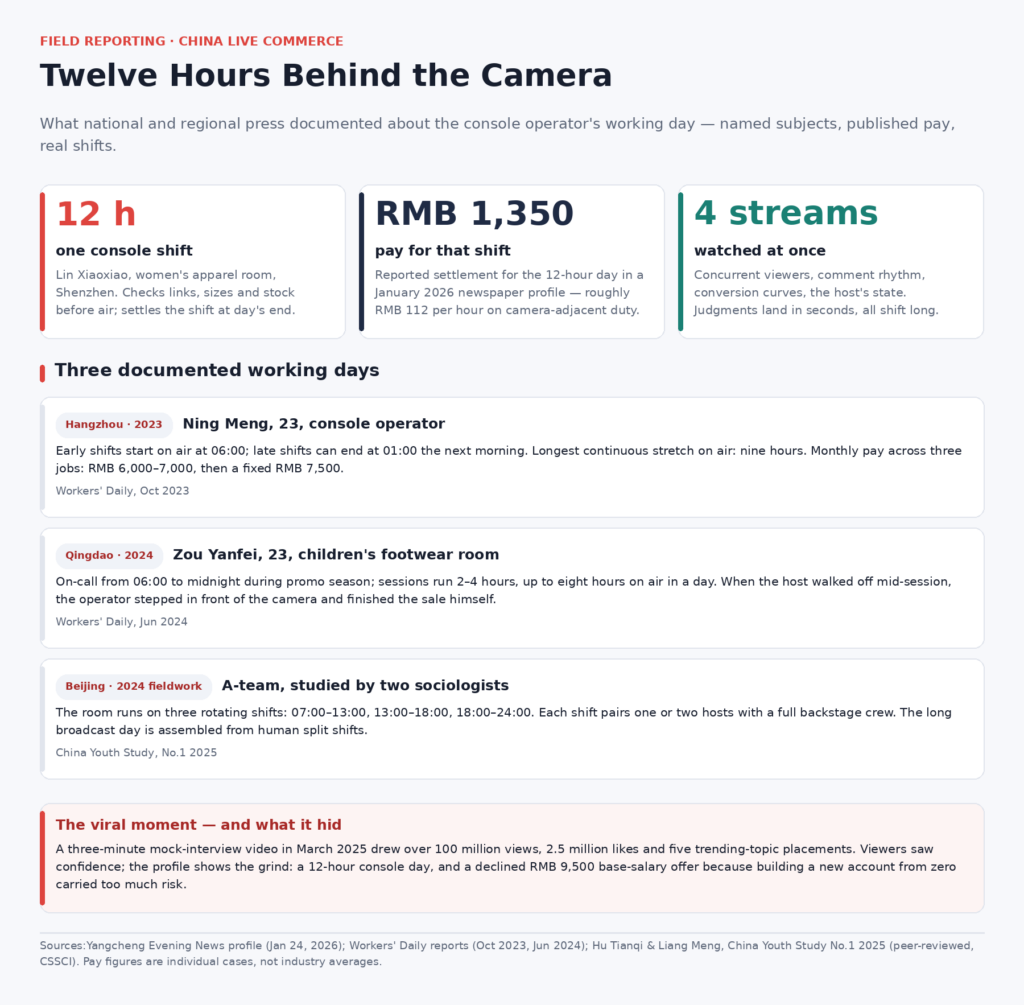
The camera never pans to her. Viewers of a Shenzhen women’s-apparel livestream see a host holding up jackets, and they hear a second voice — sharp, cheerful, slightly hoarse — firing back “Yes, exactly!” and “Three, two, one, link up!” That voice belongs to Lin Xiaoxiao, and she is the reason the room works. Before the stream starts she checks every product link, every size chart, every stock count. Once the host starts talking, Lin settles into the console seat off camera and spends the next twelve hours watching four things at once: the swing of concurrent viewers, the rhythm of the comment feed, the conversion curve on her backend dashboard, and the host’s energy level. When viewers dip, she switches a link. When the host fades, she jumps in. Most of these decisions happen inside a few seconds. At the end of the shift she stands up, clocks out, and collects RMB 1,350 — about 112 yuan an hour for work a researcher later described as physical and mental labor fused into constant, instantaneous judgment.
That portrait ran in Yangcheng Evening News in January 2026, and it is the rare piece of journalism that points the camera at the back of the room. This article follows that camera. Because here is the thing most coverage of China’s live-commerce machine gets backwards: the host is the actor, but the operating team is the director — and the director works a week nobody photographs.
The Shift the Camera Never Shows
Start with the documented day, because it anchors everything else. Lin’s twelve-hour console shift, profiled by a regional newspaper with her name attached, is not an outlier dressed up as a story. It matches what national trade press has been recording for years.
In October 2023, Workers’ Daily interviewed Ning Meng, a 23-year-old console operator in Hangzhou. His early shifts put him on air at 6 a.m. His late shifts could run until 1 a.m. the next morning. His longest continuous stretch behind the microphone: nine hours. Throat lozenges, he said, are standard equipment.
In June 2024, the same paper profiled Zou Yanfei, 23, who runs the console for a children’s footwear room in Qingdao. During promo season he might be attached to streams from 6 a.m. to midnight. Sessions run two to four hours; he has spent eight hours on air in a single day. And when his host abruptly walked off mid-session in June 2023, Zou simply stepped in front of the camera and finished the broadcast himself, talking to a few thousand viewers as if he had done it all his life. He had — in training, every night, in his head.
Notice what these three portraits share. The hours are long, the pay is published, and the person doing the work is interchangeable to the audience but irreplaceable to the room.
The Night the Operator Became the Host
Zou’s rescue act deserves a pause, because it demolishes the idea that console work is just cheerful echoing. A host can leave; the room cannot go dark. Someone has to know every SKU well enough to sell it live, unscripted, while watching the comment feed turn sour. The operator is the understudy who never gets a playbill — and, as we will see, often the person with more actual authority than the star.
Small rooms compress this further. Legal Daily’s investigation found console staff answering comments, launching giveaways, changing prices and restocking links in the same minute, sometimes all by themselves. In the smallest operations, the console operator and the rhythm-keeper merge into one body.
Who Actually Sits at the Console
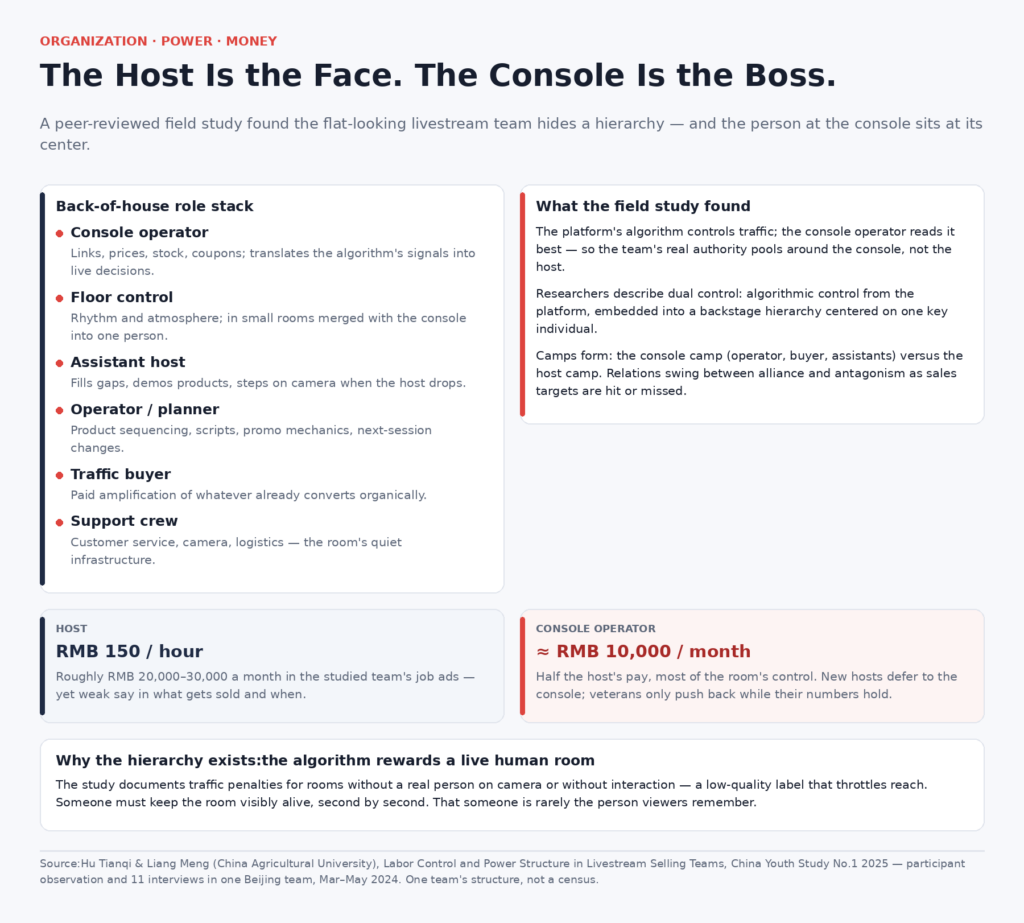
The role stack behind a mature Douyin room reads like a film crew: console operator (links, prices, stock, coupons), floor control (pace and atmosphere), assistant host (demos and stand-ins), operator-planner (product sequencing and scripts), traffic buyer (paid amplification), plus customer service and camera. The official research institute under China’s International Electronic Commerce Center counts more than thirty distinct job types radiating from a single livestream room, from hosts to video analysts to cost-pricing specialists.
Thirty jobs. One camera. You see one face.
The Study That Found the Real Boss
For years this backstage world had journalism but little scholarship. That changed with a 2025 paper in China Youth Study, a peer-reviewed CSSCI journal, by Hu Tianqi and Liang Meng of China Agricultural University. They spent the spring of 2024 inside one Beijing selling team, observing and interviewing eleven people — four console operators, four hosts, two assistants, one traffic buyer.
Their finding flips the marquee. The team looks flat, but because the platform’s algorithm controls traffic, and because the console operator is the person who reads the algorithm’s signals fastest, real authority pools around the console. The researchers call it dual control: algorithmic control from above, embedded into a backstage hierarchy centered on one key individual. Camps form — the console camp (operator, buyer, assistants) versus the host camp — and relations swing between alliance and antagonism depending on whether the sales target is being hit.
The pay inversion is the sharpest detail. In the team’s own job ads, hosts earned RMB 150 an hour, roughly 20,000–30,000 a month. The console operator earned about 10,000. Half the money, most of the control. New hosts deferred to the console completely; veterans pushed back only while their numbers held. Renmin University’s Dong Chenyu, who has done his own fieldwork in these rooms and tried the console seat himself, makes the same structural point from another angle: the industry’s base is not a lottery of overnight-rich hosts. It is a vast population of backstage workers. His best-known study — a seven-month digital ethnography published in Chinese Journal of Journalism & Communication in 2021 — examined showroom hosts rather than sellers, but its core concept, the double precarity of relational labor, rhymes with what the selling-team study found.
The Week Is Built From Split Shifts
So where does the legendary sixteen-hour room come from? Not from superhuman hosts. From rotation. The Beijing team in the academic study ran three shifts: 7 a.m.–1 p.m., 1 p.m.–6 p.m., 6 p.m.–midnight, each pairing one or two hosts with a full backstage crew. Ning Meng’s 6 a.m. start and 1 a.m. finish are the seams of that system as felt by one body. The room is always on; the humans are not. When brands marvel at a livestream channel’s uptime, they are admiring a schedule assembled out of other people’s split shifts.
Sequencing: The Economics of the Product Ladder
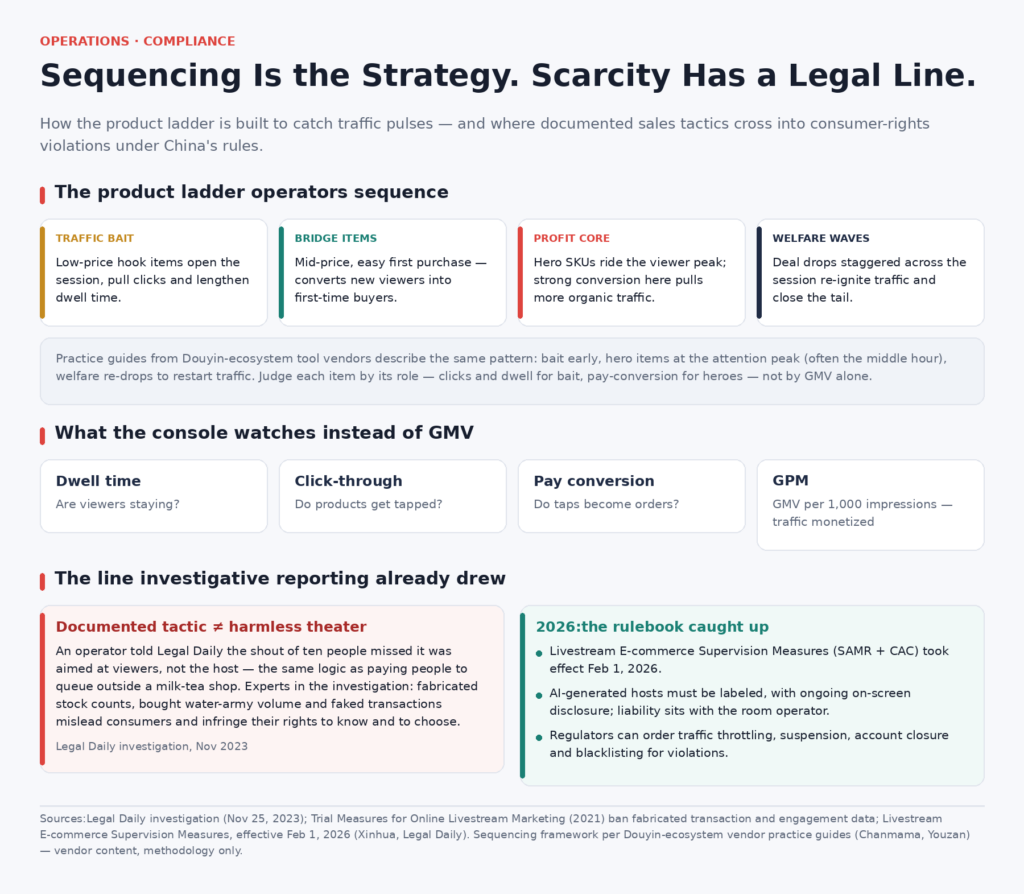
What fills those hours? Mostly, decisions about order. Practitioner guides across the Douyin ecosystem — including material from data-tool vendors like Chanmama and commerce-SaaS provider Youzan, whose interest is selling you software, so treat their framing as trade convention rather than science — describe the same four-rung ladder. Traffic bait opens the session: cheap, high-appeal items that pull clicks and stretch dwell time. Bridge items convert newcomers into first-time buyers. Profit core — the hero SKUs — rides the viewer peak, usually the middle stretch of a session, because strong conversion there signals the algorithm to send more organic traffic. Welfare waves, staggered deal drops, re-ignite attention and harvest the tail.
The timing logic is the strategy. Drop the hero product when the room is cold and you burn it. Hold a deal back — the practice operators call order-holding — and you concentrate demand into a pulse. Release the same hero in waves across the session and you manufacture repeat traffic spikes. None of this is mysterious; all of it is judgment, executed live, under a countdown nobody on camera ever announces.
Process Metrics: What the Console Actually Watches
Here is a tell that separates real operating teams from host-worshippers: ask what they watch during a stream. The answer should not be GMV. GMV is the scoreboard, not the game. The console watches dwell time (are people staying?), product click-through (does anything get tapped?), pay conversion (do taps become orders?), and GPM — gross merchandise value per thousand impressions, the efficiency with which traffic turns into money. Zou, the Qingdao operator, described judging every product by its click, exposure and conversion rates, cross-checked against what viewers request in the comments. These are cause metrics. Move them and the scoreboard moves; stare at the scoreboard and nothing does.
Paid Traffic Amplifies — It Cannot Create
The traffic buyer sits in the same camp as the console for a reason. The field’s working rule, echoed across practitioner guides, is that paid flow amplifies a room that already converts organically; it cannot rescue one that doesn’t. Buy traffic into a broken product ladder and you are paying to accelerate failure. That is why the buyer and the operator need shared, real-time visibility — the academic study’s console camp is, functionally, an argument for seating them together. When the person spending the money cannot see the conversion curve the person running the room sees, the budget leaks in the gap between two screens.
The Debrief Is the Real Product
Every documented account ends the same way: after the stream, the team gathers. Which SKUs converted? Where did viewers drop? What broke? What changes tomorrow? Zou’s team debriefs in detail after every session. Ning Meng’s colleagues review average watch time and sales together. The job is not the twelve hours on camera-adjacent duty; the job is the loop — perform, measure, adjust, repeat. Hosts rotate through this loop. The loop itself, and the team’s accumulated feel for goods, people and traffic rhythm, is the asset that persists.
The Myth of Three Sentences and Easy Money
The internet’s favorite framing — say three phrases, earn 8,000 a month — comes from viral clips of the console’s call-and-response patter. The reporting says otherwise. Ning Meng repeated those phrases hundreds or thousands of times per session, on split shifts, with a ruined voice, for 6,000–7,500 a month across three jobs. His colleague put it plainly: the entry bar is low, so the competition is brutal, and it is far less glamorous than it looks. Even Lin, the viral star of the genre, turned down a 9,500 base-salary offer because building a new account from zero carried too much risk. Her three-minute mock-interview video drew over 100 million views, 2.5 million likes and five trending placements in March 2025 — and changed her daily grind not at all. By May 2026, follow-up coverage by Shenzhen TV found her earning RMB 1,725 for an 11.5-hour day, her rooms now spanning three provinces. The fame monetized slightly; the labor did not shrink.
The Legal Line Hidden Inside the Patter
Now the uncomfortable part. Some of that patter is not theater; it is exposure. Legal Daily’s November 2023 investigation transcribed the scripts: a host asks how many are left, the console shouts that it’s the last order, gone — a full combination performed inside a minute, on loop, so any viewer entering at any moment gets swept into urgency. One operator, speaking under a pseudonym, explained that shouting “ten people missed it” was aimed at the audience, not the host — “the same logic as paying people to queue outside a milk-tea shop.”
Experts quoted in the investigation drew the line precisely: when the scarcity is fabricated — fake stock counts, purchased water-army volume, inflated transaction data — the room is publishing false information, infringing consumers’ rights to know and to choose. China’s trial measures for online livestream marketing, in force since May 2021, already prohibit fabricating or tampering with transaction, follower, view and like counts. The tactic is not a gray-area growth hack. It sits on the wrong side of a written rule.
2026: The Rulebook Catches Up
And the rulebook has grown teeth. On February 1, 2026, the Livestream E-commerce Supervision Measures — jointly issued by the State Administration for Market Regulation and the Cyberspace Administration of China — took effect. Three changes matter for the people at the console. First, AI-generated hosts must be labeled with ongoing on-screen disclosure, and liability for anything the digital host does sits with the room operator, not the software vendor. Second, regulators gained an explicit traffic-control toolbox: warnings, throttling, suspension, account closure, blacklisting. Third, private-domain livestreams were pulled into scope. The operator’s job description now includes a compliance officer nobody hired.
What Brands Should Actually Buy
Pull the threads together and the procurement advice writes itself. Evaluate the operating team, not the face: ask a prospective partner for their sequencing logic, their in-stream dashboard, their debrief artifacts. Seat media buying inside the room’s data loop, not behind a wall. Write the compliance line into the brief — scripted fake scarcity is a liability, not a technique. And budget the human cost honestly: twelve-hour console days, split shifts and merged roles are the real cost structure underneath “cheap” live commerce. A brand that buys a host buys a face. A brand that buys the operating system buys the thing that persists.
The Counterarguments, and Their Limits
Three objections deserve answers. One profile is not an industry — true, and the RMB 1,350 figure illustrates rather than generalizes; but the role structure is corroborated across national trade press, a peer-reviewed field study and an official research institute, which is more than most marketing claims ever get. Automation will erase these jobs — digital hosts are real and spreading, yet the documented core of the work is instantaneous multi-variable judgment plus legal accountability, and the 2026 rules assign that accountability to humans; the same institute’s flagship report, released in May 2025, frames AI as reshaping the chain rather than deleting the crew. The tactics work, so who cares — the investigation and the new measures answer that: short-term lift purchased with fabricated scarcity carries a legal tail, and the platforms can now throttle you into irrelevance.
It is worth being honest about the numbers themselves. The headline market figure — roughly RMB 5.8 trillion in 2024 — is an estimate by iResearch, a commercial research firm, cited in that institute’s report, not a government statistic; the official anchor is the National Bureau of Statistics’ RMB 15.52 trillion in total online retail sales, which puts live commerce at well over a third of the online pie. The claim that every RMB 100 million of live-commerce GMV supports about 1,200 jobs is modeled on Kuaishou platform data — the platform is an interested party, and the report says so. The finding that 72% of new customers come from livestreaming among firms that stream steadily is likewise a Kuaishou merchant survey. Directionally useful; not a census. The audience, for scale, passed 597 million live-commerce viewers by late 2023 per CNNIC, and the count of professional hosts reached 38.8 million in 2024 per the industry’s network-audiovisual report. Behind every one of those decimal points sits a console seat.
The Takeaway
A week inside a Douyin room is a week of invisible judgment: a console operator tracking four data streams for twelve hours and RMB 1,350; a planner re-sequencing a product ladder to catch traffic pulses; a buyer who must sit inside the room’s data, not outside it; a nightly debrief that is the team’s actual product; and a script with a legal boundary that investigative reporting drew years before regulators codified it. The next time a livestream clip makes you laugh at the echoing voice in the background, remember: that voice is running the room. The face on camera is just the part you were meant to see.