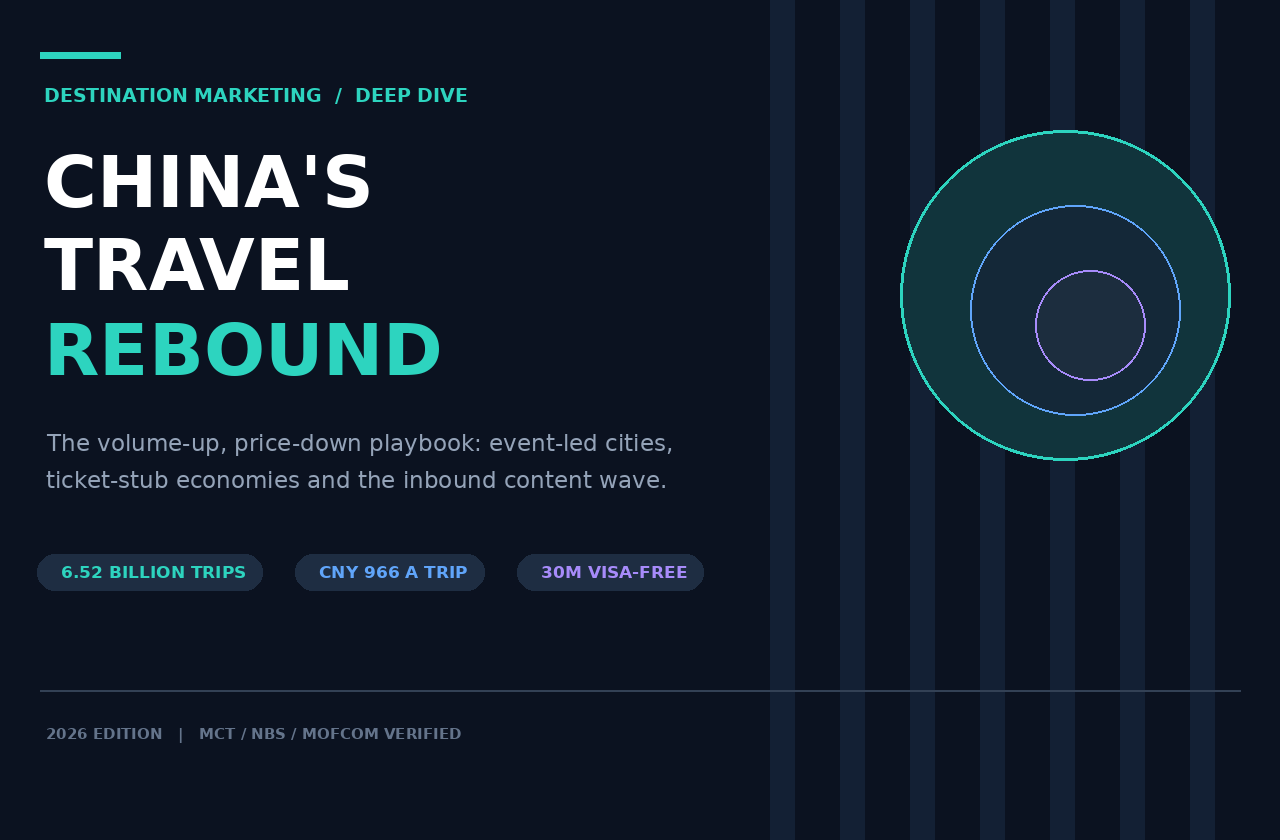
Look at the headline numbers and you would be forgiven for thinking China’s travel industry simply snapped back. It didn’t. Something stranger — and far more useful for marketers — happened. In 2025 the country logged a record 6.52 billion domestic trips, blowing past the old 2019 high. But the average wallet per trip actually shrank. Meanwhile, millions of foreign visitors poured in, many of them arriving on visa-free passes and filming every minute of it for a global audience.
If you sell travel, destinations, or hospitality, this is the part that matters: the recovery was not a return to the old normal. It was a restructuring of demand, and it came with an entirely new marketing playbook — one built on occasions rather than itineraries, on policy as a distribution partner, and on ordinary travellers as the media channel.
The Rebound That Changed the Brief
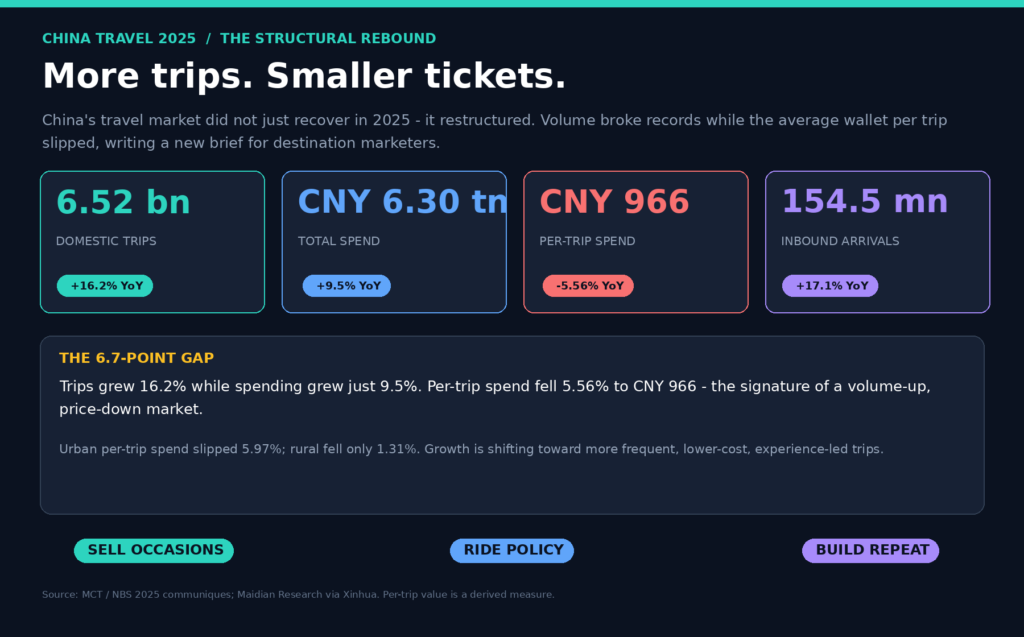
Here is the paradox that defines the whole story. According to the Ministry of Culture and Tourism’s 2025 statistical communique, domestic trips hit 6.52 billion, up 16.2 percent — roughly 907 million more trips than the year before. Total domestic spending climbed to CNY 6.30 trillion, a healthy 9.5 percent gain. All good news.
Except spending grew more than six percentage points slower than volume. That gap is the whole ballgame. Divide one number by the other and average spend per trip lands at about CNY 966, down 5.56 percent from the prior year, based on figures calculated by Maidian Research and published through Xinhua. Zoom in and the split gets sharper: urban travellers spent about CNY 1,061 per trip (down nearly 6 percent) while rural travellers spent roughly CNY 655 (down just over 1 percent).
So what does a market look like when it gets bigger and cheaper at the same time? Think of it as a switch from one big purchase to many small ones. The industry stopped selling a single, expensive, once-a-year holiday and started selling more frequent, shorter, lighter-weight escapes. If your marketing still assumes every traveller is a high-roller planning a two-week itinerary, you are now aiming at a target that has quietly moved.
More Trips, Smaller Tickets: Anatomy of Liang Zeng Jia Huan
The Chinese phrase liang zeng jia huan — volume up, price down — is the neat summary, and you can see its signature everywhere. Travellers became masters of the compressed, high-intensity short break and of the clever budget substitute. Why book an expensive resort when a lesser-known county town gives you the same photos, the same noodles, and a fraction of the bill?
This is not belt-tightening in the gloomy sense. It is a reallocation ofenthusiasm. People are trading the single flagship trip for a stack of weekends — a concert in one city, a football match in another, a mountain town in between. The spend per occasion falls, but the number of occasions multiplies, and the total pot still grows.
For marketers the implication is almost embarrassingly simple. Stop optimizing only for the long-haul package. Start optimizing for the repeatable, shareable, low-friction occasion — the thing someone can say yes to on a Tuesday night.
The Special-Forces and Substitute Logic
Two behaviours capture this shift. The first, nicknamed “special-forces tourism,” packs an absurd number of sights into one ruthless day. The second chases “value substitutes” — cheaper destinations that stand in for pricier icons. Both reward the same attributes: convenience, density of experience, and a strong photo. Neither rewards a glossy, high-price brochure.
The Rural Surprise: Growth From Below
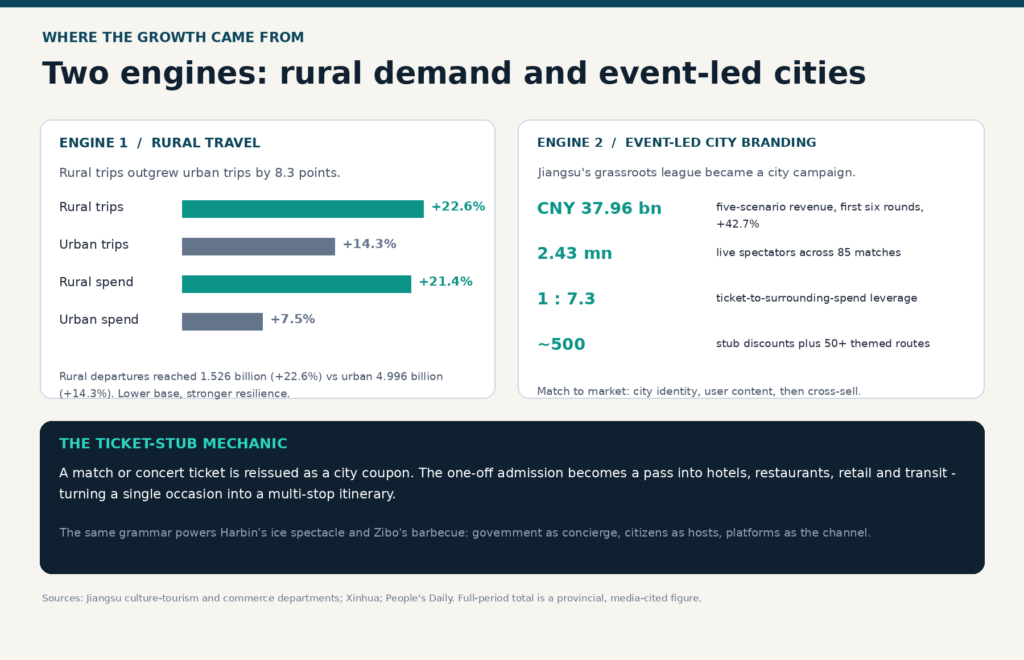
If there is one number that should make a destination marketer sit up, it is this: rural residents made 1.526 billion trips in 2025, up 22.6 percent, while urban trips grew 14.3 percent. That is an 8.3-point gap, and rural spending grew an even more impressive 21.4 percent. The lower rungs of the market are not catching up — in growth terms, they are pulling ahead.
Why? Partly the low base, partly something sturdier. Rural travel demand is more essential and less discretionary: visiting family, local pilgrimages, regional festivals. When budgets get cautious, that kind of demand bends less. It is the shock absorber of the whole system.
The strategic read: China’s next wave of volume is not coming from the usual affluent coastal cities. It is rising from below, and it favours affordability, cluster booking, and products sold through the platforms those travellers already trust.
Event-Led City Branding: The Su Chao Case
Nothing illustrates the new occasion economy more vividly than Su Chao, the Jiangsu City Football League. On paper it is an amateur tournament. In practice it became one of the most effective city-marketing machines China has ever seen.
From Grassroots Match to City Identity
The league ran for roughly 175 days across 85 matches, pulling in about 2.43 million live spectators, with a final that filled Nanjing’s Olympic venue with more than 62,000 fans. And here is the detail that makes marketers greedy: of the 516 players, only 29 were professionals. The rest were teachers, couriers, ordinary locals. That authenticity was the product.
The Jiangsu provincial culture and tourism department stitched the tournament into a weeks-long campaign — more than 2,800 cultural events, over 50 cross-region travel routes, and nearly 500 ticket-stub discounts. Local tourism bureaus turned municipal rivalry into free content, trading affectionate taunts between cities and riding the wave of memes. A match became an excuse to visit a city; the city became the campaign.
The numbers back it up. In the first six rounds, five monitored scenarios — travel, transport, catering, accommodation and sport — generated CNY 37.96 billion in service revenue, up 42.7 percent, according to the Jiangsu Department of Commerce. The wider claim that full-period cultural-tourism consumption topped CNY 120 billion circles in provincial media, but it is a local government figure rather than a national statistical release, so treat it as directional.
The Hospitality Spectacle: Harbin and Zibo
Su Chao did not invent this grammar; it refined it. Two earlier cities wrote the template.
Harbin turned ice and snow into a national obsession. Its 2024–2025 ice season drew more than 3.5 million visits to the Ice and Snow World alone, with ticket revenue above CNY 1 billion, according to local reporting. The city installed changing rooms at the airport, warmed up pedestrian tunnels with velvet handrails, and trained taxi drivers to deliver English welcome patter. Government acted as concierge; citizens acted as hosts. When an opening-day queue sparked “refund” chants, officials apologized and issued refunds overnight — and won a wave of public goodwill.
Zibo, a city nobody associated with tourism, did it with barbecue. It launched skewers trains, twenty-plus dedicated bus lines, cleared 207 public units’ parking and toilets for visitors, and capped hotel prices. Its tourism bureau chief personally boarded a train to hand out souvenirs.
The Half-Life of a Spectacle
But be honest about the catch. Spectacles have a half-life. Zibo’s skewer fever cooled within a year, and Harbin’s “pleasing personality” persona raised expectations so high that any slip became a crisis. A city that positions itself as a perfect servant can never step down from that pedestal. The lesson is not “behave theatrically.” It is “build the service system underneath the theatre,” so the moment fades but the capacity stays.
Ticket-Stub Economics: The Occasion-Bundling Math
This is the cleverest mechanic in the whole playbook, and the simplest to copy. A ticket stub stops being proof of entry and becomes a coupon for the city.
Jiangsu’s commerce department described a leverage ratio of CNY 1 of ticket generating CNY 7.3 in surrounding spend. Across the country, concert-goers and match fans increasingly find their stub unlocking hotel discounts, free attractions, restaurant deals and retail offers. Qingdao formed a merchant alliance around the idea; Shenzhen converted event and flight records into vouchers during the national games.
Why does it work? Because it attacks the exact weakness of the price-down era — low spend per visit. Bundle one admission with three adjacent purchases and you lift the whole basket without raising the headline price. For a destination marketer, this is the highest-leverage move available: you are not creating demand, you are redirecting demand that already exists.
The Policy Demand Engine
Here is where the story gets unusual. In China, the state is not just a regulator — it is a co-marketer.
The 2025 tourism push leaned on a stack of policy levers: unilateral visa-free entry for 50 countries as of early 2026 (it was 48 at the end of 2015 — sorry, 2025), mutual visa waivers with 29 countries, and 240-hour transit visa-free access covering 55 countries. Add instant tax refunds at departure, new spring and autumn school breaks, and winter “snow vacations,” and you have a demand-generation apparatus no private campaign could afford.
Note the time stamp carefully. Country counts moved during the period, so always date the figure. That tiny discipline is the difference between a trustworthy brief and one that gets quietly corrected later.
The Inbound Content Wave
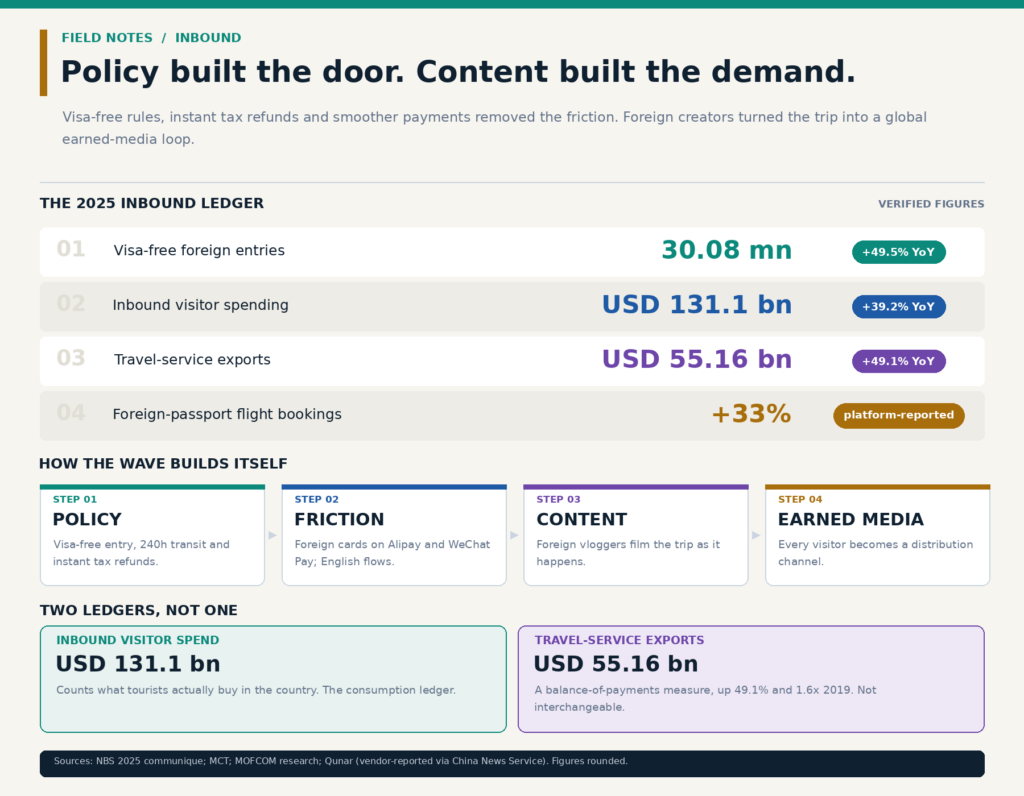
Policy opened the door; content dragged the world through it. In 2025, inbound arrivals reached 154.5 million, up 17.1 percent, including 35.17 million foreign visitors, according to the National Bureau of Statistics. Foreign visitors spent USD 131.1 billion, up 39.2 percent. Visa-free foreign entries hit 30.08 million, up 49.5 percent.
Separately, the Ministry of Commerce reported that travel-service exports reached USD 55.16 billion, up 49.1 percent and 1.6 times the 2019 level. Do not mix these two numbers. Inbound visitor spending counts what tourists buy; travel-service exports is a payments-balance measure. They describe different things, and using them interchangeably is a classic analytical own-goal.
Fixing the Friction
What made the “China Travel” wave spread was not only policy — it was the removal of small, embarrasing frictions. Foreign cards now work far more smoothly on Alipay and WeChat Pay. English signage and booking flows improved. In 2025, inbound visitors used mobile payment for roughly CNY 80 billion in spending, according to the culture minister’s annual press briefing.
And the distribution? Foreign vloggers. A tourist with a phone became a free, credible, endlessly syndicated ad. Qunar, an online travel platform, reported that bookings made with non-Chinese passports rose by more than 30 percent during the 2025 National Day holiday, reaching roughly 33 percent by the platform’s own measurement — vendor-reported data worth citing as such. Destinations suddenly had an earned-media channel they did not control and could not buy.
The Content Funnel: Seeding to Booking to Compound
The domestic discovery funnel runs on a simple loop. Short video and lifestyle platforms — Douyin and Xiaohongshu — do the “seeding,” planting desire through imagery and peer stories. Booking platforms such as Ctrip and Meituan do the “harvesting,” converting interest into reservations. Then user-generated content recirculates, compounding the effect for free.
For global marketers this is familiar territory, with one twist: AI answers now sit on top of the funnel. When a traveller asks an assistant “where should I go in Jiangsu in autumn,” the destination that has clear, structured, answer-ready content wins the recommendation. Optimizing for AI retrieval — the discipline often called GEO — is no longer optional for destinations that want to be named, not just seen.
Holiday Economics: Concentration and Arbitrage
China’s travel demand arrives in enormous, compressed bursts. The 2026 Spring Festival alone stretched to nine days and produced 596 million domestic trips and CNY 803.48 billion in spending — both record highs, per the Ministry of Culture and Tourism’s data centre. The National Immigration Administration logged 1.313 million foreigner entries and exits over the holiday, up 21.8 percent on a daily average basis.
That concentration creates two plays. Massive campaigns cluster around the big holidays, where attention is cheap to capture because everyone is looking. But the smarter operators work the shoulders — off-peak and reverse-route travel, where hotels must defend yield and travellers get better value. For a marketer, the arbitrage is real: visibility is most expensive exactly when everyone buys it.
The Price-Down Response: Bundles and Repeat
So how do you actually win in a volume-up, price-down market? You stop discounting and start bundling. You sell value stacks — transport plus stay plus experience — that feel generous without eroding the headline price. You cross-sell into local-services ecosystems, where a trip becomes a gateway to restaurants, retail and membership.
Crucially, you chase the second trip, not just the first. Private-domain communities, loyalty mechanics and post-trip content keep the relationship alive. In a market defined by frequency, retention is the compounding asset. Reach is rented; repeat is owned.
Global Mirrors: What Travels and What Doesn’t
China is not alone. Japan welcome 42.7 million inbound visitors in 2025, up roughly 16 percent and its first year above 40 million, with record spending near JPY 9.5 trillion, according to the Japan National Tourism Organization. Its playbook — weak currency, national strategy, regional dispersal — rhymes with China’s, but the drivers differ. Where China leans on state-coordinated campaigns and domestic occasion marketing, Japan leans on currency and sustained destination branding.
The post-pandemic “revenge travel” surge has also faded globally, replaced by more measured, value-conscious behaviour. The transferable lesson is not a specific tactic. It is the structural one: when consumers trade down per occasion but up in frequency, sell the occasion and the system around it, not the luxury label.
The Playbook: Five Moves
Strip all of this down and you get a usable shortlist:
- Sell occasions, not packages. The match, the concert, the festival — the reason to go now.
- Put UGC first. Design the photo, the meme, the shareable moment before you design the media plan.
- Ride policy. Visa rules, tax refunds and new holidays are demand partners; build calendars around them.
- Be inbound-ready. Foreign-card payments, English content, answer-ready AI presence.
- Optimize for repeat. In a frequency market, retention is where the margin hides.
Conclusion
China’s travel rebound was never really about getting back to 2019. It was about inventing a different engine: more trips, thinner tickets, cities behaving like campaigns, tickets behaving like coupons, and travellers behaving like broadcasters. If you take one thing away, let it be this — in a market where each occasion is smaller, the winner is the brand that owns the most occasions.