Picture the customer your brand has in mind when someone says “Chinese senior consumer.” Go on, be honest. It’s probably a frail figure in a beige cardigan, haggling over vegetables, suspicious of anything that costs more than a bowl of noodles, waiting for a grandchild to explain the television remote. That person exists. But she is no longer the default — and if your strategy is built around her, you are marketing to a minority while the majority scrolls past your ads without recognizing itself.
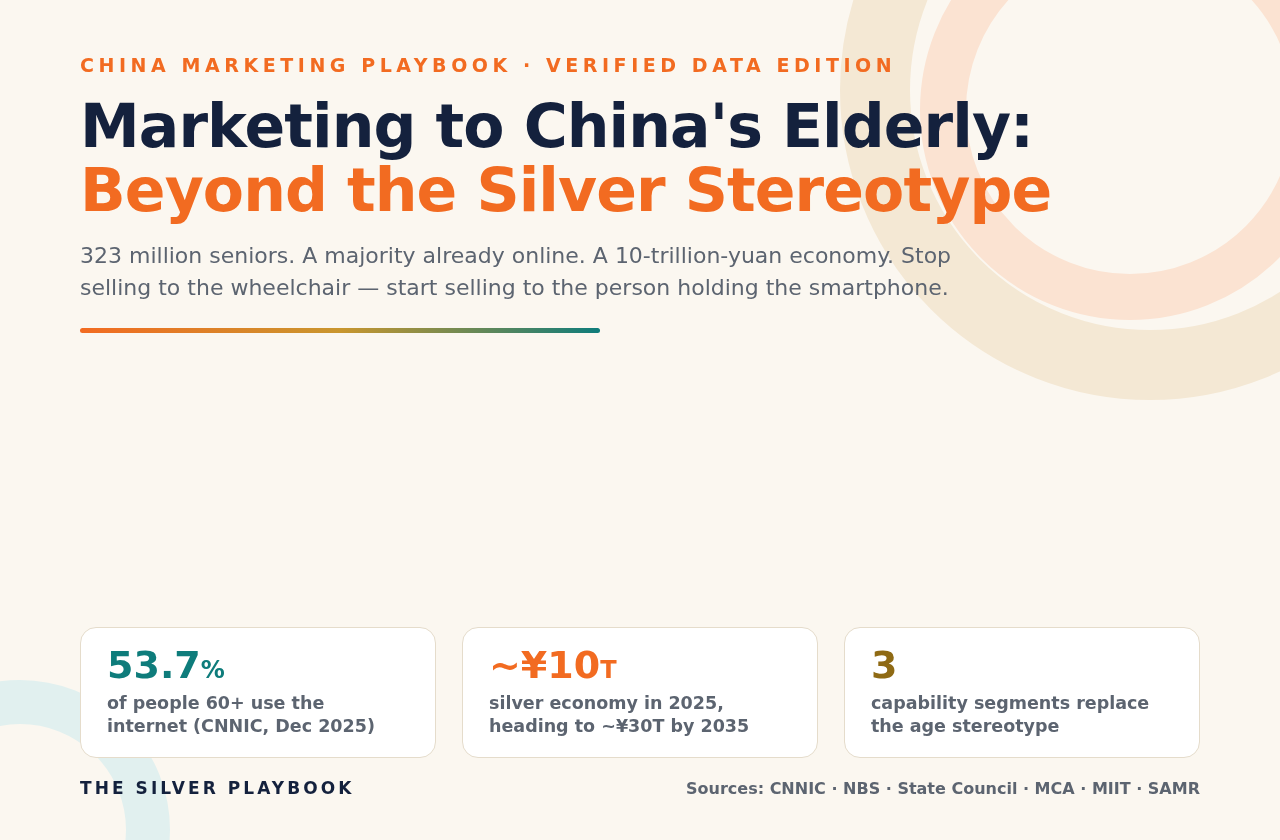
Here is the majority. At the end of 2025, China counted 323.38 million people aged 60 and over — 23% of the population, according to the National Bureau of Statistics. And per CNNIC’s 57th internet report, released in February 2026, 53.7% of them use the internet. Read that again: more than half. The previous report, covering June 2025, had already counted 161 million senior netizens. These are not people who need to be taught what a smartphone is. They are watching short videos, arguing in comment sections, booking train trips, and — in a detail that should make every marketer sit up — 30.9 million of them had tried AI by December 2025, up 9.44 million in just six months.
The stereotype says offline, frail, price-obsessed. The data says online, active, and upgrading. This playbook is about closing that gap.
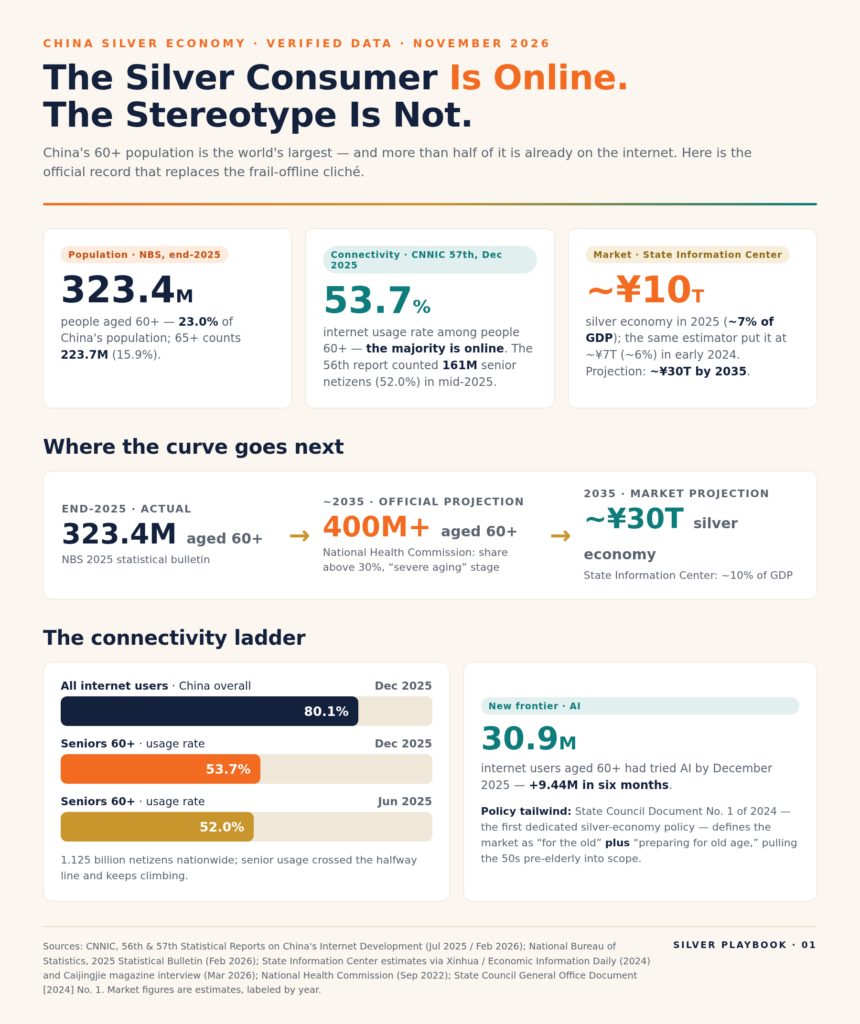
The Stereotype Is a Minority Report
Why does the cliché survive? Because it was true once, and because the most visible senior marketing in China has long been the worst kind: health-supplement pitches, miracle mattresses, “free” egg giveaways that end in a sales ambush. When that is your only reference point, you conclude that seniors only buy frailty products. The actual consumption data tells a more complicated story — the China Research Center on Aging’s 2025 blue book, built on the fifth national sample survey of older adults, finds that basics still dominate: food, healthcare, transfers and transport account for roughly 90% of senior spending. The upgrade is real but uneven. That is precisely why segmentation matters. You cannot sell a cruise to someone whose budget goes to insulin, and you cannot sell a miracle cure to someone who just booked a photography tour. Both customers are 68 years old. They have nothing else in common.
The State Already Wrote Your Market Brief
In January 2024, the State Council’s General Office issued its Document No. 1 of the year — the first national policy ever named after the “silver economy.” Twenty-six measures across four areas, and one definition worth memorizing: the silver economy is the sum of economic activities that provide products and services to older people, plus activities that prepare people for old age. That second half — what Chinese policy calls “preparing for the old” — quietly expands your total addressable market to everyone in their fifties who is already buying pension products, health checks and retirement-apartment brochures. The document names seven potential industries to cultivate: senior products manufacturing, smart health and eldercare, rehabilitation aids, anti-aging, pension finance, tourism services, and aging-friendly retrofits. When a market gets a State Council document, subsidies and standards follow. Plan accordingly.
How Big Is Big? Label Your Numbers
The headline estimate comes from the State Information Center, whose researcher Hu Zuquan put the silver economy at roughly RMB 7 trillion — about 6% of GDP — in early 2024, and projected around RMB 30 trillion, or 10% of GDP, by 2035. In a March 2026 interview with Caijingjie magazine, he updated the current figure: about RMB 10 trillion in 2025, roughly 7% of GDP. Treat these as official estimates, not audited statistics — the definition is broad, spanning everything from adult diapers to pension wealth management, and narrower “senior products only” counts are much smaller. Meanwhile the population math is firmer: the National Health Commission projects the 60+ cohort will pass 400 million around 2035, exceeding 30% of the population. Life expectancy has reached 79.25 years, per the 2025 national aging bulletin. Longer lives, more of them, more spending years. That is the demand floor.
Segment by Capability, Not by Birthday
Here is the operating core of this playbook. Age brackets are a lazy proxy for what actually determines your channel, your offer and your message: what the person can do. Three segments, three playbooks.
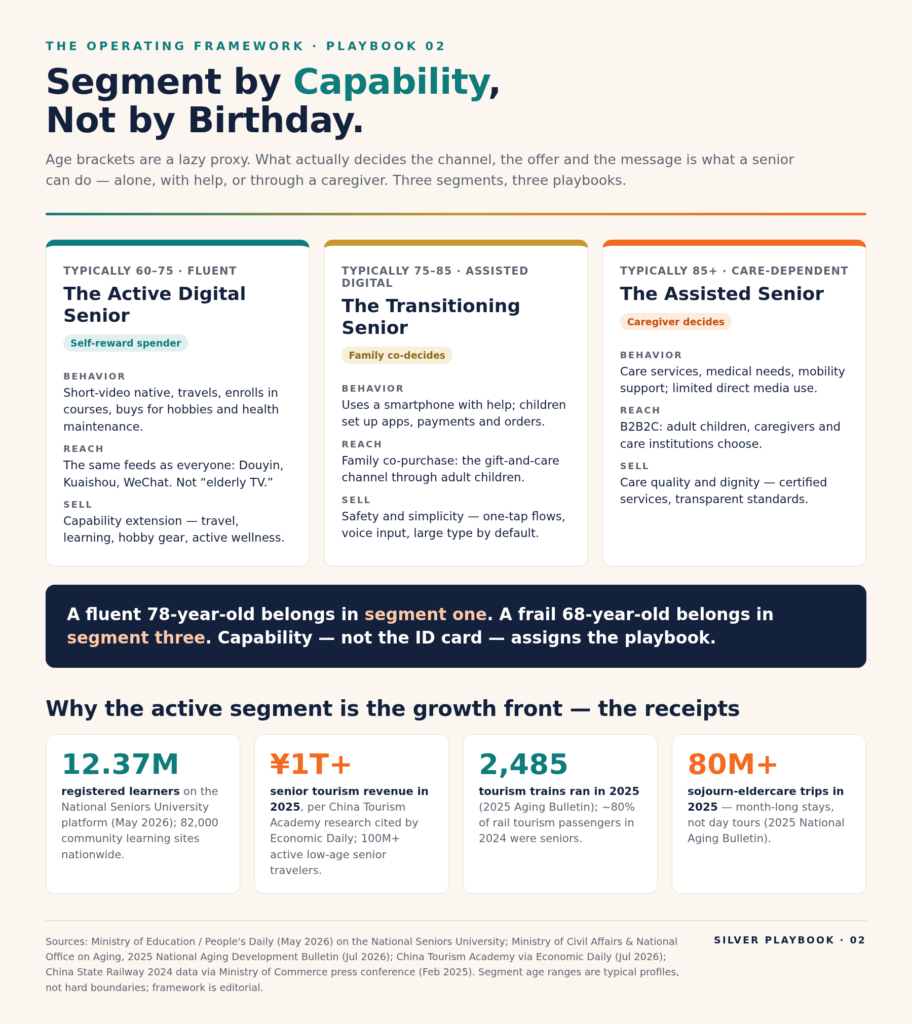
The active digital senior — typically 60 to 75, fluent on a smartphone. She watches Douyin and Kuaishou in the same feeds as her grandchildren, travels, enrolls in courses, and spends on herself. Reach her where she already is, and sell capability extension: travel gear, learning, hobbies, health maintenance. Not decline management.
The transitioning senior — typically 75 to 85, using a phone with help. His daughter installed the apps, bound the payment card, and approves anything expensive. Reach him through family co-decision, and sell safety and simplicity: one-tap flows, voice input, large type as standard.
The assisted senior — typically 85 and up, care-dependent. The buyer is an adult child, a caregiver, or an institution. This is a B2B2C sale: market care quality and dignity to the decision-maker, with certifications and transparent standards doing the persuading.
The principle underneath: a fluent 78-year-old belongs in segment one; a frail 68-year-old belongs in segment three. Capability assigns the playbook, not the ID card.
The Active Majority Has Receipts
If you doubt that self-reward spending is real, look at what the state itself has recorded. The National Seniors University — built by the Ministry of Education on the Open University of China system since 2023 — now runs 44 provincial branches and 82,000 grassroots learning sites, and its online platform passed 12.37 million registered users by May 2026, per People’s Daily. Registration is free and opens at 50. Popular offline courses sell out in minutes; these are not people passively waiting to be cared for. In travel, research from the China Tourism Academy cited by Economic Daily shows senior tourism revenue broke RMB 1 trillion in 2025, with more than 100 million high-propensity, healthy, younger-old travelers. The 2025 national aging bulletin counts 2,485 tourism trains run that year and over 80 million sojourn-eldercare trips — month-long stays in warmer provinces, not day tours. Back in 2024, seniors already made up nearly 80% of rail tourism passengers. And the policy machine is feeding the trend: a February 2025 action plan from the Ministry of Commerce and eight other bodies targets 100-plus boutique silver rail routes, 160 adapted trainsets and 2,500-plus trains a year by 2027.
Accessibility Is the Door, Not a Special Mode
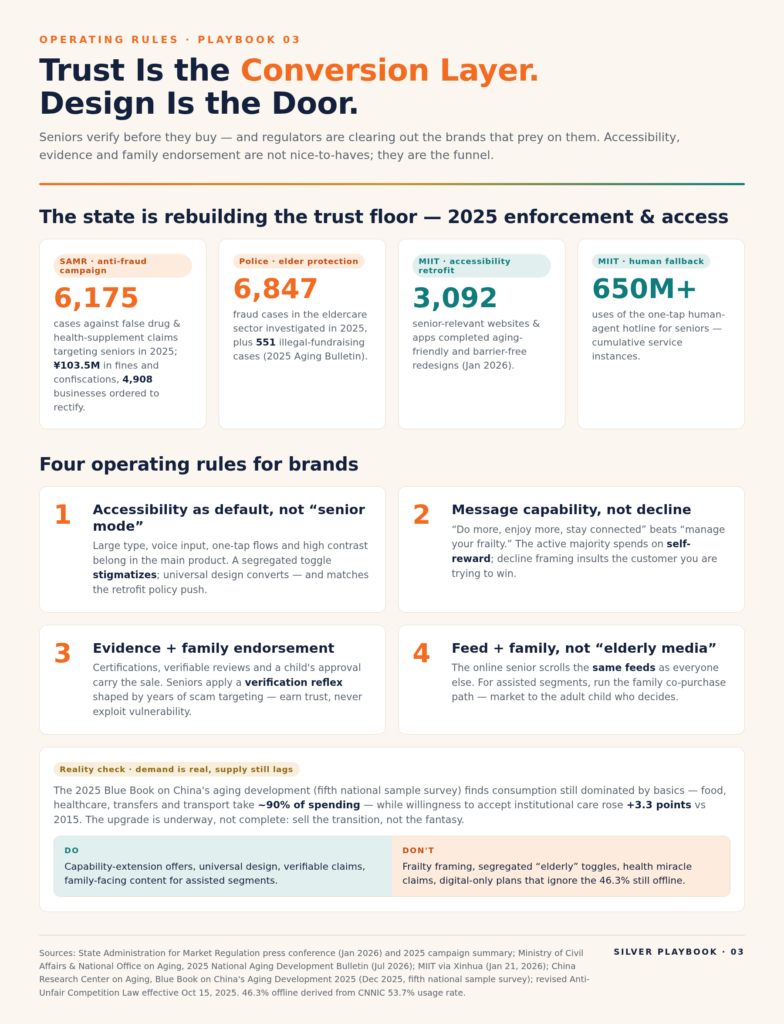
China’s retrofit push is not decoration. By January 2026, the Ministry of Industry and Information Technology reported 3,092 senior-relevant websites and apps had completed aging-friendly and barrier-free redesigns, and the one-tap human-agent hotline for seniors had served over 650 million cumulative uses. The lesson for your product: large text, voice input, high contrast and one-tap flows belong in the default experience, not behind a toggle labeled “senior mode.” A segregated mode stigmatizes — it tells the customer you think she is broken. Universal design converts, because it also helps the tired 45-year-old and the kid on a cracked screen. And it aligns you with the direction of policy, which increasingly treats accessibility as infrastructure rather than charity.
Message Capability, Never Decline
The active senior is spending on becoming more herself, not on managing her decay. “Do more, enjoy more, stay connected” is the register that works; “manage your frailty” insults the exact customer you are trying to win. This is not politeness — it is positioning. The same 68-year-old who resents a decline-framed ad will happily buy a better camera, a dance class, or a slow-travel package framed as earned reward. Sell the extension of a life, not the administration of its ending.
Trust Is the Conversion Layer
Seniors verify. Years of being targeted by scams have installed a reflex: check the certificate, read the reviews, ask the son. Your funnel should assume that reflex and feed it — verifiable claims, real certifications, visible reviews, and content a skeptical adult child can approve. And understand what the regulator is doing to the alternative. In 2025, the State Administration for Market Regulation ran a special campaign against false drug and health-supplement claims aimed at seniors: 6,175 cases, RMB 103.5 million in fines and confiscations, 4,908 businesses ordered to rectify. Police investigated 6,847 fraud cases and 551 illegal-fundraising cases in the eldercare sector that year. The revised Anti-Unfair Competition Law, effective October 15, 2025, tightened the rules on false promotion and platform responsibility — including the private livestream rooms where “free health lectures” funnel seniors into high-pressure sales. The brands that exploit vulnerability are being removed from the field. The trust premium goes to whoever earns it honestly.
Reach Them in the Feed — and Through the Family
Two channels, matched to segments. For the active and transitioning seniors, the answer is boring and correct: the same feeds everyone else uses. Short video, WeChat, community groups. There is no separate “elderly media” worth buying at scale — the online senior is already in the mainstream attention market. For assisted seniors, run the family co-purchase path: gift-and-care framing aimed at the adult child who decides, with the senior’s dignity kept intact in the creative. The child buys the massage chair; the ad should make the parent look like a person receiving love, not a problem being solved.
Don’t Over-Rotate: The Divide and the 50s
Two honest caveats. First, 46.3% of seniors are still offline — the complement of that 53.7% usage rate. Rural, older, poorer cohorts remain large and real; a digital-only plan abandons them, and the assisted segment’s needs do not disappear just because they are hard to reach through feeds. Second, the policy’s “preparing for old age” framing pulls the 50s into the market — and the stereotype risk follows them there. Do not “aging”-frame an active 55-year-old who buys running shoes and retirement funds in the same week. She is a pre-elderly customer with decades of consumption ahead, and she will punish anyone who treats her as already old.
The 90-Day Action List
Audit your senior assumptions: pull your last three campaigns aimed at 60+ and ask which segment they actually addressed. Re-segment by capability, not birthday. Ship universal accessibility into the default product — type scale, voice, one-tap — and kill the segregated toggle. Build the family co-purchase lane for assisted segments: child-facing content, gift framing, approval-ready evidence. Move your active-segment offer mix toward capability extension — travel, learning, hobbies, active wellness — and test it in the mainstream feeds. And put every health claim through a verification gate before it ships; in this market, compliance is not a cost center, it is the moat.
Conclusion: Market to the Person, Not the Wheelchair
China’s seniors are 323 million strong, a majority online, sitting inside an economy the State Information Center now estimates at roughly RMB 10 trillion and projects toward RMB 30 trillion by 2035. The state has written the market brief, built the accessibility rails, and started clearing out the predators. What remains is the part only brands can do: stop addressing the stereotype, segment by capability, design for dignity, earn trust with evidence, and sell the extension of a life rather than the management of its decline. The silver consumer is a smartphone user first. Market to the person holding the phone.