Here is the uncomfortable truth about Chinese e-commerce copy: your product page is never read by just one audience. It is read by a search algorithm that decides whether you exist, a skeptical shopper who assumes you are exaggerating, and a compliance scanner — human or machine — hunting for the one word that triggers a fine. Most listings fail at least one of these readers. The slogan-heavy title never gets retrieved. The adjective-heavy detail page never gets believed. The “best-in-class” claim gets flagged, and suddenly your best seller is offline.
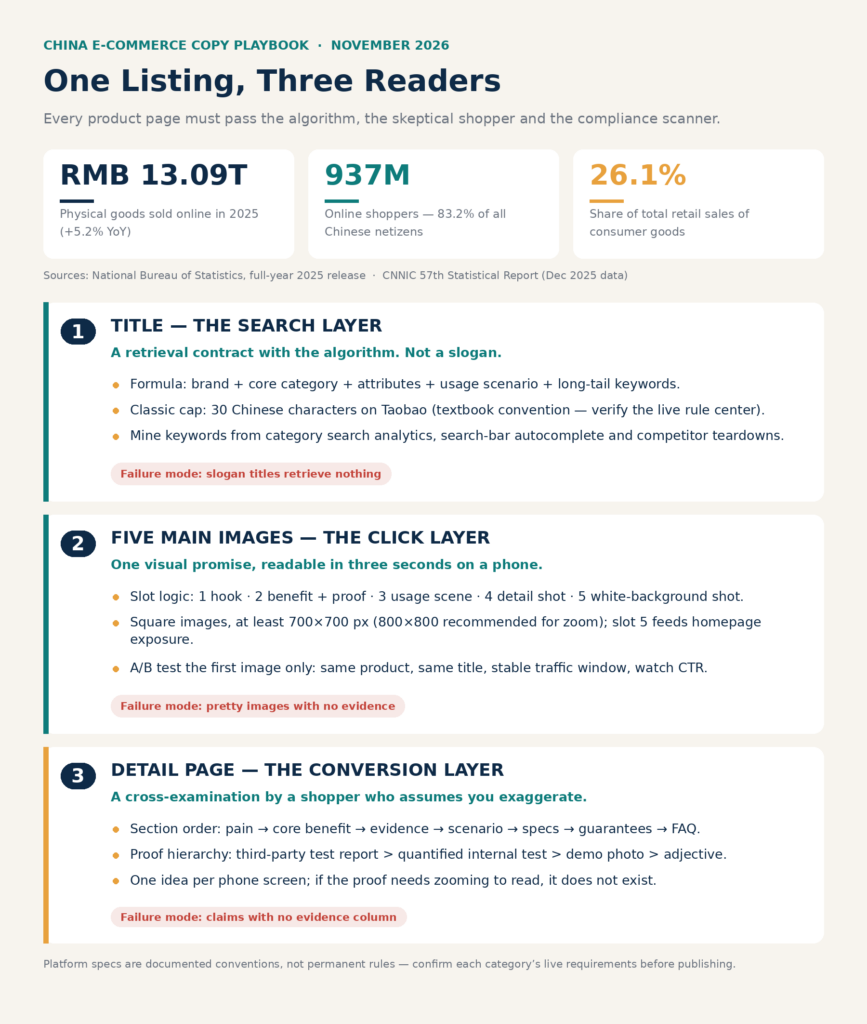
The stakes are not small. Physical goods sold online in China reached RMB 13.09 trillion in 2025, about 26.1% of all retail sales of consumer goods, according to the National Bureau of Statistics’ full-year release. And per CNNIC’s 57th statistical report, 937 million people — 83.2% of all Chinese internet users — shop online. That penetration number matters more than the headline scale: the audience is nearly maxed out. You are no longer writing to convert new internet users. You are writing to win skeptics who have seen every trick before.
This playbook gives you the system: three writing surfaces, a claim-evidence method that keeps you legal, category templates, and an AI workflow with gates instead of vibes.
Surface 1 — The Title Is a Retrieval Contract
Your title is not persuasion. It is a contract with the search engine about what your product is. On Taobao, the classic cap is 30 Chinese characters (60 character units) — a convention documented across e-commerce textbooks and platform tutorials; always confirm the current limit in the platform’s live rule center before you publish, because category rules change.
Inside that tiny budget, the working formula is: brand word + core category word + attribute words + scenario words + long-tail words. A ceramic pour-over coffee dripper is not “Brew Happiness Every Morning.” It is brand + pour-over dripper + ceramic + V-shaped filter + home office. Every character earns its place by matching something a buyer actually types.
Where do the words come from? Three places, in order of reliability: your category’s search-term analytics (on Taobao, the Business Advisor tool), the platform’s search-bar autocomplete, and a teardown of the top twenty competing listings. Autocomplete is underrated — it is the platform telling you, for free, what real demand sounds like.
Two rules keep titles alive. First, keywords must match your registered category and attributes; a fresh-fruit listing cannot borrow dried-fruit keywords. Second, superlatives are not just useless here, they are illegal bait — more on that below. A title stuffed with “No.1” loses retrieval relevance and invites a compliance flag at the same time. Worst of both worlds.
Surface 2 — Five Images, One Three-Second Promise
The main-image carousel is your click layer. The widely documented Taobao convention: square images, at least 700×700 pixels (800×800 recommended so the zoom function works), and a white-background product shot in the fifth slot, which feeds the mobile homepage’s recommendation surfaces. Again — conventions drift, so check the live category rules; the logic is what you should internalize.
That logic is slot economics. Image one carries the click: product plus one visual promise, readable in three seconds on a phone at arm’s length. Image two states the core benefit with proof, not adjectives. Image three shows the usage scenario — the kitchen, the desk, the commute. Image four is the detail shot that answers the most common pre-purchase doubt (the stitching, the port layout, the texture). Image five plays by the platform’s white-background rules and earns you free exposure. Where a main-image video is supported, treat it as the first slot’s upgrade, not an afterthought: motion demonstrates what stills can only claim.
Test image one the way performance marketers test ad creative: same product, same title, swap only the first image, and watch click-through rate over a stable traffic window. If you cannot beat your own first image with a challenger, your promise is probably already right — or your traffic is too thin to tell.
Surface 3 — The Detail Page Is a Cross-Examination
The detail page is where the skeptical shopper puts you on the stand. Chinese consumers browse with a verification reflex: they check the Q&A section, sort reviews by recency, and compare your spec table against three competitors before scrolling back. Write for that reader, in that order.
A section order that survives cross-examination: confirm the pain → state the core benefit → present evidence → show the usage scenario → publish full specs → list service guarantees → answer the top objections as FAQ. Notice that evidence comes before specs but right after the benefit — the reader wants the promise, then the receipt, then the fine print.
The proof hierarchy is strict. A third-party test report beats your own quantified test with a stated method. A quantified test beats a demonstration photo. A demonstration photo beats an adjective. “Ultra-durable” is worth nothing; “10,000 open-close cycles in a third-party lab test” is worth a screenshot the shopper can verify. Ingredient-transparency copy — what Chinese beauty communities call the chengfen dang style, writing for readers who audit ingredient lists — is simply this hierarchy applied to formulas: name the actives, state the concentrations you are allowed to state, cite the evidence you actually hold.
And design for the thumb. Most detail pages are read as a vertical scroll on a phone, so each screen should carry one idea, in large type, with the evidence visible without pinching. If your proof only becomes legible when zoomed, it does not exist.
The Legal Layer You Cannot Scroll Past
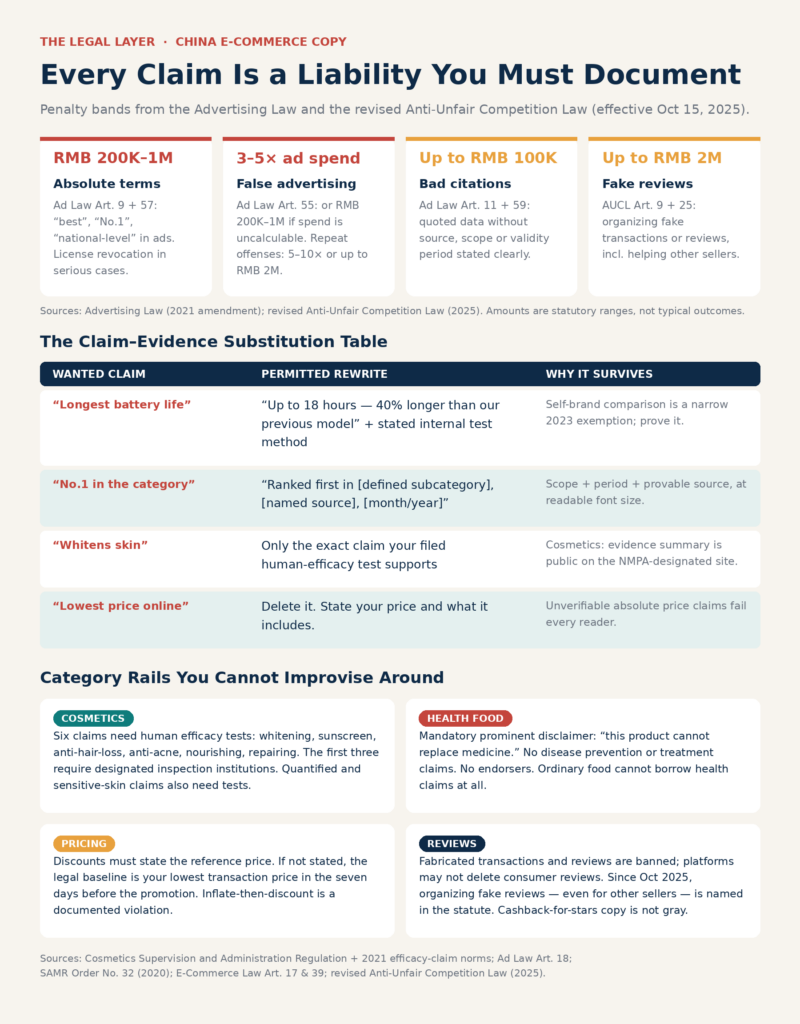
Now the reader nobody plans for: the regulator — in most cases the State Administration for Market Regulation, or SAMR. China’s Advertising Law, Article 9, bans absolute terms — “national-level,” “highest-level,” “best,” and their close cousins. This is not a style preference. Under Article 57, publishing an ad with prohibited absolute content brings a fine of RMB 200,000 to 1,000,000 on the advertiser, and serious cases can cost you the business license. False advertising is priced even more aggressively under Article 55: three to five times the advertising spend, or RMB 200,000 to 1,000,000 where spend cannot be calculated; three or more violations within two years escalate to five to ten times spend, or RMB 1,000,000 to 2,000,000 where spend cannot be calculated.
Read those bands again. One lazy superlative in one listing can cost more than a year of that listing’s profit. This is why “compliance copywriting” in China is not a niche skill. It is the skill.
The 2023 Exceptions — Narrow Doors, Not Open Gates
SAMR’s February 2023 enforcement guide on absolute terms softened the mechanical bans, and good copywriters should know the exact shape of the exceptions. Absolute wording can fall outside the ban when it compares your product only against your own brand’s other products, or when it states an objectively verifiable fact limited by explicit time and place — a sales rank scoped to a defined period and region, for example. First-time minor violations that are promptly corrected may go unpunished.
But two doors stay shut. The advertiser must still prove the truth of any factual claim — an exception is not an evidence waiver. And the guide explicitly refuses to treat certain uses as minor: efficacy or cure-rate absolutes in medical, medical-aesthetic, drug, device and health-food advertising, outcome promises in education and training ads, and return or safety guarantees in investment advertising. If you sell supplements or devices, write as if the rules never softened, because for your category they effectively did not.
The 2026 Citation Guide Killed the Small-Print Trick
In June 2026, SAMR issued a new enforcement guide on advertising citation content, aimed squarely at a habit e-commerce teams know well: big print to attract, small print to disclaim. The guide defines cited content — third-party data, statistics, survey results, quotations used to sell your product — and puts the burden of proof on the advertiser. Crucially, sources, scope and validity conditions must be clearly legible: you cannot shrink the qualifiers into tiny type, low-contrast colors, or folded-away corners of the page.
This sits on top of the Advertising Law’s Article 11, which already requires that quoted data be true and accurate, that sources be indicated, and that any scope or validity period be explicitly stated. A claim like “93% of users saw improvement” needs the survey source, the sample context, the time window — all readable at normal size. Get this wrong and the fine reaches RMB 100,000 under Article 59; get it wrong in a way that misleads, and you are back in false-advertising territory with the million-renminbi bands.
The practical translation for your detail page: every number you cite is a liability you must be able to document, at full font size, with its conditions attached. If that makes the claim less punchy — good. That is the point.
The Claim-Evidence Method
Here is the operating system that makes all of the above manageable: before anyone writes a sentence, build a claim library. One row per claim, four columns: the claim you want to make, the evidence document that supports it, the permitted wording, and the expiry or review date.
| Wanted claim | Evidence on file | Permitted wording | Review trigger |
|---|---|---|---|
| “Longest battery life” | Internal comparison vs own previous model | “Up to 18 hours — 40% longer than our previous model (internal test, method stated)” | New model launch |
| “No.1 in category” | Third-party ranking report, defined window and scope | “Ranked first in [defined subcategory], [named source], [month/year]” | Report expiry |
| “Whitens skin” | Human efficacy test per cosmetics rules | Only the exact claim the filed evidence supports | Formula change |
| “Lowest price online” | None — unverifiable | Delete. State your price and what it includes | Always |
The substitution pattern is always the same: replace the superlative with a measurement, replace the ranking with a scoped fact, replace the guarantee with a service commitment you can honor. “Best insulation” becomes “keeps water above 60°C for 12 hours in a stated lab condition.” The skeptical shopper trusts the second version more anyway. Legal and persuasive turn out to pull in the same direction.
Category Landmines Worth Memorizing
Cosmetics are the strictest mainstream category. Under the Cosmetics Supervision and Administration Regulation and the 2021 efficacy-claim evaluation norms, six claims — whitening/spot-removal, sunscreen, anti-hair-loss, anti-acne, nourishing and repairing — require human efficacy evaluation tests, and the first three must be tested by designated inspection institutions under mandatory national standards. Evidence summaries are published on a regulator-designated website for anyone to check, including your competitors. Quantified claims (“hydration for 8 hours”) and “suitable for sensitive skin” also require tests. Your copy ceiling is literally your test report.
Health foods carry a mandatory prominent disclaimer — “this product cannot replace medicine” — cannot claim disease prevention or treatment, and cannot use endorsers for testimony. Ordinary food cannot borrow health claims at all.
Pricing copy has its own trap. Under the 2020 promotional-behavior rules, a discount must state its reference price; if you do not state one, the legal baseline is your lowest transaction price in the seven days before the promotion. Inflate-then-discount is not a growth hack; it is a documented violation pattern.
And the review layer is now triple-locked. The E-Commerce Law requires truthful disclosure and bans fabricated transactions and reviews, and platforms may not delete consumer reviews — a duty backed by fines that reach RMB 500,000 in serious cases. The revised Anti-Unfair Competition Law, effective October 15, 2025, explicitly targets fake reviews and the businesses that organize them for others, extends protection to competing operators, and bans abusing platform rules through fake transactions, fake reviews or malicious returns. Penalties run up to RMB 1,000,000, or RMB 1,000,000 to 2,000,000 in serious cases — and notably, the old RMB 200,000 minimum fine was removed, giving regulators room to scale punishment to the offense. Review-farming copy — cashback for five stars — is no longer gray. It is named in the statute.
Category Templates: Match the Proof to the Purchase
Different categories fail different readers, so the template shifts. In beauty and personal care, lead with the filed efficacy evidence and ingredient transparency; the title carries function words, the detail page carries test data. In food — the fastest-growing physical online segment in 2025 at 14.5% per the statistics bureau — lead with origin, freshness logistics and certification; taste adjectives are cheap, cold-chain receipts are not. In consumer electronics, the spec table is the hero: put measurable comparisons early and let the scenario images close. In apparel, the fight is fit and fabric honesty — size charts with real garment measurements, material percentages, unretouched detail shots — in a segment that grew only 1.9%, where trust differentiates more than novelty. In home goods, durability proof and installation clarity convert; the FAQ section does heavy lifting because the objections are logistical.
The common thread: decide which evidence type your category’s skeptic demands, then structure every surface around delivering it.
The AI Workflow Needs Gates, Not Vibes
Generative AI is now mainstream in China — CNNIC counted 602 million users of generative AI products by the end of 2025 — and your competitors are already drafting listings with it. Fine. But raw model output fails Chinese listings in two predictable ways: it hallucinates specs you never supplied, and it reaches for illegal superlatives because its training data is full of Western marketing copy. The fix is a gated pipeline.
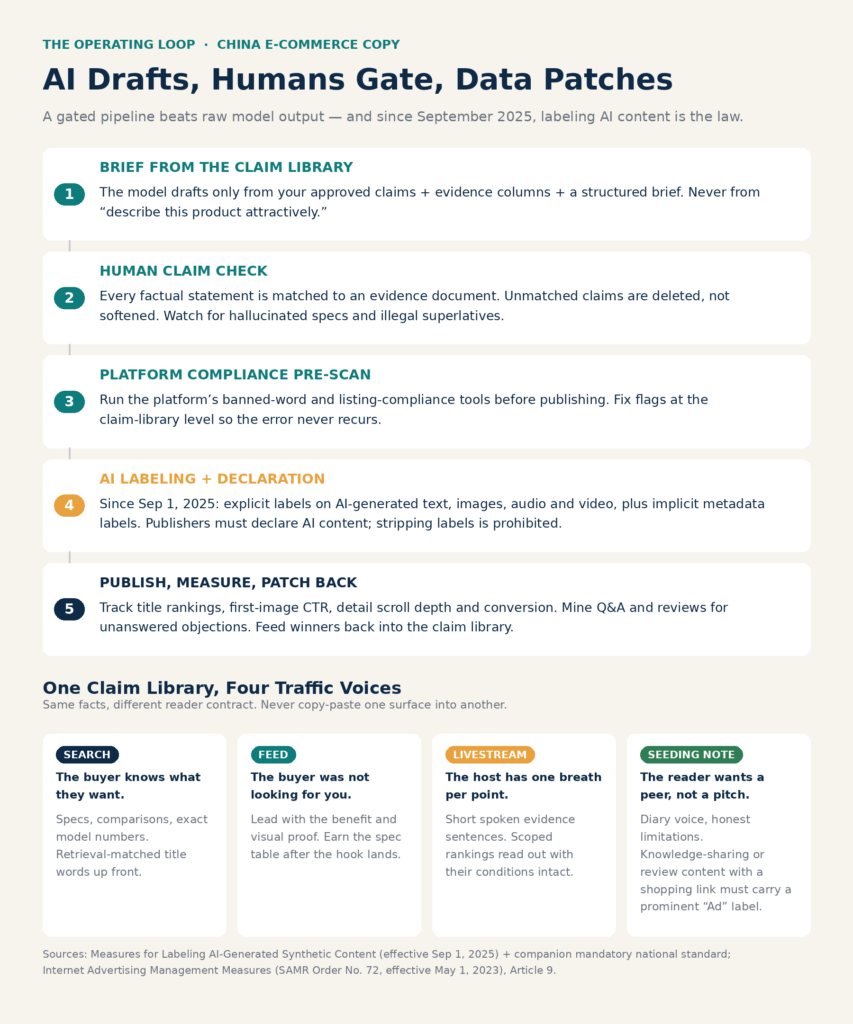
Step one: the model drafts only from your claim library plus a structured brief — never from “describe this product attractively.” Step two: a human checks every factual statement against the evidence column; anything unmatched is deleted, not softened. Step three: run the platform’s compliance pre-scan tools before publishing. Step four: handle labeling. Since September 1, 2025, China’s AI-content labeling measures require explicit labels on AI-generated text, images, audio and video, plus implicit metadata labels; publishers must proactively declare AI-generated content, and stripping labels is prohibited. If your listing images are AI-generated, declare them through the platform’s flow. Step five: publish, then feed performance back into the claim library.
One adjacent rule catches teams that reuse listing copy for seeding notes: under the 2023 internet advertising measures, experience-sharing or review-style content that promotes a product and attaches a shopping link must prominently carry an “Ad” label. The diary voice does not exempt the commercial intent.
One Product, Four Voices
The same claim library serves four traffic contexts, but the voice must change. Search traffic already knows what it wants — give it specs, comparisons, exact model numbers. Feed traffic was not looking for you — lead with the benefit and the visual proof, earn the spec table later. Livestream copy is the spoken version: short evidence sentences a host can say in one breath, with the scoped ranking read out with its conditions intact. Seeding notes are diary-voice — first-person experience, honest limitations, and the ad label where required. What never works is copy-pasting one surface into another. The detail page pasted into a feed ad reads like a tax form; the seeding note pasted into a title reads like noise.
Measure the Copy, Not Just the Sales
Copy iteration is a loop, not a launch. Track keyword rankings for the title, click-through rate for image one, scroll depth and conversion for the detail page, and mine the Q&A and review sections for the objections your copy failed to answer — recurring questions are unpaid focus groups. Patch one surface at a time: change a single variable, run it over a stable traffic window, compare against the prior period, and keep or revert. Teams that A/B five things at once learn nothing five times faster; they learn nothing once, expensively.
Six Ways Listings Die
The failure modes are boringly consistent. Slogan titles that retrieve nothing. Detail pages made of claims with no evidence column. Superlatives that trip Article 9. Spec errors — a wrong dimension — that manufacture returns and bad reviews. Cross-platform copy-paste that ignores each surface’s reader. And ungated AI output that ships a hallucinated certification. Every one of these is preventable with the system above, which is why the system is the deliverable, not the sentences.
Summary
Write the title for the algorithm, the images for the click, the detail page for the skeptic — and run every claim through the evidence library before any of them meet the regulator. In a market where 937 million people already shop online and the rulebook tightened again in 2025 and 2026, the winning copy is not the loudest. It is the copy that is retrievable, verifiable and legal — in that order, on every surface, every time.