Insight · The why behind trends · For a global marketing audience · November 2026 · Companion analysis to the Xiaohongshu note-anatomy playbook.
Here is a pattern every operator eventually notices. One note collects a wave of likes and goes quiet within a week. Another collects a fraction of the applause but several times as many saves — and is still pulling visitors months later. The vanity metric picked the wrong winner. Why?
Because the two buttons buy different things. A like is applause: cheap to give, socially frictionless, and finished the moment it lands. A save is a confession of future intent — “I will need this again when I buy, cook, pack or compare.” One signal tells the platform a note was pleasant. The other tells it the note is useful. And on Xiaohongshu, usefulness has a second revenue stream that pleasantness does not: the search bar.
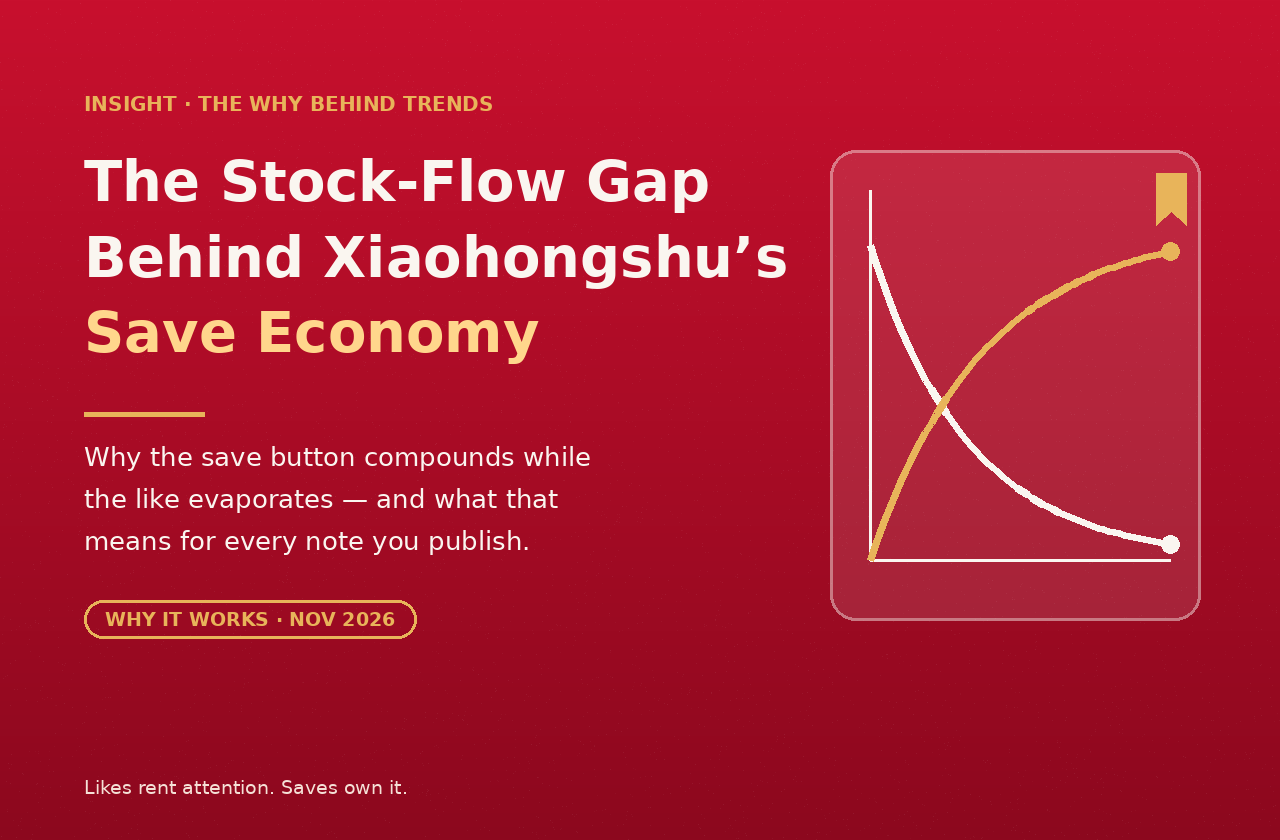
Here is the mechanism. Feed distribution is a flow — the algorithm must choose your note again in every session, and its appetite for novelty means yesterday’s winner is today’s inventory. Search visibility is a stock: once a note is indexed against a real query and has proven engagement, it sits on the shelf while demand walks past on its own. Operators report notes harvesting search traffic three to six months after posting. No official formula confirms the weighting — the widely circulated CES scores are practitioner folklore — but the structural asymmetry does not depend on any formula. Flows evaporate. Stocks compound.
The demand side makes the stock unusually valuable. The platform disclosed over 800 million searches a day in May 2026, and its 2025 trends report counted 73% of monthly users searching, nearly 90% of queries user-initiated. At the December 2025 WILL conference it said roughly 200 million users seek purchase advice monthly. These are platform self-disclosures, not audited figures — but even discounted, they describe a shelf with extraordinary foot traffic. A saved note is not just a bookmark; it is a small equity position in that traffic.
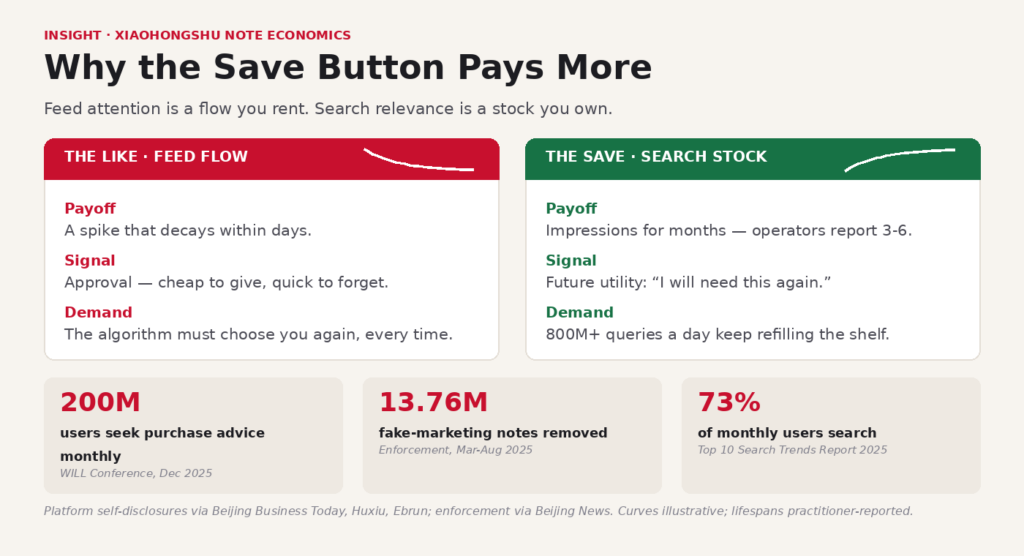
The enforcement ledger explains the other half of the gap. Between March and August 2025 the platform removed 13.76 million fake-marketing notes and over 360 million fake comments. Read that as a price list: manufactured approval is abundant and therefore worthless, while verifiable utility is scarce and therefore priced. The save button survives fraud inflation because faking future intent at scale is harder than faking applause — and the platform keeps raising the cost of trying.
So the gap is not a quirk of one app’s algorithm. It is what happens when a social feed grows a search engine underneath it: attention splits into a rented flow and an owned stock, and the metrics that looked interchangeable suddenly price different assets. Write for the stock. The applause will follow — or it won’t, and you will still be paid.