In February 2018, a Chinese sportswear company most young shoppers considered their father’s brand walked onto a New York Fashion Week runway. The show was themed Wu Dao — roughly, “enlightenment” — and the clothes carried four Chinese characters in a bold box logo: China Li-Ning. Runway sneakers sold out on Tmall within a minute. Within roughly 40 days, the company’s market value had climbed by about HK$6 billion. Guochao, the “national tide” of pride-driven buying of domestic brands, had found its standard-bearer.
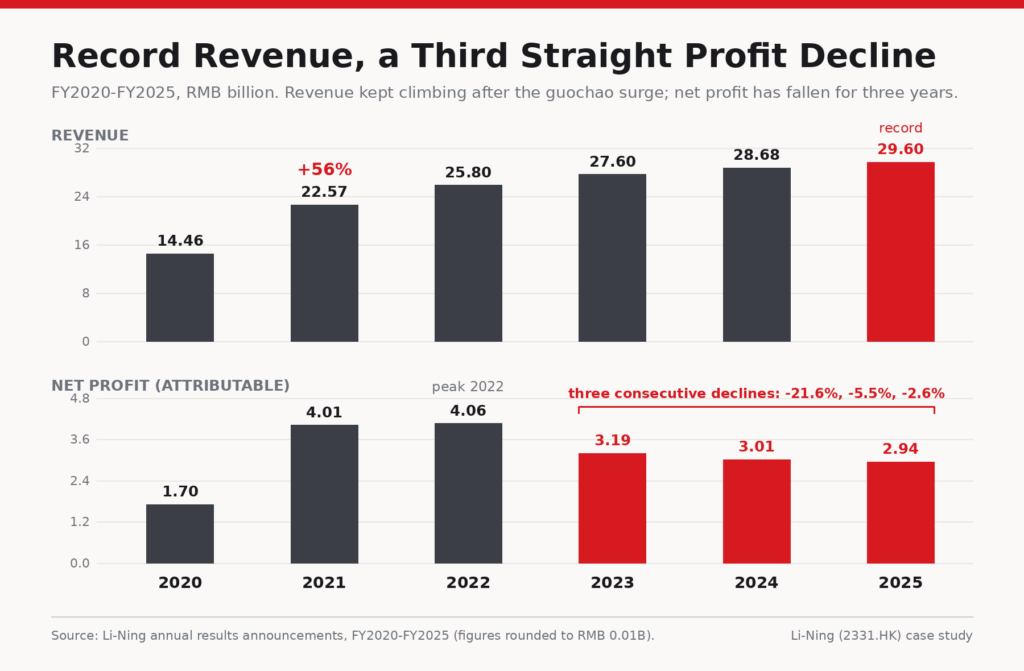
Seven years later, the tide has receded — and Li-Ning is still standing, but in a different pose. FY2025 revenue hit a record RMB 29.598 billion, up 3.2%. Net profit fell 2.6% to RMB 2.936 billion, its third straight annual decline. And the company’s biggest growth story is no longer a hoodie with Chinese characters on it. It is a carbon-plated racing shoe.
This is the story of a brand learning that a cultural moment is not a moat — and betting its second act on professional sport.
Act One: How the Tide Lifted the Brand
The 2018 runway moment was not an accident, but it was close. Li-Ning was the only sportswear label among the four Chinese brands invited to Tmall’s China Day at New York Fashion Week, and the design team had about a month to prepare 34 looks — pulling from existing products, adding the retro red-and-yellow palette of China’s classic Olympic podium suits, and stamping the China Li-Ning characters across the chest. The response rewrote the brand’s relationship with young consumers: fashion credibility, premium pricing, and queues.
Then came the accelerant. In 2021, the Xinjiang cotton controversy pushed Chinese consumers toward domestic brands, and Li-Ning’s revenue surged 56.1% to RMB 22.572 billion — the fastest growth since its 2004 listing. Net profit more than doubled to RMB 4.011 billion. In 2022, profit peaked at RMB 4.064 billion.
But look closely at that peak and you can see the crack. Revenue growth decelerated from 56% to 14.3% in a single year. Gross margin fell from 53% to 48.4%. The company had expanded stores and inventory against demand that assumed the cultural premium was permanent. It wasn’t. Guochao was a tailwind — a moment when national sentiment, platform marketing and design novelty aligned. Tailwinds fade. Moats don’t. Li-Ning had ridden the first brilliantly; it had not yet built the second.
For context on how brutal this industry can be when brand heat fades: Li-Ning’s earlier crisis, from 2012 to 2014, produced cumulative losses of over RMB 3 billion and roughly 1,800 store closures in 2012 alone. The company knows what the wrong side of a trend looks like. That memory shapes everything about the second act.
Act Two: The Professional Turn
By FY2025, Li-Ning’s strategy reads like a deliberate rebuttal of its own fashion era. The company calls it “single brand, multiple categories, multiple channels” — and the engine room is professional sport.
Running Is Now the Crown Jewel
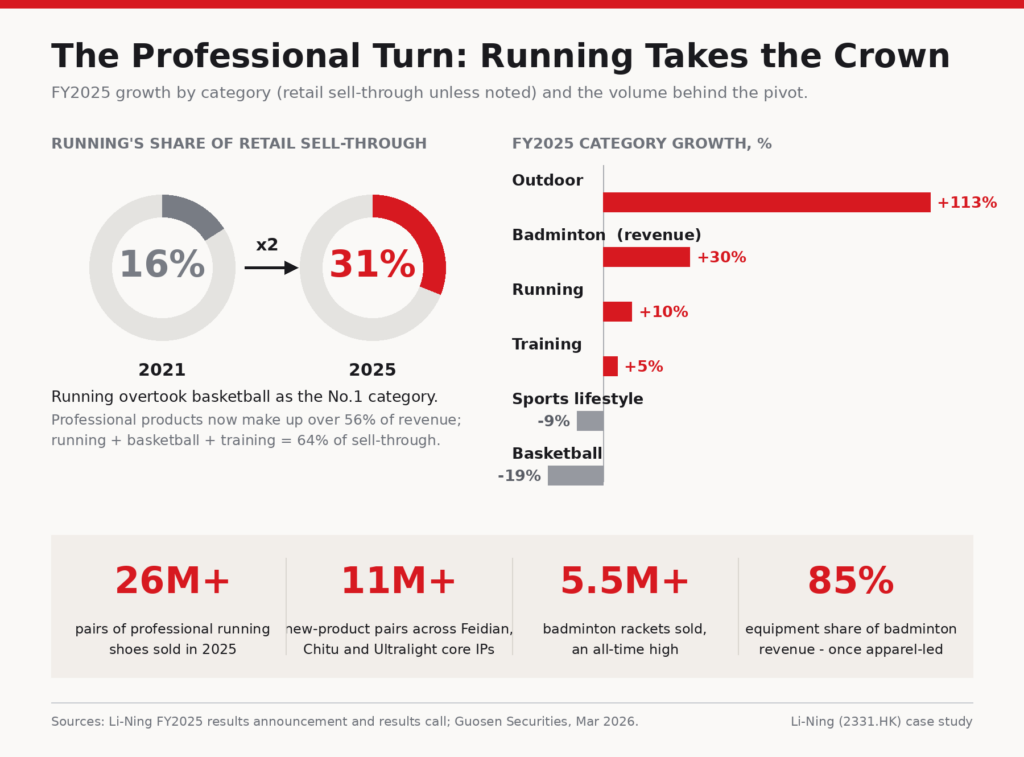
Running’s share of retail sell-through climbed from 16% in 2021 to 31% in 2025, overtaking basketball as the No.1 category. Sell-through grew 10% in a year when overall retail flow was flat. Li-Ning sold more than 26 million pairs of professional running shoes in 2025; the three core franchises — Feidian (racing), Chitu (race-training) and Ultralight (daily) — moved over 11 million pairs of new-season product, up from about 10.6 million in 2024 and roughly 9 million in 2023.
The credibility is earned on course, not on camera. Since 2019, athletes in the Feidian series have won 277 championships and stood on 522 podiums. At the 2025 Shanghai Marathon, Feidian took the No.1 wear-rate among sub-three-hour finishers for the first time. The technology ladder is real, too: the 2019 Feidian 1 was the first carbon-plate racer from a Chinese brand, at a flagship price of RMB 2,099; the 2025 Super Beng Capsule midsole claims 95% energy return. When World Athletics deemed one Feidian 5 Ultra prototype’s dual-plate structure too aggressive for competition, that was, perversely, the best professional endorsement money can’t buy.
Co-CEO Qian Wei is candid that this was manufactured, not lucked into: the running surge was “not business scale we waited for, but something we pushed top-down, deliberately, over years.” Internally, management still calls the lead a “relative advantage” — one careless season and you fall back.
Badminton: The Hard, Right Path
Badminton looks like a niche until you see the economics. Category revenue grew 30% in 2025 to roughly RMB 2 billion (about 7% of group revenue), with racket sales passing 5.5 million — an all-time high. The strategic twist: three or four years ago, apparel made up 60–70% of Li-Ning’s badminton business. Today, professional equipment — rackets, strings, shoes — accounts for about 85%.
“We took the hard but right path,” Qian said at the results call. “We gave up a lot of short-term scale to focus on rackets, strings and the professional core.” Apparel is easy volume; equipment is earned trust. Once a serious player switches to your racket and string — Li-Ning developed China’s first domestic competitive string, the L67N — the relationship compounds. This is category ownership, the closest thing sport retail has to a moat.
The Olympic Return
In January 2025, Li-Ning announced it had won the sportswear partnership for the Chinese Olympic Committee and Team China for 2025–2028 — covering the Milan-Cortina 2026 Winter Games, the 2026 Asian Games and Los Angeles 2028. Media reports put the four-year price around RMB 800 million; the company has not disclosed terms.
The symmetry is almost novelistic. Li-Ning dressed Team China’s podium from Barcelona 1992 through four consecutive Summer Games, then lost the partnership to Anta in 2009. Anta held it for 16 years — a tenure during which Anta’s revenue grew from RMB 5.87 billion to over RMB 70 billion. Now the rights are back, and Li-Ning is monetizing them through the Glory Gold Label line (the first products co-carrying the COC commercial emblem) and a new flagship format, the Dragon Store, opened in Beijing’s Sanlitun in December 2025.
Management is explicit that this is brand equity, not an ad campaign: top-event sponsorship “is not a strategy that converts to business immediately — it builds brand potential.” The cost, however, is immediate. Advertising and marketing rose from 9.5% to 10.7% of revenue in 2025 — over RMB 3 billion, up 16.3%.
One Brand, Many Bets
Where Anta bought FILA, Descente, Kolon and Amer Sports (Arc’teryx, Salomon), Li-Ning incubates: LI-NING 1990 for premium sport fashion and golf, Li-Ning YOUNG for kids (1,518 stores), and COUNTERFLOW, whose first standalone outdoor store opened in Beijing in 2025 as outdoor sell-through grew 113% and outdoor footwear passed 500,000 pairs. Even the culture play has been repositioned: the Palace Museum collaboration, running since 2019 and formalized in December 2024, now sits inside the Olympic narrative — a joint themed space opened in the Forbidden City in January 2026, with a Li-Ning exhibition at Milan’s China House during the Winter Games. Culture as heritage, not hype.
Reading the Profit Squeeze Correctly
Here is where most takes on Li-Ning go wrong. “Third straight profit decline” sounds like decay. Decompose the FY2025 income statement and it looks like a company spending on transition while running the core better.
Gross margin slipped 0.4 points to 49.0%, from deeper promotional discounts and a channel-mix shift. But selling and distribution costs fell from 32.1% to 31.0% of revenue — closing weak stores, renegotiating rents — and operating margin rose from 12.8% to 13.2%. The core business got more profitable, not less.
Below the operating line, three things bit. First, tax: restructuring onshore-offshore funds triggered withholding provisions, lifting the effective rate from 26.7% to 29.9%. Second, real estate: the North Point office tower bought from Henderson Land in December 2023 for about HK$2.2 billion has been impaired by RMB 333 million in 2024 and another RMB 269 million in 2025 as HK office prices fell — roughly RMB 600 million of paper losses across two years. Third, finance income collapsed about 81% to RMB 33 million as rates fell and cash was reshuffled. None of these is a running-shoe problem.
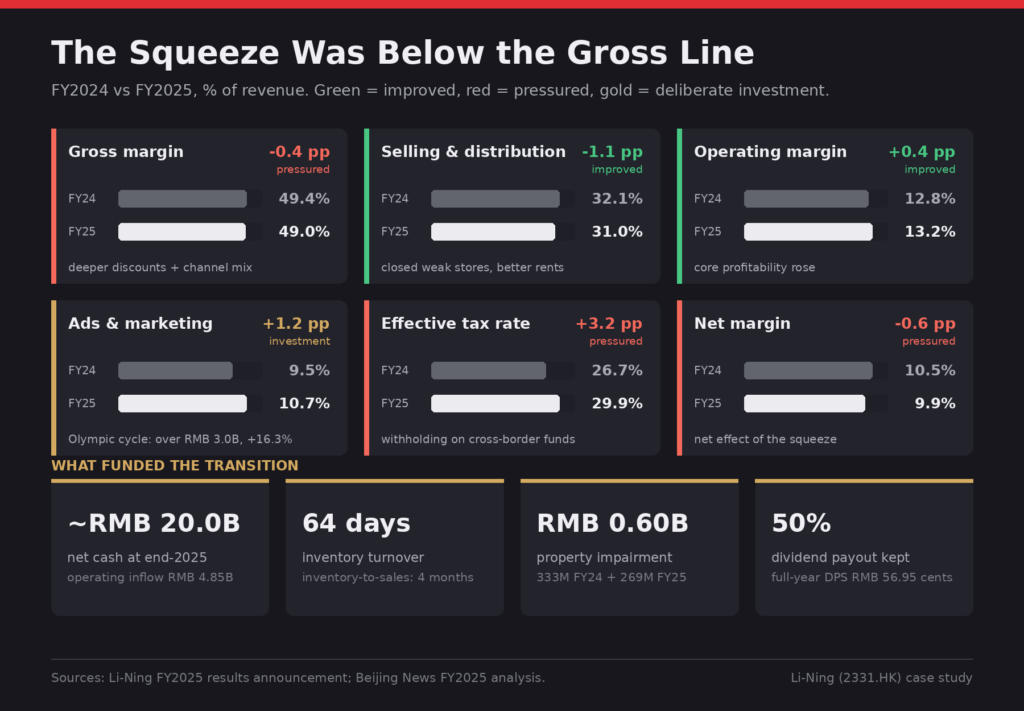
Meanwhile the balance sheet is a fortress: net cash of roughly RMB 20 billion at end-2025, operating cash inflow of RMB 4.85 billion, inventory turnover of 64 days, about 85% of channel inventory younger than six months and only 6% older than twelve. The dividend payout stayed at 50%. A company in decline does not fund a RMB 800 million Olympic cycle, raise marketing spend 16%, and still pay out half its earnings.
The honest caveat: full-year retail sell-through was flat in 2025, with the second half declining (Q3 mid-single-digit, Q4 low-single-digit). Wholesale revenue growth outran terminal demand, and that gap deserves watching. The category pivot is real; the consumer recovery is not yet.
The Competitive Map
The FY2025 scoreboard shows why strategy, not scale alone, is the story. Anta Group grew revenue 13.3% to RMB 80.219 billion — 2.7 times Li-Ning — though its namesake brand managed just 3.7% growth and group profit fell 12.9% on a high base (up 13.9% excluding Amer-listing effects). Xtep, the self-declared running specialist, grew revenue 4.2% to RMB 14.151 billion with net profit up 10.8%. 361 Degrees, the value player, posted double-digit growth in both lines for a fifth straight year: revenue RMB 11.146 billion (+10.6%), profit RMB 1.309 billion (+14.0%).
Read that map carefully: Li-Ning’s running pivot drives straight into Xtep’s home turf, its single-brand model carries none of Anta’s multi-brand shock absorbers, and value-priced 361 keeps squeezing the mass market underneath. Li-Ning’s answer is differentiation by professional credibility — the one lane where a gymnast-founded brand with real podium results can claim authenticity that marketing budgets can’t copy.
What Everyone Misunderstands
Misread one: Li-Ning is still a guochao brand. It isn’t — or rather, it can’t afford to be. The fashion premium peaked around 2021–22; the FY2025 growth came from running, badminton and outdoor. Guochao was act one, not the identity.
Misread two: falling profit means a failing business. Operating margin rose, revenue hit a record, net cash sits near RMB 20 billion. The decline is tax, property and promotion — visible, quantifiable, and largely transitional.
Misread three: single-brand is a weakness. It is a trade-off. Li-Ning forgoes Anta’s diversification but also forgoes M&A integration risk, brand cannibalization and the discipline problems of portfolio management. One brand means one reputation to defend — and every category extension either strengthens or dilutes it.
Misread four: the Olympic deal should show up in this year’s earnings. It won’t, and management says so. Association equity amortizes over a quadrennium; the expense hits now. Judging the 2025–2028 partnership by FY2025 profit is like judging a gym membership by the first week’s mirror.
The Reusable Methodology
For any brand that has ridden a cultural wave — nostalgia, nationalism, a viral aesthetic — Li-Ning’s transition offers four transferable rules.
One: classify your tailwind honestly. If removing the cultural moment would remove your pricing power, you have a tailwind, not a moat. Build the moat while the tide is still high; Li-Ning started pushing running years before the fashion premium faded.
Two: replace cultural premium with performance proof. Championships, wear-rates among serious athletes, equipment adoption by professionals — these are verifiable claims competitors can’t out-shout. The 277 titles behind Feidian do more pricing work than any runway.
Three: efficiency is the transition’s shock absorber. Li-Ning funded rising marketing spend by cutting the selling-expense ratio 1.1 points — closing 59 weak direct stores while franchise and e-commerce grew. You can invest in the second act only if the first act’s cost base pays for it.
Four: choose concentration deliberately. Single-brand focus compounds credibility and simplifies operations, but it removes the portfolio buffer. Make that bet with fortress liquidity — Li-Ning’s RMB 20 billion net cash is what lets a single-brand company act like a patient one.
Risks and Honest Caveats
The performance premium is not yet proven at fashion-era scale: can a Feidian racer command the margin a China Li-Ning hoodie did? Running is the most contested category in Chinese sport — Xtep owns marathons, Nike owns aspiration, and Qian himself calls the lead “relative.” Single-brand concentration means a stall in the main brand is a stall for the group; there is no FILA to lean on. The Olympic ROI lands over years while the costs land quarterly — and management has already guided FY2026 net margin down to mid-to-high single digits as Curry-brand basketball investment and Asian Games marketing ramp up. Terminal demand stayed soft through late 2025. And a professional brand lives on quality trust: complaint volumes about shoe durability are a slow-acting acid on exactly the credibility this strategy depends on.
The H1 2026 Epilogue: First Signs the Turn Is Working
The interim results announced in August 2026 gave the thesis its first checkpoint. Revenue rose 2.8% to RMB 15.235 billion; net profit rose 4.5% to RMB 1.816 billion — the first profit growth after three annual declines. Gross margin improved 0.9 points to 50.9% on cost optimization and mix. Professional running shoes sold 14.8 million pairs in six months, growing against a high base. The effective tax rate normalized to 25.8%, confirming that 2025’s tax bite was a transition artifact. Marketing spend kept climbing (11.2% of revenue) as the Stephen Curry partnership, signed in June 2026, opens a second front in basketball. Management trimmed full-year revenue guidance to low-single-digit growth with mid-to-high single-digit net margin — the honest price of investing through a soft consumer market. The second act is not proven. But the script is being followed.
Conclusion
Li-Ning’s first act taught Chinese marketing that culture can reprice a brand overnight. Its second act is teaching something less glamorous and more durable: that after the tide goes out, what keeps you standing is product proof, category ownership, channel efficiency and a balance sheet patient enough to fund the transition. Record revenue with falling profit is not the contradiction it appears — it is what a deliberate pivot looks like on an income statement. The guochao pioneer’s real test was never the runway. It is whether, by Los Angeles 2028, consumers reach for Li-Ning because it wins — not because it trends.