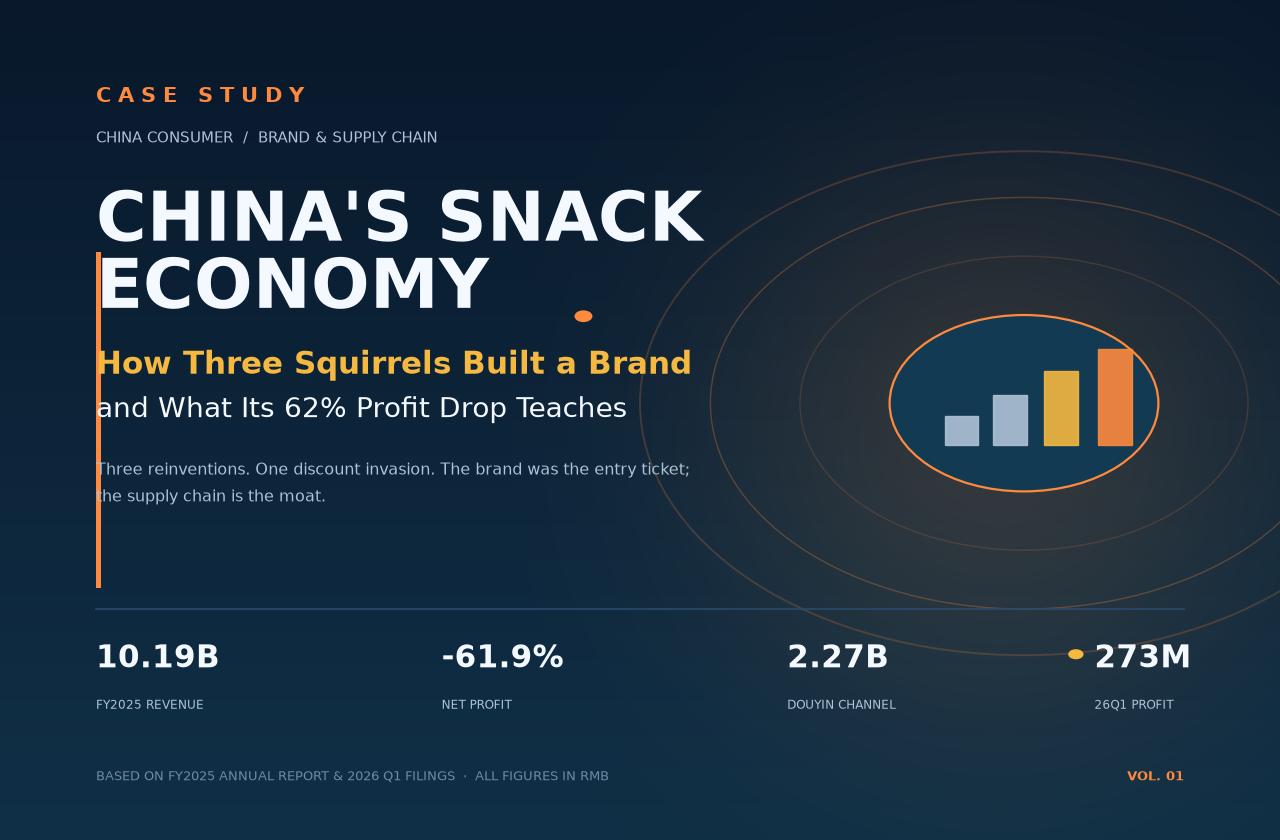
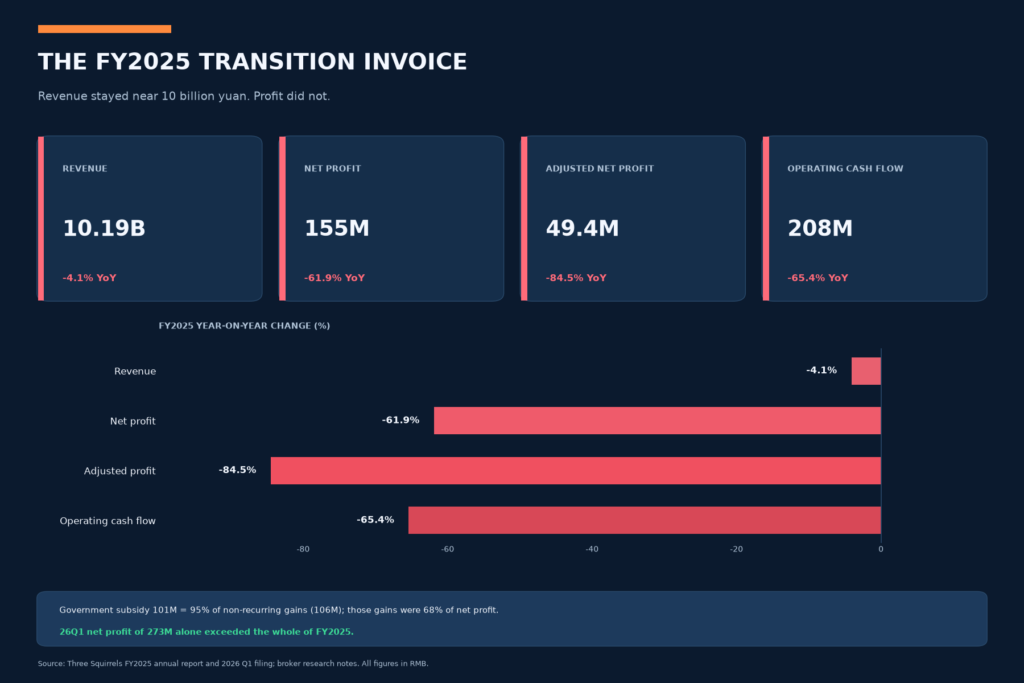
A company can sell ¥10.19 billion of snacks in a single year and keep almost none of the reward. Three Squirrels did precisely that in FY2025. Revenue slipped 4.1%, which is a rounding error in the language of China’s snack wars. Net profit fell 61.9% to ¥155 million. Strip out the subsidies and one-off items, and adjusted profit collapsed 84.5% to ¥49.4 million. Then came the twist: in the first quarter of 2026, the company earned ¥273 million — more than it made in the entire previous year.
Is this an accounting trick? Not really. It is the clearest case study available of a particular kind of brand being built, and then being overtaken by the economics that built it. Three Squirrels mastered the first era of Chinese e-commerce, watched the rent on that traffic rise, and has spent the past few years reinventing itself three times: as a content-commerce operator, as a manufacturer, and now as a community discounter. The FY2025 numbers are not a story of decline. They are the invoice for a transition.
Act I — The IP Brand on Rented Traffic
Start in 2012. Zhang Liaoyuan, a former e-commerce consultant, took five people to Wuhu in Anhui province and launched Three Squirrels on Tmall that June. The model was deliberately light: outsource production to contract manufacturers, pour resources into brand, packaging and service. There were no physical stores for years — the company actively refused offline distribution.
What made it work was theatre. Cartoon squirrels, a customer-service script that addressed buyers as masters, unboxing kits with nuts and bonuses tucked into elaborate packaging — every parcel was a small performance. Double 11 in that first year produced ¥7.66 million in a single day and the number-one slot in Tmall’s nuts category. By 2019, when the company listed on the ChiNext board, revenue had reached ¥10.17 billion and third-party e-commerce accounted for roughly 97% of sales.
Here is the part worth absorbing: the early advantage was never cheap traffic. It was a one-time arbitrage between an underpriced distribution channel and an asset-light brand model. Traffic was abundant, platforms were still buying growth, and a memorable unboxing experience could travel across millions of feeds for very little money. That window closed. Platform service and promotion fees climbed from about ¥660 million in 2019 to ¥1.312 billion in 2025. Even back at IPO, the warning was visible — a 22.59% selling-expense ratio left a net margin of just 2.35%. Growth was there. Profit was already thin.
The Traffic Tax Arrives
By FY2025 the arithmetic was brutal. Selling expenses reached ¥2.011 billion, up 7.67% from ¥1.867 billion a year earlier. Inside that number sat ¥1.312 billion of platform service and promotion fees — nearly ¥1 billion more than six years before. Revenue, meanwhile, was shrinking.
This is the central lesson of the case. A brand built on rented traffic does not own its customer; it rents the customer back from the platform every quarter. When the platform raises the rent, there is no asset to retreat into. The squirrel IP could still generate affection, but affection does not negotiate ad rates.
Consider the comparison that investors keep making. In the same year, hard-discount operator Wanchen Group grew revenue 59.17% to ¥51.46 billion while its selling-expense ratio fell 1.42 percentage points to 3.00%. Two snack companies, opposite directions: one paying an escalating toll to digital platforms, the other removing intermediaries from the supply chain entirely. The gap is not about snacks. It is about who owns the route to the customer.
Act II — Douyin as the New Shelf
The first reinvention was to follow the consumer into content. Three Squirrels pushed into Douyin with a system it calls D+N — Douyin plus a wider omni-channel network — treating short video and livestreaming not as advertising but as a new shelf.
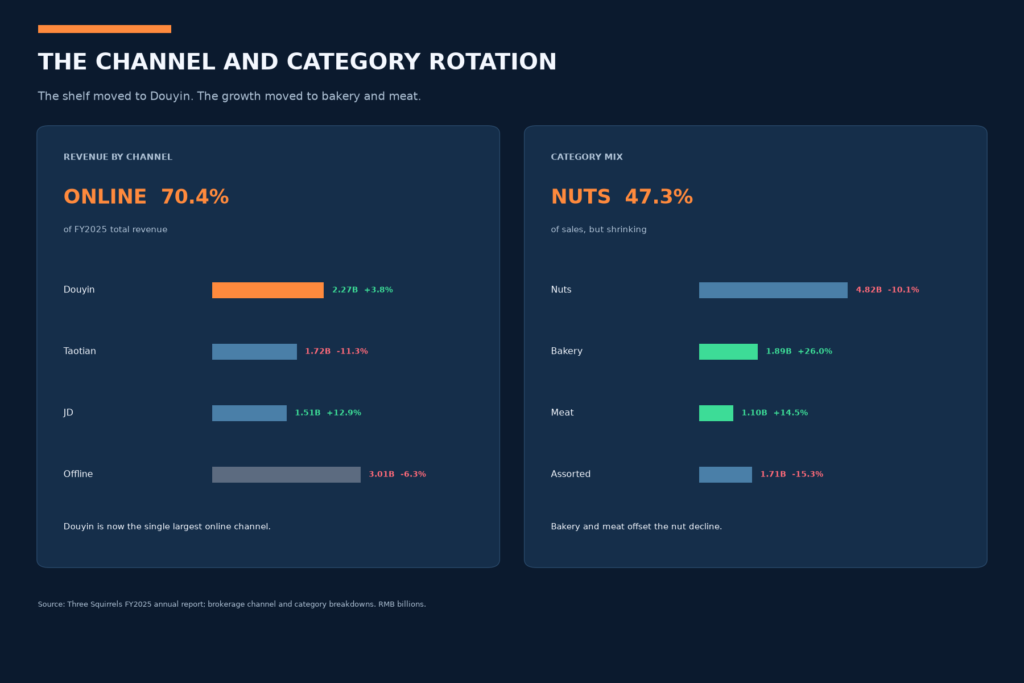
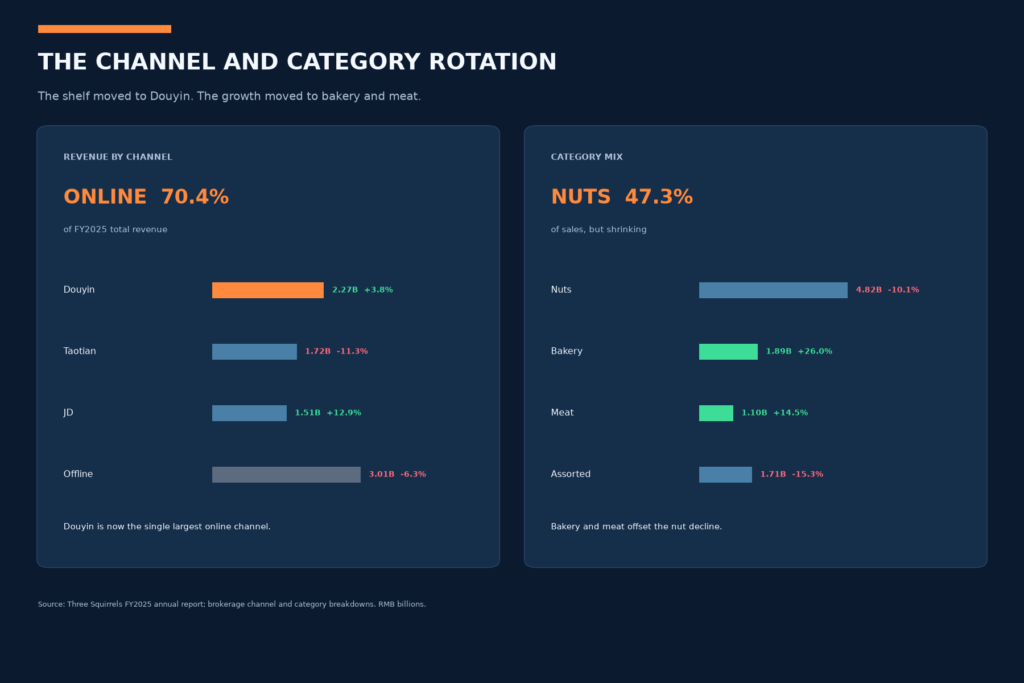
It worked, in relative terms. Douyin generated ¥2.272 billion in FY2025, up 3.84%, making it the company’s single largest online channel at 22.30% of total revenue. Taotian, the old home turf, fell 11.25% to ¥1.719 billion. JD grew 12.91% to ¥1.513 billion. Online in aggregate slipped 3.11% to ¥7.176 billion, or 70.42% of revenue — still dominant, but no longer growing.
One caution for anyone drawing a clean arrow from Taobao to Douyin: in the second half of 2025, shelf-based commerce on Tmall and JD regained ground, and Tmall’s half-year revenue overtook Douyin’s. The channel mix is fluid. What looks like a permanent migration often turns out to be a temporary discount window. Brands that bet the entire operation on one platform’s current algorithm tend to be surprised by the next one.
Act III — From Brand Company to Manufacturing Company
The second reinvention went deeper. Management stopped describing Three Squirrels as a brand owner and started calling it a manufacturing-style private-label retailer. That is not a slogan. It is a balance-sheet decision.
The company has built four regional supply-chain bases — East China around Wuhu and Wuwei, the northern base in Tianjin’s Wuqing district, a southwestern base in Jianyang, Sichuan, and a southern base in Foshan, Guangdong. It now operates more than twenty factories, including source facilities in Guangxi, Yunnan and Jilin, and established a mango-processing plant in Cambodia in late 2025. The organizing principle is summarized as one region, one product, one chain: control the source, control processing, control cost.
Why does this matter? Because nuts — the category that made the brand — are exposed to raw-material inflation. In FY2025 nut revenue fell 10.12% to ¥4.823 billion, and gross margin in that category dropped 2.13 points to 21.85%. You cannot advertise your way out of a bad harvest. Owning factories gives you a hedge that marketing can never provide.
The Category Rotation
Look at what grew instead. Bakery revenue rose 25.97% to ¥1.891 billion, with gross margin up 4.50 points to 25.72%. Meat products grew 14.53% to ¥1.10 billion, margin up 1.77 points. Assorted products declined 15.30% to ¥1.709 billion, with margin down 5.15 points.
This is portfolio rotation as risk management. Nuts still account for 47.34% of sales, so the category remains the anchor. But the incremental growth is coming from categories with better margins and, in the case of short-shelf-life bakery and prepared meat, from a different kind of retail logic — one that rewards proximity and frequency rather than shipping distance. That logical shift points directly at the fourth act.
The Discount Invasion
While Three Squirrels was rebuilding its supply chain, a different model was eating the market from the bottom. The hard-discount snack stores — Wanchen’s Haoxianglai and the Mingming Henmang group behind Lingshi Henmang and Zhaoyiming — operate on a simple premise: strip the brand out of the equation, buy direct from manufacturers at scale, keep SKUs tight, turn inventory fast, and let the store itself be the media.
The FY2025 scoreboard is hard to ignore. Wanchen’s snack business alone booked ¥50.86 billion, up nearly 60%, and the group ended the year with 18,314 stores after adding 4,118 net new locations. Mingming Henmang reported ¥66.17 billion in revenue, up 68.2%, across 21,948 stores. For context, China’s broader snack and beverage retail market grew from ¥3.2 trillion in 2019 to ¥4.0 trillion in 2024, while the discount format itself compounded at 77.9% annually over that period.
Three Squirrels ended 2025 with 366 stores in total — 298 national snack shops, nine Life Halls and 58 discount outlets. The contrast in density is almost comical. The discounters are not competing on product; they are competing on the number of minutes between a craving and a purchase.
Act IV — Life Hall
The third reinvention is the company’s answer: Life Hall, a community hard-discount format launched in Wuhu in June 2025. Its positioning is deliberately domestic — a second kitchen at your doorstep, built around fifteen-minute community living circles and the idea of five meals a day.
The unit economics are engineered for frequency. Each store carries roughly 1,500 SKUs, of which more than 90% are private label. Fresh produce, short-shelf-life bakery, prepared foods, beverages and daily household goods sit alongside traditional snacks. A central kitchen of more than 4,000 square metres, commissioned in Wuhu in December 2025, supplies stores on a daily-delivery cycle; leafy vegetables and meat are explicitly not sold overnight. The first flagship store, opened in late November 2025, reported ¥1.26 million in sales over three days.
Store counts need timestamps. There were nine Life Halls at the end of 2025; by 11 April 2026 the network had reached 31 across Anhui and Jiangsu — one flagship, nineteen standard stores and eleven mini formats. Later in 2026 the format was refreshed under a new name, Squirrel Scoop, and extended into additional provinces. The business is moving fast enough that any undated figure is already stale.
The strategic comparison writes itself. This is Aldi and Lidl logic applied to a Chinese community: limited assortment, overwhelming private-label share, central kitchen, ruthless cost control. The difference is that Three Squirrels arrives with an established consumer brand — which is either an advantage in trust or a liability in cost structure, depending on how disciplined management stays.
The 2025 P&L as Transition Invoice
Read the profit drop line by line and it stops looking mysterious. The company itself named four causes: a sharp rise in nut raw-material prices; a shift in online traffic mix that lifted platform fee rates; strategic investment in store optimisation and the Life Hall rollout; and higher depreciation and amortization from newly acquired property.
Then add the quality-of-earnings detail. Non-recurring gains totalled ¥106 million, equal to 68.29% of reported net profit. Government subsidies of ¥101 million made up 94.95% of those gains. Gross margin actually ticked up 0.17 points to 24.42%, but net margin fell 4.41 points to 1.53%. Operating cash flow dropped 65.36% to ¥208 million. The fourth quarter was the worst: ¥2.43 billion in revenue but a small net loss and a slightly larger adjusted loss.
So the honest reading is this: the core business earned very little in 2025, and the reported profit was substantially a transfer payment. That is a transition invoice, not a verdict on the model.
The 26Q1 Rebound
Then the first quarter of 2026 arrived. Revenue reached ¥3.835 billion, up 3.01%. Net profit was ¥273 million, up 14.35%. Adjusted net profit jumped 51.59% to ¥246 million. One quarter out-earned the entire prior year.
Three things explain the swing. First, the Chinese New Year shopping festival landed in a different period, removing the structural mismatch that hurt 2025’s seasonal peak. Second, the supply-chain bases and factories began absorbing input-cost pressure rather than passing it through to margin. Third, channel discipline improved — less low-efficiency投放, more focus on core SKUs, and a fee structure that stopped escalating quite so aggressively.
Be careful with straight-line extrapolation. A festival calendar effect will not repeat every quarter. The more durable signal is the adjusted-profit line: a 51.59% jump suggests that underlying operations, not subsidies, drove the recovery.
What Travels Globally
Three ideas in this case are portable.
Build the IP as an entry ticket, not a moat. Personality, packaging theatre and distinctive service can earn attention in any market. They buy you the first transaction. They do not protect the fiftieth.
Treat supply chain as the real brand. Four regional bases, source-level factories, an overseas processing plant and a one product, one chain discipline are the assets that survive a platform-fee shock. Western DTC operators obsessed with creative testing would do well to look at the factory floor instead.
Private label is the endgame of snack retail. When more than 90% of a store’s assortment is own-brand, the retailer captures the margin that used to belong to the manufacturer. Whether the format is a Chinese community hall or a European discounter, the logic is identical.
What Does Not Travel
Three constraints are local.
The festival calendar is unforgiving. Chinese New Year snack demand is a single, enormous, date-sensitive spike; a few weeks of misalignment can rewrite a full year’s numbers. Western snack brands do not face quite the same calendar cliff.
Platform-fee volatility is structural in China’s intensely competitive e-commerce market, where promotionalRate changes can swing margins within a quarter. Elsewhere the toll may be steadier — or simply paid to different intermediaries.
Finally, discount density is a geographic fact. Fifteen-minute community living circles, dense urban populations and central-kitchen delivery economics are specific to Chinese cities. Replicating 18,000-store networks in a low-density market is a different business entirely.
Five Rules for Global Snack and DTC Brands
One. Never confuse traffic access with customer ownership. If your margin depends on a platform’s current fee rate, you are a tenant, not an owner. Build an asset the platform cannot repric
Two. Watch the adjusted-profit line, not the headline. In FY2025, 68% of reported net profit came from non-recurring gains. A subsidy is not a business model.
Three. Diversify channels before you are forced to. Three Squirrels’ Douyin pivot helped, but the mix shifted again within six months. Single-channel dependence is a slow-acting poison.
Four. Buy cost control early. The nut-price shock hurt precisely because the company had not owned enough of the chain. Manufacturing capability is a hedge that compounds.
Five. Decide what your stores are for. Are they showrooms, fulfillment nodes, or media? Life Hall treats them as all three — and funds that ambition with 90% private label. Pick your version deliberately.
Conclusion
Three Squirrels is not a cautionary tale about a brand that failed. It is a case study about what a brand is worth when the channel it was born into stops being cheap. The squirrel IP still works; the factories are being built; the community stores are multiplying. The FY2025 profit collapse was the cost of changing the engine while the car was moving. Whether the reinvention sticks will depend on a less glamorous question: can a former brand company become a genuinely excellent retailer and manufacturer before the next traffic tax arrives?
For global marketers, that is the whole lesson. In China’s snack economy, the brand is the entry ticket. The supply chain is the moat. And the discount channel is quietly deciding who gets to own the customer.