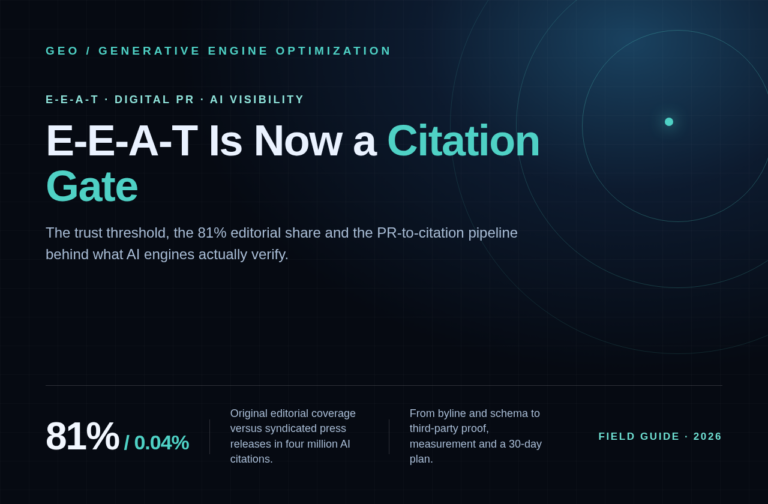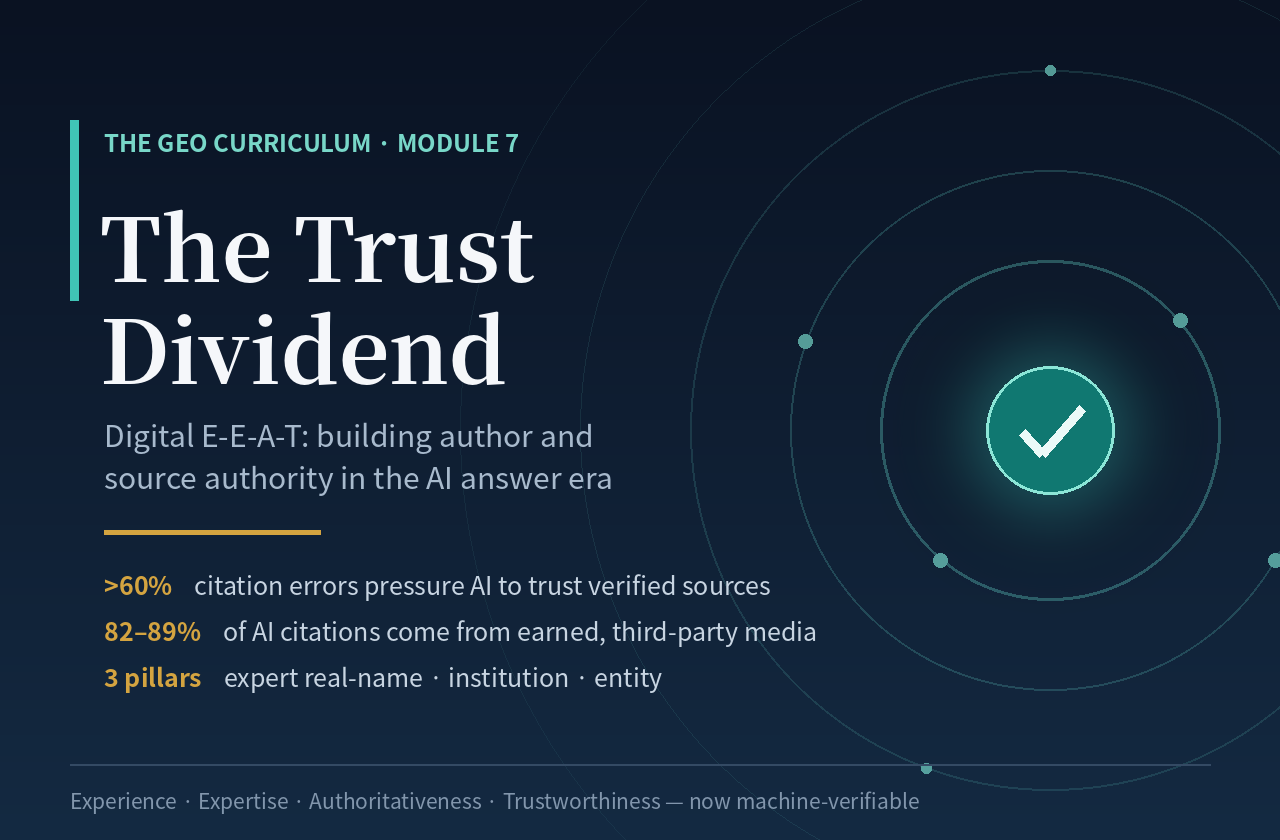
AI search engines keep citing the wrong sources — a Columbia University test found error rates above 60% across eight tools — so the market is drifting toward sources machines can actually verify. The evidence is blunt: across four editions of Muck Rack’s citation research (July 2025 to October 2026), 82–89% of AI citations came from earned, third-party sources, while paid content scraped by at 0.3%. This module reframes Google’s E-E-A-T for the answer era as Digital E-E-A-T, built on three pillars: expert real-name identity, institutional endorsement, and knowledge-graph entity realization. The defining property is uncomfortable but liberating — none of it pays off this quarter, and all of it compounds. Every trust deposit you make today decides citations you haven’t earned yet.
Why AI Engines Keep Getting It Wrong
Let’s start with the embarrassment that explains everything else.
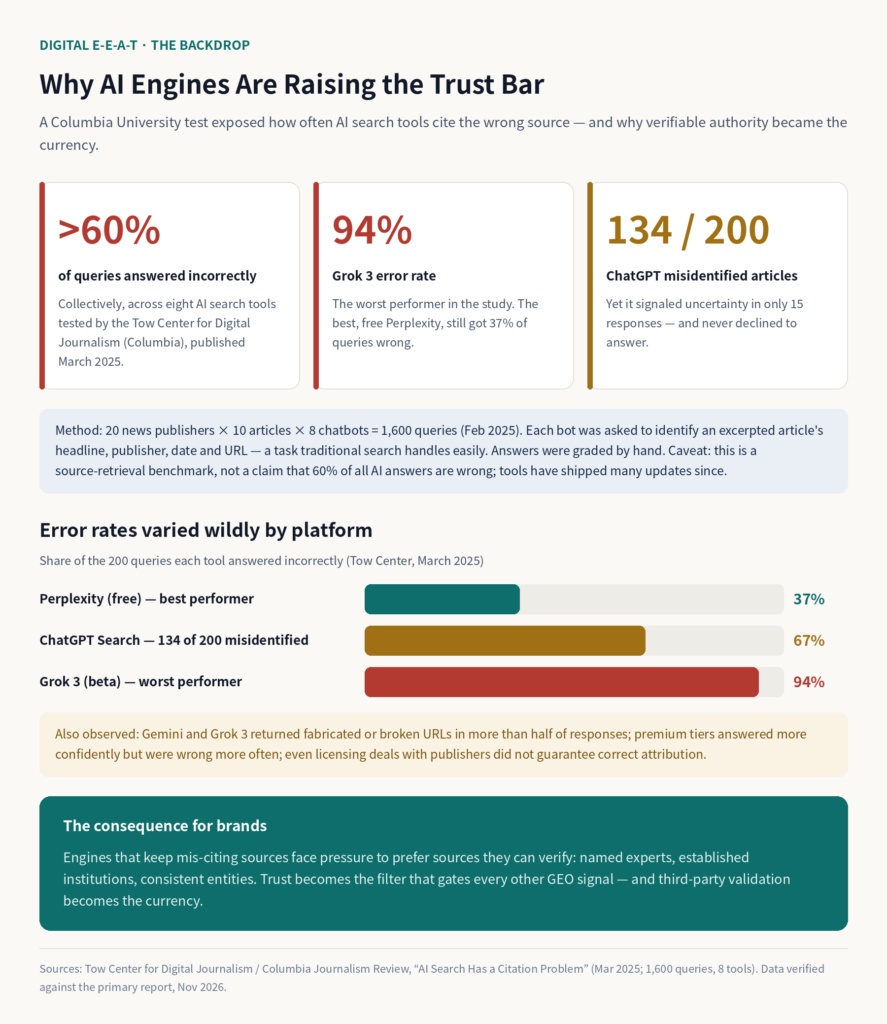
In March 2025, the Tow Center for Digital Journalism at Columbia published a study with a title that pulls no punches: “AI Search Has a Citation Problem.” Researchers Klaudia Jaźwińska and Aisvarya Chandrasekar fed excerpts from 200 news articles into eight AI search tools — ChatGPT Search, Perplexity, Perplexity Pro, DeepSeek Search, Copilot, Grok-2, Grok-3 and Gemini — and asked each one the simplest question imaginable: where did this come from? Identify the headline, the publisher, the date, the URL. A traditional search engine handles that in seconds.
The chatbots, collectively, answered incorrectly on more than 60% of the 1,600 queries. Perplexity, the best performer, still got 37% wrong. Grok 3 got 94% wrong. ChatGPT misidentified 134 of its 200 articles — yet signaled uncertainty only 15 times and never once declined to answer. More than half of Gemini’s and Grok 3’s responses pointed to fabricated or broken URLs. And here’s the twist that should worry anyone paying for a premium tier: the paid models were more confidently wrong than the free ones.
One honest caveat before we build on this: it was a source-retrieval benchmark run in February 2025, not a verdict that 60% of all AI answers today are wrong. The tools have shipped dozens of updates since. But the failure mode it exposed — confident answers resting on unverifiable attribution — is structural, and it explains the pressure every engine now faces.
The Trust Bar Is Rising — Follow the Citations
No platform has published a memo saying “we read the Tow study and tightened our sourcing.” We shouldn’t pretend otherwise. What we can observe is behavior — and the behavior is remarkably consistent.
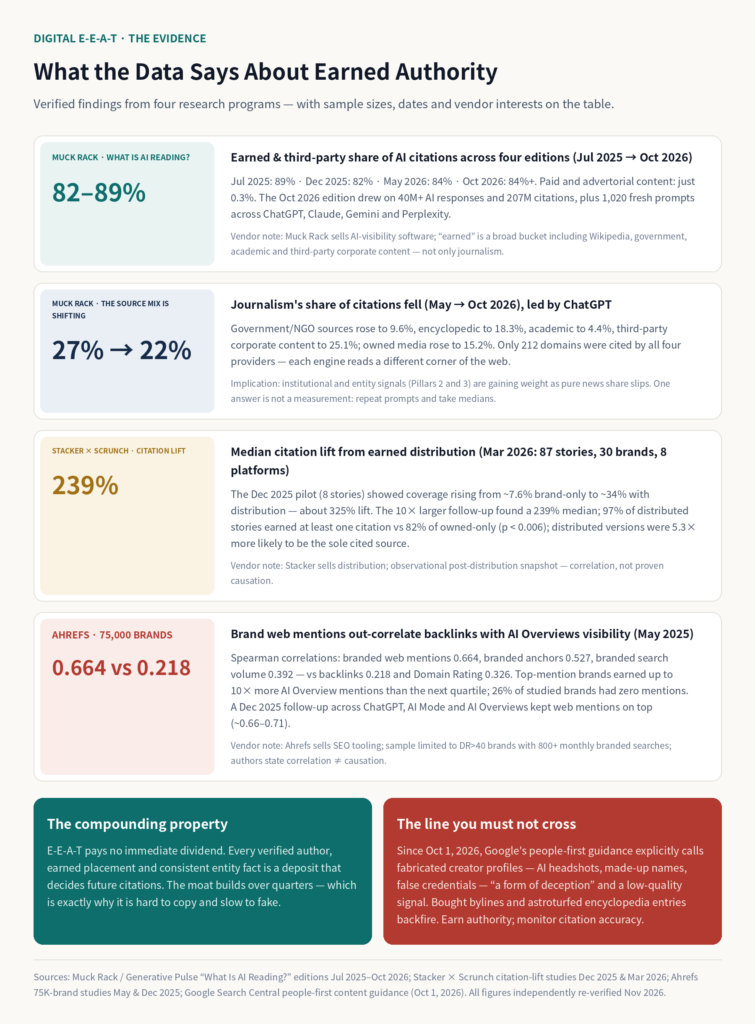
Muck Rack, the PR software company, has run its “What Is AI Reading?” study four times since July 2025, and the headline barely moves: earned and third-party sources account for 82–89% of AI citations in every edition. The first edition (July 2025, over one million links) put earned media at 89%. December 2025: 82%. May 2026 (25 million links, 17 industries): 84%. The October 2026 edition — drawing on more than 40 million AI responses and 207 million citations, plus a fresh set of 1,020 prompts across ChatGPT, Claude, Gemini and Perplexity — held above 84%. Paid and advertorial content? A rounding error: 0.3%, unchanged since May.
Read that again. The content marketers pay to place is essentially invisible to the machines writing the answers. The content brands earn — coverage they didn’t buy and don’t own — is nearly the whole game.
A fair warning about the label: Muck Rack sells AI-visibility software, and its “earned” bucket is broad. It includes journalism, but also Wikipedia, government and NGO sites, academic research, and third-party corporate content. When the company was challenged on that definition, it responded with a neat piece of evidence: of 58,490 references across 489 S&P 500 companies’ Wikipedia pages, roughly 60% were journalism. The encyclopedia entry is downstream of the earned coverage. You can’t separate the two — which is precisely the point of this module.
What Google Actually Says About E-E-A-T
Before we reframe anything, let’s respect the original. Google added the second E — Experience — to E-A-T on December 15, 2022, in its Search Quality Rater Guidelines. The four dimensions ask whether content shows first-hand experience, real expertise, authoritativeness (“a go-to source for the topic”), and trust. The guidelines call Trust “the most important member at the center of the E-E-A-T family”; the other three exist to support it.
Two clarifications the SEO industry keeps forgetting. First, the guidelines are a manual for human raters who benchmark Google’s systems — the ratings don’t directly change any page’s rank. Second, Google’s own documentation says E-E-A-T “isn’t a specific ranking factor.” It describes what the ranking systems are tuned to reward, not a score you can stuff into a meta tag.
So why does it matter more than ever? Because AI engines face the same problem the raters were hired to solve — telling reliable sources from confident fakes — except they must do it at machine scale, in milliseconds, without a human in the loop. The answer is to prefer trust signals a machine can verify. That’s the reframe.
Digital E-E-A-T: From Human Impression to Machine Evidence
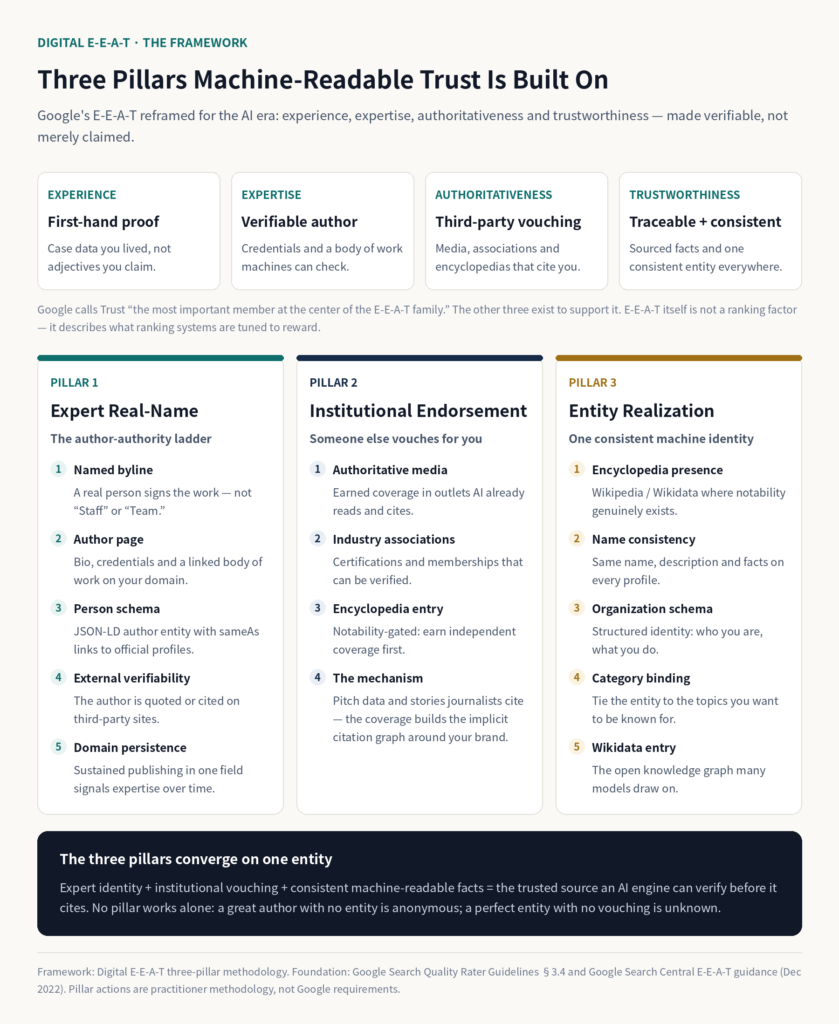
Here is the curriculum’s working definition: Digital E-E-A-T is E-E-A-T rebuilt as machine-verifiable trust. Each dimension gets an evidence requirement, not an adjective:
- Experience becomes first-hand proof — case data you lived through, with the five elements a real case needs: context, constraint, action, result, lesson. Demonstrated, never claimed.
- Expertise becomes a verifiable author — credentials and a sustained body of work a crawler can confirm.
- Authoritativeness becomes third-party vouching — media, associations and encyclopedias that independently reference you.
- Trustworthiness becomes traceability — sourced facts and one consistent entity across every surface.
Notice what disappeared: the vibes. “We’re passionate industry leaders” verifies nothing. “Jane Chen, CFA, wrote this; she’s quoted in three trade publications; her author page links her LinkedIn and her firm’s Wikidata entry” verifies everything. Three pillars carry that weight.
Pillar 1: The Expert Real-Name Ladder
Author authority isn’t a byline. It’s a ladder with five rungs, and each one makes the next verifiable.
Rung one: a named byline. A real person signs the work. Not “Staff,” not “Team,” not an AI-generated avatar with an invented résumé. Google’s stance here hardened recently, and it’s worth quoting exactly. Since October 1, 2026, its people-first content guidance warns: fabricating creator profiles — “AI-generated headshots, made-up names, or false credentials to make content appear as if it was written by human experts” — is “a form of deception” and “a signal of a low-quality page.” The rater guidelines already told human raters to grade such pages Lowest. Now the site-owner documentation says it too.
Rung two: the author page. Bio, credentials, and a linked body of work on your own domain. This is the hub every other signal points back to.
Rung three: Person schema. JSON-LD that declares the author as an entity, with sameAs links to official profiles. You’re not decorating the page; you’re handing the machine a resume it can parse.
Rung four: external verifiability. The author is quoted, cited or interviewed on third-party sites. This is where Pillar 1 shakes hands with Pillar 2 — an expert nobody else references is just a name on a page.
Rung five: domain persistence. Years of sustained publishing in one field. Expertise is a time series, not a declaration.
Scale this across a team and you get the multi-expert matrix: several credentialed authors, each persistently covering one domain of your topic network, each externally verifiable. The team’s authority becomes the site’s authority.
Pillar 2: Institutions That Vouch for You
Self-publishing says “trust me.” Institutional endorsement says “they’ll vouch for us.” Three types carry the most weight: authoritative media coverage, industry-association certification, and an encyclopedia entry.
The mechanism is earned media outreach with a GEO twist: pitch data and stories journalists will actually cite. Original research, sharp statistics, genuinely useful analysis — the raw material of coverage that later feeds AI answers. December 2025’s Muck Rack edition found a telling gap: only about 2% overlap between the journalists PR teams pitch most and the journalists AI cites most for a given brand. Most teams are knocking on doors the machines don’t read.
The same edition found press-release citations had grown fivefold since July, driven by ChatGPT and Gemini — and the releases getting cited were structured: roughly twice as many statistics, 2.5 times as many bullet points, more objective sentences. Even the humble press release earns citations when it’s built like evidence instead of a brochure.
The association and encyclopedia paths run on the same fuel. Certifications must be real and checkable. Wikipedia entries are notability-gated: independent coverage comes first, the entry follows. Try to reverse that order and you’ve crossed into the fake-authority trap we’ll get to.
And does distribution actually move citations? The strongest evidence yet comes from Stacker, a company that sells earned-media distribution — so hold that interest in mind. Its December 2025 pilot with measurement firm Scrunch tracked eight stories: living only on the brand’s site, they were cited in about 7.6% of relevant AI responses; distributed across trusted news publishers, coverage rose to roughly 34% — about a 325% lift. Because eight stories prove little, they scaled it: 87 stories, 30 brands, 8 AI platforms, roughly 30 prompts per story. The March 2026 results: a 239% median citation lift, cross-platform coverage tripling from 5.4% to 17.9%, and 97% of distributed stories earning at least one citation versus 82% of owned-only — a statistically significant gap. Distributed versions were 5.3 times more likely to be the sole cited source. The authors are explicit that this is observational data: correlation, not proven causation. But the direction matches every other dataset in this module.
Pillar 3: Entity Realization — One Machine Identity
The third pillar is the technical layer where the first two converge: making your brand a consistent, resolvable entity in the knowledge graph. Five actions, in order:
- Encyclopedia presence where notability genuinely exists — Wikipedia and its structured sibling, Wikidata.
- Radical consistency — the same name, description, founding facts and category on every profile, directory and schema block. Contradictions are trust leaks.
- Organization schema — JSON-LD declaring who you are, what you do, and who works for you, tied to the Person entities from Pillar 1.
- Category binding — consistently associating the entity with the topics you want to be known for, across your content and your coverage.
- A Wikidata entry — the open, structured knowledge graph that many models draw on directly.
Why does this matter so much now? Look at where the citations are going. The October 2026 Muck Rack edition recorded the biggest source-mix shift in the study’s history: journalism’s share fell from 27% to 22%, led by ChatGPT, while encyclopedic sources rose to 18.3%, government and NGO sites to 9.6%, academic research to 4.4%, and third-party corporate content to 25.1%. The machines aren’t abandoning earned trust — they’re diversifying it toward exactly the structured, institutional, entity-shaped sources this pillar builds. The same edition found only 212 domains cited by all four providers. Each engine reads a different corner of the web; a consistent entity is how you show up in all corners at once.
The Proof Stack: What Independent Data Confirms
Step back and the three pillars stop looking like a framework and start looking like a description of observed reality.
Ahrefs — an SEO tooling vendor, disclosure noted — studied 75,000 brands in May 2025 and asked what correlates with visibility in Google’s AI Overviews. Branded web mentions topped the list at 0.664 (Spearman correlation), roughly three times backlinks at 0.218. Branded anchor text scored 0.527, branded search volume 0.392, Domain Rating just 0.326. Brands in the top mentions quartile earned up to ten times more AI Overview mentions than the next quartile down — and 26% of the studied brands had zero. A December 2025 follow-up across ChatGPT, AI Mode and AI Overviews kept web mentions on top, in the 0.66–0.71 range. The authors stress correlation isn’t causation, and the sample skewed to established brands (Domain Rating above 40, meaningful branded search volume). Fine. But when a mentions-first pattern shows up in Ahrefs’ correlations, Muck Rack’s citation census and Stacker’s distribution study — three vendors with three different products and no shared methodology — the convergent evidence gets hard to dismiss.
One more discipline before you celebrate any single screenshot: AI citations are noisy. In Muck Rack’s October data, running the same prompt twice in one day, ChatGPT repeated only 41% of its cited domains and Gemini 45% (Perplexity, the outlier, repeated 94%). One answer is an anecdote. Run your tracked prompts repeatedly, take medians, and log model changes — otherwise you’ll mistake the engine’s mood for your strategy’s result.
The Compounding Property: Why This Is the Slowest Moat
Here’s the part nobody puts in a quarterly OKR: E-E-A-T pays no immediate dividend.
Publish an author page today and your citations won’t move tomorrow. Earn a trade-publication placement this month and the Wikipedia references it enables might materialize next year. The trust ledger settles slowly — over quarters, not sprints.
But that’s exactly what makes it a moat. A competitor can copy your content format in a week. They cannot copy five years of a named expert’s publication history, a decade of earned coverage, or an entity record that a hundred independent sources corroborate. Every deposit — every verified author, every genuine placement, every consistent fact — raises the probability of future citations across every engine at once. The asset compounds because trust is reusable: the same verifiable identity works in ChatGPT, Claude, Gemini and Perplexity simultaneously, and in whatever ships next.
If you need results this quarter, run the faster modules — structure, freshness, distribution. If you want to still be cited in three years, fund this one. The curriculum’s honest position: this is the slowest, deepest moat in GEO, and the only one that gets harder to attack over time.
The Integrity Line: Earn It, Never Fake It
A warning with teeth, because the temptation is obvious. If machines reward named experts and encyclopedia entries, why not buy bylines, generate headshots, commission a Wikipedia page?
Because the fraud is now explicitly named. Google’s October 2026 guidance calls fabricated creator profiles deception and a low-quality signal — and the rater guidelines instruct Lowest ratings for it. Wikipedia’s notability enforcement deletes paid puffery. Astroturfed citations collapse when the sock puppets are traced. And the failure isn’t symmetric: faked authority doesn’t just fail to help, it poisons the entity record you’ll need to repair for years. In a system built on verification, the one move that guarantees distrust is being caught unverifiable.
There’s a second, subtler liability: being cited inaccurately. The Tow study showed engines misattribute even legitimate sources. So the job isn’t finished at placement — monitor how AI answers represent you, correct the record where you can, and keep your own facts so consistent that error correction becomes easy for machines too. Accuracy monitoring is part of the asset, not an afterthought.
Your First 90 Days of Trust Deposits
Concrete, in order:
- Days 1–15 — identity audit. Real bylines on everything worth citing. Author pages with credentials and work history. Person schema with sameAs links. Kill every “Staff” byline and every decorative avatar.
- Days 15–30 — entity hygiene. One canonical name and description everywhere. Organization schema tied to your authors. Fix contradictions across profiles before adding anything new.
- Days 30–60 — earned evidence. Package one piece of original data journalists would cite. Pitch the outlets AI actually reads in your category — check the citation data, not your prestige instincts. Publish the research on your own domain first, structured for extraction.
- Days 60–90 — measurement baseline. Build a fixed panel of 20–30 prompts your buyers actually ask. Run each several times across the engines your audience uses; record medians. This is the baseline every future trust deposit gets measured against.
- Ongoing — the ledger. Log every placement, every author credential earned, every entity fix. Review quarterly. Expect the curve to bend late — and keep depositing anyway.
Conclusion
The logic chain is short. AI engines keep mis-citing sources, so verifiable authority becomes the scarce input. The citation data shows where that authority lives: 82–89% earned and third-party, 0.3% paid, with the mix steadily shifting toward institutional and entity-shaped sources. Digital E-E-A-T names the three pillars that produce it — expert real-name identity, institutional endorsement, entity realization — and one property defines the whole module: no immediate return, compounding forever. Earn the identity, earn the vouching, keep the entity consistent, never fake any of it, and monitor your accuracy. Today’s trust investment is tomorrow’s citation. That’s the dividend.