Ask an AI assistant who wrote the article it just summarized, and you’ll notice something odd. Sometimes it names the author with total confidence. Sometimes it shrugs. And sometimes — the truly uncomfortable case — it confidently names the wrong person. Your expertise didn’t change between those three answers. Your identity plumbing did.
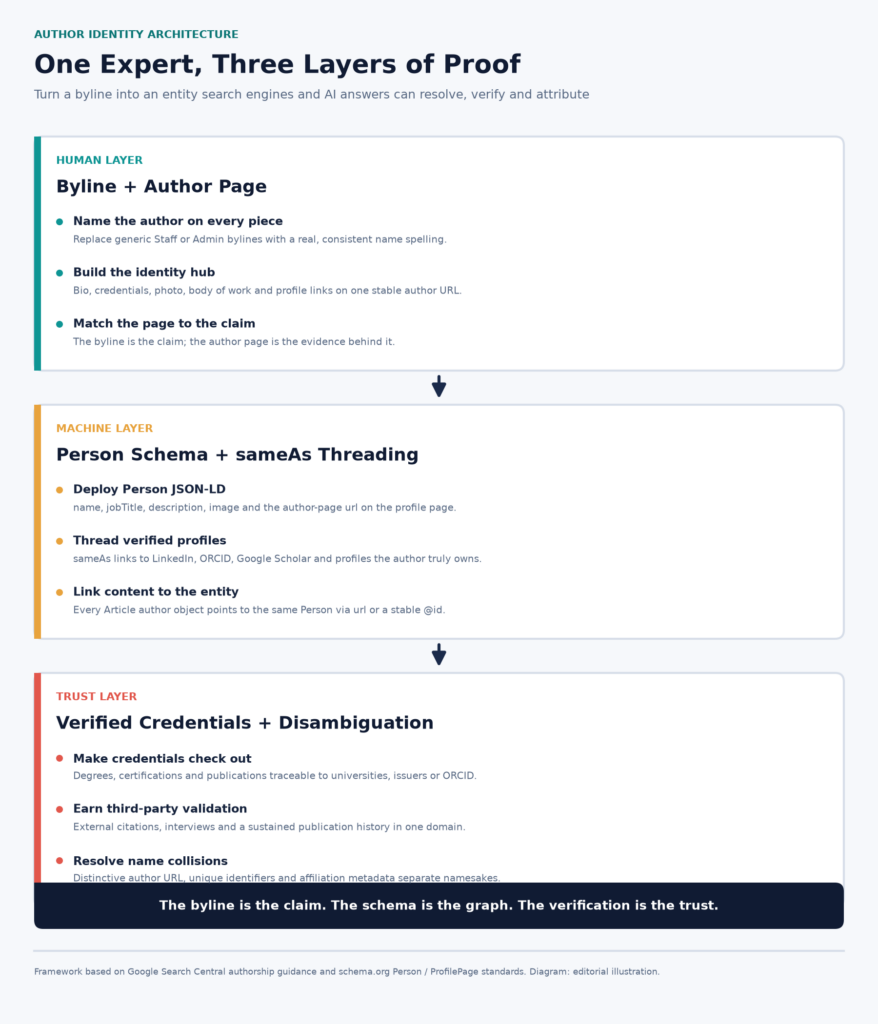
That’s the gap this playbook closes. The strategy layer of GEO says “build expert authority.” Fine. But authority that machines can’t resolve is authority that machines can’t attribute. This is the technical execution: turning every author on your site into a resolvable, disambiguated entity — a person the engine can verify, thread across platforms, and credit by name. Three operations do the work: the byline plus author page (the human-readable identity), Person schema plus sameAs threading (the machine-readable identity), and credential verification plus disambiguation (the trust layer). Let’s build all three.
Why AI Answers Must Decide Who Is Speaking
Generative engines don’t just retrieve pages; they synthesize claims and attach citations. The foundational GEO study by Aggarwal and colleagues, published at KDD 2024, showed that content edits can lift a source’s visibility in generative answers by up to 40% — and the winning tactics were telling. Adding citations, expert quotations and statistics outperformed everything else, while classic keyword stuffing did nothing or worse. The lesson: engines reward verifiability, not volume.
But here’s the nuance most GEO advice skips. A July 2026 critical survey of 45 studies (a preprint by Olivier Martinez, arXiv:2607.14035) found that those gains are conditional on your page already sitting in the retrieved context, and no reviewed technique shows a stable, cross-platform causal effect on discoverability or traffic. Translation? Rewriting paragraphs is the shallow game. Being a source the engine can confidently identify, trust and attribute is the deeper one — and author identity is exactly where that game is played.
Google’s own guidance points the same way. Its “Creating helpful, reliable, people-first content” documentation asks three blunt questions: Is it self-evident who authored your content? Do pages carry a byline where readers expect one? Do those bylines lead to further information about the author? Google calls this the “Who” of content quality, and states plainly that trust is the most important aspect of E-E-A-T — while E-E-A-T itself is not a single ranking factor. You’re not gaming a score. You’re removing every reason to doubt who’s speaking.
The Human Layer: Bylines and Author Pages
Start with the visible identity, because machines read what humans read first.
Name the author on every piece. Not “Staff.” Not “Admin.” A real name, spelled the same way every single time. Consistency sounds trivial until you remember that engines match strings before they resolve entities — “J. Smith,” “Jane Smith” and “Jane A. Smith” are three strangers until you tell the system otherwise.
Build the author page as an identity hub. One stable URL carrying the bio, credentials, a real photo, the body of work, and links to the author’s genuine external profiles. Google explicitly lists “an author page on a news site” and “an employee page on a company website” as valid use cases for its ProfilePage structured data — this page is a first-class citizen, not a decorative extra.
Reframe the relationship. The byline is the claim; the author page is the evidence. A byline that links nowhere asks the reader — and the crawler — to take your word for it. Don’t.
The Machine Layer: Person Schema and sameAs Threading
Now make the identity legible to software. The vehicle is JSON-LD using schema.org’s Person type, deployed on the author page inside ProfilePage markup, where the Person is the mainEntity — the required property that tells Google this page is fundamentally about one person.
A minimal, honest deployment looks like this:
{
“@context”: “https://schema.org”,
“@type”: “ProfilePage”,
“mainEntity”: {
“@type”: “Person”,
“@id”: “https://example.com/authors/jane-smith#person”,
“name”: “Jane Smith”,
“jobTitle”: “Senior Research Analyst”,
“description”: “Jane Smith covers retail media measurement and has analyzed attribution systems since 2014.”,
“image”: “https://example.com/authors/jane-smith/photo.jpg”,
“url”: “https://example.com/authors/jane-smith”,
“worksFor”: { “@type”: “Organization”, “name”: “Example Research” },
“alumniOf”: “Example State University”,
“sameAs”: [
“https://www.linkedin.com/in/janesmith-analyst”,
“https://orcid.org/0000-0002-1825-0097”,
“https://scholar.google.com/citations?user=example”
]
}
}
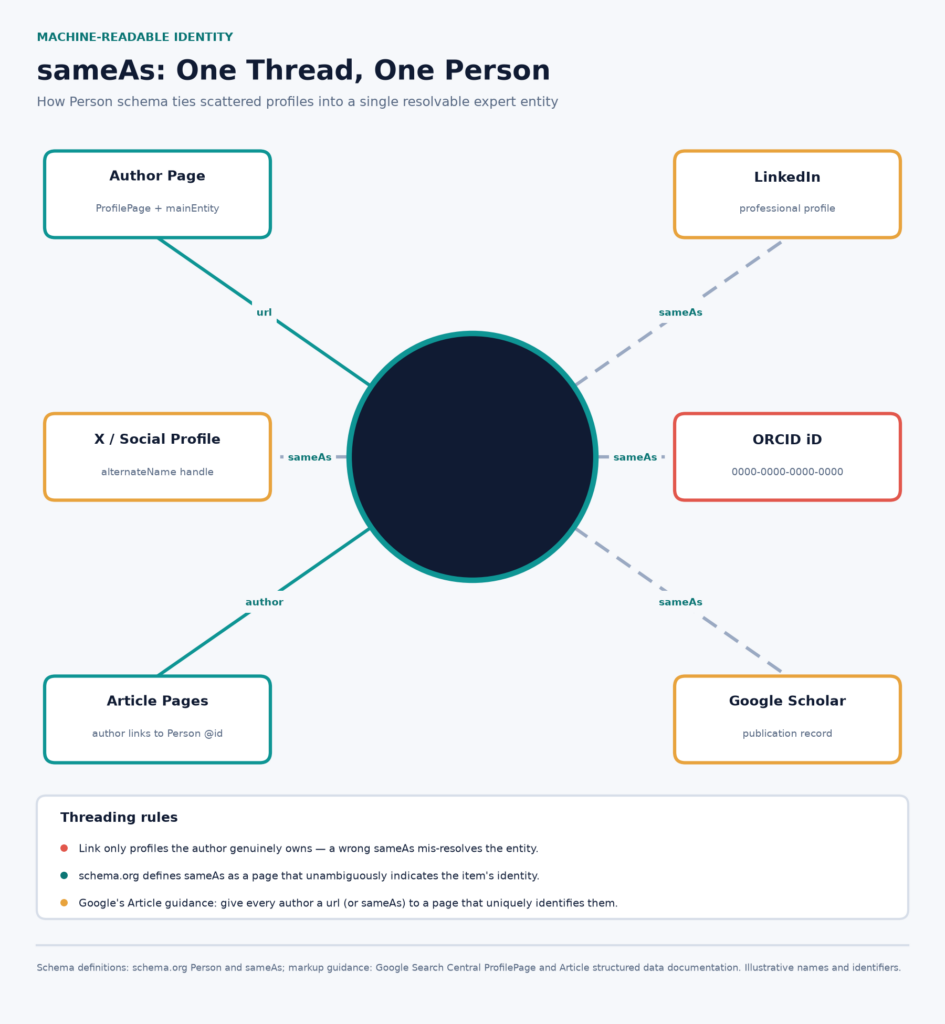
The sameAs array is the star of the show. Schema.org defines sameAs as the “URL of a reference Web page that unambiguously indicates the item’s identity” — think Wikipedia pages, Wikidata entries, official websites. Each entry is an explicit edge in the knowledge graph: this LinkedIn profile, this ORCID record, this Scholar page — all the same human. You’re not hoping the engine guesses. You’re handing it the resolution on a plate.
Two supporting moves complete the layer. First, every Article’s author property should point at this same Person — same name, same author-page URL, ideally the same @id. Google’s Article documentation recommends author.url link to “a web page that uniquely identifies the author,” and when that URL is an internal profile page, Google recommends marking it up with ProfilePage structured data. The loop closes: article → author page → Person → external profiles. Second, validate everything with the Rich Results Test before deployment, exactly as Google’s structured data workflow prescribes. Deploy, verify, then scale.
Five Rules for sameAs That Keep You Out of Trouble
Threading is powerful precisely because it’s assertive — you’re telling an engine two pages are the same entity. Assert wrongly and you corrupt your own graph. So:
- Link only profiles the author genuinely owns or controls. A sameAs pointing at a namesake’s LinkedIn doesn’t just fail; it actively mis-resolves your author into someone else.
- Prefer unambiguous, stable destinations. An ORCID record or a personal domain beats a social handle that gets renamed.
- Keep the thread consistent everywhere. The same sameAs set on the author page, in every article’s author object, across every property you control.
- Use real names in the name field. Google recommends real names for name and social handles for alternateName — not the reverse.
- One author, one object. Google’s author markup best practices are explicit: include every author shown on the page, give each their own author entry, never merge names into a single string, and keep author.name free of job titles, honorifics, publisher names and phrases like “posted by.”
The Trust Layer: Credentials That Check Out
Self-assertion is the floor, not the ceiling. “Award-winning expert” in a bio is a claim; a credential an engine can trace to its issuer is evidence. Three signal classes matter.
Verifiable credentials. Degrees traceable to universities, certifications traceable to issuers, publications traceable to ORCID or publisher records. Schema.org even provides hasCredential for awarded credentials — but the markup is only as good as the external record behind it.
Third-party validation. When other credible sites quote, interview or cite your author, the engine sees corroboration it didn’t get from you. This matches the GEO study’s finding that citation-rich, quotation-rich content wins visibility: the same verifiability logic applies one level up, to the person.
Domain persistence. A sustained publication history in one field is expertise-over-time. Ten years of retail-media analysis beats ten months of writing about whatever trends.
And the hard line: Google’s guidance explicitly calls fabricating creator profiles — AI-generated headshots, made-up names, false credentials — a form of deception and a signal of a low-quality page. Verify, never invent. The short-term lift of a fake “Dr.” is a long-term liability with your name on it. Literally.
The Name-Collision Problem Is Real — and Measured
Think disambiguation is academic paranoia? The scholarly-identity research community has been quantifying this failure for years, and the numbers should humble anyone.
The LAGOS-AND project (Zhang, Lu and Yang, JASIST 2023) built a gold-standard dataset of 7.5 million citations from roughly 798,000 unique authors by linking ORCID iDs to DOIs. Two findings jump out. First, Microsoft Academic Graph’s production author-ID system — built by one of the best-funded data teams on earth — scored only 70.59% B-cubed F1 against that gold standard. Roughly three in ten attributions were wrong in some way. Second, between 5.80% and 9.59% of author records showed last-name spelling variation compared with the authors’ own official ORCID names. Your name drifts across databases even when you never change it.
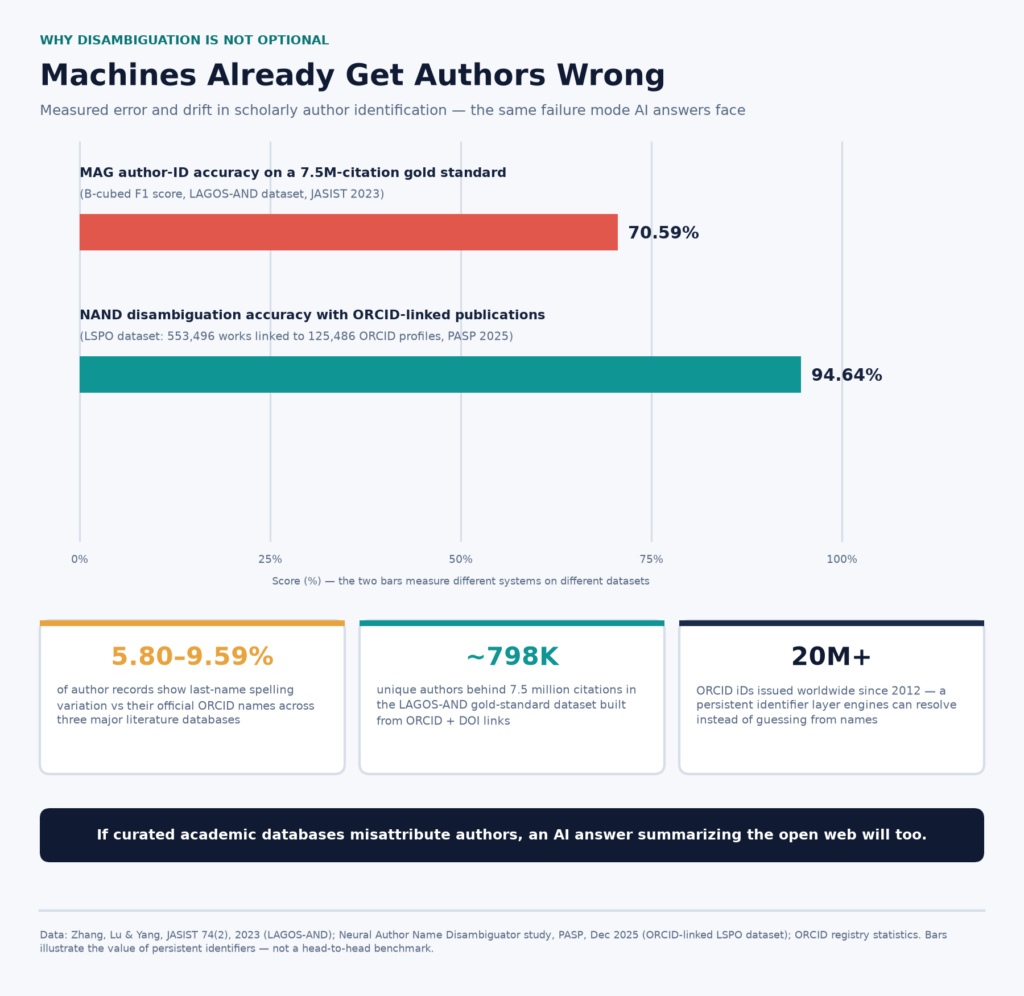
Now the encouraging half. A December 2025 study in the Publications of the Astronomical Society of the Pacific introduced NAND, a disambiguation model trained on LSPO — a dataset linking 553,496 NASA/ADS publications to 125,486 ORCID profiles. With those persistent identifiers as ground truth, it hit 94.64% accuracy, even though nearly 30% of the underlying entries were missing affiliation metadata. The pattern is unmistakable: names alone resolve poorly; names anchored to persistent identifiers resolve well.
An AI answer engine summarizing the messy open web faces the same problem with worse inputs. If curated academic databases misattribute authors, what do you think happens to your byline in a generative summary? Disambiguation isn’t vanity. It’s attribution insurance.
Your Disambiguation Toolkit
The fixes are unglamorous and cumulative:
- A distinctive author-page URL. /authors/jane-smith-retail-analyst beats /author/jane. The URL itself carries disambiguating context.
- A persistent identifier where your field has one. ORCID launched in 2012 as a nonprofit answer to exactly this problem; more than 20 million iDs have been issued, and ORCID reported crossing 10 million yearly active researchers in August 2025. Its 2025 annual report counts 1,492 member organizations across 192 countries. If you publish research, an ORCID iD threaded via sameAs is the single strongest resolution anchor available.
- Affiliation and role metadata. jobTitle, worksFor, alumniOf and affiliation in your Person markup give the engine distinguishing features beyond the name string.
- Validated records, not just claimed ones. ORCID’s trust model lets member organizations write validated data into records — affiliations added by universities, works by publishers, funding by funders — each carrying provenance. A credential validated by its issuer outweighs one you typed yourself.
- A monitoring habit. Quarterly, ask the major engines “who is [author]” and “what has [author] written.” Check whether the answer describes your expert or a stranger. That’s your disambiguation test, and it costs nothing.
The Multi-Author Matrix: A Graph, Not a Byline List
One verified author is a win. A team of them is a moat. Map your content domains to named experts, give each a fully deployed Person entity, and connect the organization to its people: schema.org’s Organization type supports employee references to Person entities, while each Person’s worksFor points back. The result is a closed loop — the site vouches for the experts, the experts’ external records vouch for themselves, and every article hangs off a verified node.
Two cautions keep the matrix honest. Mark up only relationships visible on the page — Google’s structured data policies forbid describing invisible content. And remember Google’s ProfilePage rule: the page must focus on a single person affiliated with the site. A team listing page isn’t a profile page; each expert needs their own.
What This Playbook Cannot Promise
Honesty section — because a GEO playbook that oversells is its own kind of fake credential.
Person schema and sameAs are real, documented standards. Google’s authorship guidance is real and quotable. The name-collision data is peer-reviewed. But no Google document promises that sameAs threading earns citations in AI Overviews, and the Martinez survey’s core warning stands: across 45 studies, no technique demonstrates a stable, cross-platform causal effect on organic discoverability or downstream behavior. The disambiguation benefit argued here is mechanism-based inference — engines must resolve entities to attribute claims; consistent, threaded, verifiable identity makes resolution easier; therefore attribution errors should fall. That reasoning is sound, and it’s still reasoning, not a measured ranking guarantee. Treat every deployment as a hypothesis, monitor attribution accuracy, and let your own probe results be the evidence. Also mind the privacy line: publish only author data the person consented to share, and keep personal contact details minimal.
The 30-Day Deployment Sequence
Week one: audit bylines, kill the generic ones, standardize name spellings. Week two: build or rebuild author pages — bio, credentials, photo, body of work, genuine profile links. Week three: deploy ProfilePage plus Person markup with sameAs threading, wire every Article’s author to the same entity, validate with the Rich Results Test. Week four: verify credentials externally, register ORCID iDs where applicable, connect Organization and Person nodes, run your first “who is [author]” probes and log the baseline. Then re-probe quarterly. Identity, unlike content, compounds — every consistent signal you add makes the next one easier to resolve.





