Somewhere in your company there is a beautiful media plan for China. The budget is approved. The audience segments are drawn. The creative storyboard has been workshopped three times. And none of it matters yet, because the campaign is stuck waiting for a scan of a trademark certificate that nobody can find.
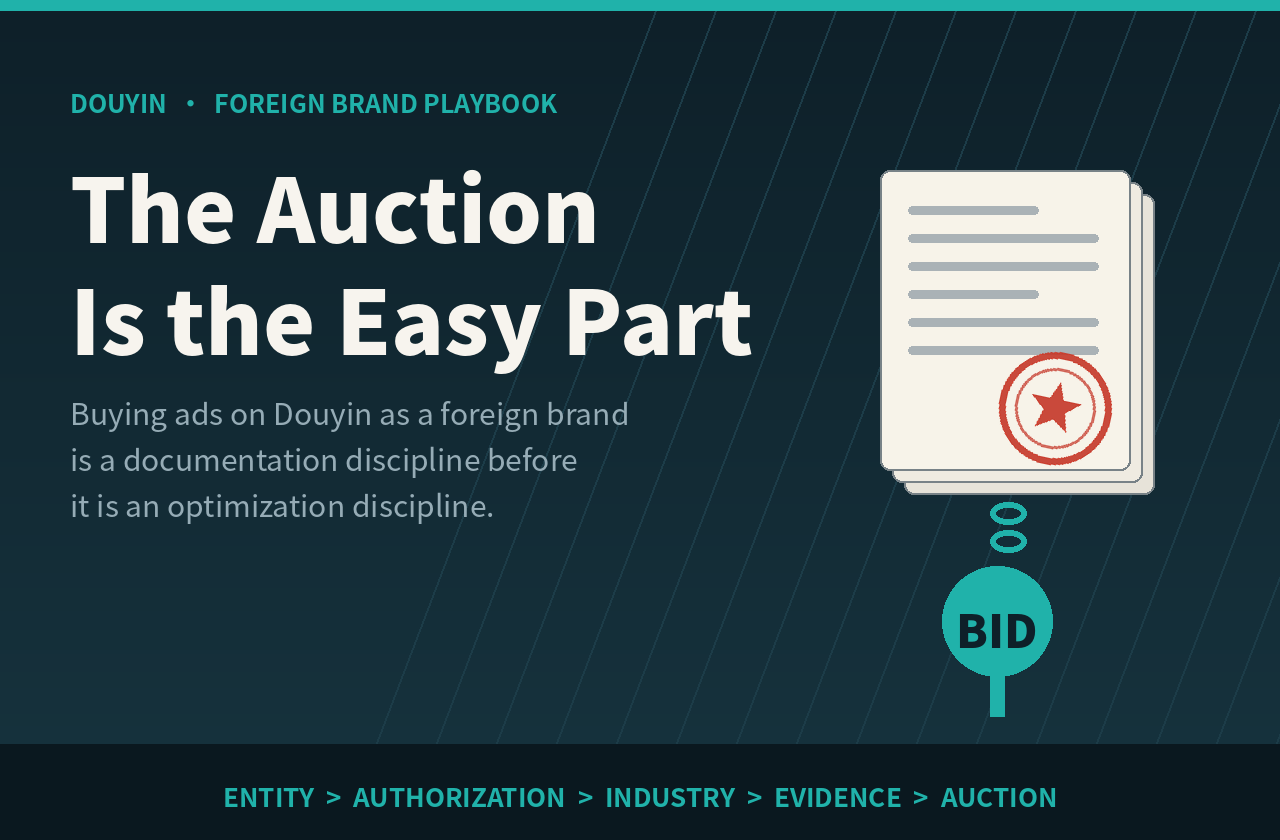
That is the part of Douyin advertising no dashboard shows you. Foreign teams plan the buy as budget → targeting → creative. The platform’s own rules quietly reorder it: entity → authorization chain → industry qualifications → creative substantiation → auction. On Douyin, media buying is a documentation discipline before it is an optimization discipline. Brands that budget only for media discover that their launch date lives in the paperwork.
This piece walks the chain gate by gate, using the platform’s published rules — Ocean Engine’s account-opening guide updated in January 2026, Qianchuan’s admission and control guidance refreshed in September 2026, and the underlying national advertising law — so you can plan the workstream instead of discovering it.
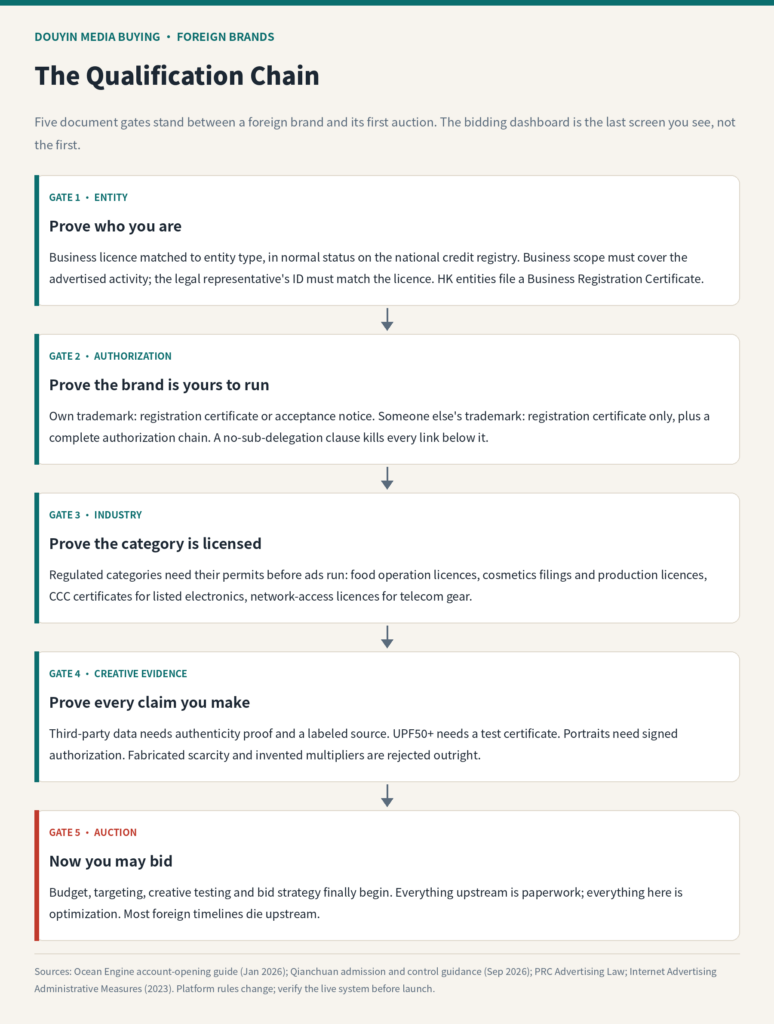
The Real Sequence: Five Gates Before the Auction
Think of the auction as the fifth gate, not the front door. Before your first bid competes for a single impression, four document gates stand in line: who you are, whether the brand is yours to promote, whether your category is licensed, and whether every claim in your creative has an attachment. Each gate has its own reviewers, its own rejection reasons, and its own lead time. Miss one and the others do not compensate — a brilliant bid strategy cannot outbid a missing certificate.
Gate 1: The Entity Layer — Prove Who You Are
Ocean Engine’s account-opening guide is blunt about the basics. You submit subject qualifications matched to your entity type: a business licence for companies, registration certificates for other legal forms. The licence must show normal operating status on the national enterprise credit registry, its validity period must cover your campaign, and — this is the one that ambushes foreign teams — its registered business scope must cover the activity you are advertising. A holding company whose scope says “investment management” cannot casually advertise skincare.
Two details feel almost analog in a digital buying world. First, photocopies of qualification documents must carry a handwritten annotation certifying the copy matches the original, with the company seal stamped across that annotation. Second, the legal representative’s identity document must match the licence, front and back. For Hong Kong entities, the guide names a specific document: the Business Registration Certificate issued by the HK Inland Revenue Department. If your mainland licence changes mid-campaign, you are expected to update the account files, and validity must always cover the flight dates.
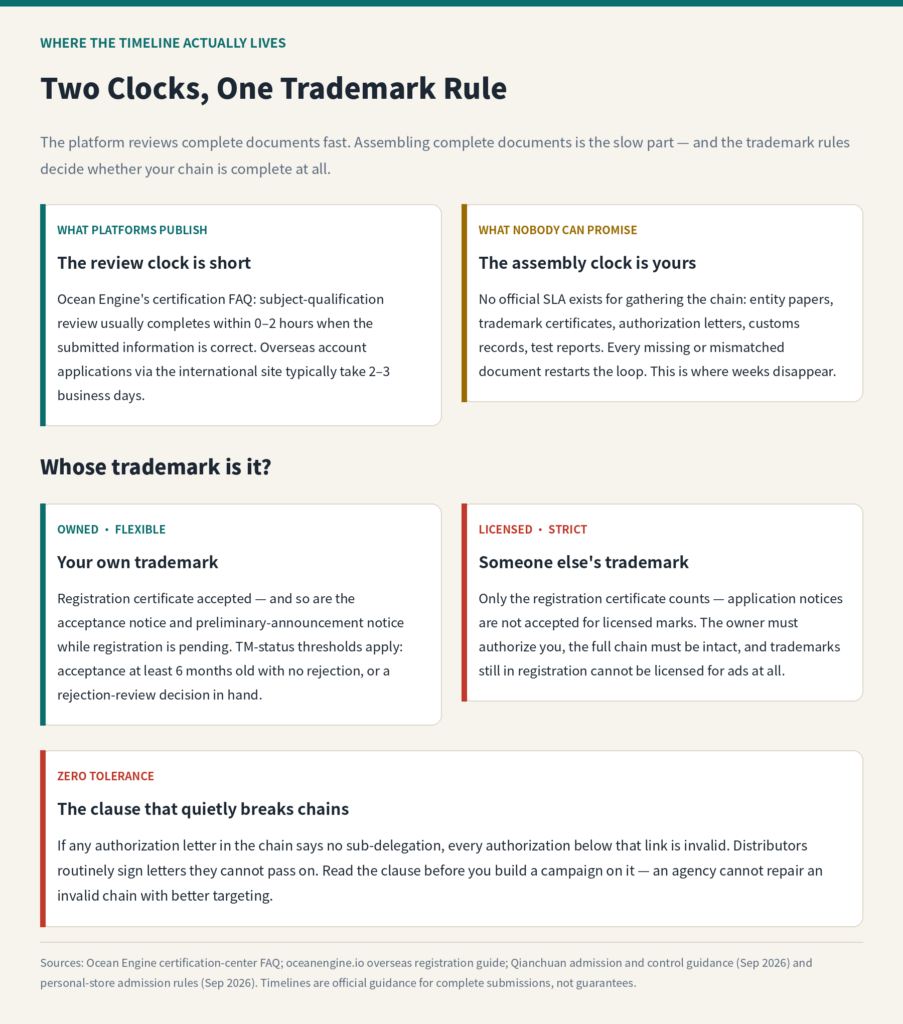
The international route exists and is official: Ocean Engine’s overseas site states it accepts non-Chinese business licences, requires an original photo or color scan (or a seal-stamped copy; where a jurisdiction has no company seal, signatures of the legal representative or senior management substitute), and puts typical account review at two to three business days, with bank transfer as a funding method. That is the published guidance — for complete, correct submissions. Hold that qualifier; it does a lot of work.
Gate 2: The Authorization Chain — Prove the Brand Is Yours to Run
Here is where most foreign campaigns actually stall, because the trademark rules are asymmetric in a way nobody expects.
The Trademark Rule Everyone Gets Wrong
Qianchuan’s September 2026 admission guidance splits the world in two. If the trademark is your own, the platform is flexible: it accepts the registration certificate, and while registration is pending it also accepts the application acceptance notice or the preliminary-announcement notice. Pending marks face thresholds — the acceptance must be at least six months old with no rejection record, or, if there was a rejection, you produce the review decision, which waives the six-month wait entirely.
If the trademark belongs to someone else — you are a distributor, a licensee, a regional arm promoting the parent’s mark — the flexibility evaporates. Only the registration certificate is accepted. Application notices do not count. The registered owner must authorize you, and the authorization chain must be complete from owner to advertiser. And a trademark still in registration cannot be licensed for advertising at all. Read that again if your China launch is timed to a trademark application: your own pending mark can pass; a pending mark you merely license cannot.
The Clause That Quietly Breaks Chains
The same guidance contains a sentence that should be printed on every distributor agreement: if an authorization letter explicitly forbids sub-delegation, every authorization below that link is invalid. Chains die in the middle. The brand authorizes its Asia distributor with a no-sub-authorization clause; the distributor authorizes you; your letter is worthless, no matter how nicely it is stamped. When the licensor is an individual, expect identity documents, a signed authorization, and photos of the person holding both their ID and the letter. Authenticity here is physical, not digital.
Gate 3: Industry Qualifications — Prove the Category Is Licensed
Regulated categories carry their own paperwork, and the qualification set is effectively how the platform prices legal risk. Food needs operation and production licences plus packaging photos showing the production licence number. Cosmetics need the producer’s manufacturing licence, the product’s filing or registration record — special-function cosmetics like sunscreen and whitening products need registration, not just filing — and packaging photos whose brand name matches the trademark certificate exactly. Imported cosmetics need Chinese-label packaging and import records. Many electronics need the national compulsory product certification; telecom-capable devices need network-access or radio-type approval. Protective masks claiming a filtration grade need a full test report from an accredited lab, issued within a year, naming the brand, product and manufacturer. None of this is negotiable at the creative stage; it is admission criteria.
Gate 4: Creative as a Claim Package — Prove Every Claim
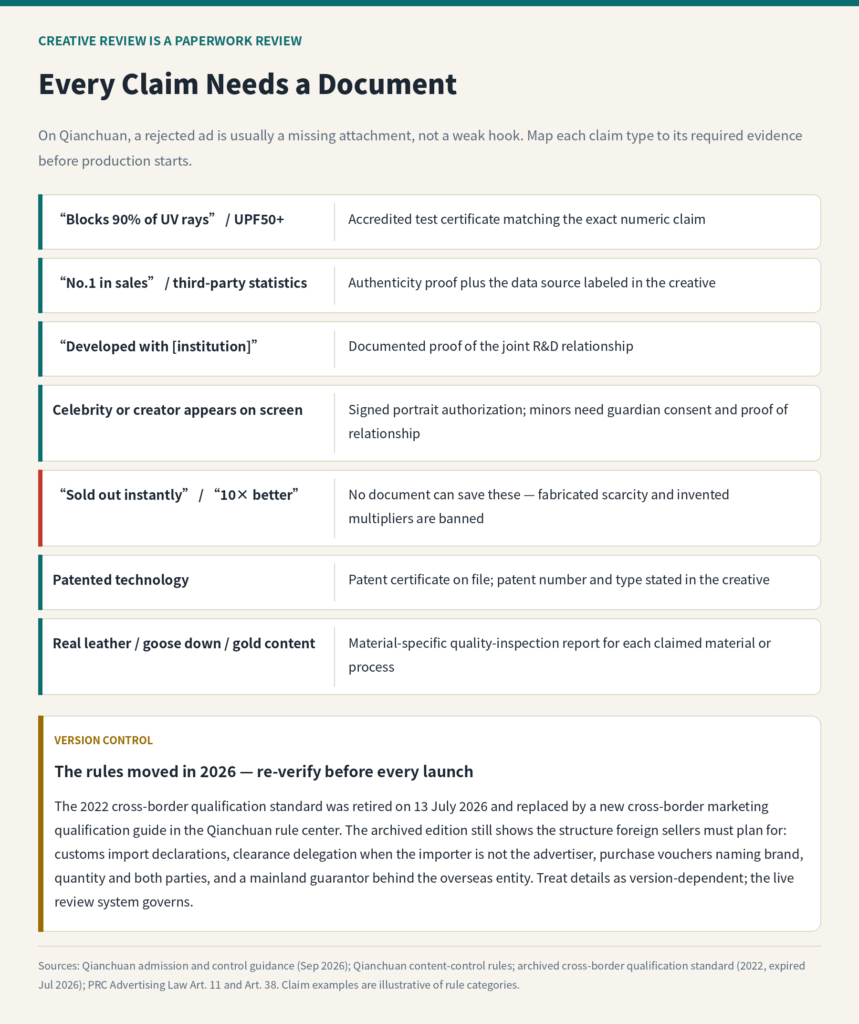
Western teams treat creative as copy plus visuals. Qianchuan treats it as a claim package: every assertion is a row in an evidence table.
The September 2026 rules are refreshingly concrete. Cite third-party market data or survey results? Provide authenticity proof and label the source in the creative. Claim UPF50+ on a sun-protection jacket, or that a fabric blocks over 90% of UV? Provide the corresponding test certificate. Say a product was “developed with” a university or hospital? Document the R&D relationship. Show a celebrity or creator? Signed portrait authorization, with agency relationships verifiable; minors need guardian-signed consent plus proof of the relationship — and under national law, children under ten cannot be advertising endorsers at all, a legal rule the platform simply enforces. Mention a patent? Certificate on file, patent number and type stated in the creative. Claim real leather, goose down, or gold content? A material-specific inspection report for each claimed material.
And some claims no document can rescue. Fabricated scarcity — “sold out the moment it launched” — and invented multipliers — “ten times better than an ordinary product” — are named as prohibited patterns. Fake countdowns and doctored sales screenshots fall in the same bin. A rejected ad here is a documentation failure wearing a creative costume.
Why the Chain Exists: The Law Under the Paperwork
None of this is platform whim. China’s Advertising Law requires that quoted data, statistics and survey results be true, accurate, and attributed — with scope and validity stated where they apply. It also obliges ad operators and publishers to verify supporting documents and check content; where documents are incomplete, the publisher must not publish. The Internet Advertising Administrative Measures, effective May 2023, operationalize that duty: verify and register the advertiser’s real identity, keep advertising archives for at least three years after the campaign ends, and staff reviewers who know advertising law.
So when Qianchuan asks for your customs declaration or your test report, it is building its own legal defense as much as screening you. The chain traces accountability: advertiser → brand owner → product → evidence. Understanding that changes your posture. You are not appeasing a bureaucracy; you are supplying a publisher with the file it is legally required to hold.
The Cross-Border Layer: Customs, Guarantors, and a Rule That Just Changed
If you sell imported goods, add a customs layer. One important version note first: the cross-border qualification standard published in February 2022 was formally retired on 13 July 2026, and the Qianchuan rule center now lists a new cross-border marketing qualification guide. Details are version-dependent; the live review system governs. But the archived 2022 edition remains the clearest public map of the structure, and the structure is what you plan around.
That structure: a customs import declaration or an entry-goods record list for the products. If none of the parties on the declaration — shipper, consignee, consuming entity — is the advertiser, you need a clearance delegation agreement or relationship proof tying you to one of them. Promoting a brand you do not own? Distribution authorization, or purchase vouchers — contracts, order forms, invoices — that name the brand, the quantity, and both companies. Overseas entities also faced legal letters: a joint-liability guarantee statement and a live-room traffic commitment, signed by a director or authorized signatory traceable in the company’s registration filings, backed by a mainland guarantor company’s licence and legal-representative ID. And overseas advertisers registering as individuals were simply not accepted.
Notice what this really is: an imported-goods advertiser must prove the goods entered China legally and that someone onshore answers for them. The paperwork is a liability map.
Three Routes to an Account — and What Each Really Buys
Foreign brands generally choose among three routes, and the choice is strategic, not administrative.
A mainland entity — your own subsidiary — gives you the domestic advertiser’s full path: standard category access, local invoicing, and account data assets that belong to your company rather than to any individual or partner. It costs incorporation time and ongoing compliance.
An overseas entity through the official international route keeps your existing corporate structure and is explicitly supported for non-Chinese licences. Expect the cross-border documentation layer above, and expect category eligibility to be narrower and more conditional than the domestic path; confirm your specific category with the platform before committing budget.
An agency buys process expertise — filing, review liaison, creative localization — not rights. The platform’s own influencer-marketplace rules illustrate the limit starkly: an account may promote its own products or act for one other entity, not run a portfolio of borrowed identities. An agency cannot lend you a trademark chain you do not have, and an invalid authorization chain stays invalid whoever submits it. Personal-account shortcuts, meanwhile, are the false economy practitioners warn about: limited access and instability, and for cross-border Qianchuan, outright inadmissibility.
One more operational nugget from the platform’s certification FAQ: Qianchuan’s subject qualification is inherited from your Doudian store — changes are made in the store system and sync across. Your ad identity and your shop identity are one legal person. Plan them together.
What Everyone Misunderstands
“We can open the account in days.” True — and misleading. The certification FAQ says subject-qualification review typically completes within zero to two hours when the information is correct, and the international route quotes two to three business days. Those are review clocks for complete submissions. No official SLA covers assembling the chain: chasing the trademark owner’s signature, re-issuing a purchase voucher that names both parties, commissioning a UPF test. The review is fast; the readiness is yours.
“A trademark application is enough.” Only for your own mark, under thresholds. For licensed marks, registration certificate or nothing.
“The agency will handle compliance.” They handle process. Underlying rights and evidence remain yours to hold.
“Creative review is about tone.” It is about attachments. “Clinically proven” without a report is not edgy copy; it is a rejection with a reason code.
The Counterargument, and Its Limit
Fair objection: rules change, so no guide can be authoritative. Correct — the platform explicitly reserves the right to adjust, and the 2022 cross-border standard’s retirement in July 2026 proves the point. But the limit of that objection is structural: entity → authorization → industry → evidence has been stable across versions because it mirrors the law, and the law moves slowly. Verify specifics at execution; plan the structure now. Second objection: this is bureaucracy, not strategy. It is both — the chain decides whether you can run at all, which makes it market-entry strategy. And no, big brands do not skip it. They staff it. Scale buys a documentation team, not an exemption.
What Smart Brands Do Differently
Start the document workstream before the media plan, with named owners and lead times: entity papers, the full trademark chain, customs and purchase evidence, test reports. Build a claim-evidence library — every claim mapped to its document, reused across creatives — so review cycles shrink instead of repeating. Choose the account route deliberately, for category access and data ownership, not for whoever answers email fastest. Localize claims, not just language: a number that is fine in your home market needs locally acceptable evidence here, or a rewrite. And re-verify the rule versions before each launch; the platform’s live system, not any article including this one, is the authority.
The Takeaway
Buying Douyin ads as a foreign brand is a documentation discipline before it is an optimization discipline. Five gates, in order: entity, authorization chain, industry qualifications, creative substantiation — then the auction. Treat the chain as a market-entry workstream and you buy media on schedule. Treat it as admin, and your campaign timeline will live in a shared folder, waiting for a scan.