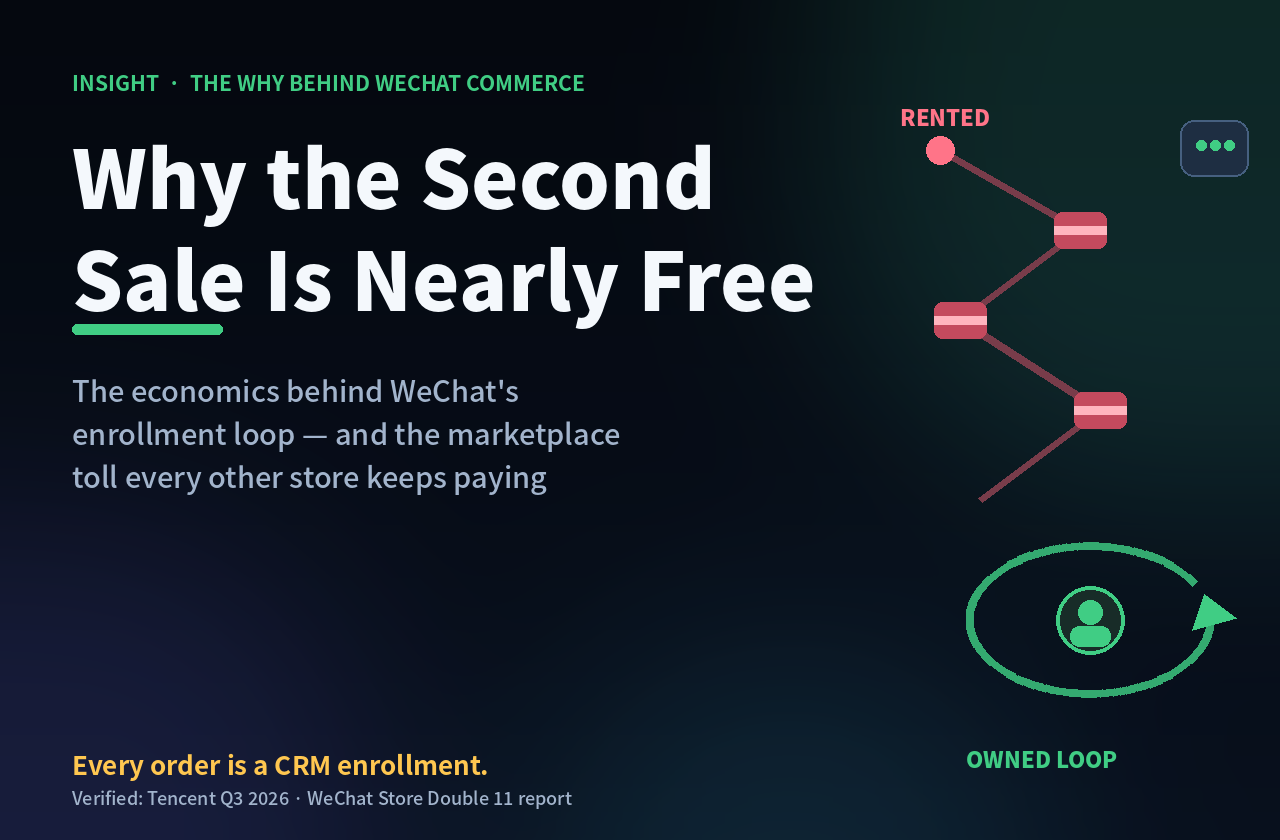
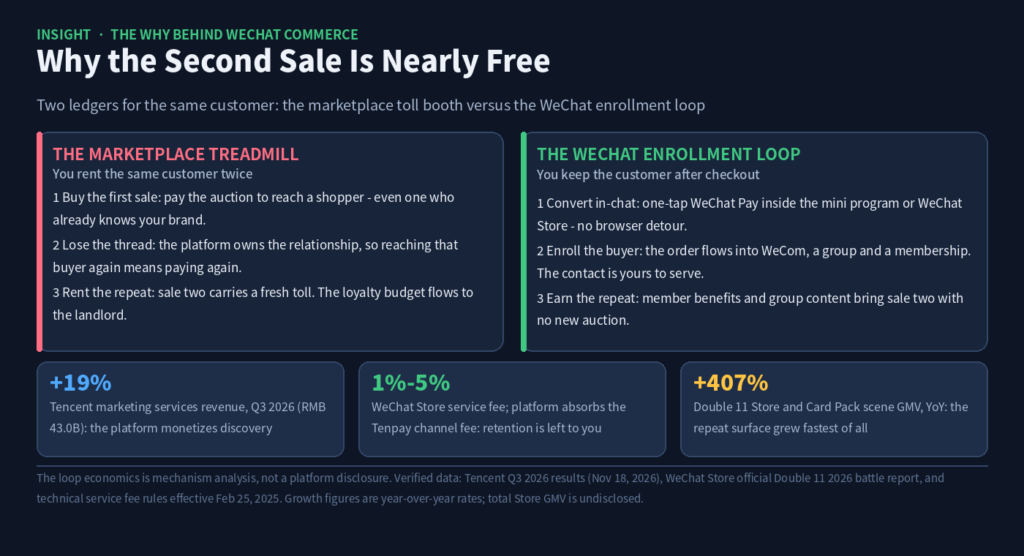
Look at where Tencent makes its money, and you will understand why WeChat stores behave so differently from marketplace stores. In the third quarter of 2026, Tencent’s marketing services revenue rose 19% year over year to 43 billion yuan. The platform earns when merchants buy discovery. But read the WeChat Store fee rules and you find the opposite logic on the other side of checkout: most categories pay just 1%–5% in technical service fees, and the platform absorbs the payment-channel fee itself. Discovery is monetized. Retention is left to you.
That asymmetry is not an accident. It is the business model.
The Toll Booth and the Enrollment
A marketplace is a toll booth on customer memory. When a past buyer searches again, the auction re-prices that attention — and the merchant who built the relationship pays to rent it back. The loyalty budget flows to the landlord.
WeChat’s loop inverts the ledger. The order converts in-chat with one-tap WeChat Pay; then the buyer is enrolled into WeCom, a group, a membership. The contact now belongs to the merchant’s own address book, not the auction. The second sale arrives through a group post or a member benefit — no bid, no toll. Tencent has been explicit that it is building this direction: on its Q2 2026 earnings call, management described new rewards for repeat shoppers designed to raise customer lifetime value. The platform is subsidizing the very behavior that makes merchants less dependent on ads. Why? Because an enrolled customer transacts more often, and every extra transaction still pays the 1%–5% clip. Tencent trades ad revenue per customer for transaction volume per relationship.
What the Data Says About the Direction
The newest evidence points the same way. WeChat Store’s official Double 11 2026 report shows the Store-and-Card-Pack scene — the shelf where past buyers return, cards in hand — grew 407% year over year, the fastest of any scene. Search grew 211%, short video 158%. The repeat surface outran the discovery surfaces. And at Open Class PRO in January 2026, the platform disclosed that brand-led GMV grew 4.3 times as fast as the overall platform in 2025 — brands being exactly the merchants with the staff to operate enrollment at scale.
The Catch Nobody Prices In
None of this makes retention free. It makes retention unbundled. The marketplace bundles re-reach into its ad price; WeChat un-bundles it into your payroll. WeCom service, group content, member benefits — each needs an operator. The 1%–5% fee looks cheap only if you remember you are now paying the salary the auction used to hide. That is why brands outrun small merchants on this platform, and why Pony Ma keeps telling everyone to think in five-year horizons. The loop compounds, but only for teams that staff it. The second sale is nearly free at the margin — after you have paid to make it possible.