Miniso spent a decade proving you could build a global chain on ten-yuan trinkets. Then it spent the next three proving something stranger: the same suppliers, the same franchise partners and nearly the same shelves could carry a 45% gross margin — a number that belongs to design brands, not dollar stores. In FY2025, revenue hit RMB 21.44 billion, up 26.2%. Adjusted net profit grew 6.5%. Reported profit collapsed 54%. Both profit figures are real, and the gap between them is the whole story: an IP transformation that works, wrapped around capital-allocation bets that bleed. And just when the overseas expansion looked unstoppable, 2026 delivered a plot twist — a roaring domestic revival walking past a deliberately slowed global machine.
Background: The Ten-Yuan Machine
Ye Guofu founded Miniso in Guangzhou in 2013 with a formula borrowed from Japanese variety stores: clean design, aggressive prices, relentless SKU turnover, and prime mall locations. The early “Japanese designer brand” positioning drew years of criticism — the company later repositioned itself as proudly Chinese — but the operating machine underneath was real. A retail-partner model let franchisees fund expansion while Miniso controlled supply chain and merchandising, pulling in more than 1,500 global suppliers behind a rapid-refresh product pipeline.
By its 2020 New York IPO, the pitch was simple: extreme value, high frequency, fast replication. Revenue crossed RMB 10 billion faster than almost any Chinese retailer before it.
The ceiling cheap couldn’t break
Then the floor fell out of the cheap game. Pinduoduo and white-label e-commerce could undercut any physical shelf on pure price. Ye admitted it publicly in 2023: on value-for-money alone, Miniso could not beat Pinduoduo. The numbers agreed — mainland China same-store GMV fell by a high-single-digit percentage in 2024, and growth leaned almost entirely on opening new stores. A commodity value retailer has a margin ceiling, and Miniso had hit it. The escape route Ye chose was not to get cheaper. It was to get cooler.
FY2025: One Company, Two Profit Stories
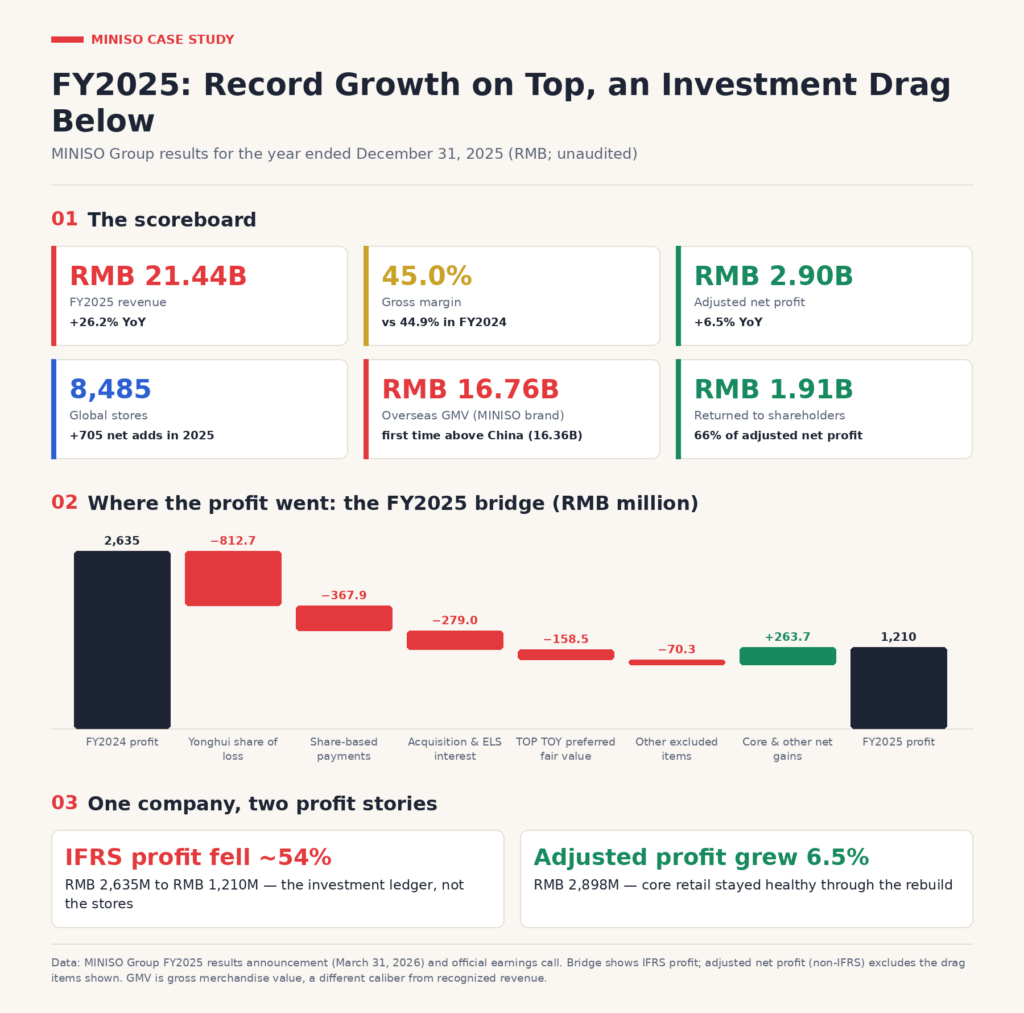
The FY2025 annual results, published March 31, 2026, read like two different companies sharing a ticker. Revenue rose 26.2% to RMB 21.44 billion. Gross margin held at 45.0%. Adjusted net profit — the company’s non-IFRS measure of core operations — grew 6.5% to RMB 2.90 billion. Yet IFRS profit for the year fell from RMB 2.64 billion to RMB 1.21 billion, a 54% drop.
The store network reached 8,485 locations, a net addition of 705. The MINISO brand alone ran 8,151 stores and earned RMB 19.52 billion: mainland China contributed RMB 10.90 billion, crossing the ten-billion line for the first time, while overseas added RMB 8.63 billion, up 29.3% and now 44.2% of brand revenue. The United States became the largest overseas market, growing more than 60% for the year with fourth-quarter same-store sales up over 20%.
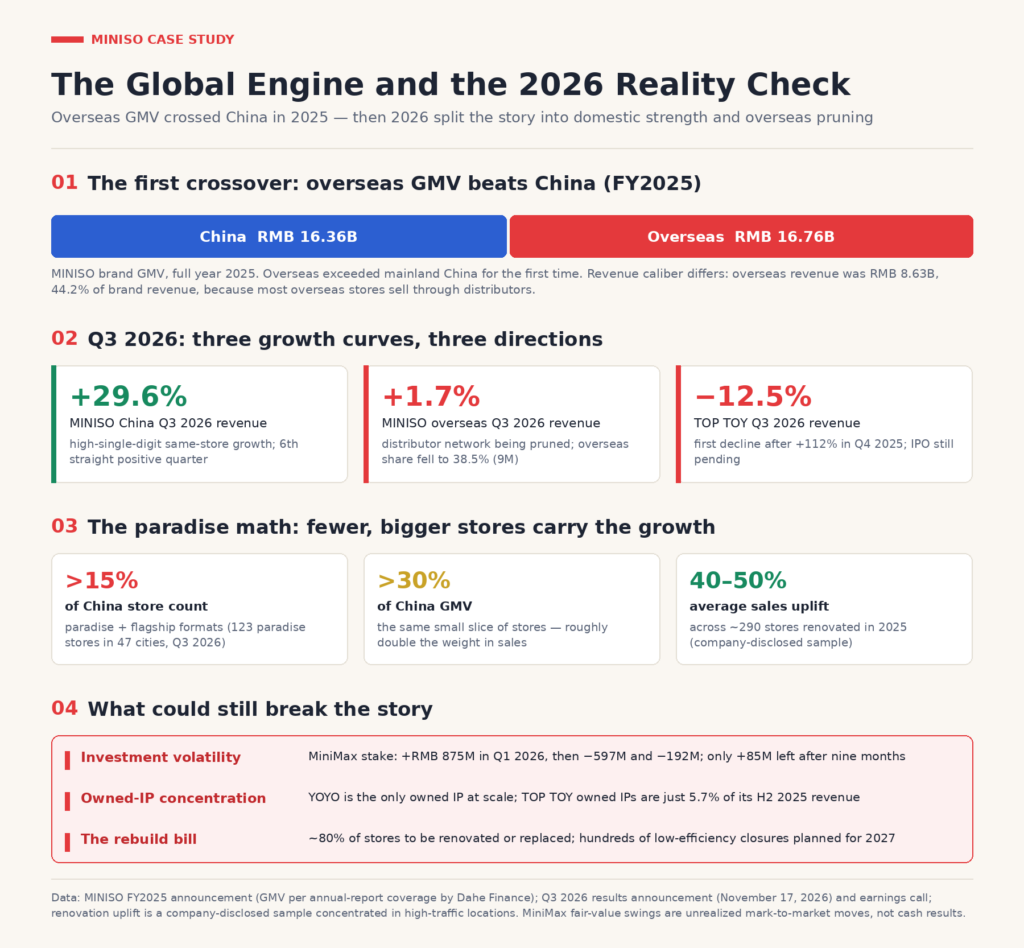
One milestone deserves a caliber warning. Overseas GMV — gross merchandise value, the sell-through at stores, not Miniso’s recognized revenue — reached roughly RMB 16.76 billion versus RMB 16.36 billion in China, beating the home market for the first time, according to annual-report figures cited by Chinese financial media. Because most overseas stores sell through distributors, GMV and revenue diverge sharply abroad. The crossover is real, but it measures shopper spend, not Miniso’s take.
The bridge nobody puts on a slide
Where did RMB 1.4 billion of profit go? The company’s own reconciliation lists it: RMB 812.7 million share of losses from Yonghui Superstores; RMB 367.9 million of share-based compensation, mostly for TOP TOY staff; RMB 279.0 million of interest on acquisition loans and equity-linked securities; RMB 158.5 million from fair-value changes on TOP TOY’s preferred shares; and RMB 70.3 million of other excluded items. Strip those out and the core business actually improved. Meanwhile the company returned RMB 1.91 billion to shareholders — about 66% of adjusted net profit — and held RMB 7.09 billion in cash. This is not a retailer in distress. It is a healthy retailer carrying a heavy investment portfolio.
The IP Engine
The transformation thesis fits in one line: cheap is the entry, cool is the margin. Three wheels drive it.
Renting cool: 180 licensed collaborations
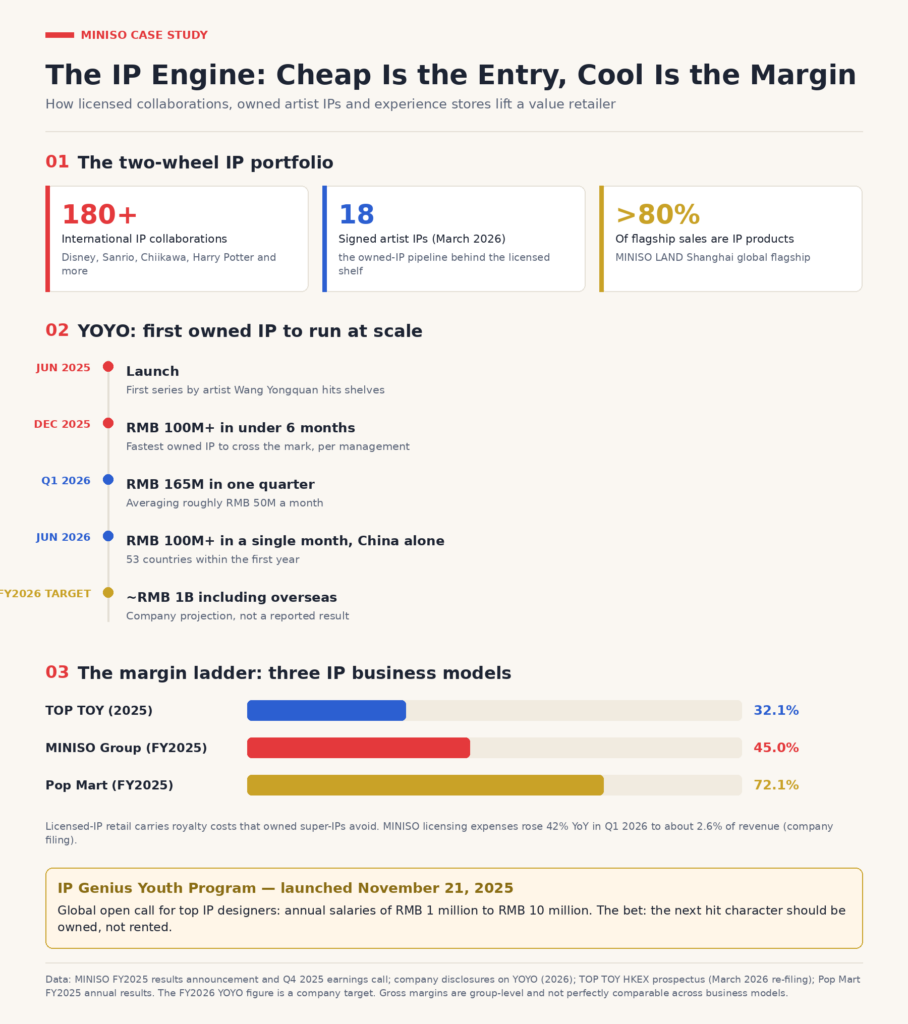
Miniso now works with more than 180 international IPs — Disney, Sanrio, Chiikawa, Harry Potter and a long tail of characters that trend, spike and fade. Licensed IP lifts average selling prices and repurchase rates on products that would otherwise compete on cents. But renting cool has a landlord. Licensing expenses rose 42% year over year in Q1 2026 to about 2.6% of revenue, per company filings, and full-year gross margin improved only 0.1 percentage points in FY2025. The margin story is real but plateauing — management itself credits pricing optimization and product mix, not IP alone.
Owning cool: the YOYO experiment
The hedge is ownership. By March 2026 Miniso had signed 18 artist IPs, and in November 2025 it launched an “IP Genius Youth Program” offering annual salaries of RMB 1 million to RMB 10 million to recruit elite designers worldwide — an open admission that the next Labubu should be owned, not rented.
The proof of concept is YOYO, a pumpkin-headed character by artist Wang Yongquan launched in June 2025. Company disclosures trace an unusually fast curve: over RMB 100 million of global sales in under six months; RMB 165 million in Q1 2026 alone; and in June 2026, its first single month above RMB 100 million in China alone. Within a year it reached 53 countries. Management projects roughly RMB 1 billion in 2026 sales including overseas — a company target, not a reported result, and worth reading as ambition rather than fact.
The store as the product: MINISO LAND
The third wheel is spatial. The Shanghai global flagship, opened on Nanjing East Road in October 2024, spans nearly 2,000 square meters over three floors — not the 1,500 sometimes quoted. It crossed RMB 100 million in sales within nine months, peaked at RMB 16 million in a single month, draws roughly ten times the foot traffic of a regular store, and sells over 80% IP products. The store is not a distribution point; it is the attraction.
By end-2025 there were 26 MINISO LAND stores in China. By Q3 2026, the broader paradise family — LAND, FRIENDS, SUPER MINISO — had grown to 123 stores across 47 cities. Together with flagships, these formats are more than 15% of the China store count but contribute over 30% of domestic GMV. Company-disclosed figures say roughly 290 stores renovated in 2025 saw average sales lift of 40–50%; treat that as a marketing sample skewed toward prime locations, not a promise for every mall in every tier-three city.
The Global Crossover — and the 2026 Plot Twist
If you stopped reading at the FY2025 report, you would conclude overseas is the engine and China is the anchor. The November 17, 2026 quarterly release flipped the script.
Third-quarter group revenue grew 14.3% to RMB 6.63 billion, with nine-month revenue up 19.3% to RMB 18.12 billion. But underneath: MINISO China grew 29.6% in Q3 with high-single-digit same-store growth — its sixth consecutive positive quarter — while overseas grew just 1.7%. Overseas revenue share slid to 38.5% of the brand for the nine months, down from 42.1%. The overseas store count actually shrank by six net stores year-to-date.
This is not collapse; it is pruning. Management pivoted its stated goal from scale to “sustainable growth rather than scale expansion,” cleaning up distributor networks market by market. Note the tension: the 2026 guidance called for 510–550 net new stores, yet by September the group had added only 180. North America remains the bright spot, up 29.1% for nine months, and the first US MINISO LAND opened in Columbus, Ohio in November. The footprint now spans 115 countries and regions. The lesson for anyone copying this playbook: globalization is no longer a land-grab metric. It is a store-quality metric.
The Yonghui Bet
In September 2024, Miniso paid RMB 6.27 billion for 29.4% of Yonghui Superstores, becoming the largest shareholder of a struggling grocery giant. The thesis: apply the Pang Donglai-style renovation magic, buy a legacy retailer at a historic-low valuation, and share the turnaround upside.
The first invoice was brutal. Yonghui’s FY2025 revenue fell 20.8% to RMB 53.5 billion with a net loss of about RMB 2.55 billion, capping five-year cumulative losses near RMB 12 billion. Miniso booked its RMB 812.7 million share of that loss, plus acquisition-loan interest. The balance sheet shows the strain: total borrowings swelled from under RMB 0.6 billion at end-2024 to RMB 7.51 billion by September 2025, and the asset-liability ratio jumped from 42.9% to 62.2% in nine months.
Then the story bent again. Yonghui closed 381 weak stores in 2025, renovated 331 by mid-2026, cut its supplier base from 2,300 toward 800, and posted roughly RMB 250 million of net profit in H1 2026 — its first meaningful green shoot, contributing RMB 77.5 million of equity income to Miniso in Q1. Ye insists over 90% of his energy stays on Miniso. Whether the bet was diworsification or patient capital is genuinely undecided; the honest read is that it is expensive either way.
The MiniMax subplot
The portfolio complication does not end with groceries. In June 2023 Miniso put US$10.4 million into a limited partnership that invested early in AI startup MiniMax. When MiniMax IPO’d in Hong Kong in January 2026, Miniso booked an RMB 875 million unrealized gain in Q1 — then gave most of it back: minus RMB 597 million in Q2, minus RMB 192 million in Q3, leaving a cumulative RMB 85 million as the stock fell about 91% from its March peak. None of it is cash. The company now excludes these swings from adjusted profit by definition. The takeaway is structural: Miniso’s income statement has become part retailer, part venture fund, and you must read the two ledgers separately.
TOP TOY: Two Sets of Books, One Clock
The pop-toy arm is the second curve — and a masterclass in why calibers matter. Miniso’s group accounts show TOP TOY FY2025 revenue of about RMB 1.92 billion, up 94.8%, counting only sales to external parties. TOP TOY’s own HKEX prospectus shows RMB 3.59 billion, up 87.9%, because it includes sales to its parent — which alone accounted for 46.6% of revenue. Both numbers are correct. Quoting one without the caliber is how case studies go wrong.
The prospectus also shows IFRS profit falling 65.6% to RMB 101 million, driven by pre-IPO share-based payments and preferred-share accounting; adjusted profit rose 77.5% to about RMB 523 million. Gross margin sits near 32%, far below Pop Mart’s 72.1% in FY2025 — the structural gap between collecting many IPs and owning a super-IP. Tellingly, self-developed products are 56.7% of TOP TOY revenue, but products on its own owned IPs were only 5.7% in H2 2025. It designs much; it owns little.
The clock is ticking. After a first filing lapsed, TOP TOY refiled in March 2026 with JPMorgan and UBS, and as of November 2026 still awaited mainland regulatory clearance. Its July 2025 Series A — about US$59.4 million at a US$1.3 billion valuation — carries preferred shares redeemable at issue price plus 10% annual interest if no qualified IPO happens within three years. And growth just wobbled: Q3 2026 revenue fell 12.5%, its first decline. The market it plays in grew from RMB 24.9 billion to RMB 87.5 billion between 2020 and 2025 per Frost & Sullivan research commissioned for the prospectus — vendor-paid sizing, so discount accordingly — where TOP TOY ranks second overall with roughly 4.8% share.
What Everyone Misunderstands
“It’s still a cheap store.” A 45% gross margin, flagship stores doing nine-figure annual sales and an owned IP crossing RMB 100 million in months say otherwise. Cheap is the customer acquisition channel; IP is the monetization layer.
“Profit fell 54%, so the business is broken.” The fall is almost fully explained by investment losses, financing costs and IPO accounting. The core grew. But do not overcorrect: the interest expense is real cash, and the capital bets consumed money the IP pipeline could have used.
“It’s an IP company now.” Not yet. Licensed IP dominates, licensing costs are compounding, and only one owned IP has reached scale. Pop Mart’s Labubu franchise earned RMB 14.2 billion in FY2025 — then declined 7.5% in H1 2026. Even true IP ownership carries fad risk; renting it carries more.
“Overseas GMV beating China means overseas is the profit engine.” GMV is shopper spend through distributors. In 2026 the overseas revenue engine actually decelerated to nearly flat while China accelerated. Read calibers before drawing arrows.
The Reusable Playbook
Four lessons travel beyond Miniso:
- Use cheap as entry, not identity. Low prices buy traffic and frequency; margin must come from a second layer — IP, design, experience — or price wars will define your ceiling.
- Make the store the media. A destination store that people photograph is an ad budget that earns revenue. The paradise formats are 15% of stores doing 30% of GMV; that ratio, not store count, is the metric to copy.
- Convert rented differentiation into owned assets. Licensing proves demand; ownership captures it. Budget the transition explicitly — Miniso’s eight-figure designer salaries are the cost of escaping the landlord.
- Audit the core and the portfolio separately. Adjusted profit for operations, full IFRS for capital discipline. A great business can fund mediocre bets for years; keep two scorecards so neither hides the other.
Risks and Honest Caveats
The owned-IP pipeline is one hit deep — YOYO — and cute characters without story universes historically fade fast, leaving inventory behind. The renovation program means years of capex, franchise friction and execution risk across thousands of stores, with hundreds of permanent closures already promised for 2027. The competitive middle is crowded: white-label platforms squeeze from below, Pop Mart’s brand gravity pulls from above, and KKV-style rivals contest the same mall corners. And the investment portfolio keeps injecting mark-to-market noise into every headline. None of these kills the thesis. All of them price it.
The Takeaway
Miniso is no longer a ten-yuan store with ambitions; it is an IP retail platform with a venture-fund habit. The 45% margin, the YOYO curve and the paradise-store math prove the transformation is real. The Yonghui drag, the MiniMax whiplash and TOP TOY’s ticking redemption clock prove that strategy and capital allocation are different sports. Cheap got 8,485 stores onto the world’s high streets. Cool is what pays for them. Whether the bets let it stay cool — that is the open question, and it is being answered quarter by quarter.