Ranked #1 and still invisible? Welcome to the citation economy.
You did everything right. The page ranks first. The backlinks rolled in. The content team framed the screenshot in Slack. Then a customer tells you she found your competitor through ChatGPT — and your brand never came up.
How does the page that wins Google lose the answer?
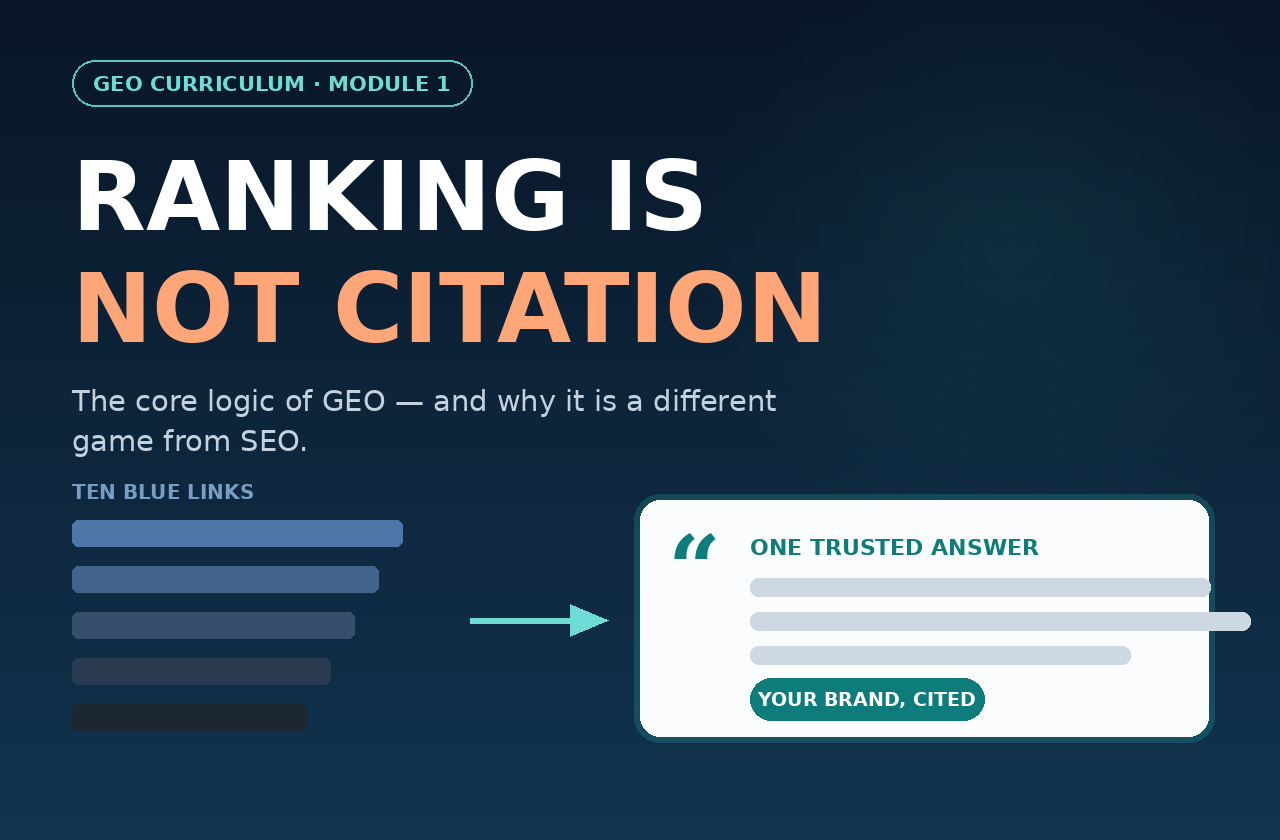
Because ranking and citation are two different games, played on two different scoreboards. SEO asks: which page deserves the top slot for this keyword? GEO — generative engine optimization — asks a colder question: which source does the model trust enough to quote? This first module of the GEO curriculum unpacks that difference across seven dimensions, walks through the measured evidence, unlearns three stubborn myths, and hands you five actions you can run this week. No hype. Every number below survived two independent verification passes against primary sources.
What GEO Actually Optimizes
Let’s define the term before the vendors define it for you. GEO is the practice of making your content understood, cited, and recommended by generative engines — ChatGPT, Gemini, Perplexity, Google’s AI Overviews and AI Mode, and in China, Doubao, Qwen and DeepSeek.
Notice what’s missing from that definition: position. A search engine returns a ranked list and lets the human choose. A generative engine returns a synthesized answer and chooses for them. The unit of competition moves from the result slot to the verdict sentence — the one line inside the answer that says “brand X is the strongest option for Y.”
You can rank tenth and own that sentence. You can rank first and never appear in it. That’s not a hypothetical; it’s now a measured pattern, and we’ll get to the measurements shortly.
This Isn’t Vendor Hype — It’s a Research Field
GEO has an academic birth certificate. In November 2023, researchers from Princeton, Georgia Tech, the Allen Institute for AI and IIT Delhi posted “GEO: Generative Engine Optimization” to arXiv; it was accepted at KDD 2024, one of the top data-mining conferences. The team built GEO-bench, a large benchmark of diverse queries, and tested content interventions systematically. Their headline finding: tactics like adding citations, statistics and quotations boosted a source’s visibility in generative responses by up to 40%, with effects varying by domain.
Two things matter here. First, content changes measurably move AI visibility — this is an optimization problem, not astrology. Second, the winning tactics were about credibility and extractability, not keyword stuffing. The machines reward the things good editors always wanted anyway.
The Seven-Dimension Comparison
Here is the curriculum’s core framework. Read it as a checklist of assumptions you may need to swap out.
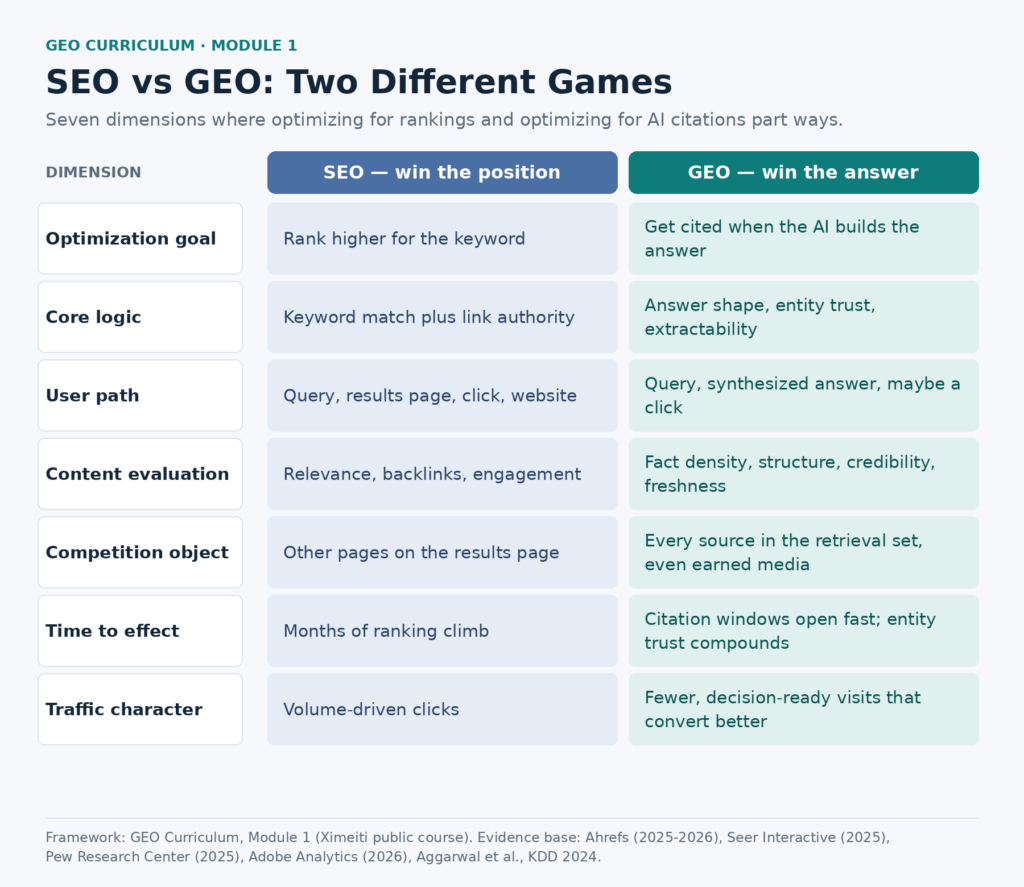
A quick tour of what actually changes:
- Optimization goal. Ranking position becomes citation priority. You’re no longer fighting for shelf space; you’re auditioning to be quoted.
- Core logic. Keyword match plus link authority gives way to answer-shaped structure, entity trust, and how cleanly a machine can lift a passage out of your page.
- User path. Query → results page → click → website collapses into query → synthesized answer → maybe a click. “Maybe” is doing heavy lifting in that sentence.
- Content evaluation. Relevance and engagement metrics matter less than fact density, structure, source credibility and freshness.
- Competition object. You’re not just racing the other nine blue links. You’re competing with every source in the retrieval set — including review sites, Reddit threads, YouTube transcripts and news coverage you don’t control.
- Time to effect. Rankings climb over months. Citation windows can open in days when a live-retrieval engine re-crawls you — but durable entity trust compounds over quarters.
- Traffic character. Volume-driven clicks become quality-driven visits. Fewer people arrive; the ones who do are further down the decision path.
The Evidence, Part One: Rankings Don’t Transfer
This is where the argument stops being theoretical.
Ahrefs — whose dataset is large enough to take seriously — ran the measurement twice. In July 2025, analyzing 1.9 million citations across a million AI Overviews, they found 76.1% of cited pages also ranked in Google’s top 10 for the same query. Overlap looked strong. SEO and GEO seemed like cousins.
Then they ran it again. The March 2026 update, covering 863,000 keywords and 4 million AI Overview URLs, put top-10 overlap at 38%. About a third of citations came from pages ranking 11–100, and another third from pages outside the top 100 entirely. In seven months, roughly two of three citations started coming from pages that don’t rank on page one.
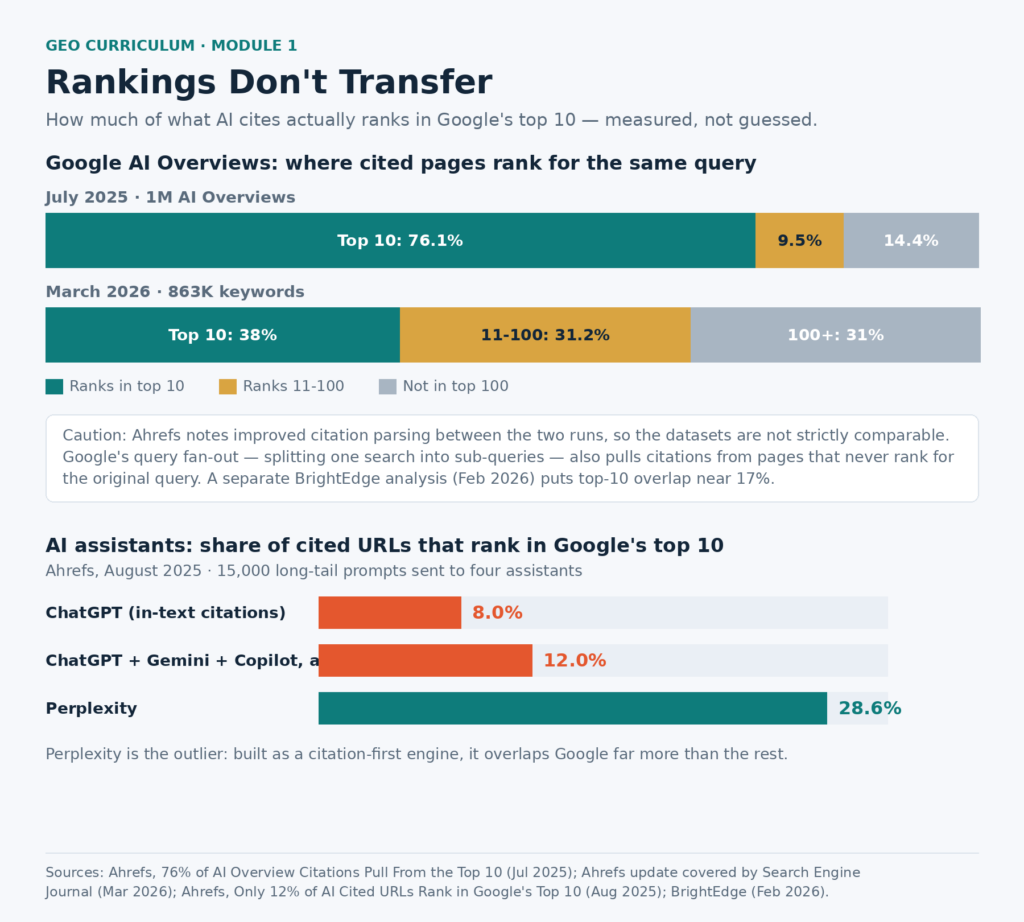
Two honesty flags, because you deserve them. Ahrefs itself notes its citation parsing improved between runs, so the two datasets aren’t strictly comparable — part of the drop is better detection, not just changed behavior. And Google’s query fan-out, where one search splits into several sub-queries, pulls citations from pages that were never meant to rank for your original keyword. A separate BrightEdge analysis in February 2026 put the overlap even lower, near 17%, using a different method. The exact number depends on whose ruler you use. The direction doesn’t.
And Google is the friendly case. In August 2025, Ahrefs sent 15,000 long-tail prompts to four AI assistants. On average, only 12% of the URLs cited by ChatGPT, Gemini and Copilot ranked in Google’s top 10 for the same prompt. ChatGPT’s in-text citations overlapped just 8%. Perplexity, built as a citation-first engine, was the outlier at 28.6%. Your Google rankings, it turns out, are a letter of recommendation the assistants barely read.
The Evidence, Part Two: Mentions Are the New Backlinks
If rankings don’t predict citation, what does? Ahrefs studied 75,000 brands and correlated dozens of signals with brand visibility in AI Overviews, using Spearman coefficients.
Branded web mentions — your name appearing across the web, linked or not — topped the table at 0.664. Backlinks, the currency SEO spent twenty years accumulating, managed 0.218. Brand-rich anchor text scored 0.527; branded search volume 0.392; Domain Rating 0.326. Every one of the top three signals lives off your site.
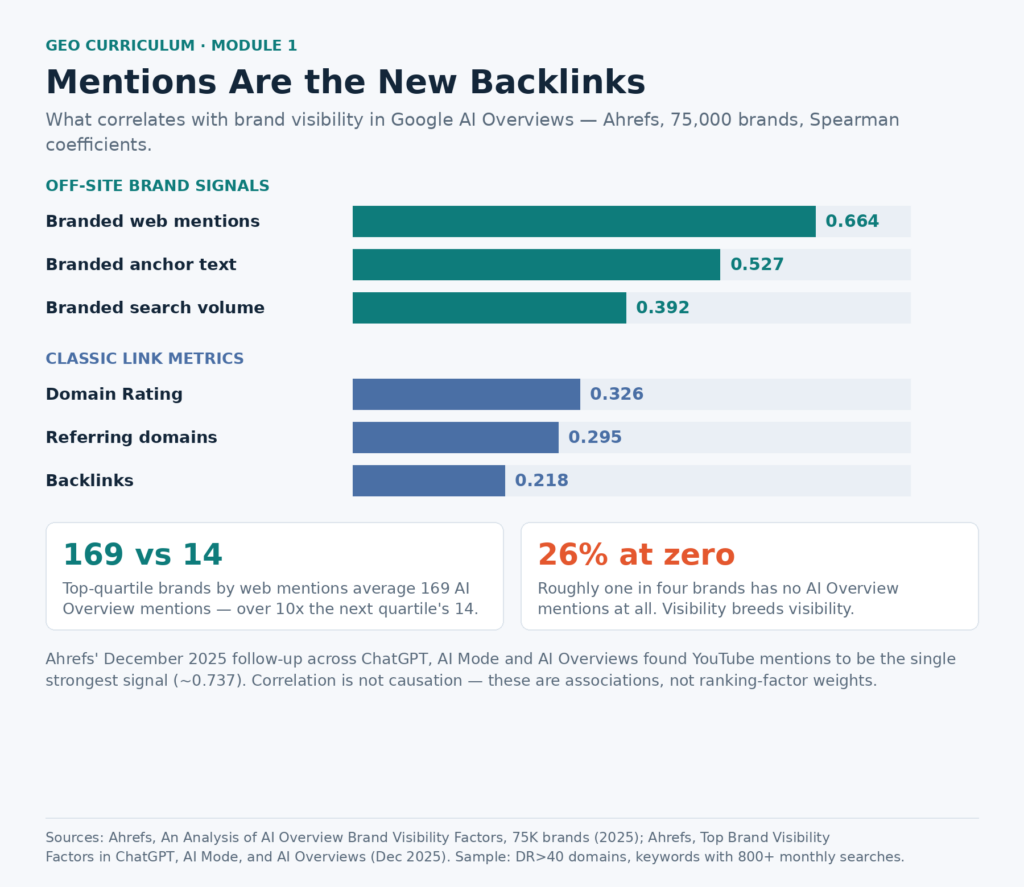
The distribution is brutal in a way averages hide. Brands in the top quartile for web mentions averaged 169 AI Overview mentions — more than ten times the next quartile’s 14. About 26% of brands had zero. Visibility breeds visibility, which means the gap compounds while you wait.
Ahrefs’ December 2025 follow-up, spanning ChatGPT, AI Mode and AI Overviews, crowned an even less traditional signal: YouTube mentions, at roughly 0.737 — the strongest single correlate across all three platforms. Both Google and OpenAI have trained on YouTube transcripts. The web’s text is the model’s memory; your brand needs to be in the conversation, not just in the link graph.
One caveat the researchers themselves underline: these are correlations, not causal weights. Nobody has proven that buying mentions buys citations. Treat this as a compass, not a promise.
The Evidence, Part Three: The Click Recession
Even where SEO still works, the payoff is shrinking.
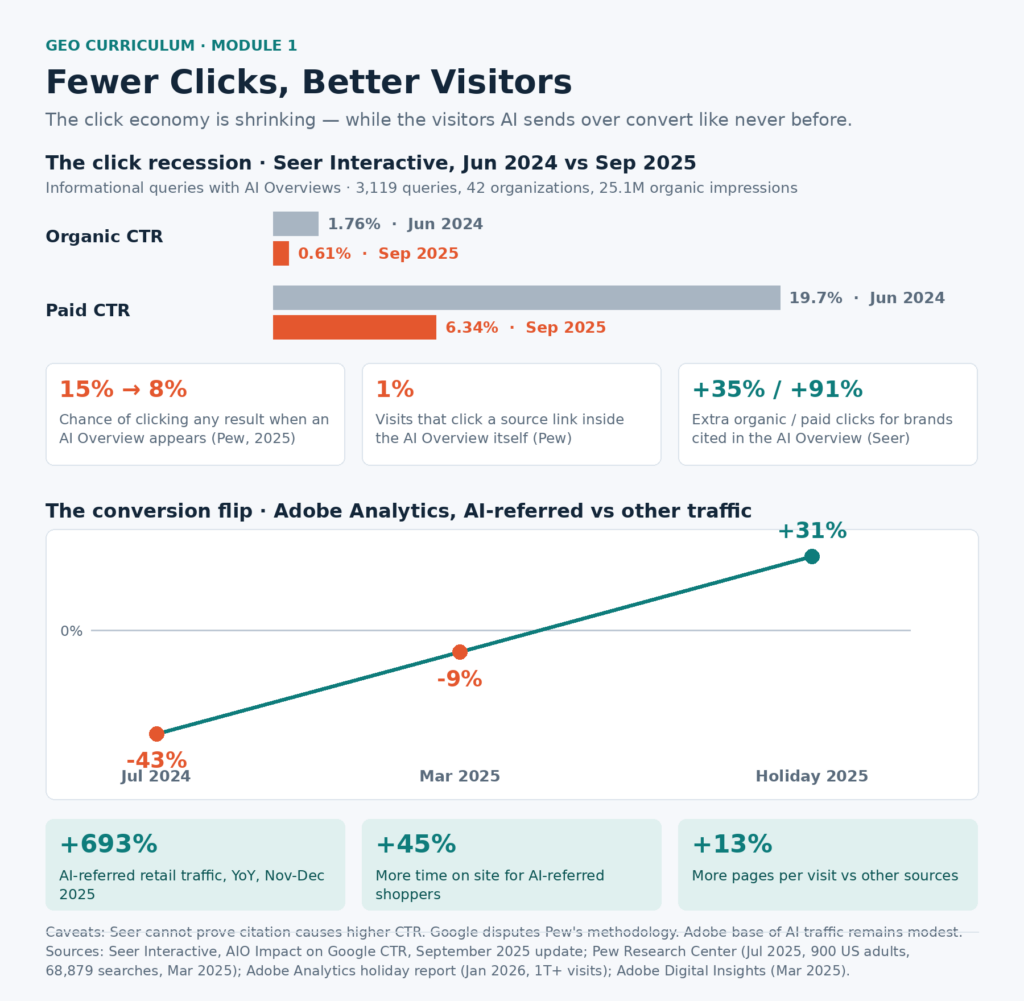
Pew Research Center tracked the actual browsing of 900 US adults in March 2025 — 68,879 real Google searches, not a survey of opinions. When an AI Overview appeared, users clicked a traditional search result in 8% of visits. Without one, 15%. Clicks on the source links inside the AI Overview itself? Just 1%. And users were more likely to end their browsing session entirely: 26% versus 16%. Google publicly disputes the methodology, calling the query set skewed — worth knowing, though publishers’ traffic dashboards tell a consistent story.
Seer Interactive measured the trend from the marketer’s side: 3,119 informational queries across 42 organizations, 25.1 million organic impressions, June 2024 through September 2025. On queries where AI Overviews appeared, organic click-through rate fell from 1.76% to 0.61% — a 61% decline. Paid CTR on those queries dropped 68%, from 19.7% to 6.34%. Even queries without AI Overviews saw organic CTR fall 41% year over year. The habit of clicking is eroding everywhere; the AI answer just accelerates it.
But here’s the twist that reframes the whole problem: brands cited inside the AI Overview earned 35% more organic clicks and 91% more paid clicks than brands left out. Seer is careful — they can’t prove citation causes the lift; stronger brands may simply get both. Still, the association points one way. In a shrinking click economy, the citation is the lifeboat.
The Quality Flip: Fewer Visitors, Better Ones
The traffic story has a second act, and it’s the one optimists should quote — carefully.
Adobe Analytics, covering over a trillion visits to US retail sites, watched AI-referred traffic through the 2025 holiday season. The full timeline matters: in mid-2024, visitors arriving from AI tools converted about 43% worse than other traffic. By March 2025, the gap had narrowed to roughly 9% worse. Then it flipped. Across November–December 2025, AI referrals converted 31% better than other sources — 54% better on Thanksgiving, 38% better on Black Friday.
The volume grew up alongside the quality. AI-referred retail traffic rose 693.4% year over year for the season. These visitors spent 45% more time on site, viewed 13% more pages, and were 33% less likely to bounce immediately. The base remains modest — Adobe says so itself — but the direction is unmistakable: the AI does the browsing and comparing, then sends you someone ready to decide.
That’s the traffic character shift from our seven-dimension table, observed in a trillion visits. Fewer but readier. You won’t replace your old click volume. You may not need to.
Three Trends That Make This Urgent
Behavior moved. Question-style queries triggered AI Overviews in 60% of cases in Pew’s data. People didn’t stop asking questions — they changed where the answers live.
Quality moved. The Adobe flip and Seer’s cited-brand premium point the same way: the visitors who still click are worth more, and they disproportionately flow to sources the AI already trusts.
The window is moving. Gartner predicted in February 2024 that traditional search volume would drop 25% by 2026, and in its late-2023 marketing outlook that brands’ organic search traffic could fall 50% or more by 2028. Those are analyst predictions, not measurements — hold them loosely. But remember the mention distribution: a quarter of brands sit at zero while the top quartile compounds. Entity trust is built in quarters, not sprints. Late entrants pay retail for what early movers got wholesale.
And the value lands differently by seat. Decision-makers should read this as CAC insurance. Practitioners, as the skill upgrade of the decade. Creators, as the rare opening where a small, well-structured site can out-cite a giant. Technologists, as a compounding capability that sits exactly where search, content and machine learning overlap.
Three Myths to Unlearn
Myth one: good SEO means good GEO. The overlap data says otherwise — 8% for ChatGPT’s in-text citations, 38% and falling for AI Overviews. SEO is the entry fee: if the crawlers can’t reach you, neither game is playable. But paying the entry fee doesn’t win the tournament.
Myth two: GEO means writing for robots. The KDD paper’s winning tactics were citations, statistics, quotations — the vocabulary of writing well for humans. GEO is answer-shaped content that people trust and machines can extract. Write a page a busy expert would quote aloud, and you’re most of the way there. Machine-readable is not machine-pandering; the quality floor stays exactly where it was.
Myth three: wait until it’s mainstream. The mention cliff — 169 versus 14 versus zero — is what compounding looks like from outside. Every quarter you wait, the brands already inside the conversation get easier to cite and you get harder to notice. There is no bell that rings when the window closes. There’s just a widening gap in someone else’s dashboard.
Five Quick-Start Actions You Can Run This Week
Module 3 turns these into a 72-hour launch plan. For now, treat them as a diagnostic:
- Open your robots.txt. Confirm GPTBot, Google-Extended and ClaudeBot aren’t blocked. A surprising number of brands are invisibly opting out of the entire channel. Ten minutes, highest leverage on this list.
- List twenty real questions. Pull them from support tickets and sales calls, not keyword tools — the phrasing customers actually type into chatbots. This seeds your question map in Module 4.
- Deploy FAQ schema on the pages that answer those questions. Structured markup is how you hand the machine a clean extraction path.
- Test your AI exposure manually. Ask ChatGPT, Perplexity and Google’s AI Mode the twenty questions. Record who gets cited — you, a competitor, or a Reddit thread from 2021. That’s your baseline.
- Schedule a weekly re-test. Same questions, logged answers. Citation windows open fast; you’ll want to notice when yours does.
Each action maps to a later module — technical foundations, question mapping, content standards, monitoring — because this curriculum is a spiral, not a pile.
The Takeaway
Ranking was the twentieth century’s scoreboard; citation is this decade’s. The evidence is no longer anecdotal: overlap between page-one rankings and AI citations has fallen sharply in the measured datasets, mentions out-correlate links roughly three to one, clicks are scarcer, and the visitors AI sends now convert better than other traffic. SEO remains the entry fee — keep paying it. But the game is now played inside the answer, and the price of admission is being worth quoting.
Module 2 opens the hood: the retrieval mechanics that decide which sources make it onto the table at all. Bring your twenty questions.