You did everything the SEO checklist told you to do. Clean headings. Solid keywords. A page that ranks. And yet, when a buyer asks ChatGPT which tool to pick, the answer quotes your competitor — sometimes a page that doesn’t even rank in Google’s top ten. Frustrating? Sure. Random? Not at all.
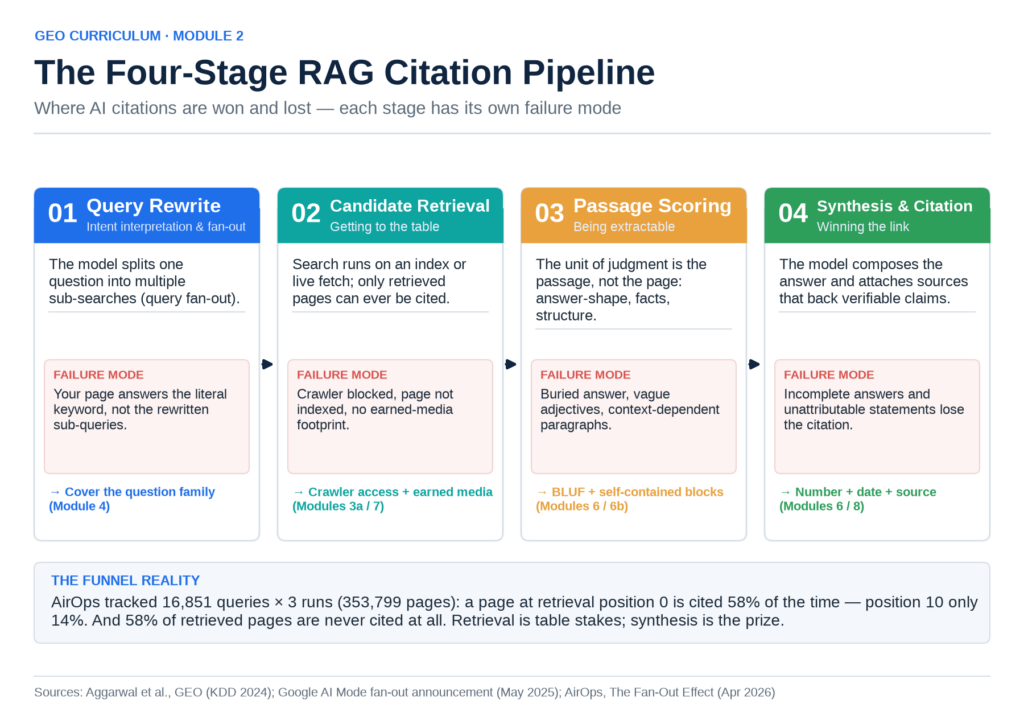
Here’s the uncomfortable truth: an AI answer isn’t a ranking list with a paragraph glued on top. It’s the output of a pipeline — retrieval-augmented generation, or RAG — and your content gets judged four separate times before a citation ever attaches to it. Miss any one of those judgments and you’re out, no matter how good the other three look.
This module opens the machine. We’ll walk the four stages where citations are won and lost, the five filters that run across them, and the reason different engines quote different sources for the exact same question. One honest note before we start: no vendor publishes its exact scoring internals. The four-stage model below is the industry-consensus abstraction, grounded in the academic RAG literature and large-scale observational studies. Treat it as a map, not an X-ray.
Stage 1: Your Question Never Travels Alone
When someone asks an AI engine a question, the engine rarely searches for that question verbatim. It rewrites it — splitting one prompt into a family of sub-queries and searching for each. Google calls this query fan-out, and it’s official: AI Mode uses a “query fan-out technique, breaking down your question into subtopics and issuing a multitude of queries simultaneously on your behalf,” as Google’s own AI Mode announcement puts it. With the Gemini 3 update in November 2025, Google said the fan-out process searches even more broadly. Google’s VP of Product for Search, Robby Stein, told Search Engine Journal in July 2025 that the Deep Search variant can issue dozens — sometimes hundreds — of background queries for a single complex question.
Think about what that does to your keyword strategy. A buyer types “best CRM for a 20-person agency.” The engine may secretly search for pricing comparisons, integration lists, migration horror stories, and reviews from teams your size. Your page optimized for the literal phrase competes against pages optimized for the questions the model actually asked.
The practical implication: cover the question family, not the keyword. Map the sub-questions a real buyer’s research pass would generate — comparisons, edge cases, objections — and give each a findable, clearly-headed home. That’s exactly what the question map in Module 4 is built to do.
Stage 2: Retrieval Is the Table Stakes
Once the sub-queries exist, the engine fetches candidate pages — from a search index, a live crawl, or licensed corpora. This stage is brutally binary: if your page isn’t retrieved, nothing else you do matters. The best-structured, most quotable paragraph in your industry is worth zero if the crawler never sees it.
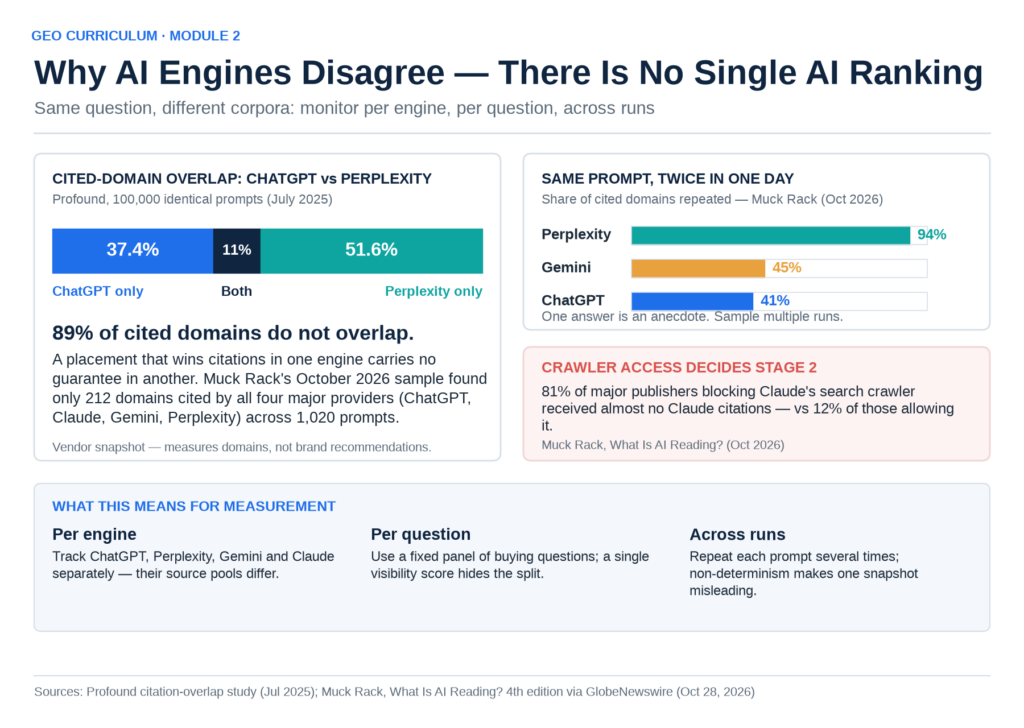
How binary? Muck Rack’s October 2026 “What Is AI Reading?” report found that 81% of major publishers blocking Claude’s search crawler received almost no Claude citations — versus 12% among publishers that allowed it. One robots.txt line, and an entire engine goes dark on you.
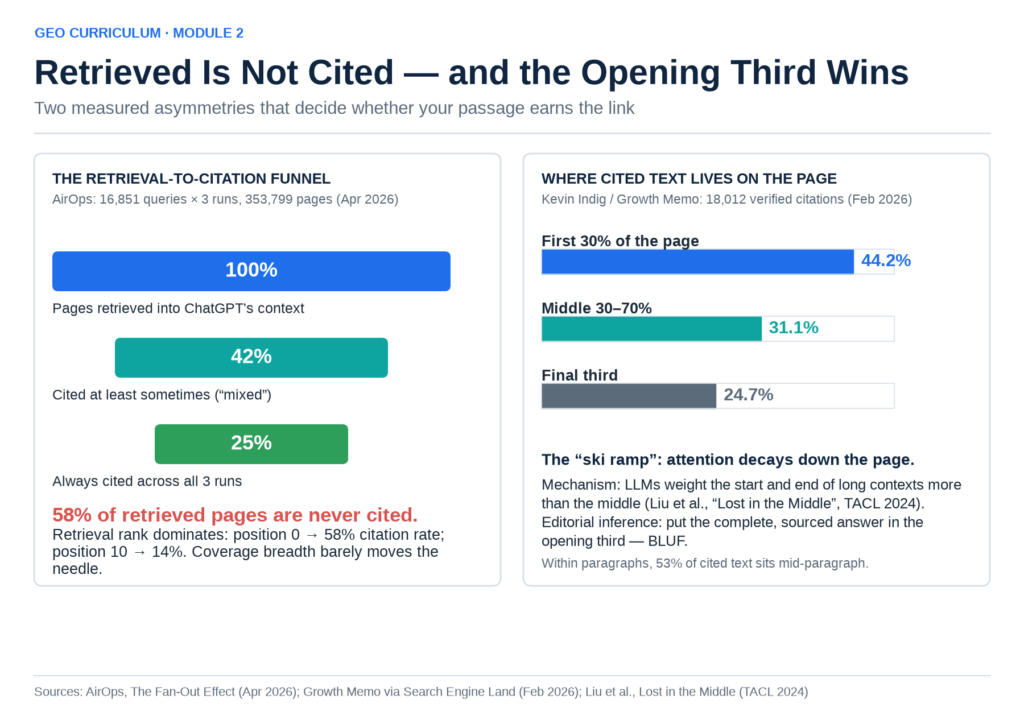
And retrieval is not citation. AirOps ran 16,851 queries through ChatGPT three times each in its April 2026 “Fan-Out Effect” study, covering 353,799 pages. The result: 58% of retrieved pages were never cited in any run. Only 25% were cited every time. Getting fetched is admission to the arena, not a medal.
Position inside that arena matters enormously. In the same dataset, a page at retrieval position 0 was cited 58% of the time; by position 10, that fell to 14%. Retrieval rank was the single strongest predictor of citation — ahead of word count, heading count, and domain authority. This is why crawler access (Module 3a) and earned-media presence (Module 7) aren’t optional extras. They’re stage-2 survival.
Stage 3: The Model Judges Passages, Not Pages
Here’s the mental shift most teams never make: the unit of judgment at stage 3 is the passage, not the page. The engine chunks your content into extractable blocks and asks, essentially: can I lift this block, drop it into an answer, and have it stand on its own?
A passage that needs three surrounding paragraphs to make sense fails. A passage that opens with a complete claim — number, date, source — passes. This is why BLUF (bottom line up front) isn’t a writing nicety; it’s an engineering requirement.
The positional data is striking. Kevin Indig’s Growth Memo analysis, reported by Search Engine Land in February 2026, examined 18,012 verified citations drawn from roughly 1.2 million ChatGPT responses. Of those citations, 44.2% came from the first 30% of the page, 31.1% from the middle, and just 24.7% from the final third. Indig calls it the ski ramp: attention starts high and slides downhill as the page runs on.
There’s academic backing for the shape. Stanford researchers showed in “Lost in the Middle” (Liu et al., published in TACL 2024) that language models use information at the beginning and end of long contexts far better than information buried in the middle. That study is about model inputs, not web pages per se — but the editorial inference is direct: don’t bury the answer where attention is weakest.
Structure signals compound this. AirOps’ “Structuring Content for LLMs” analysis of 548,534 pages found that 68.7% of ChatGPT-cited URLs followed a sequential H1→H2→H3 heading hierarchy, versus just 23.9% of Google page-one results. Cited pages were also far more likely to use exactly one H1. And in Indig’s data, pages with question-style headings plus structured data were cited about 1.7 times more often.
One more nuance worth keeping: within a paragraph, 53% of cited text came from the middle sentences, not the first or last. So write paragraphs with a real explanatory core — a topic sentence, substance in the body, a clean close. Not a lonely claim followed by filler.
Stage 4: Synthesis — Where the Link Gets Attached
At the final stage, the model composes its answer and attaches citations to the claims those sources actually support. The engine wants statements it can verify and attribute. This is where “great content” in the vague, adjective-heavy sense goes to die.
The controlled evidence here is the best we have. In the original GEO paper (Aggarwal et al., Princeton and IIT Delhi, KDD 2024), researchers tested nine content-rewrite methods across GEO-bench, a 10,000-query benchmark. The three winners — adding quotations, adding statistics, and citing sources — improved visibility by roughly 30–40% on the paper’s position-adjusted word-count metric, with the best method (quotation addition) up about 41%. Keyword stuffing, the classic SEO move, performed worse than doing nothing.
The most interesting finding is about who benefits. When the researchers simulated every source optimizing at once, adding citations lifted the fifth-ranked source’s visibility by 115.1% — while the top-ranked source actually lost about 30%. GEO disproportionately helps the challenger, not the incumbent. If you’re not the biggest name in your category, that’s your opening.
The authors also validated the approach on live Perplexity.ai, where quotation addition improved the position-weighted metric by about 22%. Smaller than the lab result — a healthy reminder that benchmark ceilings aren’t per-page promises.
The working rule for stage 4: every important claim should carry a number, a date, and a named source. “Significantly improves conversion” is unquotable. “Lifted trial-to-paid conversion 18% in a 90-day test (internal data, March 2026)” is a citation waiting to happen. And the passage must resolve the question completely — a half-answer loses to a competitor’s whole one.
The Five Filters, With Receipts
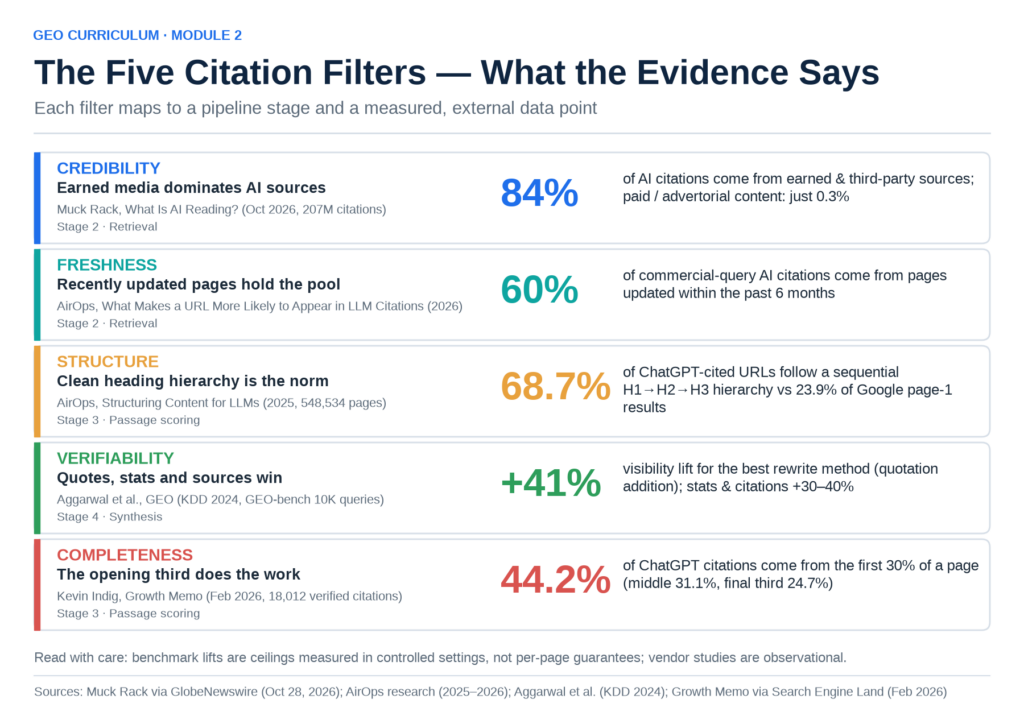
Across those four stages run five filters. Here’s each one anchored to its strongest external evidence — not folklore.
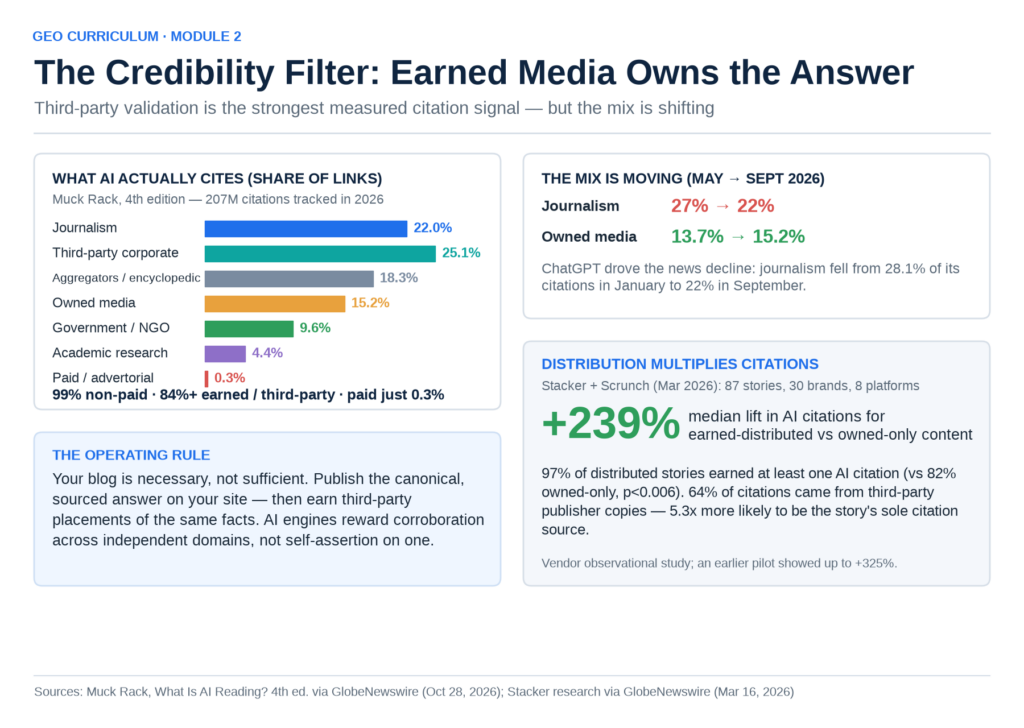
Credibility. Muck Rack’s fourth-edition report (October 2026), drawing on 207 million citations tracked across ChatGPT, Claude, Gemini and Perplexity, found that more than 84% of AI citations come from earned and third-party sources. Paid and advertorial content? 0.3%. Your own blog matters — owned media rose to 15.2% — but third-party validation dominates.
Freshness. AirOps’ 2026 analysis found over 70% of cited pages had been updated within the past 12 months, and for commercial queries, 60% of citations came from pages updated within six months. Real updates — new numbers, corrected facts — not date bumps.
Structure. The 68.7% heading-hierarchy figure above. Sequential headings, one H1, question-shaped sections, extractable lists and tables.
Verifiability. The KDD 2024 result: quotes, statistics and cited sources beat every stylistic trick tested. Numbers with names and dates are the raw material of citations.
Completeness. The 44.2% first-third concentration. The answer must live early and stand alone.
Distribution: The Multiplier Most Teams Ignore
Here’s a stage-2 hack that behaves like a cheat code: the same content, distributed across trusted third-party publications, earns dramatically more citations than the identical content sitting only on your own domain.
Stacker and Scrunch tested this directly. Their March 2026 study — 87 stories, 30 brands, more than 2,600 prompts across eight AI platforms — measured a median 239% lift in AI citations for earned-distributed content versus owned-only. 97% of distributed stories earned at least one citation, versus 82% of owned-only stories. And 64% of the citations pointed at third-party publisher copies, which were 5.3 times more likely to be a story’s sole citation source. An earlier eight-story pilot had shown lifts up to 325%.
Read the fine print honestly: this is vendor-run, observational research from a company that sells distribution. But the direction matches everything else we’ve seen — AI engines weight corroborated, editorially-vetted claims over self-assertion. Publish the canonical answer on your site, then earn placements of the same facts elsewhere. Your PR pipeline and your content pipeline are now the same pipeline.
Why Engines Disagree: There Is No Single AI Ranking
If you take one operational lesson from this module, make it this one: “AI visibility” as a single number is fiction.
Profound ran 100,000 identical prompts through ChatGPT and Perplexity in July 2025 and compared the cited domains. Only 11.0% appeared in both engines’ answers; 37.4% were ChatGPT-only and 51.6% Perplexity-only. Different retrieval stacks — ChatGPT leans on a Bing-lineage index plus institutional sources; Perplexity runs its own crawler and live fetches — produce different candidate pools before any scoring begins. Muck Rack’s October 2026 sample reinforced the point from another angle: across 1,020 prompts, only 212 domains were cited by all four major providers.
And the disagreement isn’t just between engines — it’s between runs of the same engine. When Muck Rack ran the same prompt twice in one day, ChatGPT repeated only 41% of its cited domains, Gemini 45%, and Perplexity 94%. One screenshot of one answer is an anecdote, not a measurement.
The implication for Module 8’s monitoring: track per engine, per question, across multiple runs, and report medians. A brand winning ChatGPT and invisible in Perplexity has two different problems wearing one costume.
Three Tests That Operationalize the Pipeline
Theory is cheap. Here are three verification tests, each isolating one stage — the curriculum’s method for turning the pipeline into a diagnostic.
The same-content version test (stage 3). Publish a structured and an unstructured version of the same substance on comparable URLs. Watch which one earns citations over several weeks. This isolates structure from every other variable.
The passage-independence test (stage 3). Copy your key passage into a blank document. Does it still resolve the question, with its claim, number and source intact? If it needs the surrounding page to make sense, it fails passage scoring — rewrite until it stands alone.
The AI-extraction comparison test (stage 4). Ask an engine to summarize your page, then compare its extraction against the claims you intended to be quotable. The gap between the two lists is your stage-4 work queue. Run it on multiple engines and multiple days, because — as the repetition data shows — one run tells you almost nothing.
What This Means for the Rest of the Curriculum
Every later module traces back to a stage. Stage 1 → the question map (Module 4), because fan-out rewards question-family coverage. Stage 2 → crawler access (Module 3a) and entity/earned-media presence (Module 7), because retrieval is binary. Stage 3 → the content checklist and BLUF discipline (Modules 6/6b), because passages are the unit of judgment. Stage 4 → verifiability and accuracy monitoring (Modules 6/8), because citations attach to attributable claims.
That’s the difference between a mechanism-first curriculum and a tactics list. Tactics expire when engines change. Mechanisms tell you why a tactic worked — and what to try when it stops.
Honest Caveats (Read This Before You Quote Anything)
Four limits deserve daylight. First, the pipeline is an inferred model: engines don’t publish their scoring internals, and the four-stage frame is a consensus abstraction from RAG research and observed behavior. Second, the academic lifts come from a 2023–24 prototype engine plus a limited live check; the ranking of methods is durable, the exact percentages are ceilings. Third, vendor studies — Muck Rack, AirOps, Profound, Stacker — are observational snapshots from companies with products to sell; directionally convergent, not gospel. Fourth, not every answer is RAG: models also answer from training memory, a layer the knowledge-graph module (2b) covers. Non-determinism means every test in this curriculum needs multiple runs.
The Takeaway
Citation is decided four times: at query rewrite, at retrieval, at passage scoring, at synthesis. Five filters — credibility, freshness, structure, verifiability, completeness — run across those stages, and the engines disagree because their corpora and tendencies differ. Match the question family. Get to the table. Be extractable. Be verifiable and complete. Then earn third-party corroboration and measure per engine, per question, across runs.
Understand the machine, and the tactics stop being folklore. Retrieval is the table stakes; synthesis is the prize.





