Here is an uncomfortable thought experiment. Ask ChatGPT what your company does. Then ask Perplexity. Then ask Gemini. If you get three different answers — or worse, a confident description of a competitor — you do not have a content problem. You have an identity problem.
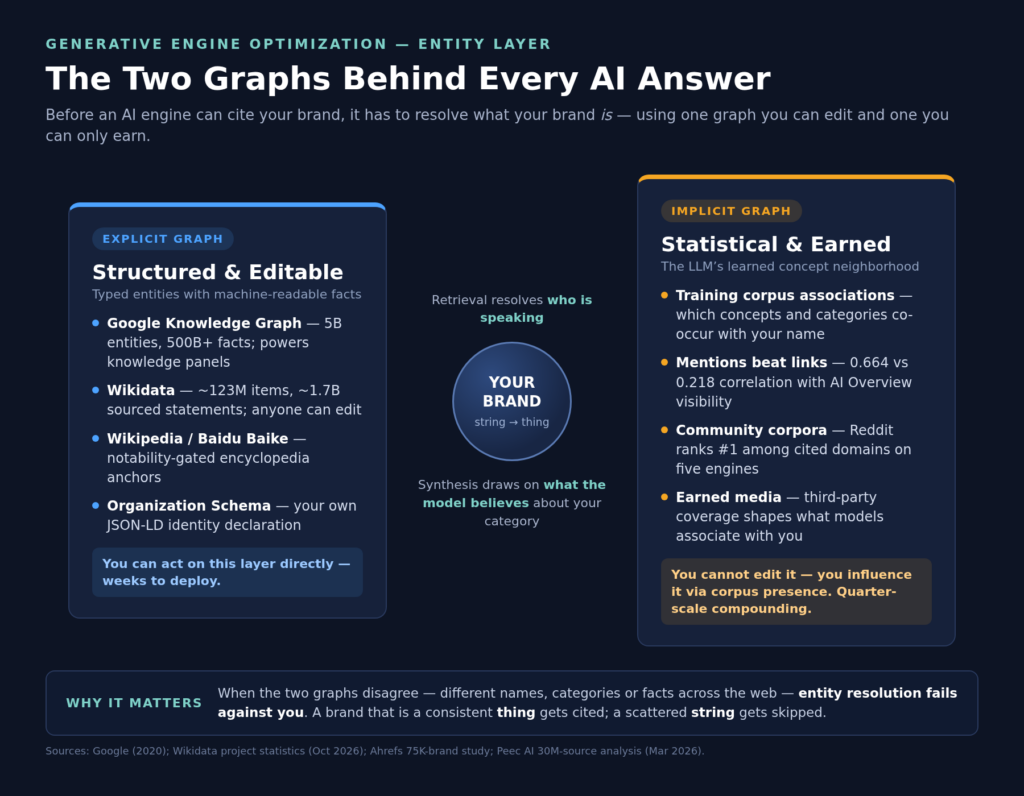
That identity lives in two graphs. The explicit graph is the world of structured entity databases: Google’s Knowledge Graph, Wikidata, Wikipedia, Baidu Baike. Places where your brand exists as a typed thing with attributes and relationships. The implicit graph is stranger and harder to touch: the statistical web of concept associations a large language model absorbed during training. Your brand’s neighborhood, built from every sentence about you the model ever read.
Citation decisions draw on both. Retrieval systems use entity resolution to decide who is speaking; synthesis leans on what the model already believes about your category. The practical consequence is the core of this module: entity-building is a distinct GEO workstream, with its own five-action playbook, its own timeline, and its own KPIs. A brand that is a string — an inconsistent name scattered across the web — loses to a brand that is a thing. Every time.
From Strings to Things: A 2012 Idea That Came Back
When Google launched the Knowledge Graph in May 2012, Amit Singhal announced it with a phrase that aged better than anyone expected: things, not strings. Search, he argued, should understand entities — people, places, organizations — rather than matching character sequences.
By May 2020, Google said the graph had amassed over 500 billion facts about five billion entities, feeding the knowledge panels that appear beside search results. Those panels are generated automatically from hundreds of web sources, licensed databases, and structured markup that content owners deploy themselves.
For a decade, this was an SEO sidebar. Nice for brand searches, irrelevant to the ranking grind. Then generative engines arrived, and the entity layer moved from the sidebar to the foundation. An AI answer engine cannot cite a source it cannot confidently identify. The 2012 idea became the 2026 prerequisite.
The Two-Graph Framework
The Explicit Graph: Structured and Editable
The explicit graph is the part you can act on directly. Google’s Knowledge Graph resolves entities and powers knowledge panels. Wikidata — the Wikimedia Foundation’s open knowledge base — holds roughly 123 million items and about 1.7 billion sourced statements, all released under a CC0 public-domain dedication. Anyone can edit it. That openness is why practitioners call it the back door to AI answers. Wikipedia and Baidu Baike sit alongside it as notability-gated encyclopedia anchors, and your own Organization Schema markup is the machine-readable declaration you control completely.
These systems store typed triples: brand → category, brand → founder, brand → product. When an engine needs to resolve an ambiguous mention, this is the layer it consults.
The Implicit Graph: Statistical and Earned
The implicit graph you cannot edit. During training, an LLM builds associations from co-occurrence: which concepts, categories, and competitors appear near your brand name across the corpus. If a thousand articles discuss you alongside “customer data platform,” that binding becomes part of what the model knows. If the corpus barely mentions you, your neighborhood is empty — and the model fills the vacuum with whatever is closest, which is often a competitor.
You influence this layer only through corpus presence: earned media, consistent mentions, community discussions, category-bound content. It shifts slowly, on model-update cycles. But it compounds.
How the Two Interact
Retrieval leans on explicit resolution; synthesis leans on implicit association. When the two disagree — your Schema says one category, the corpus says another — the engine’s confidence in your entity drops. The two-graph model is a teaching abstraction, grounded in knowledge-graph and LDM literature rather than disclosed platform internals. Treat it as a map, not an X-ray. But it is a map that predicts behavior remarkably well.
Why Entity Consistency Decides Citation
Think of resolution as a courtroom identity check. The engine has a mention of “Acme” on your site, “Acme Inc.” on LinkedIn, “ACME Software” in a review, and “Acme Labs” in a news article. Are these one entity or four? Every inconsistency raises the cost of answering yes.
When resolution fails, it fails against you. The engine either skips the ambiguous source or attributes its claims to a better-resolved entity. This is why consistency is not branding polish. It is machine resolvability — the floor beneath every other GEO tactic. You can write the most citable paragraph on the internet, and it still will not be credited to you if the engine cannot tell it is yours.
The Evidence: Mentions Now Outweigh Links
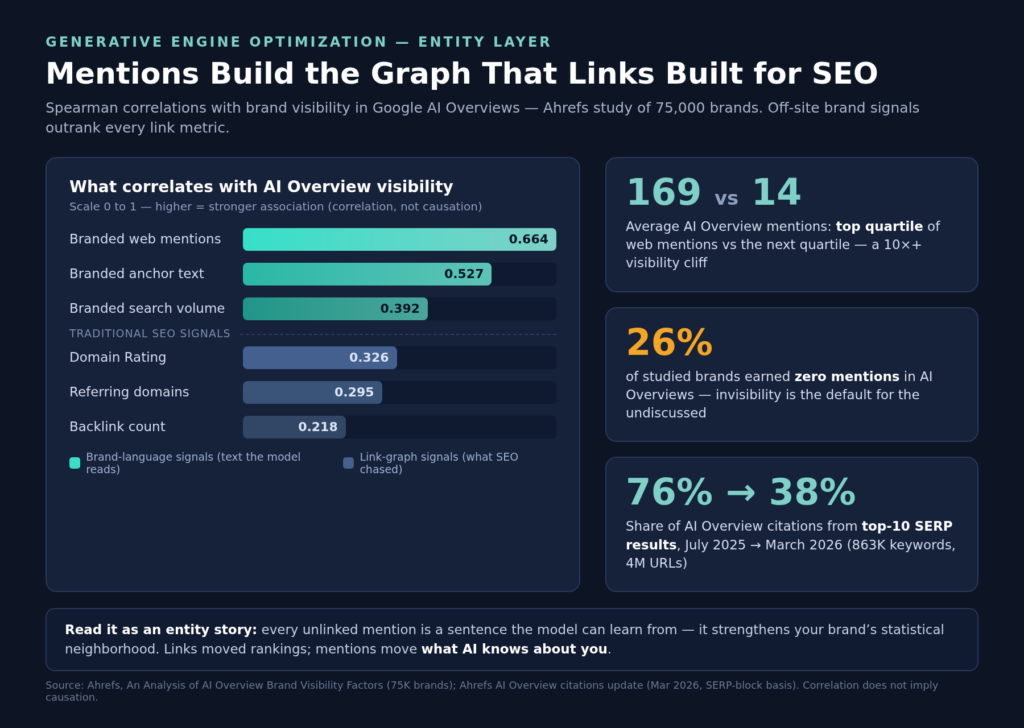
The currency shift has numbers behind it. Ahrefs analyzed 75,000 brands against millions of AI Overview responses and found that branded web mentions — linked or unlinked — show the strongest correlation with AI visibility at 0.664. Branded anchor text follows at 0.527, branded search volume at 0.392. The classic SEO levers lag behind: Domain Rating at 0.326, referring domains at 0.295, and raw backlink count at just 0.218.
Read that ordering as an entity story. Mentions are sentences the model can learn from; they build the implicit graph. Links built the old ranking graph. An unlinked mention in a trade publication does almost nothing for classic SEO and a great deal for the statistical neighborhood an answer engine draws on.
The distribution is brutal. Brands in the top quartile of web mentions averaged 169 AI Overview mentions — more than ten times the 14 averaged by the next quartile down. And roughly 26% of the brands studied earned zero AI Overview mentions at all. Visibility breeds visibility; silence breeds silence.
One honest caveat, which Ahrefs itself emphasizes: correlation is not causation. These are associations measured across brands, not a controlled experiment proving that buying mentions buys citations.
Rankings and Citations Have Decoupled
The separation goes deeper. In July 2025, about 76% of pages cited in AI Overviews also ranked in the top ten search results for the same query. When Ahrefs re-ran the analysis in March 2026 — 863,000 keyword SERPs, four million cited URLs — that overlap had fallen to roughly 38%, counting the first ten result blocks including SERP features. About 31% of cited pages sat between positions 11 and 100, and another 31% did not rank in the top hundred at all.
Ahrefs notes its citation parsing improved between studies, so part of the swing is better measurement. But the mechanism it points to is real and Google-confirmed: query fan-out. The engine splits your query into sub-queries and cites pages that perform across that wider cluster. A page can rank first for your tracked keyword and lose the citation to a page that answers a sub-query you never monitored. Ranking is still a foundation. It is no longer a proxy for being cited.
What 30 Million Citations Reveal About the Corpus
Where do engines actually pull from? Peec AI analyzed 30 million directly cited sources across ChatGPT, Google AI Mode, Gemini, Perplexity, and AI Overviews in the US, publishing the results in March 2026. The overall top five: Reddit, YouTube, LinkedIn, Wikipedia, Forbes.
Reddit ranked first or second on every engine tested. Community corpora are not a side channel — they are central training and retrieval material, which is exactly what the implicit-graph model predicts. Authentic discussion threads bind brands to categories, use cases, and complaints with a density marketing copy never achieves.
Wikipedia plays a double role that no other domain matches. Engines retrieve from it live, and models trained on it. If your entity existed in Wikipedia before a model’s knowledge cutoff, the model does not merely find you — it already knows you. That is the deepest form of implicit-graph presence available.
The platform splits matter too. ChatGPT leads with Wikipedia and leans editorial; Google’s surfaces favor YouTube and social platforms; Perplexity adds G2 for B2B queries. Your entity needs a presence in each diet, not just one.
The Five-Action Entity-Building Playbook
Action 1: Earn the Encyclopedia Entry
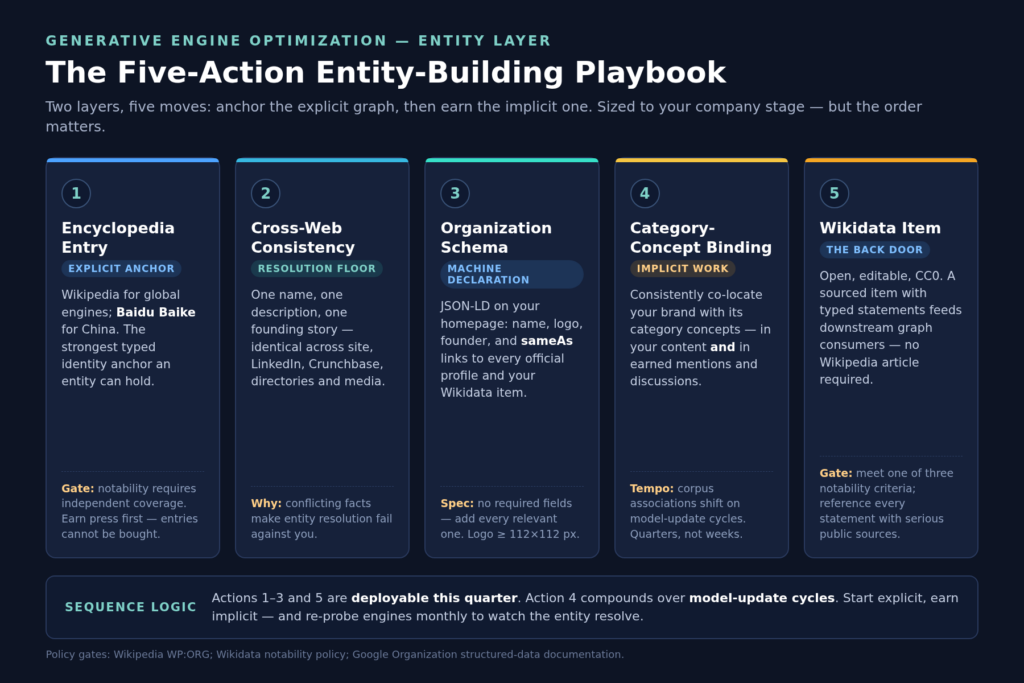
Wikipedia for global engines, Baidu Baike for Chinese ones. This is the strongest explicit anchor an entity can hold — and the most gated. Wikipedia’s organizational notability guideline requires significant coverage in reliable, independent secondary sources. Press releases do not count. Paid, undisclosed editing violates Wikimedia’s terms of use and routinely backfires through deletion and public logs. The honest sequence: earn the coverage first, let the entry follow.
Action 2: Enforce Cross-Web Consistency
One name, one description, one founding story — identical across your site, LinkedIn, Crunchbase, industry directories, and media mentions. This is the resolution floor from earlier, operationalized. Audit it like a broken-link check: quarterly, with a spreadsheet, without romance.
Action 3: Deploy Organization Schema
Your JSON-LD identity declaration. Google’s documentation is unusually permissive: no properties are required, but you should add every relevant one — name, logo, founder, address, and the sameAs array pointing to your official profiles and Wikidata item. The logo must be at least 112×112 pixels with a crawlable, indexable URL. Place the markup on your homepage or about page, not on every page. This is the one graph node you fully own.
Action 4: Bind Your Category Concepts
The implicit-graph work. Consistently co-locate your brand with its category concepts — in your content, your executives’ posts, your earned coverage, your community answers. Never “a leading innovator in transformative solutions.” Always the specific category, the specific use case, the specific nouns a buyer would actually ask an engine about. Repetition across independent sources is what turns a phrase into an association.
Action 5: Create the Wikidata Item
The back door, and it is genuinely open. Wikidata’s notability policy accepts an item that meets any one of three criteria: a valid sitelink to a Wikimedia project; a clearly identifiable entity describable using serious, publicly available references; or a structural need within the graph. No Wikipedia article required. Reference every statement — community practice generally rejects directories like Crunchbase as notability proof — disclose your affiliation, keep it factual, and let the item feed downstream graph consumers under its CC0 license.
Platform Differences and the China Layer
Google is KG-centric: the knowledge panel is your explicit-entity health check, visible to anyone. ChatGPT and Claude lean heavier on training-corpus associations, so earned-media footprint decides. Perplexity mixes live retrieval with community sources, rewarding fresh, consistent mentions.
China runs a parallel stack. Baidu Baike replaces Wikipedia as the encyclopedia anchor; WeChat and Zhihu corpora replace Reddit as the discussion layer; Doubao, Qwen, and DeepSeek resolve entities against different graphs. The multilingual entity problem is real: the same brand can occupy different neighborhoods in different languages, with different category bindings and different competitors nearby. Audit per platform, per language. One global score hides the failures that matter.
Verification: Run the Entity Health Test
You cannot manage what you never probe. Three checks, monthly:
First, entity probes. Ask each engine: What is [brand]? Who founded [brand]? What category does [brand] belong to? Record accuracy and cross-engine consistency, not just presence. An engine that mentions you while describing you wrongly is a liability, not a win.
Second, the knowledge-panel check. Presence and accuracy of your Google panel is the cheapest explicit-graph diagnostic available. Claim the panel through Google’s verification process if you have not.
Third, the sameAs audit. Every URL in your Schema’s sameAs array should resolve to a live profile that states the same facts. Dead links and drifted descriptions are resolution leaks.
The KPI That Matters: Entity-Association Strength
Presence is table stakes. The metric this module exists to move is association strength: when a user asks an engine about your core category — with no brand name in the prompt — does your brand appear, correctly described, among the first options? Track it across your twenty to thirty highest-value category questions, per engine, monthly. That single number tells you whether the implicit graph is actually shifting, and it is the slowest-moving, most defensible indicator in the entire GEO dashboard.
Risks and Honest Caveats
Three, and none optional. The notability gate cannot be faked — buying entries violates policy and the failure is public. The implicit-graph lag is structural: associations move on training and update cycles, so entity work is quarter-scale, not week-scale; anyone promising a citation jump in fourteen days is selling the explicit layer’s speed as the implicit layer’s result. And hallucinated entities are a live risk: engines invent facts about real brands, which is why monitoring must score accuracy, not mere presence.
The academic picture deserves the same honesty. The foundational GEO study by Aggarwal and colleagues, published at KDD 2024, showed content optimization can lift visibility in generative responses by up to 40% on its benchmark of roughly 10,000 queries — with citations, quotations, and statistics among the strongest methods, and keyword stuffing useless. But a July 2026 critical survey of 45 studies found no GEO technique with a stable, cross-platform causal effect on downstream traffic, and framed the famous 40% as a relative maximum on one metric in one configuration. Entity work is the best-grounded long game in GEO. It is still a long game, not a guaranteed machine.
Conclusion: Make the Leap From String to Thing
AI answers rest on an entity layer most marketing teams have never audited. The explicit graph you can edit this quarter: consistency, Schema, a properly sourced Wikidata item, an earned encyclopedia entry. The implicit graph you can only earn: mentions, discussions, category bindings accumulating across the corpus, compounding on model-update cycles.
Mentions outweigh links because mentions are what the implicit graph is made of. Rankings no longer predict citations because fan-out retrieval shops across a wider entity-aware index. And consistency beats cleverness because an engine that cannot resolve you will not risk citing you.
Start explicit. Earn implicit. Probe monthly. The leap from string to thing is the slowest moat in GEO — which is precisely why it is the deepest.





