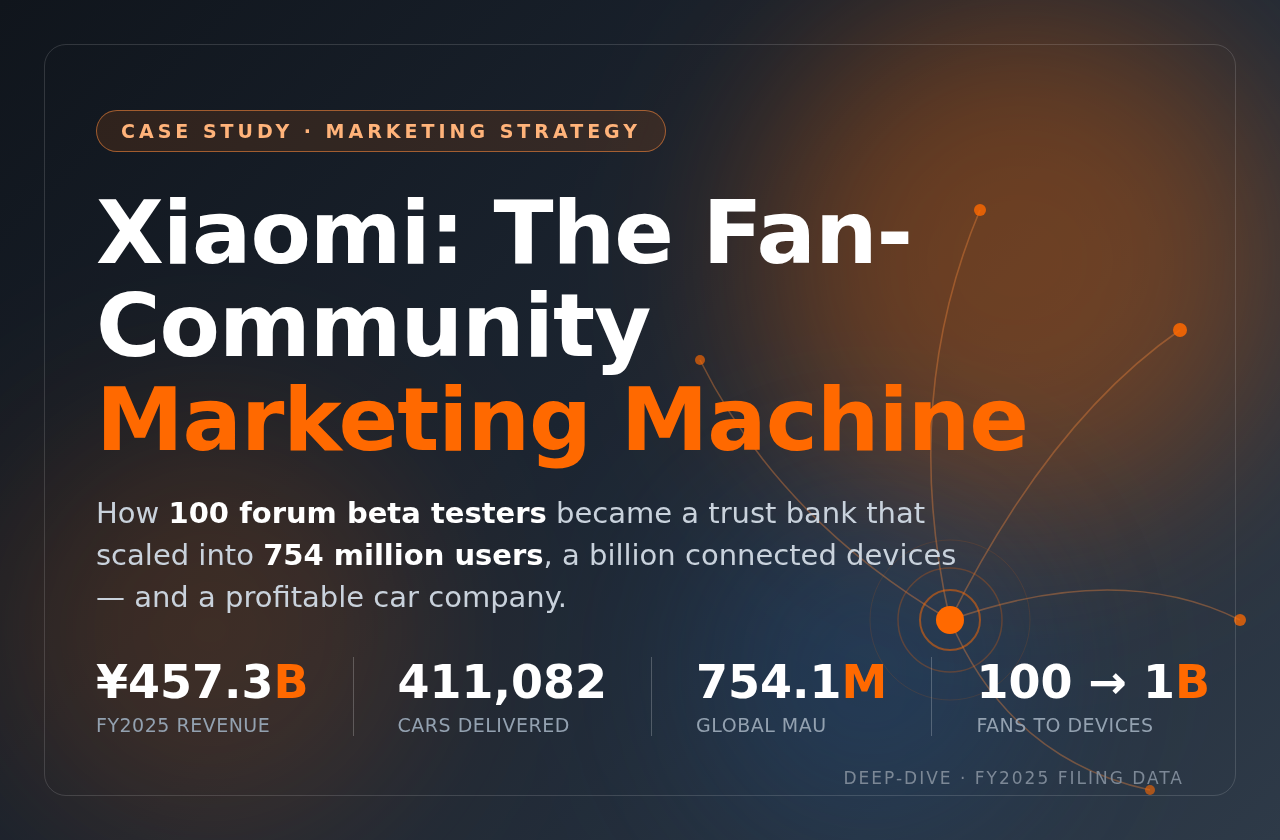
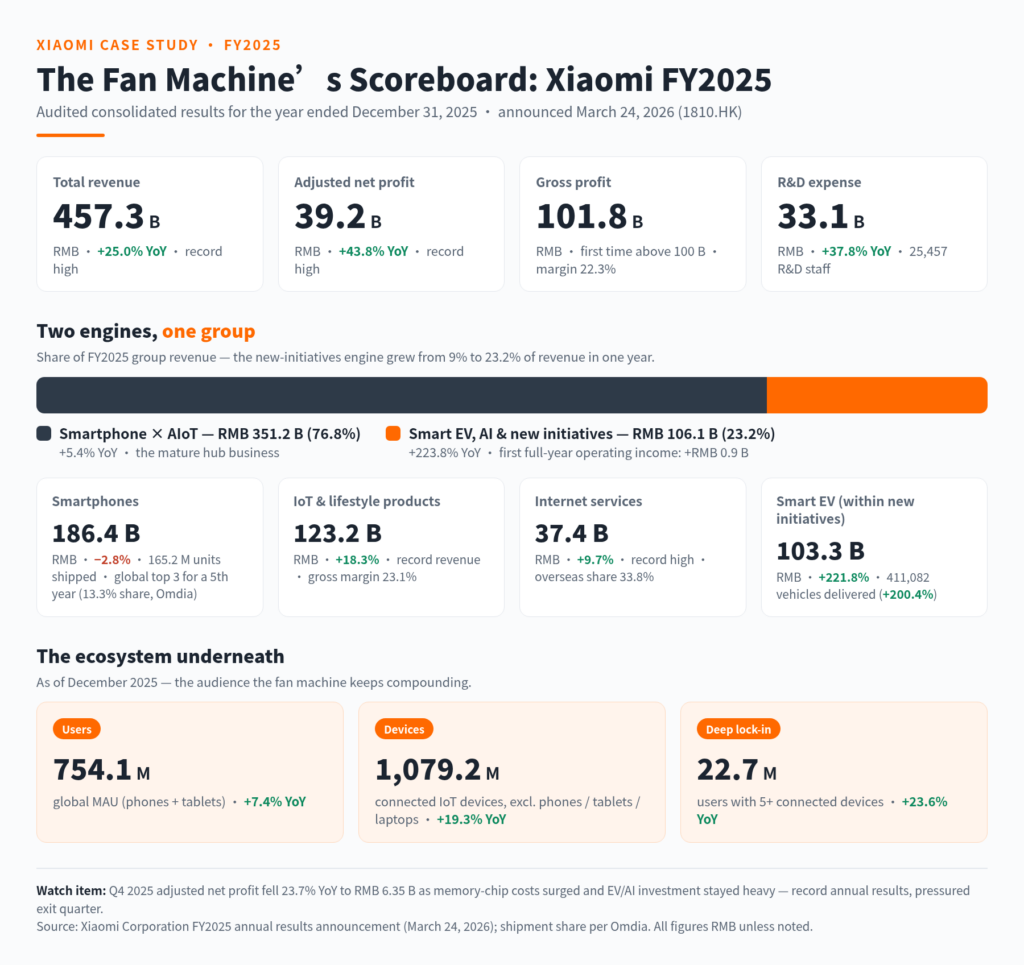
Here’s what most Xiaomi case studies miss: the company didn’t out-advertise anyone. It turned customers into co-authors. It started in 2010 with a phone interface built in public by 100 forum strangers, and sixteen years later that habit has compounded into RMB 457.3 billion of revenue, 754.1 million monthly active users, more than a billion connected devices — and a car business that delivered 411,082 vehicles and earned its first full-year operating profit in 2025. This piece unpacks how the fan machine works layer by layer, what the audited numbers actually say, where the story gets oversold, and which parts of the playbook you can steal for your own brand.
Background: A ROM Before a Phone
The 100 Dream Sponsors
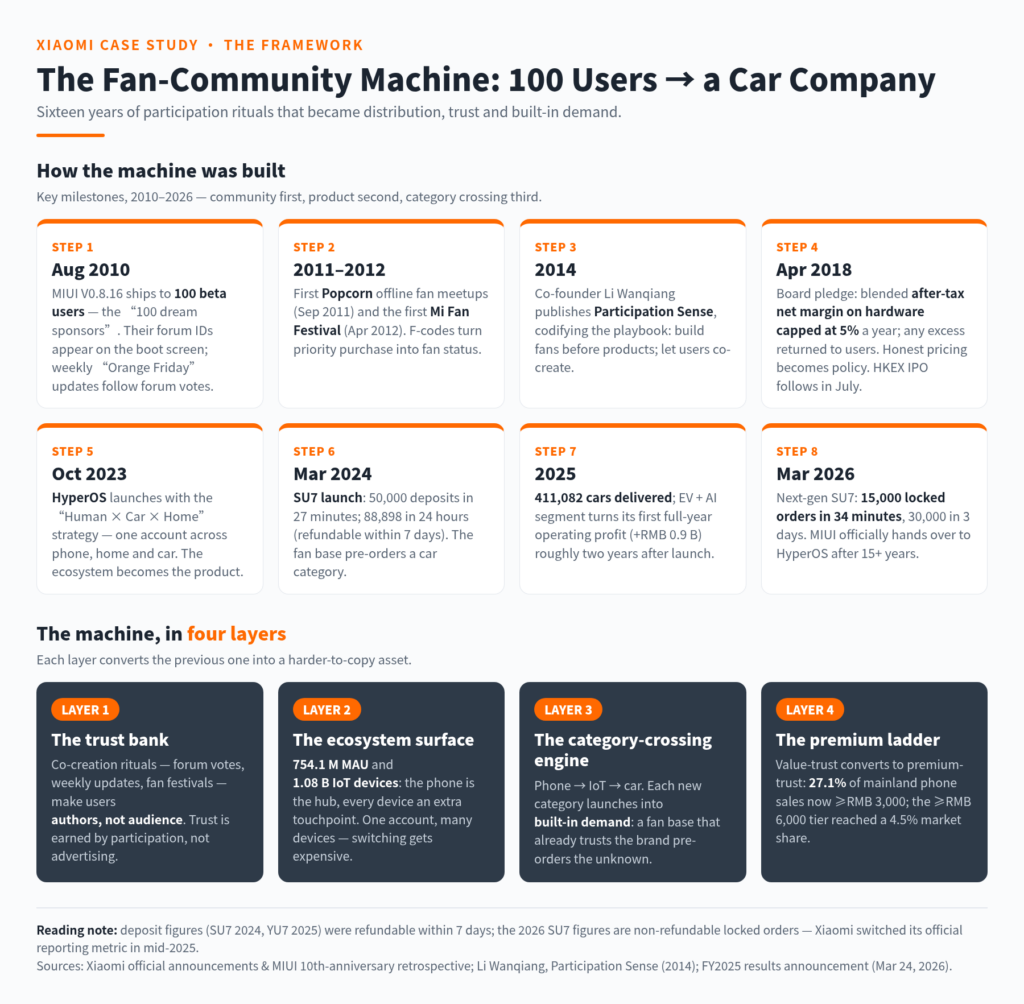
Xiaomi shipped software before it shipped hardware. On August 16, 2010, three engineers released MIUI V0.8.16 — a customized Android interface — to exactly 100 beta users recruited from enthusiast forums. These testers risked bricking their phones to flash an unknown ROM from an unknown company. Xiaomi called them the “100 dream sponsors” and printed their forum IDs on the boot screen. A 2013 short film paid tribute to them; a sculpture at Xiaomi’s campus still carries their names.
That’s not a cute origin story. It’s a structural choice. Before Xiaomi had a product to sell, it had people who felt ownership of one. And the growth was pure word of mouth: by Li Wanqiang’s account, the beta crowd doubled week after week — 100 users, then 200, then 400, then 800 — and within a year MIUI had 500,000 enthusiasts who became the seed buyers of the first Mi phone in 2011. The audience wasn’t rented from ad networks. It had been co-building the software for a year.
Orange Friday and the Rituals of Participation
MIUI updated every single Friday — “Orange Friday” — and the update pipeline ran through the community. Users proposed features on the forum, voted on them, tested the builds, complained, and watched their fixes ship the following week. Engineers argued with users in the same threads. Co-founder Li Wanqiang later codified the whole approach in his 2014 book Participation Sense: make users participants, not spectators. His rule of thumb was blunt — participation first, participation second, participation third.
The rituals multiplied. Popcorn offline meetups began in September 2011. The Mi Fan Festival launched in April 2012, turning the company’s anniversary into a fan celebration. F-codes — priority purchase codes handed to honored community members — made scarce flash-sale stock feel like a badge rather than an insult. Yes, the scarcity was partly supply constraint. But Xiaomi wrapped the constraint in status and belonging, and fans lined up Tuesday after Tuesday.
The 5% Pledge: Trust as Policy
In April 2018, days before its Hong Kong IPO, Xiaomi’s board passed a resolution Lei Jun announced at Wuhan University: the blended after-tax net margin of the entire hardware business would never exceed 5% a year, and any excess would be returned to users. Read that again — a public company voluntarily capped its own hardware profitability.
The IPO prospectus filed weeks later spelled out the logic with unusual candor: unlike internet platforms that acquire new users at high cost, Xiaomi said it leveraged hardware sales to acquire users at a profit. By March 2018, MIUI had roughly 190 million monthly active users and the platform already connected more than 100 million devices. Hardware was the acquisition channel; internet services were the margin. The 5% cap wasn’t charity — it was customer-acquisition policy, and it converted “honest pricing” from a slogan into a governance commitment. Every subsequent purchase became a small verification of the promise. That’s how a value brand builds a trust bank it can later draw on.
The Machine, in Four Layers
Layer 1: The Trust Bank
Co-creation is the deposit mechanism. Every forum vote answered, every Friday update shipped, every fan festival held deposits trust into an account that advertising can’t open. By the time Xiaomi enters a new category, it isn’t introducing itself — it’s cashing a sixteen-year relationship.
Layer 2: The Ecosystem Surface
Per the FY2025 filing, global MAU reached 754.1 million in December 2025, up 7.4%, and the AIoT platform connected 1,079.2 million devices, up 19.3% (company-reported metrics, excluding phones, tablets and laptops from the device count). Even the companion app is compounding: Xiaomi Home hit 112.7 million MAU, up 11.7% — a dedicated daily surface for the non-phone half of the ecosystem. The quiet killer stat: 22.7 million users now connect five or more devices, up 23.6%. The phone is the hub; the band, the TV, the air conditioner and eventually the car are spokes. One account, many devices — and switching costs that grow with every purchase.
Layer 3: The Category-Crossing Engine
Phones to IoT to cars. Each crossing launched into built-in demand: an audience that already trusts the brand pre-orders the unknown. When the SU7 sedan debuted in March 2024, Xiaomi logged 50,000 deposits in 27 minutes and 88,898 in 24 hours. No car startup buys that launch. Xiaomi grew it.
Layer 4: The Premium Ladder
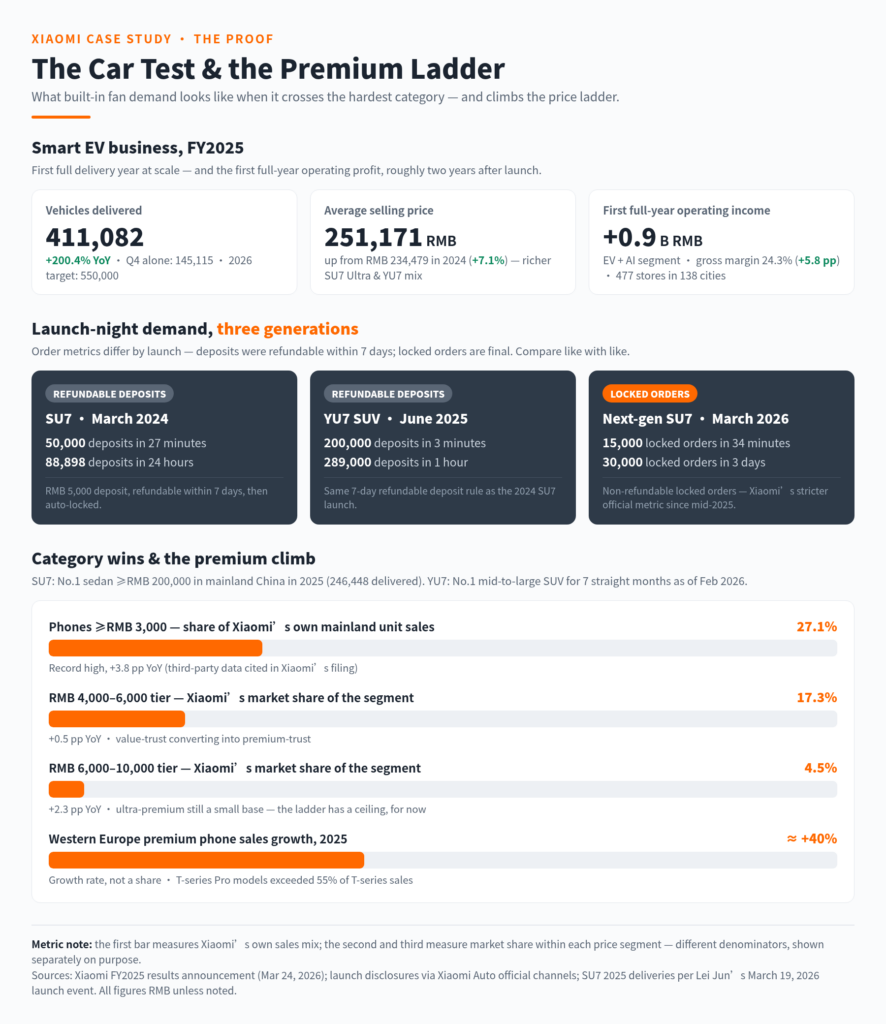
Trust built on value can be spent on premium. Third-party data cited in Xiaomi’s filing shows phones priced at RMB 3,000 and above hit a record 27.1% of its mainland unit sales in 2025, up 3.8 points. In the RMB 4,000–6,000 segment its market share reached 17.3%; in the RMB 6,000–10,000 tier, 4.5%, up 2.3 points on the strength of the 15 Ultra and the Leica-co-developed 17 series. Western Europe premium sales grew roughly 40%. The fans who came for value stayed for the flagship.
The Car Test: Crossing the Hardest Category
Launch-Night Demand, Read Honestly
Three launches tell the story — and the fine print matters. The original SU7 (March 2024) took 88,898 deposits in 24 hours, but those deposits were refundable within seven days. The YU7 SUV (June 2025) took 200,000 deposits in three minutes and 289,000 within an hour — same refundable terms. From mid-2025 Xiaomi switched its official headline metric to locked (non-refundable) orders, saying they reflect real choices more honestly. On that stricter yardstick, the next-generation SU7 launched March 19, 2026 still put up 15,000 locked orders in 34 minutes and 30,000 in three days. Even after tightening its own scoreboard, the machine keeps posting record opening nights.
The Economics Finally Worked
Deliveries reached 411,082 vehicles in 2025, up 200.4%, including 145,115 in Q4 alone. Average selling price rose 7.1% to RMB 251,171 as the pricier SU7 Ultra and YU7 enriched the mix. EV revenue hit RMB 103.3 billion; the broader smart EV, AI and new-initiatives segment reached RMB 106.1 billion — 23.2% of group revenue, up from 9% a year earlier — and posted its first positive full-year operating income of RMB 0.9 billion, at a 24.3% segment gross margin. Remember, this segment lost roughly RMB 6.2 billion on an adjusted basis in 2024. From heavy losses to operating profit in about two years, with 477 stores across 138 cities and a 550,000-unit target for 2026: the SU7 became China’s best-selling sedan above RMB 200,000 (246,448 delivered in 2025, per Lei Jun’s March 2026 launch event), and the YU7 held the No.1 mid-to-large SUV spot for seven straight months through February 2026. In Barcelona that same month, Xiaomi unveiled the Vision Gran Turismo hypercar concept — the first Chinese brand invited into the franchise — a halo play aimed at exactly the enthusiast psyche MIUI cultivated in 2010.
What Everyone Gets Wrong About Xiaomi
“It’s a phone company.” The phone×AIoT segment did RMB 351.2 billion, but smartphone revenue itself fell 2.8% to RMB 186.4 billion in 2025. Growth came from everywhere else — IoT up 18.3%, internet services up 9.7%, new initiatives up 223.8%. The phone is the hub of the business, not the business.
“It’s a cheap brand.” A brand whose premium mix keeps setting records, whose car ASP is RMB 251,171, and whose ultra-premium share is climbing fast off a small base is ascending, not camping. Honest pricing was never the same thing as cheap pricing.
“Its marketing is flash-sale gimmicks.” The flash sales were the visible tip. Underneath sat forum co-creation, weekly shipping cadence, offline rituals and a board-level margin pledge. Participation was the marketing; scarcity was just one of its instruments.
“The community runs itself.” It doesn’t. Xiaomi employed 25,457 R&D staff in 2025 and spent RMB 33.1 billion keeping the product worthy of the conversation. Participation compounds only when the software keeps shipping and the hardware keeps improving. Community is the amplifier, not the source.
The Reusable Playbook
Four moves transfer to almost any brand:
- Build community before product. Ship something co-creatable — a beta, a roadmap, a forum — and let early users leave fingerprints on it. Ownership beats awareness.
- Let the community de-risk category entry. Survey, pre-register and pre-sell to your base before betting on a new line. Built-in demand is cheaper than bought demand and converts better.
- Convert value-trust into premium-trust gradually. Keep the pricing promise while adding tiers. Fans accept your premium offer precisely because they trust your base offer.
- Make the ecosystem the switching cost. One account, connected products, accumulated data and habits. Xiaomi’s 22.7 million five-device households are the retention story hiding inside the revenue story.
How do you know the machine is working? Track participation, not impressions: the share of roadmap items sourced from users, community members’ conversion into first-day buyers of each new category, and cross-category repeat purchase. Xiaomi’s own proxy is the five-device user count — up 23.6% — because a household that keeps adding devices is voting with its wallet, not its likes.
Risks and Honest Caveats
The exit quarter was ugly: Q4 adjusted net profit fell 23.7% to RMB 6.35 billion as memory-chip prices surged and EV/AI spending stayed heavy — a reminder that the fan machine can’t repeal component cycles. In cars, BYD, Tesla and Huawei-backed rivals won’t politely cede the segment; fan demand must keep converting into repeat purchases and word-of-mouth beyond the faithful. The RMB 6,000–10,000 share of 4.5% says the ultra-premium climb is early, not done. And intimacy dilutes with scale: a community of 754 million can’t all argue with engineers on a forum. R&D of RMB 33.1 billion — up 37.8%, with RMB 105.5 billion spent over five years — shows Xiaomi knows the rituals alone won’t carry it. The participation must keep shipping real technology.
Conclusion: Participation Is the Moat
Strip away the product categories and one asset remains: a machine that converts participation into trust, trust into distribution, and distribution into demand for whatever Xiaomi builds next — phones, air conditioners, cars. The FY2025 numbers are the machine’s output, not its secret. The secret is sixteen years of treating users as authors. Products can be copied in a year. A community that helped write the product cannot.