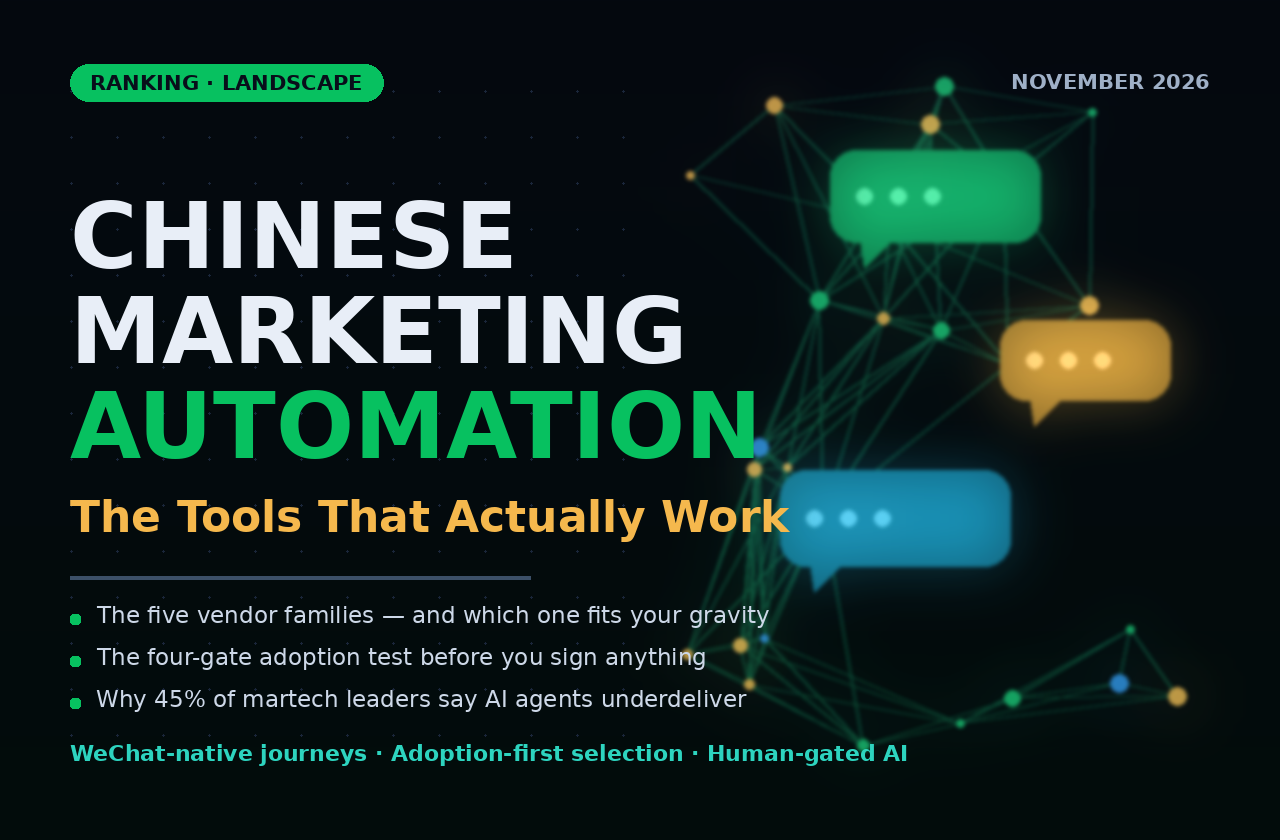
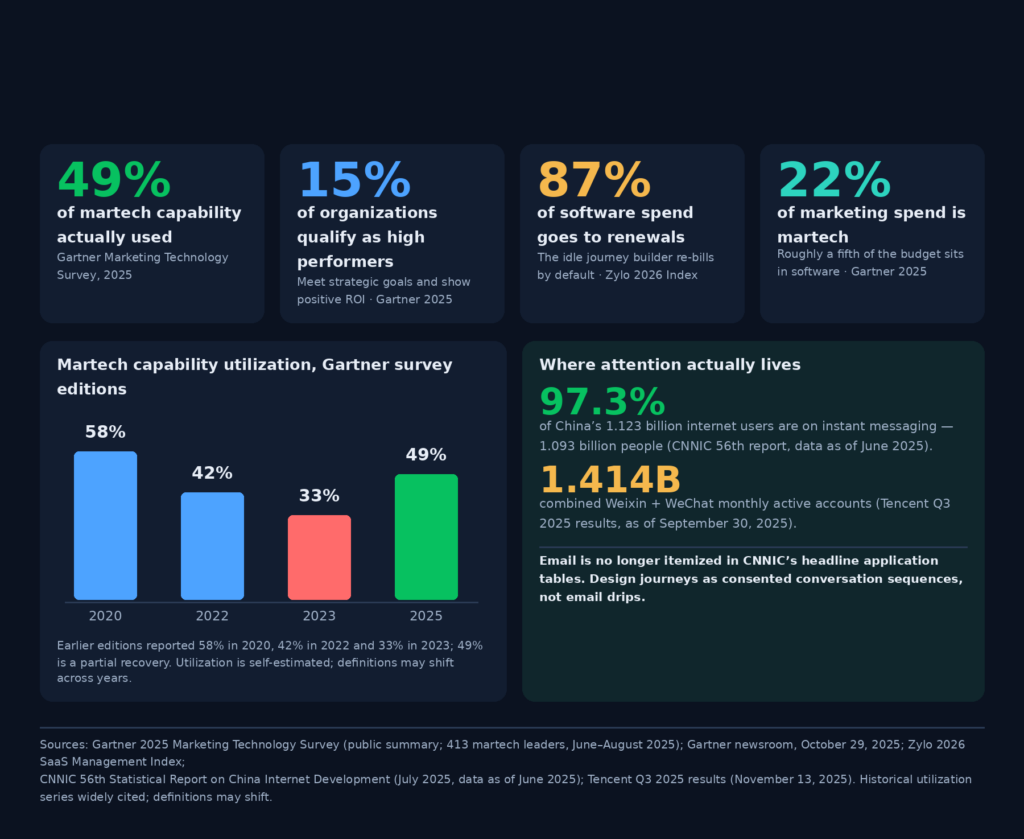
Here is an uncomfortable number to start with: marketing teams use only 49% of the capability they have already paid for. That is Gartner’s 2025 Marketing Technology Survey — a partial recovery from 33% in 2023, still far below the 58% recorded in 2020. Only 15% of organizations qualify as high performers that meet strategic goals and show positive ROI. And marketing automation is where that waste goes to hide, because a journey nobody designs never runs, never errors, and never shows up on a dashboard. It just sits there, licensed and silent.
China adds a second trap. The Western MA playbook — email drips, lead-scoring nurture streams, webinar follow-ups — assumes email is where customers live. In China, it isn’t. So “actually work” in this ranking means two things at once: the tool survives WeChat’s channel physics, and your team actually operates it. Everything below is built on that double filter.
The 49% Problem: Why MA Becomes Shelfware
Let’s be precise about what the research says, because this category attracts a lot of invented statistics. Gartner’s public survey summary puts utilization at 49% and notes that martech now absorbs roughly 22% of total marketing spend. The survey behind Gartner’s October 2025 AI-agent findings covered 413 marketing technology leaders, fielded June through August 2025. Utilization is self-estimated and the sample skews enterprise — treat it as a direction, not a lab measurement.
The mechanism matters more than the number. Software renewals are the default state of the system — Zylo’s 2026 SaaS Management Index found renewals account for 87% of software spend — so an unused journey builder bills again every year unless a human actively stops it. Buying gets celebrated; idleness gets invoiced to nobody. MA is uniquely exposed because its output is invisible until someone writes the content, wires the triggers, and owns the calendar. Buy the platform without those three, and you have purchased a very expensive blank canvas.
The China Reality: Your Journey Is a Conversation, Not an Email
Consider where attention actually sits. CNNIC’s 56th statistical report, released in July 2025 with data as of June, counted 1.123 billion internet users in China — and 1.093 billion of them use instant messaging, a 97.3% penetration rate. Tencent’s third-quarter 2025 results put combined Weixin and WeChat monthly active accounts at 1.414 billion. Meanwhile, email has quietly disappeared from CNNIC’s headline application tables altogether; the national statistical report no longer itemizes it. When a government survey stops counting a channel, that tells you something.
Email still works in China for B2B, foreign enterprises and formal receipts. But a consumer lifecycle program built on email drips is broadcasting into a hallway nobody walks down. The unit of automation here is the conversation sequence: a WeCom message from a named staff member, a Mini Program service notification, a community post, an SMS fallback. Design journeys as conversations with quota and consent constraints, and the tool choice becomes obvious. Design them as email drip charts, and no tool will save you.
The Channel Rules That Decide Everything
Before comparing vendors, internalize the physics. In China, the platform — not the software you buy — sets the sending limits, and every serious MA vendor is really an orchestration layer on top of these rules.
WeCom: Configurable Quotas, Shared Across the Company
WeCom’s official help documentation now describes admin-configurable broadcast rules: each customer or customer group can receive one message per day, or seven per week, or a monthly allowance equal to the number of days in that month. Two details trip up imported playbooks. First, personal broadcasts by staff and enterprise-wide broadcasts share the same quota, counted per customer — your campaign and your store associate’s morning greeting draw from one pool. Second, older “four messages per month” figures still circulating in blog posts describe the legacy API-era rule; the configurable framework is the current official one. A single broadcast can carry up to 8,000 characters and nine attachments, and personal one-shot sends can target up to 20,000 customers. Plan frequency like a scarce budget, because it is one.
Mini Program Subscribe Messages: One Tap, One Message
Mini Program notifications run on subscription mechanics. Under the standard one-time model, each user tap of consent earns you exactly one service message — no tap, no send, no exceptions. Long-term subscriptions, where one consent permits repeated sends, are restricted to public-service categories such as government, healthcare, transport, finance and education. A newer beta flow allows platform-templated service notifications after a WeChat Pay transaction or specific service buttons, which eases transactional messaging — but it is not a marketing blast license. The practical consequence: consent collection is a journey step, not a legal footnote. The best programs ask for the subscription at the moment the customer wants the outcome — order shipped, price dropped, class starting.
SMS, and the Template Message That No Longer Exists
SMS remains the workhorse fallback: it reaches anyone with a phone number, needs no app relationship, and is priced per send — with consent and opt-out obligations attached. One correction worth memorizing: WeChat service-account template messages were retired on April 30, 2021, replaced by subscription notifications. Any vendor deck or 2020-era tutorial that promises unlimited template-message pushes is describing a channel that died years ago. If a demo leans on it, that tells you how recently the vendor updated its own worldview.
The Landscape Map: Five Families, Not Fifty Logos
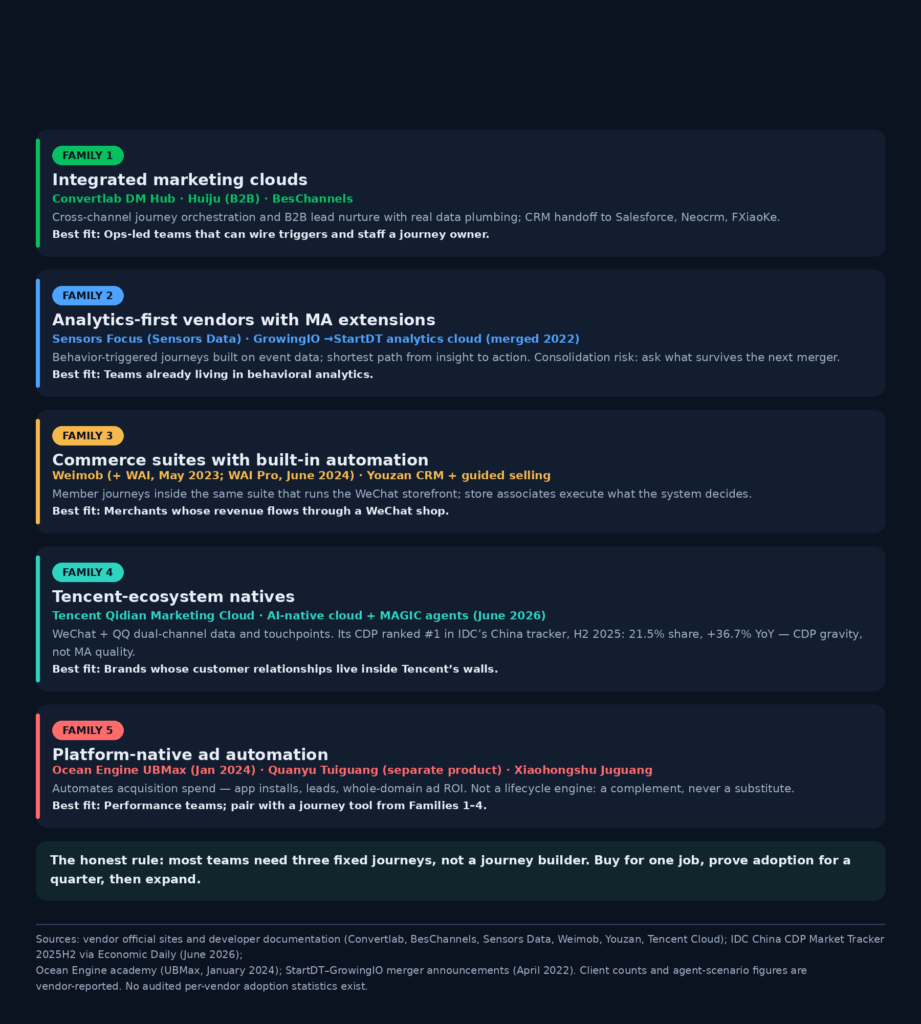
China’s MA market makes more sense as five families than as a ranked list of fifty logos. The honest ordering principle is ecosystem gravity: pick the family whose center of gravity matches your business, then shortlist inside it. iResearch projected China’s martech service-provider market — vendor revenue, excluding ad spend — would reach the hundred-billion-yuan scale by 2025; that 2023-vintage forecast describes the whole landscape, not MA alone, so treat it as context rather than a segment size.
Family 1: Integrated Marketing Clouds
Convertlab, founded in 2015 by an ex-SAP team and backed by a 2020 Series B led by Tencent’s industry ecosystem fund, built its suite around DM Hub, the marketing automation core, plus Data Hub (CDP), Ad Hub and an AI Hub positioned as an enterprise AI-agent platform. Its developer docs expose the practical surface: automated flows, channel operations, even task assignment to staff. For B2B, Convertlab’s Huiju product and BesChannels are the specialists — BesChannels, the official English brand of Zhiqu Baichuan, sells a one-stop B2B marketing cloud with workflow nurture, lead scoring and two-way sync to Salesforce, Neocrm and FXiaoKe, and names Microsoft and Schneider among the 600-plus enterprise clients it claims on its own site. Ideal for teams that need cross-channel orchestration with real data plumbing.
Family 2: Analytics-First Vendors With MA Extensions
Sensors Data built its reputation on behavioral analytics and ships Sensors Focus, described on its official English site as a marketing automation platform for real-time, full-scenario customer journey orchestration. If your team already lives in event data, triggering journeys from behavioral segments is the shortest path from insight to action. A cautionary tale belongs in the same family: GrowingIO, once the analytics darling, merged into StartDT in April 2022 and now sits as the analytics cloud beside StartDT’s data cloud — its MA story is no longer the main event. Vendor consolidation is a real selection risk; ask what survives the next merger.
Family 3: Commerce Suites With Built-In Automation
Weimob and Youzan approach MA from the store, not the campaign. Weimob’s merchants get marketing automation inside the same suite that runs their Mini Program shop, and its WAI assistant — launched May 2023, with an enterprise WAI Pro in June 2024 — claims an agent matrix spanning dozens of commerce scenarios, with more than 42,000 merchants using WAI as of late 2024 (vendor-reported figures). Youzan bundles CRM-driven automated marketing with its guided-selling platform, so store associates execute what the system decides. If your revenue flows through a WeChat storefront, this family removes an entire integration project.
Family 4: Tencent-Ecosystem Natives
Tencent Qidian is the incumbent’s own answer: an enterprise SaaS spanning marketing, sales and service across the WeChat and QQ dual channels. Its marketing cloud CDP ranked first in IDC’s China CDP Market Tracker for the second half of 2025 with 21.5% share, growing 36.7% year over year, and in June 2026 Tencent launched an AI-native marketing cloud with agent capabilities it calls MAGIC. One calibration: CDP market share is not MA market share — the ranking proves data-layer gravity, not journey-builder quality. Still, when your customer relationships live inside Tencent’s walls, choosing the native suite eliminates the friction every third party must negotiate.
Family 5: Platform-Native Ad Automation
A different species entirely: Ocean Engine’s UBMax, launched January 2024, automates ad buying for app downloads, lead generation and traffic-to-commerce scenarios, while its separate Quanyu Tuiguang product automates whole-domain ROI optimization for e-commerce and local services. Xiaohongshu’s Juguang is the platform’s official ad system. These tools automate acquisition spending, not customer lifecycles — they belong in your stack, but they do not replace a journey engine. Confusing the two is how teams end up “fully automated” with zero retention programs.
| Family | Representative tools | Strongest at | Best-fit team |
|---|---|---|---|
| Integrated marketing cloud | Convertlab DM Hub, Huiju, BesChannels | Cross-channel journeys, B2B nurture | Ops-led teams with data plumbing |
| Analytics-first extensions | Sensors Focus; GrowingIO (analytics now) | Behavior-triggered journeys | Teams already living in event data |
| Commerce suites | Weimob (+WAI), Youzan CRM | Member journeys inside the store | WeChat storefront merchants |
| Tencent-ecosystem native | Tencent Qidian Marketing Cloud | WeChat/QQ-native data and touchpoints | Brands deep in Tencent’s walls |
| Platform ad automation | Ocean Engine UBMax, Quanyu Tuiguang; Juguang | Automated acquisition, not lifecycle | Performance teams (complement, not MA) |
Pick by Job, Not by Feature List
Feature matrices are how shelfware gets sold. Jobs are how tools get chosen. Ask which job dominates your next twelve months:
- B2B lead nurture: you need scoring, content gating and CRM handoff — BesChannels or Convertlab’s Huiju were built for exactly this motion.
- E-commerce member journeys: the store suite wins on integration cost — Weimob or Youzan before a standalone cloud.
- Private-domain activation SOPs: staff-executed sequences inside WeCom — an SCRM-centric stack beats a journey canvas here.
- Cross-channel orchestration at scale: an integrated cloud or Sensors Focus, if behavioral triggers are the point.
- Campaign and launch automation: honestly, most teams need three fixed journeys, not a canvas — see the test below.
And the honest rule that vendors will never put on a slide: most teams should buy for one job and prove adoption before expanding. The 49% utilization rate is not a tooling failure; it is a portfolio of jobs nobody assigned.
The Adoption Test: Four Gates Before You Sign
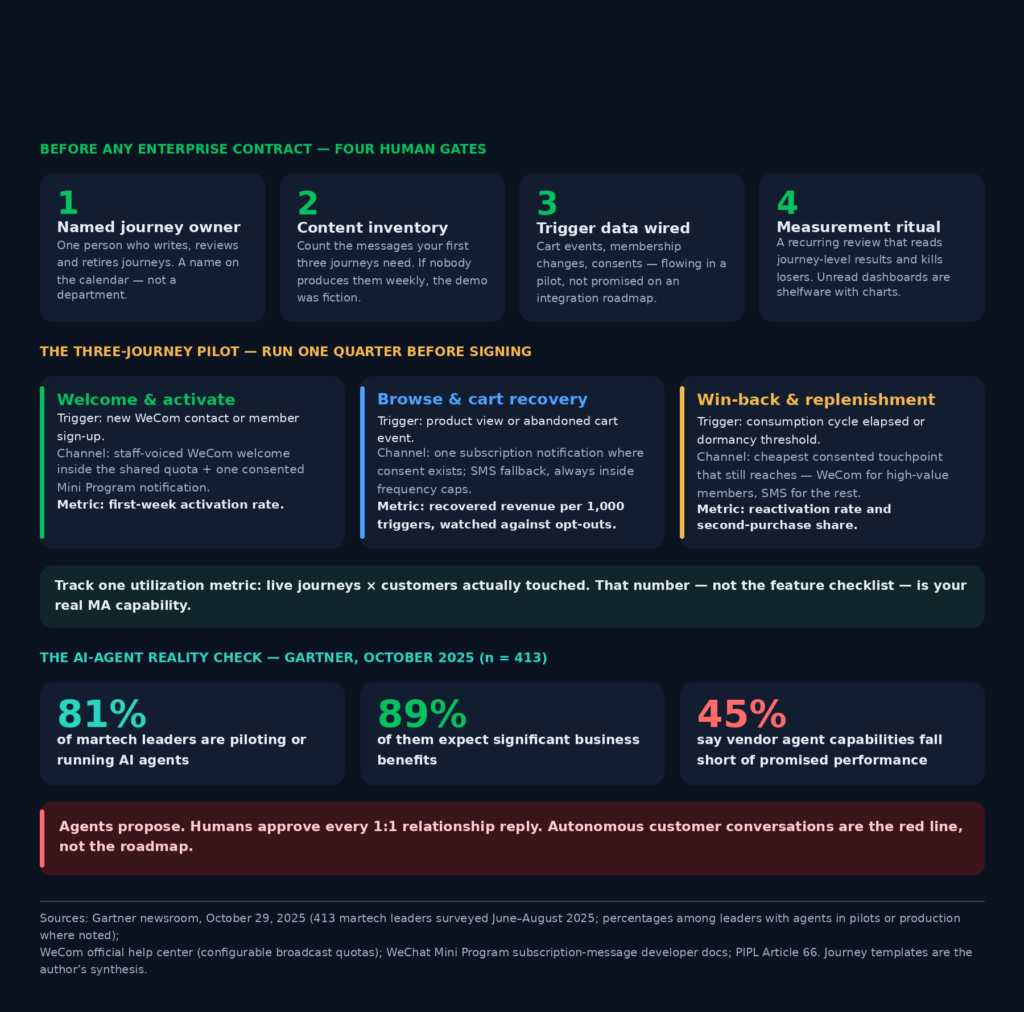
This is the filter that makes the phrase “actually work” mean something. Before any enterprise contract, require four gates — all human, none technical:
- A named journey owner. One person whose calendar includes writing, reviewing and retiring journeys. Not a department. A name.
- A content inventory. Every automated message needs a body. Count the messages your first three journeys require, then ask who produces them weekly. If the answer is nobody, the demo was fiction.
- Trigger data actually wired. Cart events, membership changes, subscription consents — flowing into the tool in a pilot, not promised in an integration roadmap.
- A measurement ritual. A recurring review where someone reads journey-level results and kills losers. Dashboards nobody reads are shelfware with charts.
Then run the three-journey pilot below for one quarter before signing anything annual. Track one utilization metric: live journeys multiplied by customers actually touched. That number, not the feature checklist, is your real MA capability — and it is the number that moves you toward Gartner’s 15% high-performer club.
The Three Journeys That Actually Run
Nearly every functioning program we can verify in this market reduces to three sequences. Build these first; add a canvas later if you ever outgrow them.
Welcome and Activate
Trigger: new WeCom contact or new member registration. Channel: a staff-voiced WeCom welcome within the shared quota, plus one consented Mini Program notification offering the first benefit. Content: who you are, one immediate value, one clear next action. Metric: first-week activation rate. This journey decides whether the relationship exists at all.
Browse and Cart Recovery
Trigger: product view or abandoned cart event from your storefront or Mini Program. Channel: one subscription notification where consent exists, SMS fallback where it doesn’t, always inside frequency caps. Content: the specific item, one reason to return — stock, price, service — not a generic coupon blast. Metric: recovered revenue per thousand triggers, watched against opt-out rate so you notice when recovery becomes harassment.
Win-Back and Replenishment
Trigger: predicted consumption cycle elapsed, or dormancy threshold crossed. Channel: the cheapest consented touchpoint that still reaches — often WeCom for high-value members, SMS for the rest. Content: replenishment reminder or a genuine reason to come back. Metric: reactivation rate and second-purchase share. In a market where acquisition costs keep climbing, this quiet journey is usually the highest-ROI automation you will ever ship.
The AI-Agent Shift: Promise Versus Shipped
Now the 2026 question: do agents change the ranking? The hype cycle says everything; the survey data says be careful. Gartner’s October 2025 release found 81% of martech leaders piloting or running AI agents, and 89% of those expect significant business benefits — yet 45% say vendor-offered agent capabilities fall short of the promised business performance, and about half admit their technical stack and talent are not ready. The top pilot uses are unglamorous: asset production (52%), enrichment (49%), campaign management and optimization (43%). Gartner also predicts that by 2028, 33% of enterprise software will include agentic AI, up from less than 1% in 2024, with at least 15% of day-to-day work decisions made autonomously.
The global wave is real — Salesforce shipped Agentforce in late 2024 and a 2.0 release that December — and Chinese vendors are moving in step: Tencent’s MAGIC agents, Weimob’s WAI matrix, Convertlab’s AI Hub. But notice the pattern in what actually ships: agents draft content, enrich segments and tune campaigns. The relationship itself — the one-to-one conversation where trust is built or burned — stays human-gated in every credible deployment. Design for that boundary deliberately: agents propose the next-best action; a person approves anything that speaks as your brand to one customer. Autonomous relationship replies are the red line, not the roadmap. The buying advice follows: pay for agent features that remove production toil today, and treat autonomous journey orchestration as a 2027-and-beyond evaluation, not a 2026 contract term.
Compliance Is a Feature: PIPL and Consent by Design
China’s Personal Information Protection Law, effective November 2021, is the operating environment, not a checkbox. Serious violations can draw fines up to RMB 50 million or 5% of the prior year’s turnover — note the “or” — plus penalties on responsible individuals. For automation, PIPL translates into concrete design: purpose-limited consent per channel, working opt-outs on SMS, subscription mechanics respected in Mini Programs, and identity stitching that uses only data you legitimately collected. Treat frequency caps as trust design rather than a compliance tax: the quota exists because customers punish noise, and the platform enforces what the law demands. Any tool that makes consent states hard to see or opt-outs hard to honor is disqualified regardless of its demo.
TCO: The License Is the Small Number
Chinese MA pricing is overwhelmingly quote-based, so a public price comparison would be fake precision. Model total cost instead: license, plus content production (the messages your journeys consume weekly), plus operations headcount (the owner and the analyst), plus integration maintenance. In most real deployments the license is the minority of that sum. Which yields the build-versus-buy rule for small teams: if you cannot staff the content and the owner, start with WeCom’s native broadcast tools, a spreadsheet of segments and three manual journeys. Graduate to a platform when manual execution — not missing features — becomes the bottleneck. That upgrade path is also the best negotiation position you will ever have.
Honest Boundaries of This Ranking
Three confessions keep this piece trustworthy. First, no vendor publishes audited adoption or utilization statistics; client counts and agent-scenario numbers cited here are vendor-reported and labeled as such. Second, IDC’s ranking measures the CDP layer, not journey-builder quality, and market-size forecasts describe the whole martech service industry with dated methodology. Third, “actually work” is ultimately a property of your operating model, not the software: the same platform is a growth engine in one company and a renewal line item in the next. This ranking narrows the field; the adoption test decides the winner.
The Bottom Line
Match the family to your gravity: commerce suite for storefronts, Tencent-native for deep WeChat plays, integrated cloud or analytics extension for orchestration, B2B specialists for lead nurture — and platform ad automation as a complement, never a substitute. Pass the four gates. Ship the three journeys. Measure live journeys times customers touched. Gate the agents at the relationship boundary. Do that, and you will be operating in the half of the stack that works — while your competitors are still comparing feature lists for software they will never turn on.