A European skincare brand rolls out Salesforce in its Shanghai office with the confidence of a company that has done this before. Six months later, the pipeline dashboard is immaculate and the China team is running the actual business somewhere Salesforce cannot see: in WeChat chats, in customer groups, in the private notes of a sales rep who is about to resign. The CRM is not broken. It is simply pointed at the wrong unit of reality.
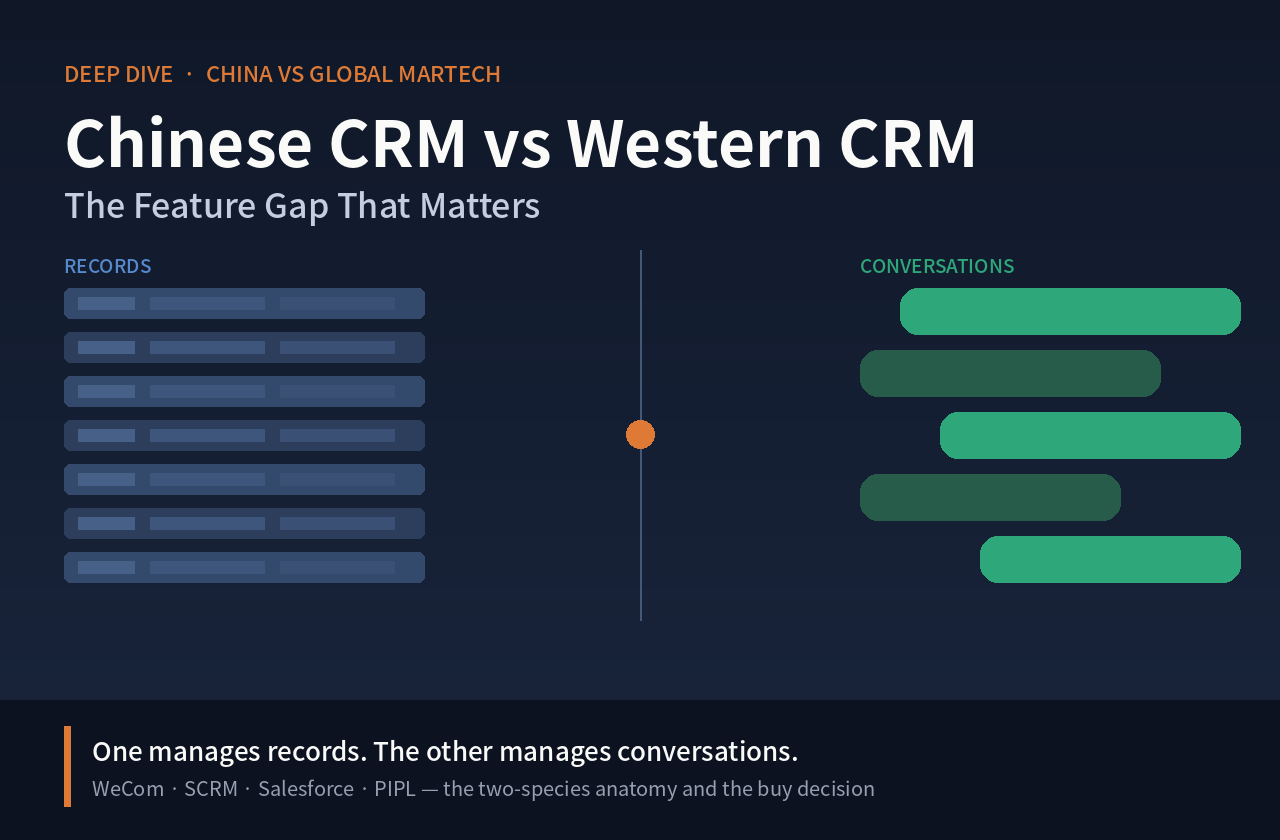
Here is the uncomfortable truth this deep dive is built on: Western CRM and Chinese CRM are not two products in one category. They are two species that happen to share a name. Western CRM manages records — leads, deals, tickets, fields. Chinese CRM, better known as SCRM, manages conversations — the WeChat threads where customers actually ask questions, haggle, complain, and buy. The gap that matters is not a feature checklist. It is what each system believes a customer relationship is.
Let’s dissect both species, map where each one genuinely wins, and end with the architecture decision most global brands get wrong.
The two species: a structural anatomy
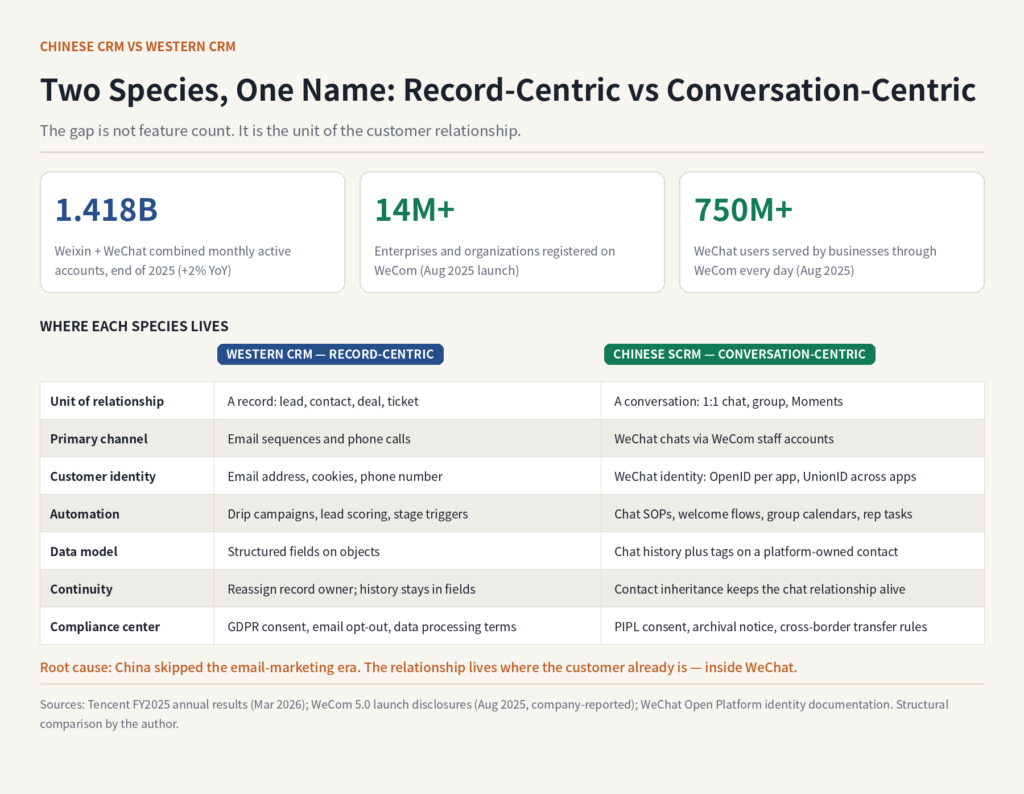
Start with the unit of the relationship. In the Western stack, a customer becomes real to the software when a record exists: an email address attached to a lead, a deal moving through stages, a ticket in a queue. The relationship is a row in a database, and the conversation is an attachment to that row.
In the Chinese stack, it is inverted. The customer becomes real when they add a staff member’s WeCom account on WeChat. The conversation is the relationship — and the record, such as it is, is a set of tags hanging off a chat thread. Everything else follows from that inversion: the channel (WeChat instead of email), the identity (platform-issued WeChat IDs instead of email addresses), the automation (chat SOPs instead of drip sequences), and the sales motion (a hybrid of store associate and service agent instead of a pipeline-stage owner).
Why did this happen? Because China largely skipped the email-marketing era. Consumers went from SMS to WeChat, and brands followed. Tencent’s 2025 annual results put Weixin and WeChat at 1.418 billion combined monthly active accounts. At its August 2025 product launch, the WeCom team disclosed — these are company-reported figures, not audited — that more than 14 million enterprises and organizations had registered, and that businesses were serving over 750 million WeChat users through WeCom every day. When half the population can reach your staff without installing anything new, email nurturing stops looking like a strategy and starts looking like an archaeology project.
The feature-gap map: where each species wins
Now resist the urge to declare a winner. The honest map is complementary, and pretending otherwise is how procurement disasters begin.
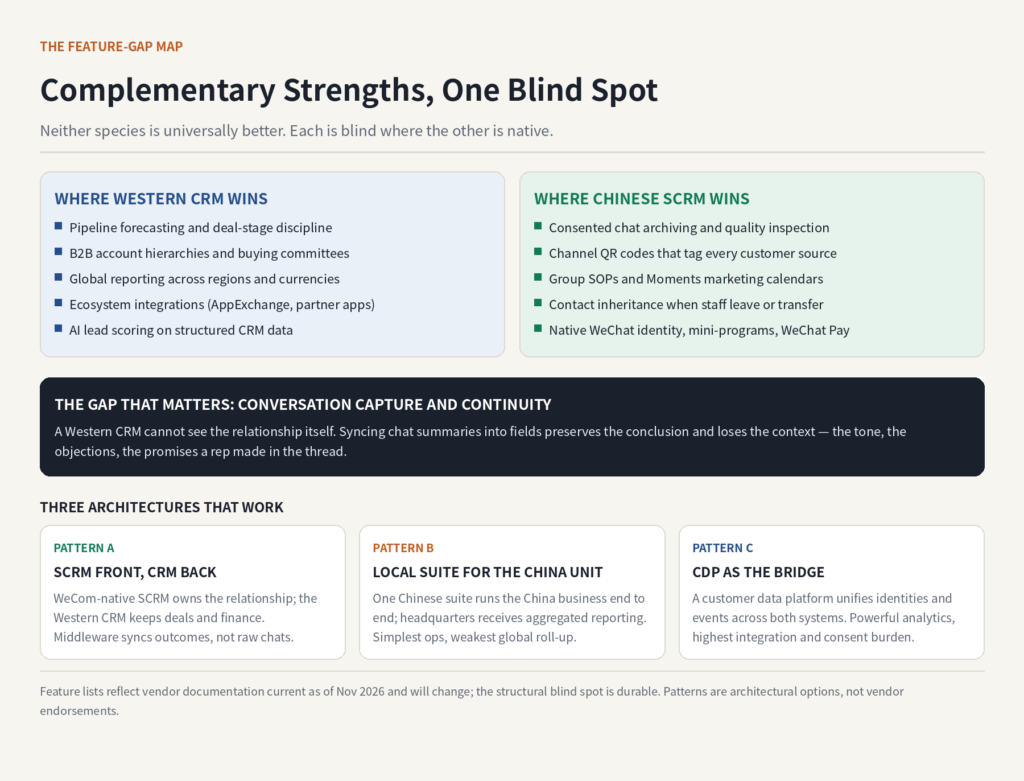
Western CRM wins where the relationship is a process. Pipeline forecasting, deal-stage discipline, B2B account hierarchies with buying committees, multi-region reporting, a mature integration ecosystem, and AI lead scoring trained on years of structured outcomes — Salesforce and HubSpot earned those muscles over two decades. Salesforce closed fiscal 2026 with $41.5 billion in revenue, up 10%; HubSpot ended 2025 with roughly $3.13 billion, up 19%, serving 288,706 customers. These are not niche tools. They are industrial-grade process machines.
Chinese SCRM wins where the relationship is a presence. Consented chat archiving with quality inspection. Channel QR codes that tag every customer by source, store, and associate. Group SOPs and Moments marketing calendars. Native access to WeChat identity, mini-programs, and payments. And the feature with no Western equivalent worth the name: contact inheritance. When a rep resigns, WeCom’s documented APIs let the enterprise reassign that rep’s customers and customer groups to a colleague — the customer keeps the same chat thread, and the relationship survives the employee. In a record-centric system, reassigning an owner moves a field. In a conversation-centric system, it transplants a living relationship.
The gap that matters sits between the two columns. A Western CRM cannot see the conversation at all. It can store a summary, but the tone, the objection, the promise a rep made at 11pm — the actual substance of the relationship — lives in a thread it has no native access to. That is not a missing feature. It is a blind spot in the data model.
Why bolting fails: the integration trap
The instinctive fix is to sync WeChat into Salesforce. It fails in three distinct ways, and each one deserves its own warning label.
First, lossy compression. Chat-to-field sync preserves conclusions and discards context. A rep types “customer hesitant about price” into a notes field, and six months of negotiation nuance evaporates. The record is technically updated; the relationship is not captured.
Second, the platform controls the pipe. WeCom’s customer-contact APIs are not an open firehose. In a November 2025 notice, effective December 18, 2025, Tencent tightened the rules: third-party apps with low usage inside an enterprise can only retrieve customer data for actively using staff; apps the enterprise has long stopped using lose customer-data access entirely; and agency-developed apps no longer receive customer avatars, gender, or staff-noted phone numbers. Read that again if your integration plan assumes a dormant middleware app can quietly mirror everything forever. The platform now ties data access to actual usage. Shelfware loses its data rights.
Third, identity does not travel. Inside WeChat, identity resolution is a configuration step: bind your apps to one Open Platform account and each user resolves to a single UnionID across all of them. Outside WeChat, your CRM knows an email address that most Chinese consumers never gave you. The join key you need does not exist in the Western record.
Three architectures that actually work
So what do you build instead? Three patterns, in ascending order of ambition.
Pattern A: SCRM front, CRM back. A WeCom-native SCRM owns the customer relationship; the Western CRM keeps deals, finance, and global reporting. Middleware syncs outcomes — qualified lead, order, renewal — not raw chats. Each system is the record of what it can actually see. This is the default for global consumer brands with a serious China business.
Pattern B: a local suite for the China unit. One Chinese suite runs the China business end to end, and headquarters receives aggregated reporting. Operationally simplest, weakest global roll-up. It fits companies whose China unit is effectively a separate business — and it is more common than Western head offices like to admit.
Pattern C: a CDP as the bridge. A customer data platform unifies identities and events across both stacks. Most analytical power, highest integration tax, heaviest consent burden. Choose it when cross-market customer analytics is a genuine board-level requirement, not because a vendor drew a beautiful diagram.
There is even a vendor-built bridge worth knowing: JINGdigital, a Salesforce ISV partner since 2018 by its own account, sells exactly this connective tissue — WeChat and WeCom engagement synced into Salesforce leads and contacts. It works. But notice what it is: a translator between species, not a merger of them. The conversation still lives in WeChat.
The AI convergence: same destination, different gravity
Both species are sprinting toward the same word: agents. Salesforce’s Agentforce reached roughly $800 million in annual recurring revenue, up 169%, with 29,000 deals closed in its first fifteen months; combined with Data 360, the AI-and-data line exceeded $2.9 billion ARR. HubSpot’s Breeze agents — customer service and prospecting — became the centerpiece of its 2025 story.
WeCom’s 5.0 release took the same turn from the other direction: smart search across chats and documents, smart summaries that compile project progress from group threads, and a smart bot that learns your SOPs and product knowledge, with an API for connecting your own systems. It also shipped a service summary that shows a rep the customer’s budget, concerns, and suggested next step right beside the chat window.
The convergence point is conversation AI — both species now believe the thread is where intelligence should live. But data gravity still differs, and this is the part the keynote slides skip. Western agents reason over records you own. Chinese agents reason over conversations a platform hosts, under rules the platform sets — remember the usage-linked API tightening. Same destination, different physics. Your AI strategy should inherit your architecture, not the other way around.
Compliance: the constraint that decides the architecture
If the feature map leaves you undecided, the law will not.
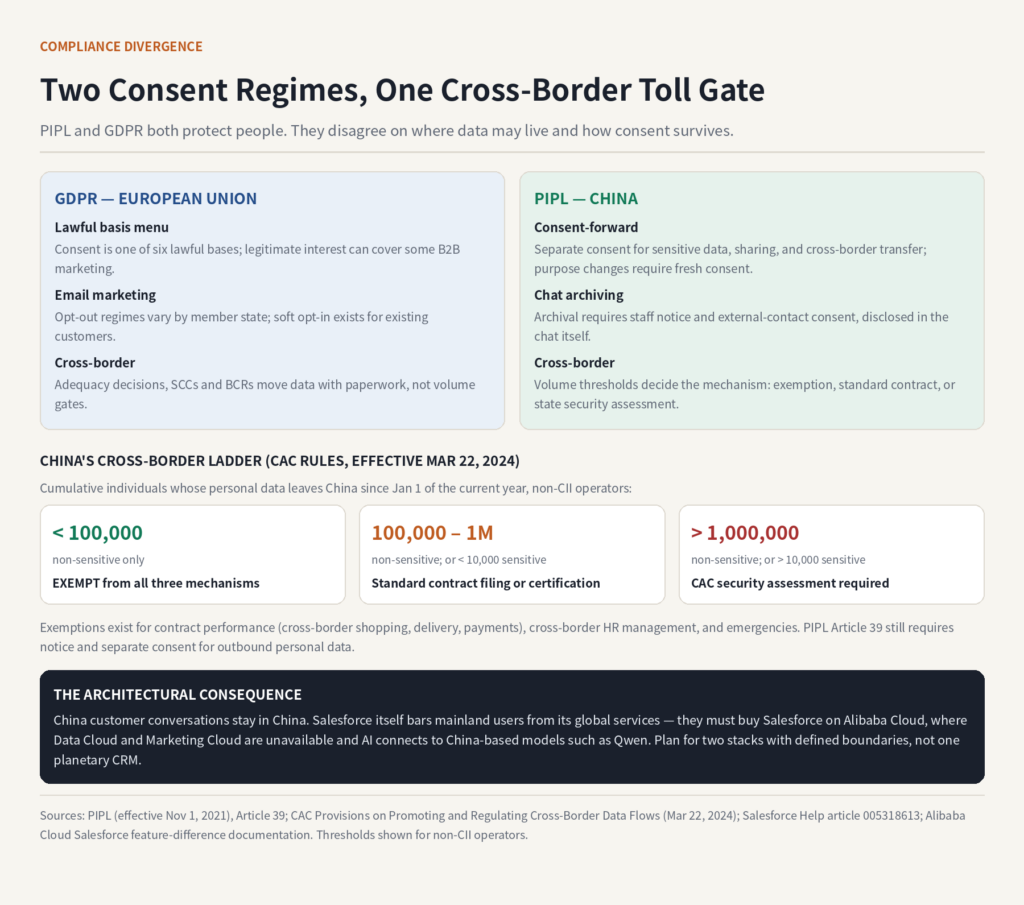
Europe’s GDPR offers a menu of six lawful bases; consent is one option among them, and cross-border transfers run on adequacy decisions and standard contractual clauses — paperwork, not volume gates. China’s PIPL, in force since November 2021, is consent-forward: separate consent for sensitive data, for sharing, and for sending personal data abroad. Article 39 requires that outbound personal data come with notice of the overseas recipient and the individual’s separate consent.
Since March 22, 2024, the Cyberspace Administration of China’s cross-border provisions have made the mechanics concrete. For non-CII operators, counted cumulatively per calendar year: fewer than 100,000 individuals’ non-sensitive data leaves exempt from all three mechanisms; 100,000 to one million non-sensitive (or under 10,000 sensitive) requires a filed standard contract or certification; above one million non-sensitive or 10,000 sensitive triggers a state security assessment. Exemptions exist for contract performance — cross-border shopping, delivery, payments — and for cross-border HR management. A chat archive full of customer conversations is none of those things.
And the archive itself is governed at the product level. WeCom’s documented mechanism requires the admin to set the archive scope, trusted IPs, and an encryption key; staff pass a disclosure page; the external contact receives a service notice in the chat and must consent before their side is archived. Enterprises can opt to restrict service when a contact declines — a backend setting, and a compliance conversation your legal team should own, not your growth team.
The industry’s own behavior confirms where this ends. Since 2019, Alibaba has been the exclusive provider of Salesforce in Greater China. Salesforce’s current help documentation is blunt: customers based in mainland China or Macau may not use the global services, and neither may mainland users of foreign-headquartered customers — they must buy Salesforce on Alibaba Cloud. In that edition, per Alibaba Cloud’s official feature-difference documentation, Data Cloud, Marketing Cloud, AppExchange connectivity, and Account Engagement are unavailable, and the AI layer connects to China-based models such as Qwen through Alibaba’s Model Studio. The world’s largest CRM vendor does not fight the two-species reality. It ships a separate species.
The buy decision: a decision table, not a bake-off
Compress everything above into four questions.
Are you China-only? Then a Western CRM is a costume. Buy a WeCom-native SCRM, add a local CDP when analytics demands it, and stop paying for pipeline theater your customers will never enter.
Are you global with a real China B2C business? Pattern A. SCRM front, CRM back, middleware syncing outcomes. Budget the integration as a permanent line item, not a one-time project — the API rules changed in December 2025 and will change again.
Are you B2B selling into China? The species gap narrows but does not close. Your buying committee still lives in deals and email; your champions still live in WeChat. Keep the Western CRM as the system of record — bought through Alibaba Cloud if users sit on the mainland — and give the China team a WeCom layer for the relationships, with a connector like JINGdigital doing the translation.
Is your China unit effectively a separate company? Pattern B, and be honest about the reporting trade-off you are accepting.
Whichever row you land on, price the exit before you sign the entrance. Ask every vendor to demonstrate export of contacts, tags, consent records, and archive — with a timeline and a cost. A customer relationship you cannot take with you is a rental, and rentals renew at the landlord’s price.
Honest boundaries
Three caveats, because this argument deserves its own scrutiny. The species thesis is structural and durable; specific features are not — everything in the feature map reflects vendor documentation as of November 2026 and will drift. The WeCom scale figures are launch-day disclosures by Tencent, not audited metrics, and Tencent does not break out WeCom revenue in its filings. And no vendor is universally better: a record-centric machine pointed at a record-centric business is exactly right, in Munich or in Shenzhen. The failure mode is not choosing the wrong species. It is assuming there is only one.
The takeaway
Western CRM asks “where is this customer in our process?” Chinese SCRM asks “who is talking to this customer, and what did they promise?” Both questions are legitimate. Neither system can answer the other’s question natively, and no amount of field-mapping changes that. The brands that win in China stop trying to force one species to impersonate the other. They run both, with a border treaty between them: the CRM records the deal, the SCRM keeps the relationship, the middleware carries outcomes across, and the law decides what may never cross at all.