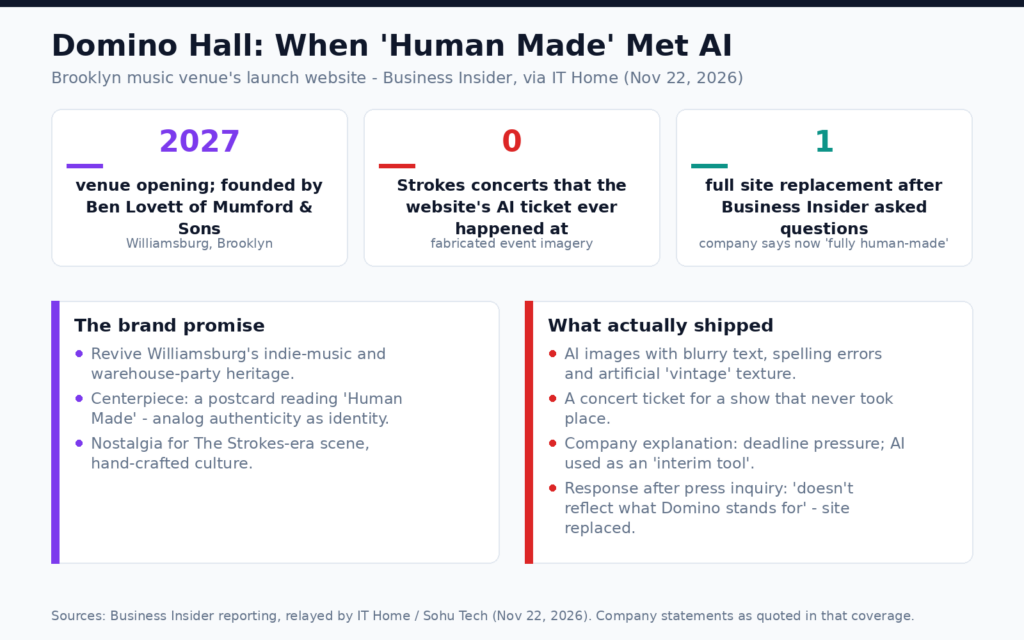
A concert venue’s new website became this weekend’s most instructive AI failure — not because a model hallucinated in a lab, but because real ticket buyers met the hallucination at checkout. Domino, a music venue, shipped a redesigned site substantially built with AI coding tools, and visitors quickly found the seams: event pages describing shows that don’t exist, mangled dates and lineup details, and copy that reads like a language model improvising a venue it has never visited. Business Insider’s original report, verified against the live site, documents a rollout where the automation demo and the production business turned out to be different things.
The failure mode deserves precision, because “AI made a bad website” undersells it. Web copy generated from thin source material doesn’t come out empty — it comes out plausible. A model asked to describe tonight’s show with incomplete data will produce a confident paragraph with the wrong doors time, an invented supporting act, or a genre that sounds right. For a blog, that’s an embarrassment; for a venue, the event page is the product listing. Wrong details on a ticketing page are mis-selling: customers travel across a city for a show that starts an hour later than the page said, or doesn’t happen at all.
What makes the Domino case a marketing story rather than a developer anecdote is where the errors landed: in the conversion path. The website is the venue’s storefront, search snippet, social-share preview and customer-service script all at once. Every generated error propagates — into Google’s index, into shared links, into the inbox of someone asking for a refund. The recovery cost of AI-generated content is not editing time; it is trust, refunds and support load, incurred at the exact moment the business was trying to look modern.
There is a defensible version of what Domino attempted. AI coding tools are genuinely good at scaffolding: layouts, components, styling, boilerplate. The workable pattern is AI-built structure with human-owned facts — event data flowing from a single verified source (the booking system), never from model improvisation, with a publish gate that blocks any page whose dates, prices or lineups don’t reconcile against that source. Generation is cheap; verification is the product. Teams that skip the second half don’t save money, they defer it into incidents.
The broader timing is unkind. Venues and SMBs are adopting AI site builders under real budget pressure, and vendor demos emphasize speed-to-launch while omitting the maintenance contract with reality. Domino’s weekend shows the missing clause: someone must own the truth of every fact the site asserts. That owner can be assisted by AI, but cannot be replaced by it — not while the output is a promise to a paying customer.
For marketing teams shipping AI-assisted sites, the checklist is short: single source of truth for facts, automated reconciliation before publish, a human accountable for the event calendar, and a rollback plan for when the model invents a headliner. The venue that gets this right will look boring and solvent. The one that doesn’t will trend — for the wrong reason.