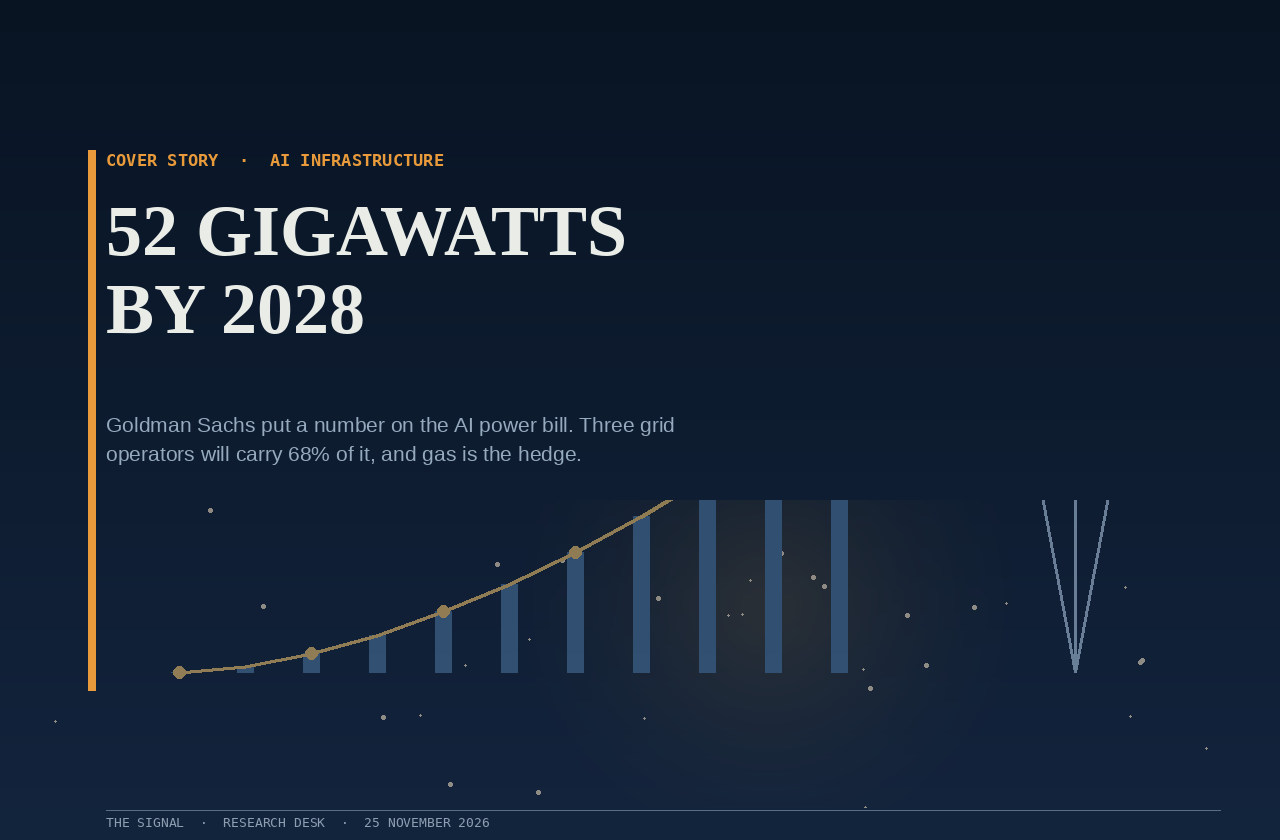
The bank expects US data-center capacity to keep compounding through 2028 — and warns the binding constraint is no longer chips.
Goldman Sachs said in a November 24 research note that strong growth in US data-center power capacity is likely to continue through 2028, with roughly 52 gigawatts of additional capacity potentially coming online that year alone. Reuters reported the analysis, which has been picked up widely across energy and tech coverage.
The framing is what makes it useful. Data-center power capacity and demand in the US have grown nearly 30% this year, and that expansion accounted for more than a third of total US electricity demand growth. Goldman’s forecast implies the curve steepens rather than flattens: the bank points to both more facilities and higher power density per facility, which is the harder half of the problem — a denser site needs more firm capacity at the same location, not just more sites.
The concentration matters for anyone modeling exposure. The bank’s analysis attributes roughly 68% of the incremental capacity — about 35 gigawatts — to three grid operators: PJM, ERCOT and MISO. That is a narrow set of interconnection queues absorbing a very large share of national load growth, and each has its own political economy around new gas plants, transmission siting and large-load tariffs.
Goldman’s read-through is bullish for natural gas, reinforcing its constructive view on Henry Hub prices for 2028–2030. That tracks: intermittent renewables plus dense, always-on load tends to get balanced with gas-fired capacity in the near term, regardless of longer-run decarbonization plans.
The bank also flagged the downside risk in plain terms: a policy shift after the midterms could moderate the upside. Its reasoning is specific — Democratic wins in the November midterms, including in Republican-leaning areas and in Texas and Georgia, which are both major data-center hubs, point to divided government and potentially stricter scrutiny of data-center development. Roughly 26 gigawatts of 2028 capacity has not yet broken ground, which is precisely the tranche that permitting risk can touch.
For marketers this is one step removed but real: compute costs feed into AI inference pricing, and inference pricing feeds into what AI-native marketing tooling costs per generation. The power bill eventually shows up in the per-second rate on a video model.