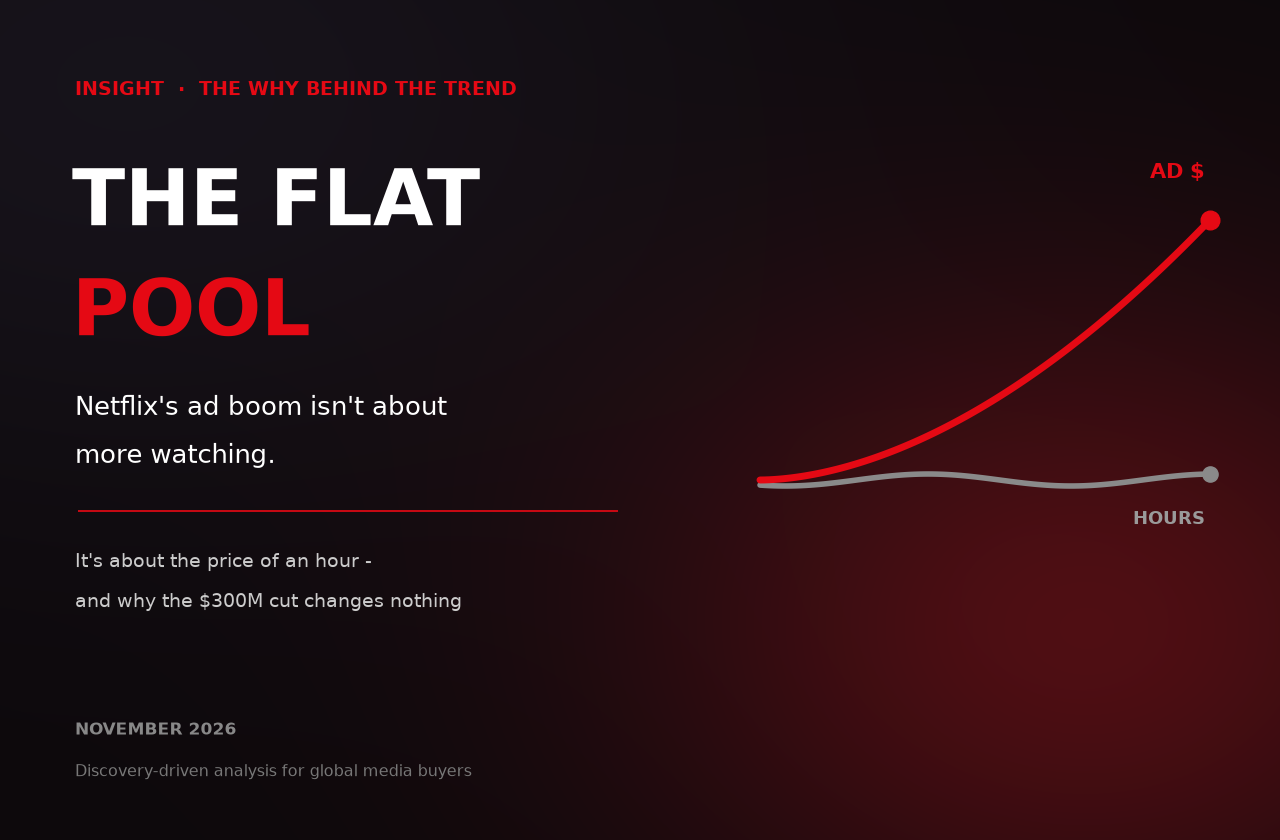
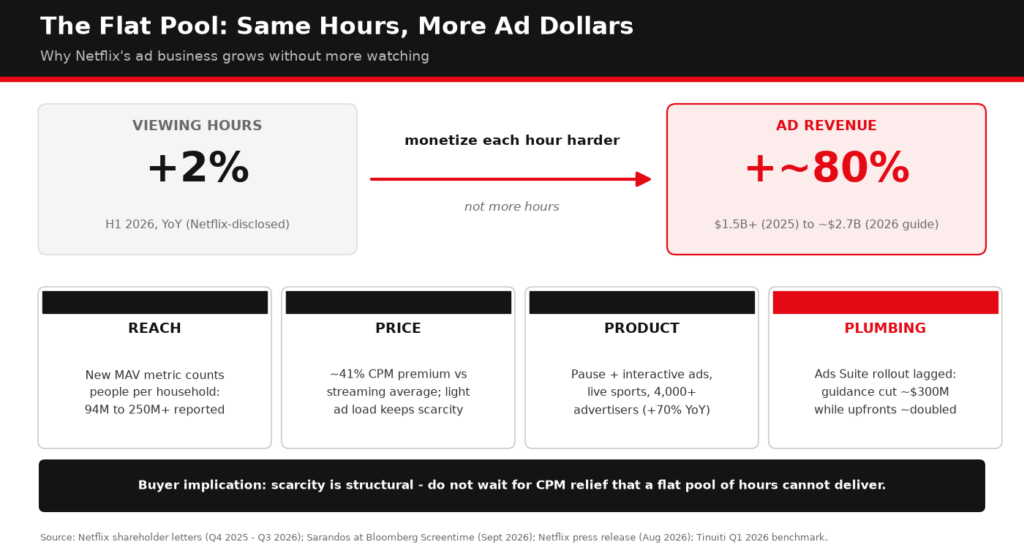
Here is a pair of numbers that shouldn’t coexist. Netflix’s total viewing grew about 2% in the first half of 2026 — co-CEO Ted Sarandos said so himself at Bloomberg’s Screentime event, calling the pace slower than he wants. Meanwhile, the company’s ad revenue is heading from more than $1.5 billion in 2025 toward roughly $2.7 billion in 2026. Same eyeballs, same hours, ~80% more ad money. Where does the gap come from?
The answer is that Netflix isn’t selling more hours. It’s repricing the hours it already has — through four levers that compound.
Lever One: Count More People Per Hour
In November 2025, Netflix switched its audience metric from ad-watching profiles to monthly active viewers — members multiplied by estimated household size. Reported reach went from 94 million to 190 million to 250 million+ within a year. Part definitional, part real — but either way, every hour of viewing now carries a bigger audience number into the upfront room. When reach metrics inflate faster than engagement, price per impression has room to hold even as total supply stays flat.
Lever Two: Keep the Supply Artificially Thin
Netflix runs roughly four minutes of ads per hour with frequency caps — a fraction of linear TV’s load. In a flat viewing pool, that restraint is a pricing strategy. Scarcity plus brand safety plus Tinuiti’s measured ~41% CPM premium over streaming averages is the whole thesis: fewer, better impressions sell for more. Waiting for Netflix CPMs to collapse the way open-web inventory did means waiting for a supply flood that a flat pool cannot produce.
Lever Three: Sell the Same Hour Twice
Pause ads, interactive Send to Phone and Frame Ads units, sponsorships, live sports — each adds a monetizable surface inside hours people were already watching. The NFL games, WWE and the coming Women’s World Cup are appointment moments that command top-of-range CPMs without adding meaningful hours (live is ~5% of the content budget for ~1% of viewing, per Sarandos). The advertiser count — 4,000+, up 70% year over year — shows the demand side filling in.
Lever Four: Fix the Plumbing — Eventually
The October guidance cut, from ~$3B to ~$2.7B, is the tell. Netflix blamed its own ad-product rollout speed, not advertiser demand; upfront commitments nearly doubled. Translation: the repricing engine has more capacity than the pipes currently deliver. That’s an execution ceiling, not a demand ceiling — which is why the cut should worry Netflix’s CFO more than its ad sales team, and why buyers shouldn’t read it as weakness in the channel.
What This Means If You Buy Media
Three implications follow. First, budget for premium prices that persist — structural scarcity doesn’t discount. Second, evaluate Netflix on lift and incrementality, because a channel repricing attention will never win a last-click bake-off. Third, expect the mix to shift toward new surfaces — pause, interactive, live — before it shifts toward more raw inventory. The flat pool isn’t a bug in Netflix’s ad story. It is the story: an attention economy where the growth comes from the price of an hour, not the number of them.