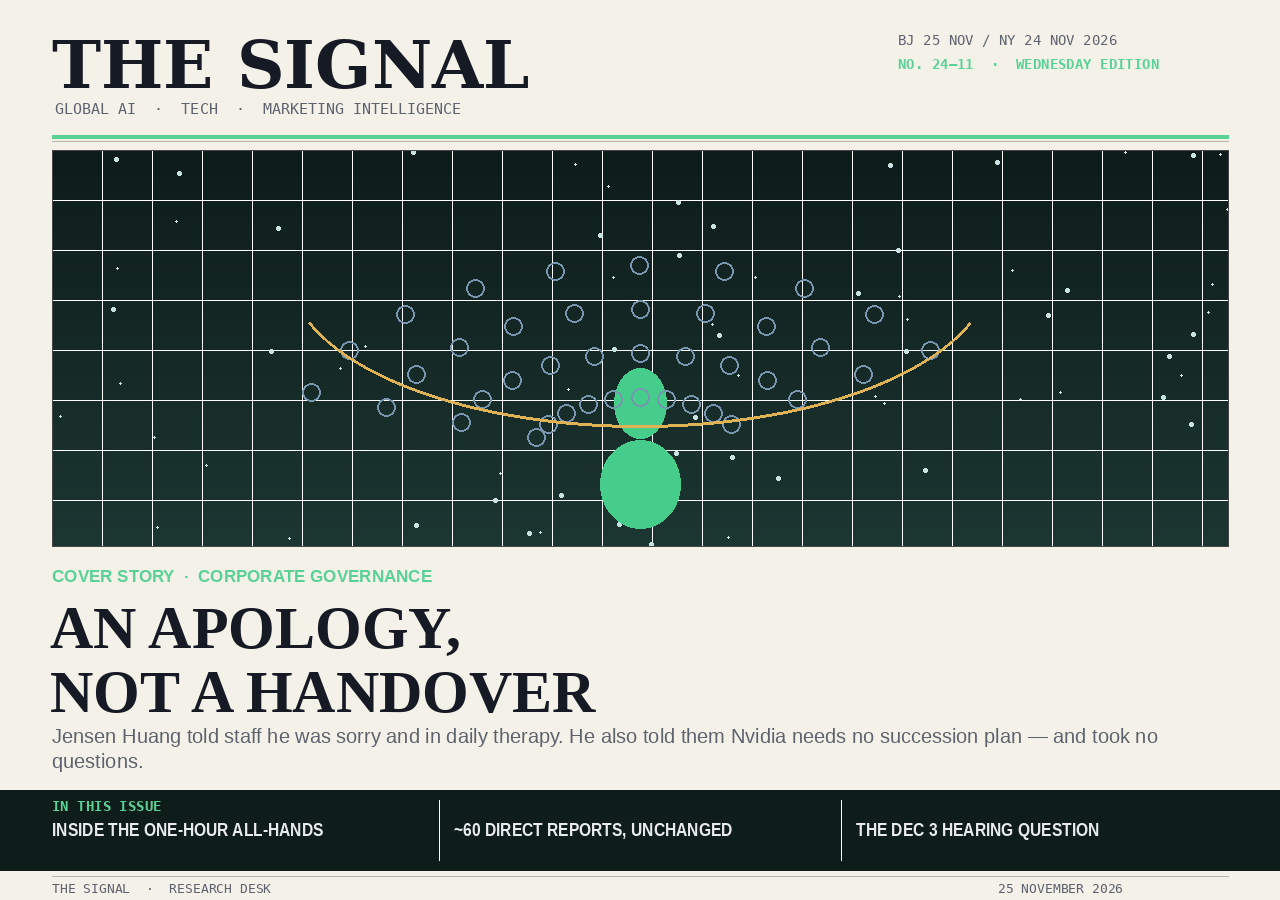
At his first all-hands since being reinstated, the CEO acknowledged violating the company’s code of conduct and disclosed he is in therapy. The org chart, he made clear, is not changing.
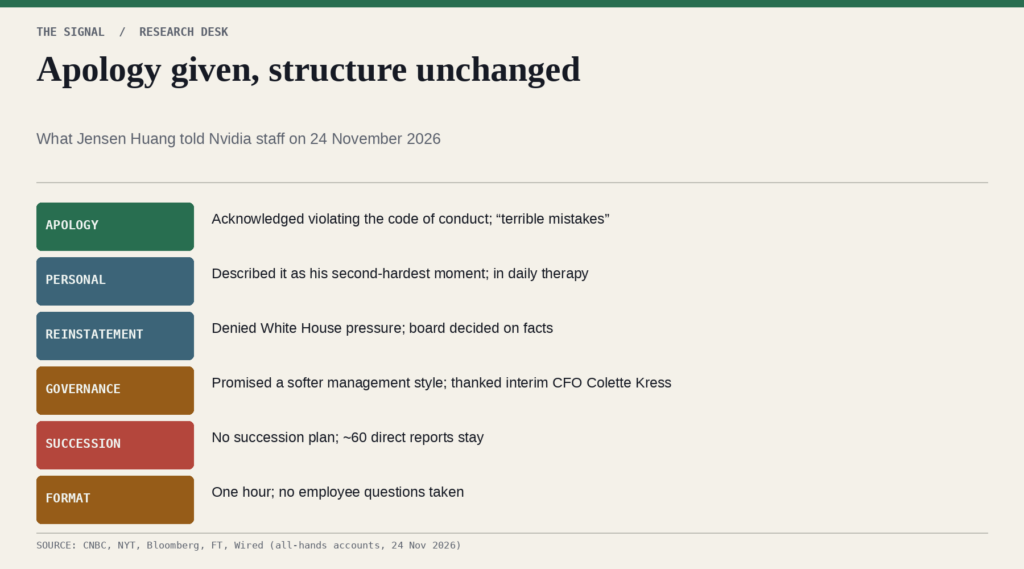
Jensen Huang held a one-hour all-hands at Nvidia’s Santa Clara headquarters on Tuesday, a day after the board restored him as CEO. Accounts from attendees, first reported by The New York Times and corroborated by CNBC, the Financial Times, Bloomberg and Wired, describe a subdued, apologetic tone. He acknowledged he had violated Nvidia’s code of conduct and said he had “made some terrible mistakes,” that he had hurt his family, his wife and everyone at the company, and that he is receiving therapy. He called the meeting the second-hardest moment of his life; the hardest, he said, was the conversation with his wife.
He also pushed back on two narratives that have followed the reinstatement. He denied that the White House pressured the board to bring him back, saying the directors decided on the facts after receiving assurances that there was no national-security risk. And he rejected the idea that he is untouchable — “I am not a tech bro above the law,” in one account. He thanked CFO Colette Kress, who had served as interim CEO, and promised to soften a management style long described as demanding.
Then came the part governance observers were listening for. Huang said Nvidia still has no succession plan, arguing that formal plans create unnecessary layers. Roughly 60 executives report directly to him, a structure he defended. No employee questions were taken.
An apology and a refusal to change the structure are not contradictory — they are two different conversations. The first addresses conduct; the second answers the question institutional investors have been asking since November 12, which is what happens to a $4 trillion company when one person is the entire decision tree. On the second question, the answer on Tuesday was: nothing changes.
That lands eleven days before Huang is due to testify before Congress on December 3, where both the code-of-conduct finding and the absence of a succession plan are now documented, on the record, before a public audience. The stock’s 23-year-record single-day gain on the reinstatement news has already begun to give some of it back in premarket trading. Markets processed the event; the governance question is still open.