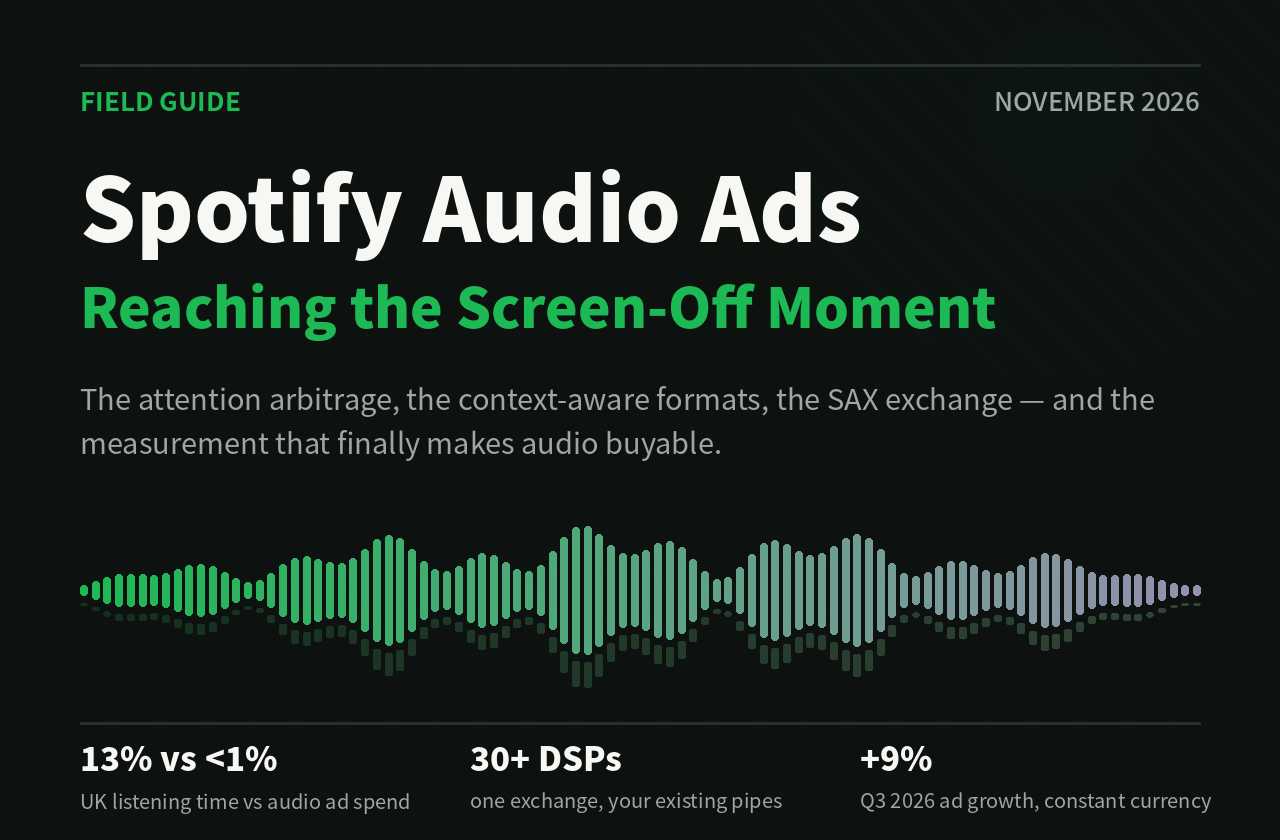
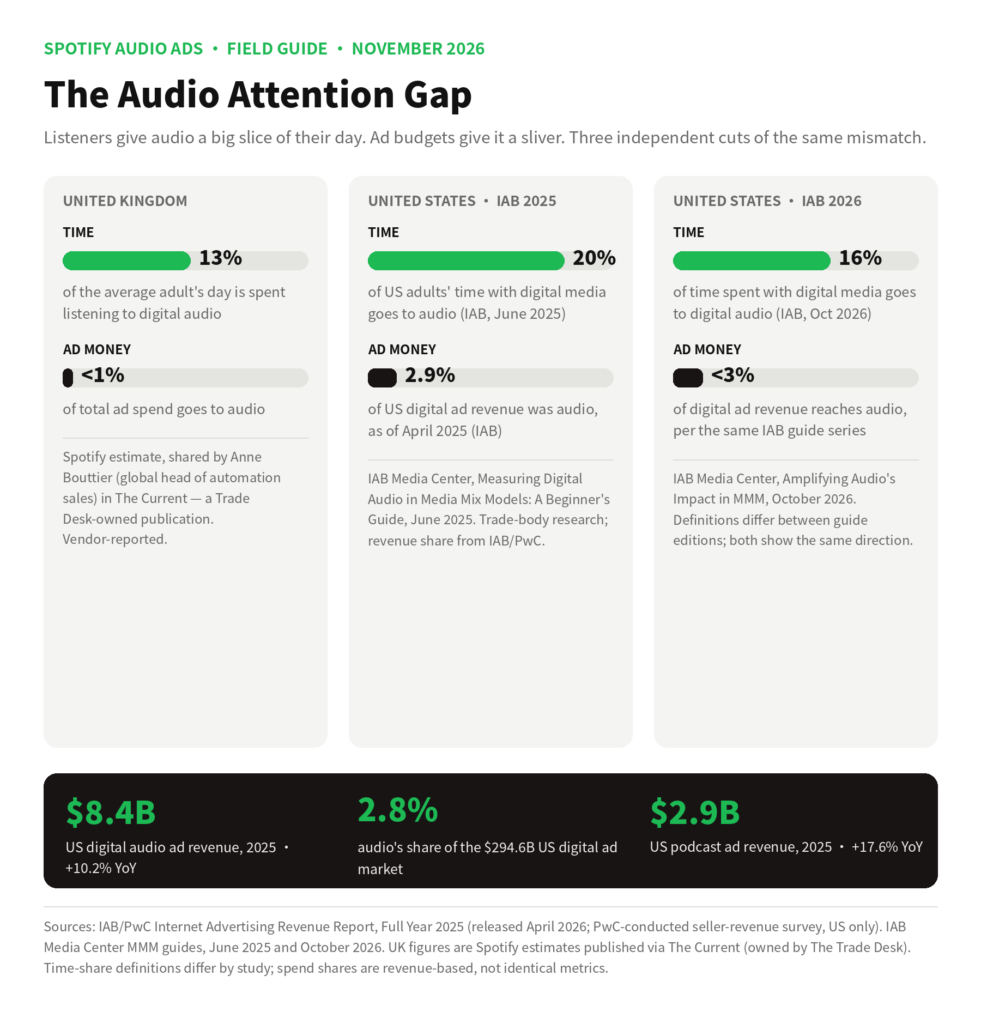
Audio is the most underpriced attention in advertising. In the UK, adults spend 13% of their day listening to digital audio, yet audio takes less than 1% of ad spend, according to Spotify estimates shared in The Current — a publication owned by The Trade Desk. In the US, the IAB’s own research puts audio at roughly 16–20% of digital-media time against under 3% of digital ad revenue. This field guide explains why the gap exists (fragmented sellers and thin measurement data, not weak effectiveness), how Spotify’s context-aware format system works, how the Spotify Ad Exchange (SAX) makes audio buyable inside existing DSP workflows, and what the Q3 2026 earnings inflection means for planners. All lift figures are labeled vendor-reported; unverifiable statistics from the source outline were deleted.
The 13% Problem: Attention Without Budget
Picture your customer at 7:40 am. Phone in pocket, earbuds in, screen dark. She is running, commuting, or walking the dog — and she is listening. For roughly two hours a day, the average free-tier Spotify user streams audio, per company statements at the April 2025 Spotify Advance event. No banner will reach her in that moment. No autoplay video will either. Only sound gets through.
Now look at the budget sheet. In the UK, Spotify’s global head of automation sales Anne Bouttier told The Current that adults spend 13% of their day listening to digital audio, while audio accounts for about 1% of total ad spend. The Current is owned and operated by The Trade Desk, and the figures are Spotify’s own — treat them as a vendor’s framing of a real gap, not an audited statistic.
The gap is not a British quirk. The IAB/PwC Internet Advertising Revenue Report — the 30th edition, conducted by PwC and released in April 2026 — counted $294.6 billion in US internet ad revenue for 2025. Digital audio, covering podcasts, streaming music and streaming radio, took $8.4 billion of it: 2.8%, growing 10.2% year over year. Podcast advertising alone reached about $2.9 billion, up 17.6%. Meanwhile, the IAB Media Center’s June 2025 beginner’s guide to audio in media mix models estimated that audio commands about 20% of US adults’ time with digital media. Its October 2026 follow-up, using a slightly different definition, still put audio at roughly 16% of digital-media time against less than 3% of digital ad revenue.
Different studies, different denominators, same direction: people give audio a fifth of their digital day, and advertisers give it a thirtieth of their money.
Why the Money Hasn’t Followed the Ears
If audio works, why is it underbought? Per Sandell, Spotify’s VP of product and co-lead for advertising, gave AdExchanger the blunt answer at Cannes in June 2026: audio is “by far the most underrepresented medium that exists in advertising today.” The problem, he said, is plumbing, not desire. Audio supply has historically been fragmented across sellers, and measurement lags other channels. Buyers cannot manage what they cannot buy cleanly or grade consistently.
The IAB’s October 2026 guide, Amplifying Audio’s Impact in MMM, makes the same diagnosis with more detail. Audio does not have an effectiveness problem; it has a data-granularity problem. Campaign detail gets lost across eight handoffs between buying systems and measurement systems. Four distinct channels — broadcast radio, streaming audio, podcasting, satellite — get merged into one “audio” line in media mix models. A model fed thin data returns a small, uncertain number, and a budget owner reads that as weak performance.
The guide’s anchor example is old but instructive: a 2012 Sequent Partners study for Arbitron replaced planned radio schedules with as-run logs across three live models, and measured radio return rose 27 percentage points to 78%, with model confidence climbing from 92% to 97%. The caveat matters: that study covered local spots only, and the IAB notes a network-radio counterexample where two years of as-run data produced no material improvement. Better data helps; it is not magic.
There is also a structural incentive worth naming. Spotify’s free tier is a funnel into Premium, where the margins live. At the end of 2025, ad-supported listeners were 63% of Spotify’s audience but generated only about 10% of revenue, per Sandell’s AdExchanger interview. Some of the “underinvestment” is simply Spotify’s freemium model working as designed. Keep that in mind when a seller tells you the market is broken.
The Audience You’re Actually Buying
Scale first. Spotify reported 788 million monthly active users and 306 million Premium subscribers in Q3 2026. The official ad-supported MAU figure was 483 million in Q1 2026, up 14% year over year, even as ad revenue dipped — note that ad-supported MAU is its own reported metric, not simply total MAU minus subscribers. The free tier keeps growing; monetization is the variable.
Engagement is the second asset. Company statements at the 2025 Advance event put average free-tier listening at about two hours per day. And Spotify is no longer audio-only: in the UK, time spent watching video inside the Spotify app rose 36% year over year, Bouttier told The Current. Video podcasts, music videos and live content turned a listening app into a watching app — which changes what you can buy there.
One Listener, Three Ad Environments
Spotify’s defining ad-tech trick is context awareness. The platform detects whether the app is in focus and serves accordingly: audio ads in screenless moments, video ads only when the screen is active. No wasted video impressions on a locked phone; no audio competing with visual attention.
The format system breaks into three environments:
- Screen off — audio ads. Spots of 15 or 30 seconds between songs, non-skippable on the free tier. Spotify’s official ad-spec document promises no long ad blocks: a 30-second ad about every 15 minutes. Audio can carry a clickable companion image for the moments the screen wakes up.
- Screen on — video and display. Video Takeover runs full-screen and sound-on between songs; opt-in video plays muted during songs and rewards the listener with ad-free time. In-feed video and display units appear while browsing. All of it is gated on the app being in focus, which is why viewability runs high.
- Any state — podcast ads. Host-read and dynamically inserted spots inside podcast content. This is the only route into Premium ears: music ads never reach subscribers, but podcast ads do.
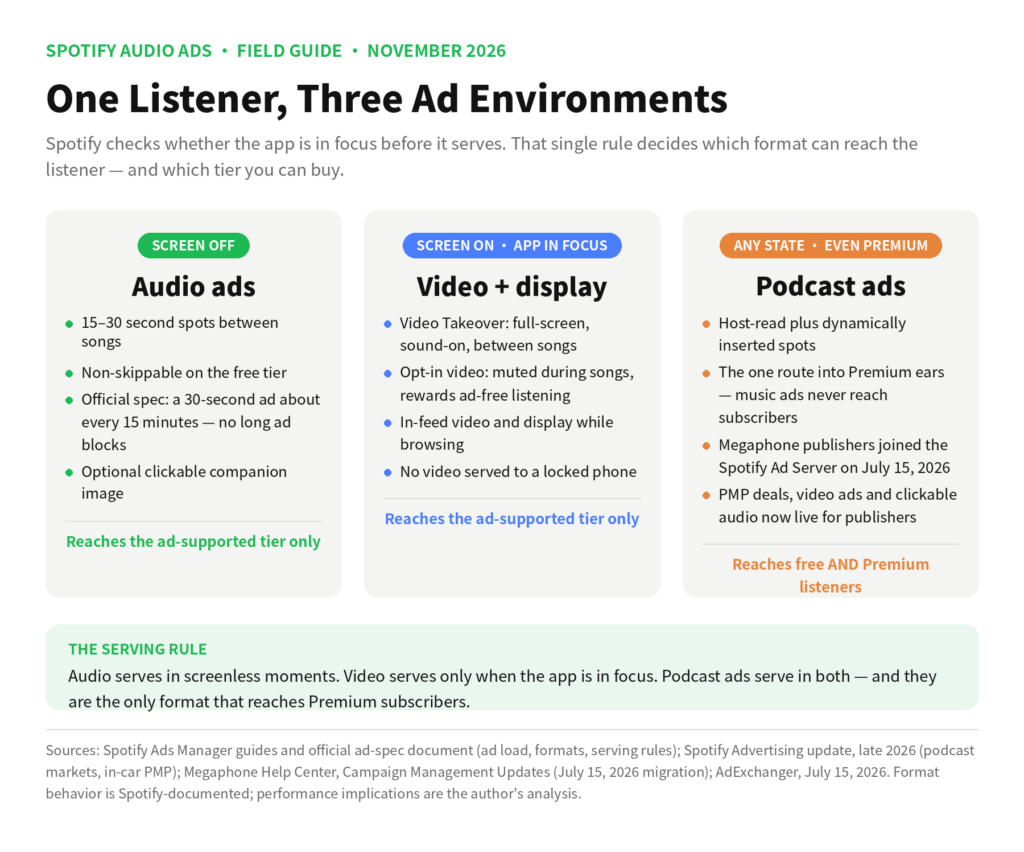
One planning consequence: each Ads Manager ad set chooses audio or video as its primary creative, so format strategy is a pre-launch decision, not an optimization toggle.
Targeting the Moment, Not Just the Demo
Spotify’s targeting base is familiar — age, gender, location, language, device. The differentiator is what the company calls Streaming Intelligence: first-party signals about genres, playlist habits, podcast categories, and the moment of listening. Workout, commute, cooking, focus/study, sleep, party — the official private-marketplace documentation lists dozens of mood and activity contexts. A fitness brand can buy workout-playlist listeners instead of a broad age band and hope.
Fan-based targeting reaches listeners of specific artists. Custom audiences let you match your own first-party lists and build lookalikes; the Spotify Pixel and Conversions API feed conversion signals back into optimization. Since April 2025, Ads Manager has also supported lower-funnel objectives — clicks, app installs, web traffic — and a lead-generation objective entered open beta in late 2026. Audio is being sold as a performance channel, not just a reach play.
SAX: Audio Joins the Programmatic Pipes
The Spotify Ad Exchange launched on April 3, 2025 at the Spotify Advance event in New York. Before SAX, buying Spotify meant a direct sales conversation or the self-serve Ads Manager — an island outside your programmatic stack. SAX opened real-time auction access to audio, video and display inventory through your DSP.
The current official picture, per Spotify’s advertising site:
- 30+ DSP integrations, including The Trade Desk, Display & Video 360, Amazon DSP, Yahoo DSP, Adform and Hawk via Magnite. Sandell told The Media Leader in mid-2026 the count had passed 40; the official page still says 30+. Use “30+” as the conservative floor and expect it to keep climbing.
- Identity frameworks you already use: LiveRamp RampID, The Trade Desk UID2.0 (and EUID in Europe), DV360 PAIR, Yahoo ConnectID, ID5 and Epsilon CoreID. Bring your own data; match it against a logged-in base.
- Deal types: open auction, private marketplace (PMP), and programmatic guaranteed on select DSPs. Podcast inventory is available via PMP.
- Market coverage spans the Americas, Europe, Asia-Pacific, the Middle East and Africa, with availability varying by DSP, market and deal type. Early secondary coverage cited 37 open-auction markets and 16 PMP markets; Spotify no longer publishes those exact counts, so confirm availability for your specific markets with the exchange team rather than planning off stale numbers.
Late-2026 updates added in-car audio targeting through always-on PMP deals across 30+ car brands, and expanded podcast audiences into 36 additional markets. Spotify says music-plus-podcast campaigns unlock over 90% more unique reach on average versus music-only in the new markets — a vendor figure, but a directionally useful one for reach planning.
For small teams, the self-serve door stays open: Ads Manager campaigns start at a $250 minimum per ad set, with free audio production tools included.
The Podcast Route Into Premium Ears
Podcasts are where Spotify’s ad story gets structurally interesting. On July 15, 2026, Megaphone — the enterprise podcast hosting and ad platform Spotify owns — completed its migration to the Spotify Ad Server. Publishers can now traffic direct-sold campaigns and PMP deals through Spotify’s stack, with new formats: video ads (app-in-focus only) and clickable audio ads with companion images. Spotify first-party data became the primary audience-targeting source, with Nielsen segments as a secondary fallback.
For buyers, this means podcast inventory is drifting into the same auction pipes as music. For planners, it means the Premium audience — the 306 million subscribers who never hear a music ad — is reachable through podcast sponsorships and dynamic insertion. If your category skews affluent or subscription-heavy, that is the door.
Creative: The Barrier That Finally Fell
Sandell’s phrase for audio creative’s historical status: “a sort of back burner creative format.” Brands poured energy into display, video and social; audio got the leftover script and a rushed voiceover. Weak creative, weak recall, self-fulfilling prophecy.
Spotify’s answer is generative tooling. Gen AI Ads launched in April 2025 in the US and Canada inside Ads Manager, free of charge: write a prompt, get a script and voiceover, tweak, ship. The UK followed in June 2025, per Broadcast. By mid-2026, Sandell said more than 7,000 advertisers had created over 20,000 AI-generated ads, using 100+ voices licensed from voice actors, in more than 12 languages, with payments flowing back to rights holders. The late-2026 update goes further: create audio ads free with the Gen AI tools and download them for use in your DSP on any SAX deal — creative production decoupled from the buy.
Sandell calls AI creative an “on-ramp into the audio highway”: crawl before you walk. His caveat is worth keeping — for big-brand storytelling, bespoke voice talent and host-read podcast integrations still carry authenticity that synthetic voices cannot match. Use AI to start and to scale variants; use humans where the voice is the brand.
The Evidence: Compounding Lift, With a Vendor Label
Now the numbers that sell audio — and the labels they deserve. Every figure below is Spotify-reported or Spotify-commissioned, published through channels with commercial interest. Directional evidence, not audited truth.
Bouttier’s The Current interview (remember: The Current is owned by The Trade Desk, Spotify’s DSP partner) cited:
- Advertisers adding Spotify to The Trade Desk media plans saw 9% lower cost per household reach and 44% lower cost per action.
- Audio plus video versus audio-only: sales-intent metrics up about 24% on average, incremental sales up 66% on average.
- UK incrementality versus linear TV +27%, linear radio +28%, social +18%.
Yahoo’s own DSP data from July–September 2025, reported by MediaPost, claimed some early SAX beta testers saw conversion rates improve nearly 70% and cost per action drop almost 90%. Also vendor-reported, also a beta sample.
The honest reading: multiple vendor studies point the same way — audio adds incremental reach and compounds with video — but none replaces your own incrementality test. Budget the lift as a hypothesis. Validate it with a holdout, a brand-lift study, or a geo experiment before you scale.
The Rebuild: A Year of Intentional Pain
Here is the part most audio evangelism skips: Spotify’s ad business got worse before it got better, on purpose.
Q1 2026: ad-supported revenue fell 5% year over year to €385 million, while ad-supported MAU rose 14% to 483 million. Sandell called it the “math problem,” and told The Media Leader the company “took some intentional pain” to rebuild its ad stack — moving from “mostly renting” technology to full ownership: its own ad server, API, Ads Manager and exchange. On constant currency, ads still grew 3% in Q1; the reported decline was partly FX. And from January 1, 2026, Spotify restated its segments, moving some activities from Ad-Supported to Premium — so compare quarters on the restated basis, not the originally reported one.
Then the turn. Q3 2026, reported October 21–22: ad-supported revenue €482 million, up 10% reported and 9% at constant currency — the fastest of the year, after 3% constant-currency growth in each of the first two quarters. The 6-K breakdown is the story within the story: automated (biddable) channels added €91 million year over year while the direct sales channel lost €53 million. The pipes flipped. CFO Christian Luiga said biddable is now about 40% of ad-supported revenue on a run-rate basis (roughly a third on a trailing-twelve-month view). Ad-supported gross margin hit 18.7%, up 105 basis points, helped by podcast cost structure. Management guided ads toward double-digit growth in Q4, and Norström said the H2 inflection was “tracking really well.”
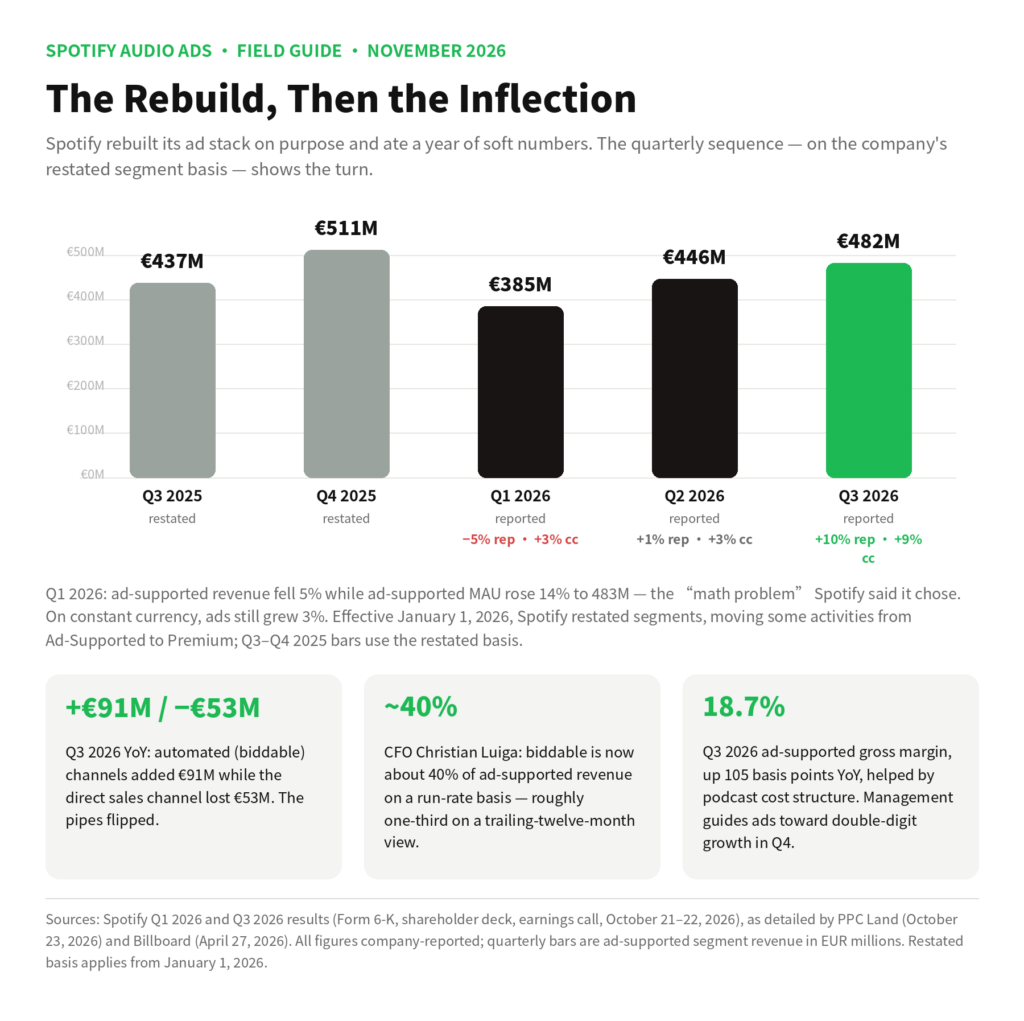
For a planner, the rebuild matters in two ways. First, forecasting: do not extrapolate the dip, and do not extrapolate the bounce either — watch whether biddable pricing stabilizes as volume grows (Q3 music impressions grew while average pricing softened). Second, leverage: Spotify now needs programmatic buyers to make its owned stack pay off. That is a negotiating moment.
Measurement: Making Audio Gradeable
The measurement stack has matured fast. Spotify Pixel and the Conversions API track web conversions; brand-lift studies and split testing live inside Ads Manager; the lead-generation objective is in open beta. Direct integrations now connect Spotify data to Nielsen, Kantar, Samba, Foursquare, TransUnion and NCSolutions (a Circana company), with more partners coming. DoubleVerify and IAS provide viewability measurement for in-feed display and carousel ads; on The Trade Desk, podcast brand safety runs through Barometer, IAS and Proximic by Comscore, with EUID extending European addressability.
But the industry-level work is unfinished. The IAB’s guides prescribe the fix: feed models as-run delivery data instead of planned schedules; model broadcast, streaming, podcast and satellite as four separate channels; supply the full field set (date, publisher, campaign, format, device, creative, impressions, spend, geography, daypart, ad position, paid-versus-bonus weight). The guide’s readability thresholds are practical: below roughly 50 million national impressions a year, signal is hard to read; local campaigns should span three to five markets.
Sandell’s framing is buyer-friendly: brands should “grade the homework” themselves, with a common currency agreed with the client. In algorithmic buying, he told AdExchanger, “ROI is what drives pricing” — deliver return, and the auction finds the value. Your job is to define the return before the auction defines it for you.
Where Audio Fits in an Omnichannel Plan
Audio now lives in the same DSPs, identity frameworks and reporting pipes as display, online video, CTV and digital OOH. That is the strategic shift: audio stops being a line item you negotiate separately and becomes a channel your existing stack can buy, cap, frequency-manage and attribute alongside everything else.
The practical allocation logic:
- Use audio for screenless reach and frequency — commute, workout, cooking, in-car. It reaches moments your visual channels structurally cannot.
- Layer video when the screen is on for the compounding effect the vendor studies describe.
- Use podcasts to reach Premium and to borrow host credibility.
- Judge the channel on incrementality against TV, radio and social, not on last-click. A screen-off medium will never win a click contest; it wins recall and incremental reach contests.
One frontier to watch: Spotify’s Q3 2026 call leaned hard into the agentic era — integrations with ChatGPT, Meta Ray-Bans and Meta’s Muse agent, with co-CEO Gustav Söderström arguing Spotify can “monetize from the background.” The filings do not specify whether audio ads serve or count when playback is initiated by a third-party agent. If your plan runs into 2027, ask your Spotify rep that question in writing.
Failure Modes to Avoid
- Back-burner creative. A repurposed radio spot with no context fit will underperform and “prove” audio doesn’t work. Write for the moment.
- Last-click grading. Screen-off audio generates recall, not clicks. Judge it with brand lift, incrementality and MMM — or don’t buy it.
- Trusting vendor lift as audited truth. Every +24%/+66% figure above is Spotify-reported, some via a Trade Desk-owned publication. Validate independently.
- Stale market counts and minimums. The 37/16 market split is no longer official; DSP counts keep moving; confirm current availability before planning.
- Ignoring the restatement. Spotify moved revenue between segments in January 2026. Compare restated quarters only.
- Forecasting off the dip or the bounce. The rebuild year distorted both directions; watch biddable volume and pricing together.
The 30-Day Audio Pilot
A concrete starting loop for a team that has never bought audio:
- Week 1 — define the moment. Pick one screenless context (commute or workout) and one audience signal (playlist/genre or artist fans). Set the success metric before launch: incremental reach, brand lift, or CPA versus a holdout.
- Week 2 — make the creative. Use the free Gen AI tools or the Partner Network to produce two or three audio variants plus a video layer for screen-on moments. Keep the spot conversational; name the brand early; give one memorable CTA.
- Week 3 — launch small. Ads Manager from $250 per ad set, or your DSP via SAX if you already trade programmatically. Install the Pixel/CAPI. Set frequency caps; choose audio or video per ad set deliberately.
- Week 4 — grade and decide. Read completion rates, brand lift, CPA against baseline. Feed as-run data into your MMM. If the incrementality holds, scale into the omnichannel plan; if it doesn’t, you learned it for a few hundred dollars, not a fiscal year.
Summary
Spotify sells the screen-off moment: 13% of the UK day for under 1% of spend, a gap the IAB’s US data confirms in different denominators. The format system is context-aware — audio when screens are off, video when they’re on, podcasts for Premium ears. SAX puts audio inside 30+ DSPs with the identity frameworks you already run, and the Megaphone migration is pulling podcast supply into the same pipes. The evidence for compounding lift is consistently positive and consistently vendor-reported; validate it yourself. The ad stack rebuild produced a deliberate Q1 dip and a real Q3 inflection driven by biddable channels. Buy audio for frequency, recall and incremental reach; grade it with lift studies and clean MMM data, not last-click; and start with a $250 pilot, not a thesis.