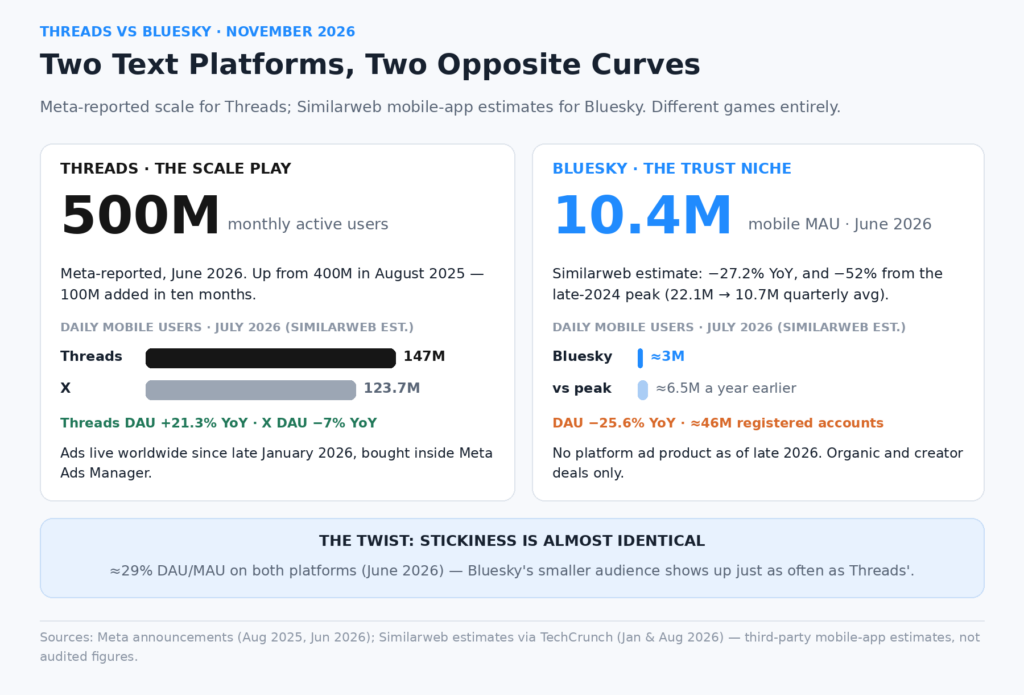
Two text-first social networks just handed marketers opposite report cards. Threads crossed 500 million monthly active users in June 2026, per Meta’s own announcement, and switched ads on worldwide in late January — bought through the same Ads Manager your team already lives in. Bluesky, meanwhile, lost roughly half its mobile monthly users from its late-2024 peak, according to Similarweb estimates reported by TechCrunch. And yet the people who stayed on Bluesky show up almost exactly as often as Threads users do: around 29% daily-to-monthly stickiness on both.
One is a scale machine with an ad engine. The other is a shrinking but loyal trust niche with no way to buy reach. If you treat them the same, you’ll waste money on one and credibility on the other. This playbook shows you how to split the hours, run a capped pilot, and grab the cheapest brand-safety win in social media — without drinking the early-mover Kool-Aid.
The Divergence You Can’t Ignore
Let’s start with the numbers that actually matter, and who counted them.
Meta says Threads hit 400 million monthly active users in August 2025 and 500 million in June 2026 — a hundred million added in ten months. Those are company-reported figures, not audited ones, and Meta stopped publishing daily-user counts after disclosing 150 million DAU in October 2025. On its Q3 earnings call in October 2026, Mark Zuckerberg claimed Threads had overtaken X in monthly actives. He didn’t give a number. X’s own filings don’t define “users” either. So treat the supremacy claim as a CEO’s flex, not a spreadsheet.
Third-party estimates fill part of the gap. Similarweb data reported by TechCrunch showed Threads at 141.5 million daily mobile users on January 7, 2026, ahead of X’s 125 million — and by July, Threads DAU reached 147 million, up 21.3% year over year, while X slid 7% to 123.7 million. These are panel-based estimates of app usage, not audited counts, but two dated snapshots point the same direction.
Threads: Scale and Ads Are Real Now
The ad timeline is worth getting precise, because most summaries blur it. Meta piloted Threads ads in the US and Japan in January 2025, opened testing to global advertisers in April 2025 (Campaign Asia counts 30-plus countries), then announced the worldwide rollout on January 21, 2026, starting the following week. Meta said delivery would stay low at first and ramp over months. As of this writing, the placement is live — but check your own Ads Manager, because phased rollouts are messy.
Mechanically, nothing is new. Threads ads run on Meta’s AI ad system, the same one behind Facebook and Instagram. Image, video, carousel, the 4:5 ratio — all supported, via Advantage+ or manual campaigns. Two operational traps: the Threads placement is switched on by default in new campaigns, so if you don’t want it, deselect it manually. And your Threads username must match your Instagram username to run ads at all. Fix that before your media buyer discovers it live.
One more sober note from Meta’s CFO: in April 2026, Susan Li said Threads would not be a meaningful revenue driver this year. Ad load is deliberately light. For buyers, that’s the actual opportunity — VaynerMedia’s APAC media lead called it underpriced attention, a classic early-auction arbitrage. Cheap inventory rarely stays cheap.
Why X Refugees Didn’t All Land on Bluesky
Here’s the story most budget decks get wrong. After the 2024 US election, millions left X and Bluesky caught the wave — Similarweb puts its mobile MAU at a 22.1 million quarterly average in Q4 2024. But protest migrations aren’t habits. By Q2 2026 that average had fallen to 10.7 million, a drop of about 52%. June 2026 mobile MAU stood at 10.4 million, down 27.2% year over year; July daily mobile users were around 3 million, down 25.6%.
Registered accounts, meanwhile, keep climbing toward 46 million. That gap between signups and active use is the whole lesson: an account counter is not an audience.
And no, the leavers didn’t all run back to X — Similarweb shows X’s mobile MAU down about 3% year over year in June too. Some simply stopped using text social altogether. Threads’ gains may come from people who never used a Twitter-like app at all, pulled in by Instagram cross-promotion. Which means “Threads is stealing Bluesky’s users” is a narrative, not a finding.
Bluesky’s Quiet Strength: The People Who Stayed, Stay
Now the twist that keeps Bluesky on the strategy map. In June 2026, its stickiness — daily users divided by monthly users — sat around 29%, per Similarweb. Threads’ ratio? Roughly the same. A smaller room, but everyone in it keeps coming back.
For brands, concentrated loyalty beats diffuse scale in specific games: earned credibility in tech, media, policy, science and publishing circles; a spokesperson with a real following; journalist attention. Bluesky’s chronological Following feed also means no algorithmic second wind — your post lives or dies on when you publish and whether people chose to follow you. That punishes campaign-style broadcasting and rewards steady, useful presence.
There’s a structural bet underneath, too. New CEO Toni Schneider, who took over from Jay Graber in early 2026, is steering the company toward the AT Protocol ecosystem rather than the app alone — projects like BlackSky and Eurosky, the video app Skylight, an AI research tool called Attie, and private-data support in development. In theory, identity and audiences could travel across protocol apps. In practice, that portability is young. Watch it; don’t budget against it.
The Budget Split: Most Hours to Threads, a Capped Slice to Bluesky
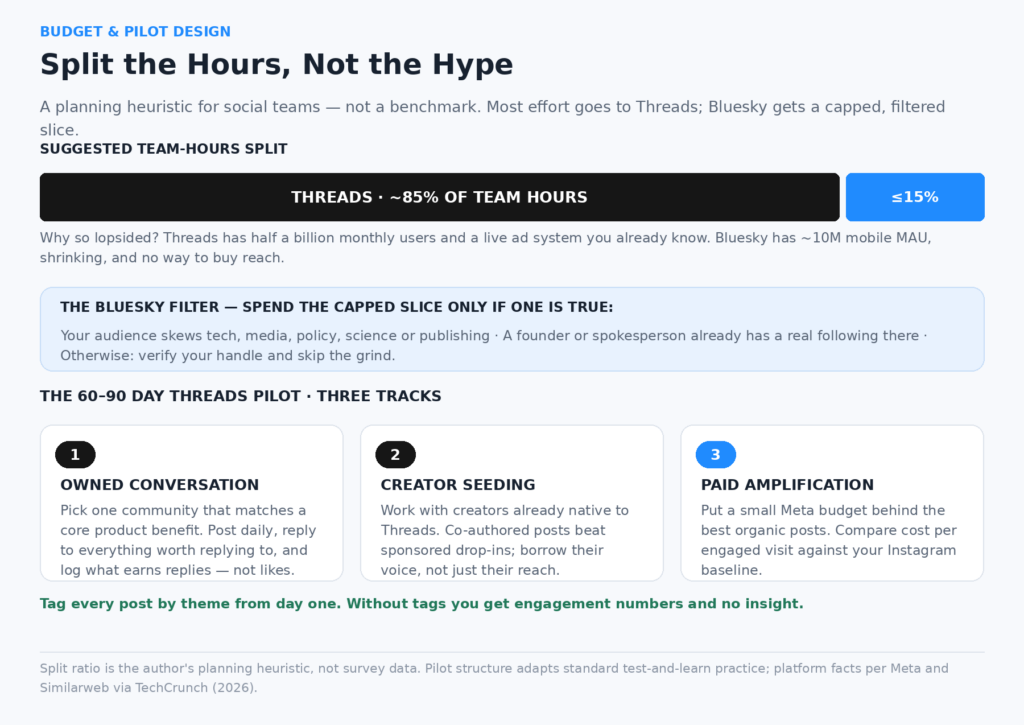
Here’s the heuristic — and it is a planning heuristic, not survey data. Give roughly 85% of your text-social team hours to Threads and cap Bluesky at 15% or less, released only through a filter.
The filter has three gates. Does your audience genuinely skew tech, media, policy, science or publishing? Does a founder or spokesperson already have a following there? Can someone commit to a light, consistent cadence rather than launch bursts? One yes earns a test. Zero yeses means: claim your handle, verify it, and move on.
Why so lopsided? Threads offers half a billion monthly users and paid amplification through infrastructure you already own. Bluesky, as of late 2026, still has no self-serve ad product — no boosted posts, no rate card. Leadership has mused about intent-driven search ads someday; nothing has shipped. Every Bluesky impression is earned through organic posting or direct creator deals. That’s a community lab, not a lead-gen machine, and it should be funded like one.
The 60–90 Day Threads Pilot, in Three Tracks
Run the pilot on three parallel tracks, and tag every post by theme from day one. Without tagging you’ll end up with engagement numbers and no insight — the most common way pilots die.
Track One: Own One Conversation
Pick a single community that maps to a core product benefit. Threads’ Communities feature left beta in June 2026 with a dedicated hub, custom icons and champion recognition; Meta credits communities for essentially all of its recent daily-user growth. Post daily, reply to everything worth replying to, and log what earns replies rather than likes. Replies are the currency here.
Track Two: Seed Through Native Creators
Work with creators who already talk like Threads users, not Instagram transplants. Co-authored posts outperform sponsored drop-ins because they borrow voice, not just reach. There’s no creator payout program on Threads in 2026, so deals are direct — budget for them like any influencer line item.
Track Three: Amplify What Already Works
Put a small Meta budget behind your best organic posts and compare cost per engaged visit against your Instagram baseline. Don’t judge Threads against Instagram’s absolute CPMs on day one; judge the trend as ad load ramps. If engaged visits cost more after sixty days, the organic content is the problem, not the platform.
What to Post: Text-First Formats That Travel
Both platforms reward clarity over polish, but the formats rhyme. Educational mini-threads of three to seven lines: problem, why it matters, a framework or checklist, one honest question. Behind-the-scenes notes without the corporate varnish — what we learned shipping X, a mistake we won’t repeat. Opinions with receipts: a point of view, an example, an acknowledged counterpoint, a polite question.
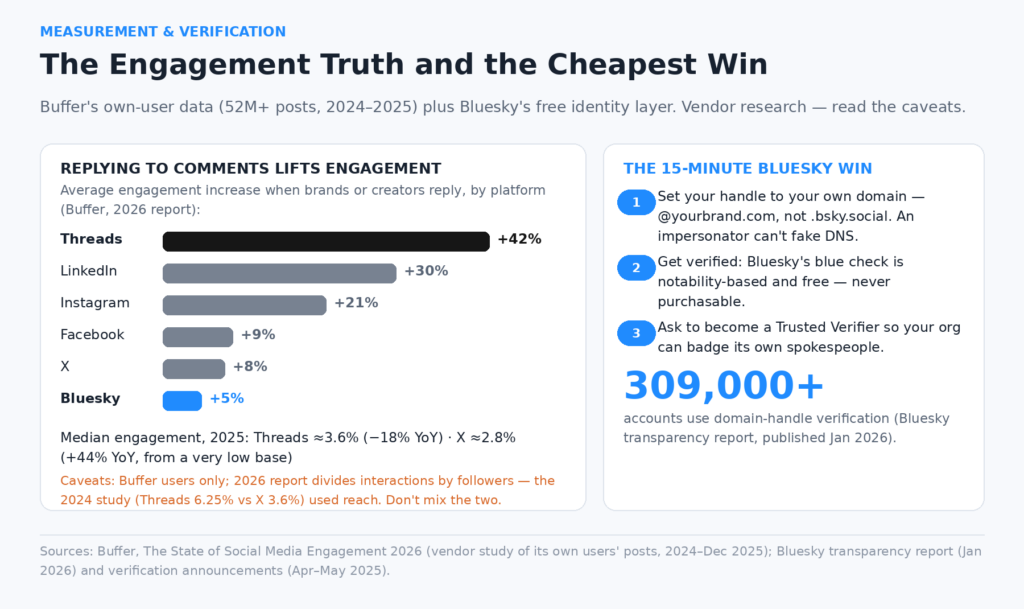
And reply. This is the most actionable number in the whole article: Buffer’s 2026 engagement study found that when brands or creators reply to comments, average engagement rises 42% on Threads — the largest lift of any platform measured. On Bluesky the lift is just 5%, which tells you engagement there is driven by what you post, not how you farm it.
The Engagement Numbers, With Their Caveats Attached
You’ll see a lot of Threads engagement statistics floating around, so let’s sort them by who measured what. Buffer’s earlier analysis of 10.2 million posts from 2024 put median engagement at 6.25% on Threads versus 3.6% on X, using a reach-based denominator. Its newer State of Social Media Engagement 2026 report — 52 million-plus posts from roughly 191,000 monthly Buffer users across 2024–2025 — switched to a followers-based denominator and shows 2025 medians of about 3.6% for Threads and 2.8% for X.
Two lessons. First, never mix those two studies’ numbers; the ruler changed between them. Second, direction matters more than decimals: Threads engagement fell about 18% year over year as its user base ballooned and feeds got noisier, while X rose 44% from a very low base. Buffer is a scheduling vendor studying its own users — a biased sample of organized accounts, not all brands. Use these as orientation, then trust your own tagged pilot data.
The 15-Minute Bluesky Win: Your Domain Is Your Badge
Even if you skip Bluesky entirely, do this today: set your brand’s handle to your own domain — @yourbrand.com instead of something.bsky.social. It’s DNS-verified, so an impersonator can’t fake it without controlling your domain. More than 309,000 accounts use domain-handle verification, per Bluesky’s transparency report published in January 2026.
Layer two: Bluesky’s blue check, launched April 2025, is notability-based and cannot be bought — a pointed contrast with X. Applications opened in May 2025. Layer three: organizations can apply to become Trusted Verifiers and badge their own spokespeople, the way The New York Times verifies its journalists. Handle, check, verifier status: fifteen minutes of setup, a permanent impersonation shield, zero media spend. It’s the cheapest concrete win in this entire playbook.
How to Measure Each Platform Without Fooling Yourself
On Threads, track replies, saves, profile visits, branded-search lift, and cost per engaged visit against your Instagram baseline; Advantage+ reporting lives in Ads Manager as usual. On Bluesky, track reply quality, spokesperson following, inclusion in relevant starter packs and custom feeds, and your standing in the niche — qualitatively. Judging Bluesky by ROAS is a category error: there’s no ad product to produce a return. Judge it the way you’d judge a trade association membership.
One measurement trap deserves its own warning: curated feeds cut both ways. Threads’ Your Algo tool, launched June 2026 in the US, UK, Canada, Australia and New Zealand, lets users privately mute topics for one, three or seven days. Users who tune their feeds will tune out promotional noise faster than any algorithm would. Your reach can silently evaporate without a policy violation — the content just stops being wanted.
Five Failure Modes to Avoid
The “be everywhere” instinct produces thin presence on both platforms and insight on neither. Treating Bluesky’s 46 million registrations as an audience ignores that barely a quarter are monthly active. Campaign-posting on Bluesky — polished launches, hashtag walls — reads as spam in a conversation culture. Budgeting against AT Protocol portability that doesn’t exist yet is speculation dressed as strategy. And flooding Threads’ curated feeds with promos gets you muted by the very users you came to reach.
Notice the pattern? Every failure is a category error — applying one platform’s logic to the other’s economy.
Summary
Threads is the scale-plus-ads text play: 500 million company-reported monthly users, worldwide ads through Meta Ads Manager since late January 2026, deliberately low ad load, and communities driving its growth. Bluesky is a shrinking-but-sticky trust niche: about 10.4 million mobile monthly users and falling, ~29% stickiness that matches Threads, no ad product, and a protocol-first strategy under new leadership. Put most of your hours into a tagged, three-track Threads pilot; give Bluesky a capped slice only if your audience fits the filter; verify your domain handle either way. It’s an early-mover strategy with the hype removed — a pilot, not a land grab.