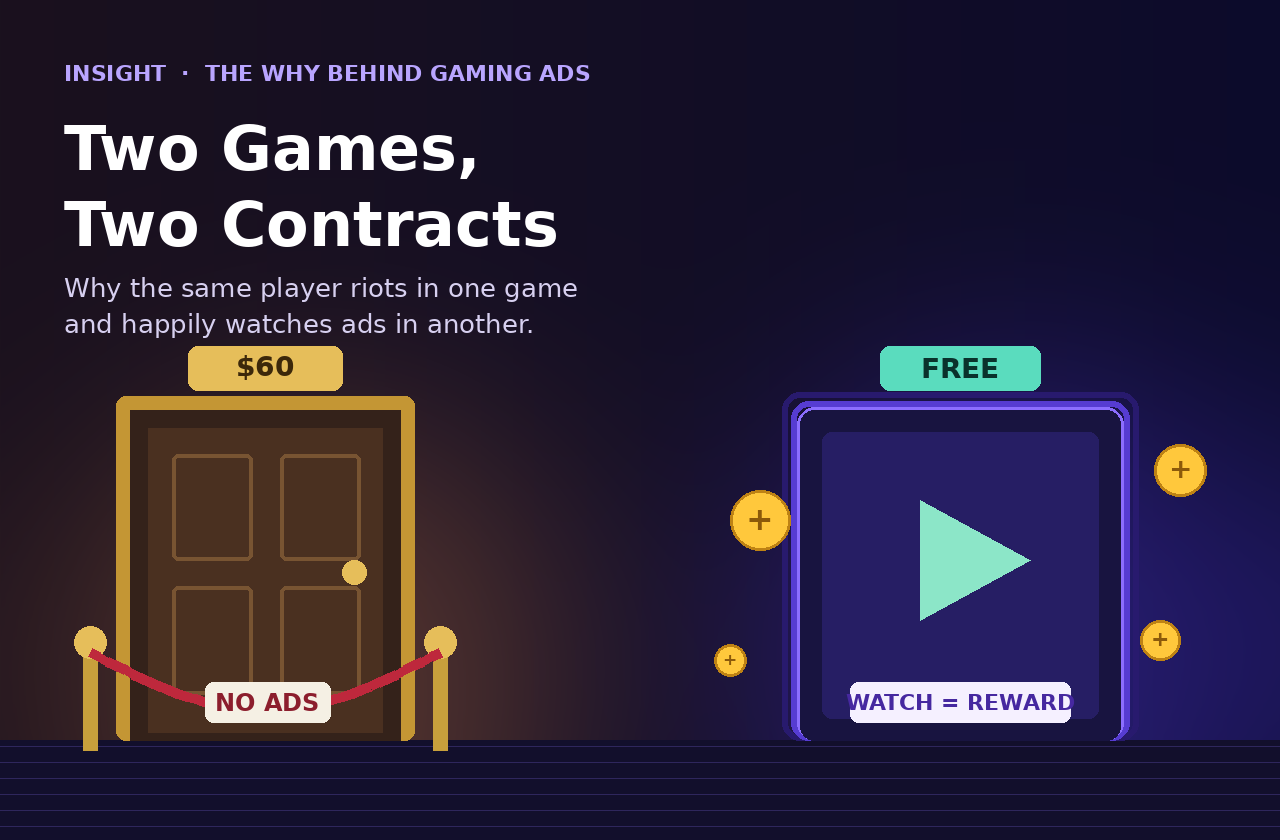
Ask a media planner why gamers hate ads and you’ll get a shrug about “ad-averse youth.” Ask a player and you’ll get something sharper: it depends which game you’re standing in. The same person who fills a Reddit thread with fury over a full-screen ad in a $60 console title will happily watch thirty seconds of video for a skin in a free mobile game — twice before lunch. That isn’t hypocrisy. It’s contract law, informally enforced.
The Premium Contract: Attention Was Already Paid For
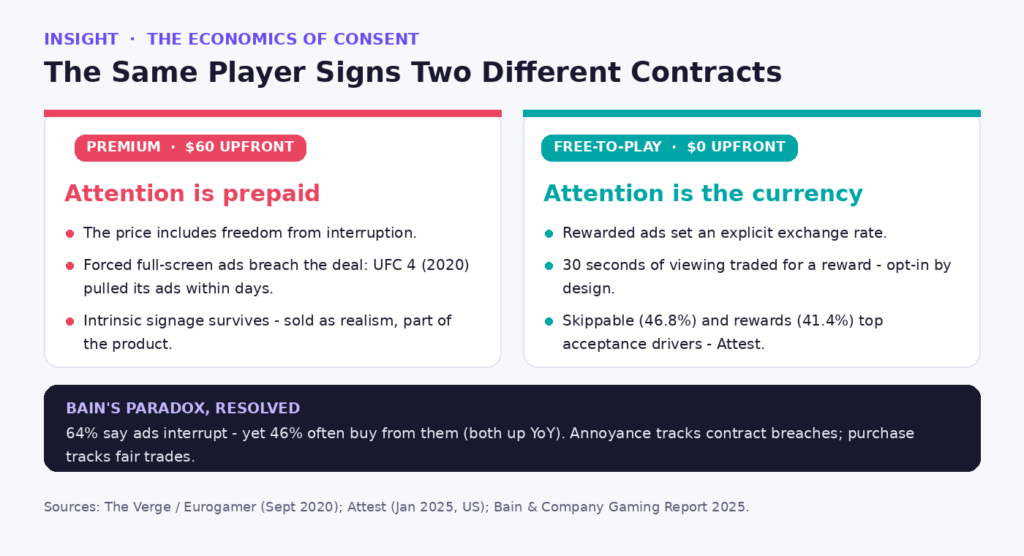
When someone pays $60 for a game, the transaction is settled. Money went one way; an uninterrupted experience comes back the other. Any forced ad after that point reads as a second charge — the player already bought their attention back, and the publisher is trying to sell it again. That’s why EA’s UFC 4 experiment collapsed in September 2020: full-screen promos for The Boys, switched on after launch and after the reviews, hit roughly 100,000 upvotes of Reddit fury and were pulled within days. Note what was never removed: the menu tiles and Octagon signage that had lived in the franchise for years. Those don’t breach the contract — they decorate the world the player purchased. Intrinsic ads survive in premium games because they’re sold as realism, not as interruption.
The Free-to-Play Contract: Attention Is the Currency
In a free game, the deal flips. The player pays nothing upfront, so attention becomes the payment method — and rewarded ads are simply the exchange counter, posting a rate: thirty seconds of viewing for one revive, one spin, one cosmetic. Crucially, the player initiates the trade. That’s why skippability (46.8%) and rewards (41.4%) top Attest’s acceptance drivers: both hand the player the pen to sign with. The format doesn’t take attention; it quotes a price and waits.
The Paradox That Proves the Mechanism
Bain’s 2025 gaming survey caught both lines rising at once: 64% of players say ads interrupt their experience (up from 59%), while 46% say they often buy because of in-game ads (up from 40%). Read through the contract lens, the contradiction dissolves. Annoyance tracks breaches — ads that charge attention without consent. Purchase tracks fair trades — ads that price attention honestly. The two metrics aren’t measuring one sentiment; they’re measuring two different economies running side by side.
Which reframes the buyer’s job entirely. The question was never “how do we make gamers tolerate ads?” It’s “which contract is this player standing in — and does our format honour it?” Get that right and the 14.6% positive-sentiment ceiling stops being a wall. It becomes a filter: the players who said yes meant it, because nobody made them.