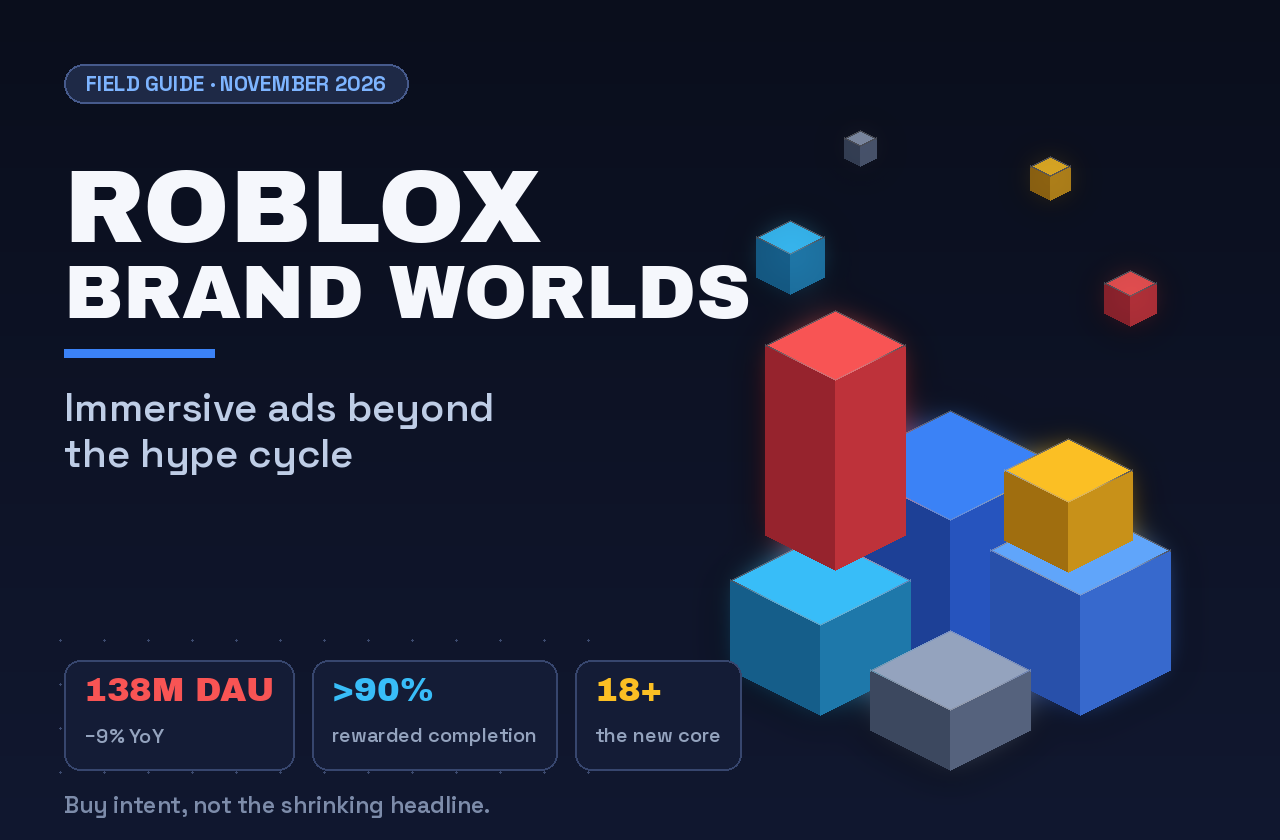
Here is the strangest timing in gaming marketing right now. In January 2026, at CES, Roblox rolled out the most complete advertising stack in its history: a premium homepage unit, a rewarded video format running across more than 400 experiences for over 1,000 brands, and five new programmatic partners. Ten months later, the company reported its first-ever year-over-year decline in daily active users — 138 million, down 9% — with engagement hours down 15% and bookings down 12%. The stock fell by roughly a sixth in a day.
So which story do you believe? Both. That is the whole point of this field guide. Roblox finally became easy to buy at exactly the moment its reach story got complicated. If your media plan still treats it as either a shiny experiment or a guaranteed Gen Z firehose, you will misprice it. The brands winning on Roblox in late 2026 are buying something narrower and more valuable than reach: opted-in attention from a high-value core, inside a platform whose ad infrastructure now works like a normal channel.
This guide walks through what shipped, what the earnings actually say, what the attention research proves (and what it cannot), and how to run a 60-day pilot that ends in a real decision instead of a renewal nobody can justify.
What Roblox Actually Announced at CES 2026
Strip away the keynote gloss and three things matter.
First, Homepage Feature: a CPM-based unit on the Roblox homepage. Click it, and the brand’s video creative opens into an immersive 3D preview — no custom development required. It launched in closed beta with e.l.f. Beauty, Sam’s Club, and Universal Pictures’ Five Nights at Freddy’s 2, with an always-on rollout promised. Roblox pitched it as the starting point for “over 151 million daily active users.” Note the footnote, because it does a lot of work: that figure was as of the quarter ended September 30, 2025. Hold that thought.
Second, Rewarded Video went mainstream. Players opt in to watch a full-screen video of up to 30 seconds in exchange for an in-game reward — an extra life, a booster, virtual currency. Roblox reports completion rates above 90% and viewability above 95%, across 400+ experiences including Grow a Garden, Dress to Impress and Brookhaven, for more than 1,000 brands. The format launched in April 2025 through a Google partnership; CES 2026 was the moment it graduated from pilot to portfolio.
Third, programmatic access widened: Amazon DSP and Liftoff on the demand side; Index Exchange, Magnite and PubMatic on the supply side, building on the existing Google relationship. Translation: Roblox inventory now shows up in the same dashboards your team already uses every day. The extraordinary project became a line item.
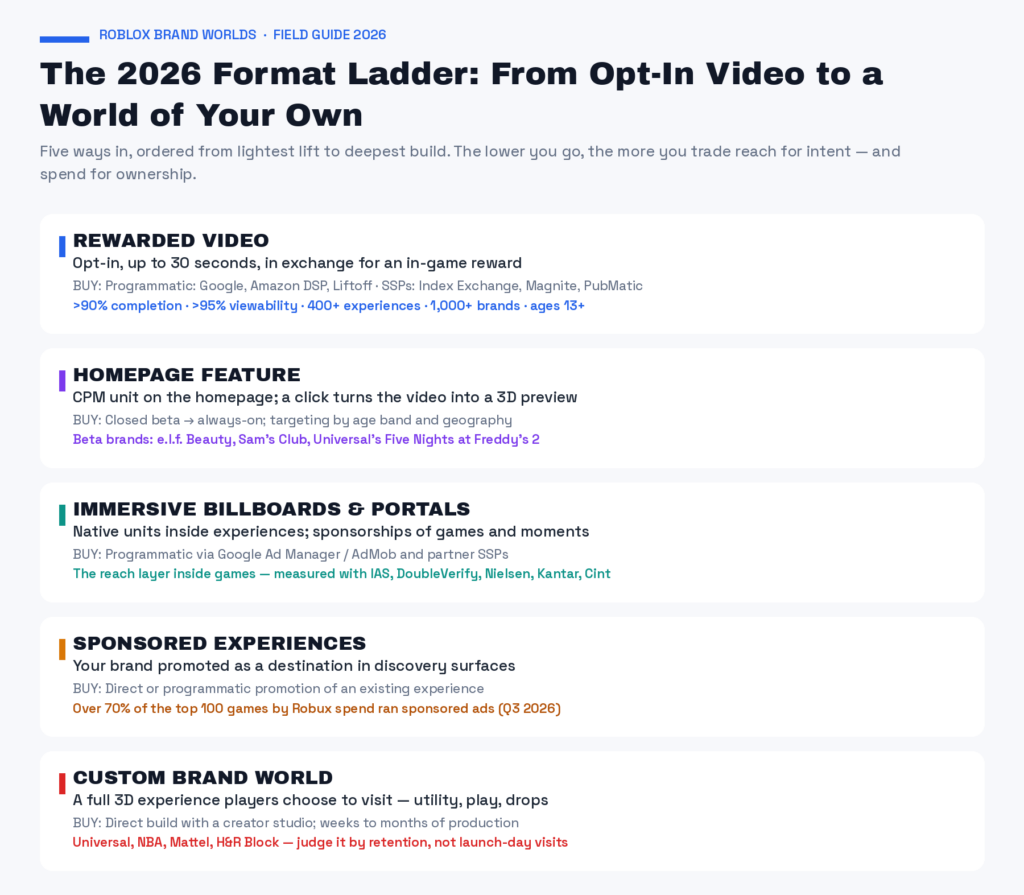
The Format Ladder: Five Ways In, Ordered by Commitment
Think of Roblox buying as a ladder, not a menu. Each rung trades reach for intent, and budget for ownership.
Rewarded Video is the performance rung. The opt-in mechanic filters out passive viewers, which is precisely why the completion numbers look so good. You are not buying broad exposure; you are buying people who chose to watch. One compliance detail buyers keep missing: these ad surfaces are age-gated to 13+.
Homepage Feature is the brand-building rung — familiar CPM mechanics, demographic and geographic targeting, premium placement where sessions begin.
Immersive billboards and portals are the in-game reach layer, bought programmatically through Google Ad Manager, AdMob and partner exchanges. Sponsored experiences promote your world as a destination in discovery. And at the top of the ladder sits the custom brand world: a full 3D experience built with a creator studio. Universal’s Jurassic World Rebirth campaign delivered roughly 2 billion impressions in summer 2025; Wicked: For Good ran a multiworld campaign with almost 8 billion. Seven of the ten top-grossing US domestic films of 2025 activated on Roblox. H&R Block, of all brands, gamified tax education for young earners and came back for 2026.
The lesson from the ladder: start low, prove value, climb only when the data asks you to.
Read the Earnings, Not the Sales Deck
Now the uncomfortable part. The quarterly sequence tells a story no CES keynote will tell you: 152 million DAU at the Q3 2025 peak, then 144 million, 132 million, 123 million — before a seasonal bounce to 138 million in Q3 2026, still 9% below a year earlier. Hours engaged fell from 40 billion at the peak to roughly 34 billion. Bookings dropped 12% year over year to $1.70 billion, monthly unique payers fell 16% to about 30 million, and Q4 guidance calls for another 10–15% bookings decline — with the CFO explicitly baking in a modest headwind from the November 19 launch of Grand Theft Auto VI.
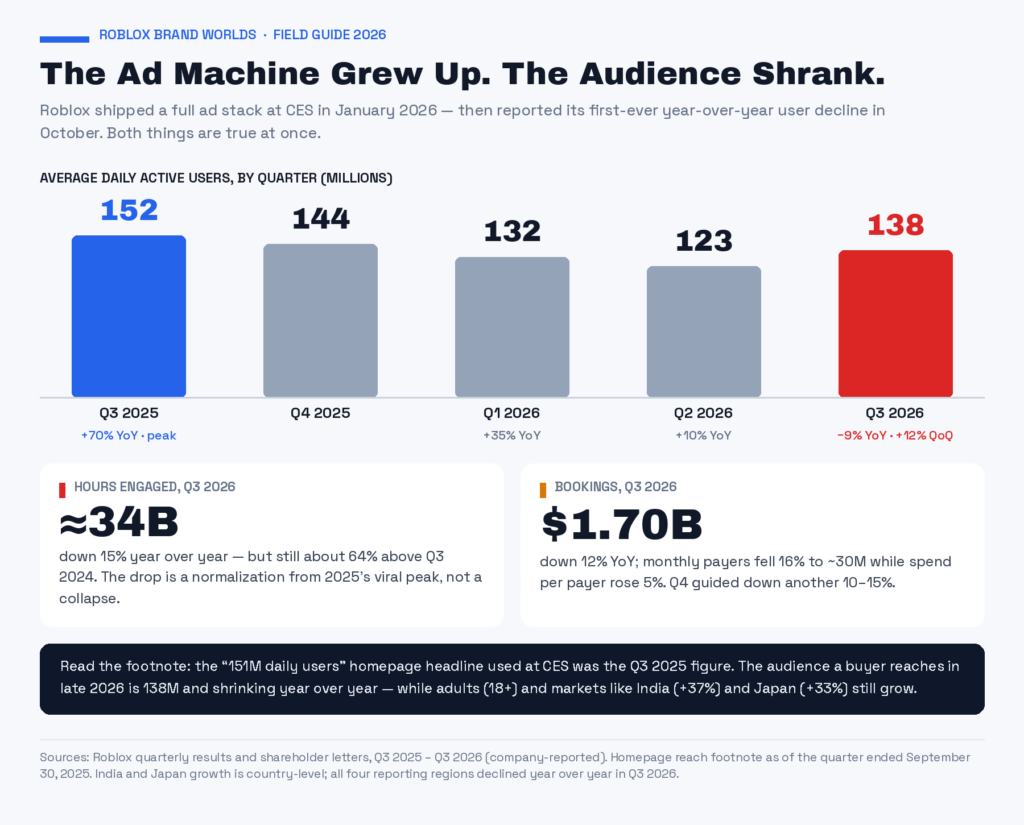
Before you write the obituary, zoom out. Against Q3 2024, DAU is still up about 55% and hours about 64%. This is normalization after a viral year, not collapse — Grow a Garden and Steal a Brainrot pulled in enormous, temporary crowds in 2025, and those crowds moved on. Management also changed the discovery algorithm to favor long-term retention over near-term monetization, knowingly trading short-term bookings for durable engagement. And the declines have identifiable causes: age-verification friction that hurt sign-ups and app-store ratings, a temporary Russia ban (since reversed), and monetization softness among younger US players.
For a media buyer, the operational takeaway is simple: the audience you can reach in late 2026 is 138 million and shrinking year over year. Price the channel accordingly, and never let a sales deck anchor you to the 151 million footnote.
The Growth Is Real — It Just Moved
The headline decline hides three genuine growth stories.
Adults. Users 18 and over now make up 29% of age-checked daily users globally and 37% in the US, where the adult cohort grew 18% year over year. Crucially, Roblox says adult US users monetize more than 50% above younger players. The company is putting money behind this: the developer exchange rate for age-checked 18+ “novel games” in the US jumped from 26.6% to 37.8% in June 2026, a deliberate subsidy for adult-oriented content.
International. India’s DAU grew 37% year over year in Q3 2026 and Japan’s 33%. Be careful with the geography here: all four of Roblox’s reporting regions declined year over year, yet individual countries within them grew fast. Both facts are true; they measure different things. Since September 2026, Aleph has represented Roblox ad sales across seven Latin American markets — Argentina, Brazil, Chile, Colombia, Ecuador, Mexico and Peru — where DAU grew 64% in 2025.
Retention. Management reported the highest seasonally adjusted retention since 2021, and average bookings per payer rose 5% even as payer counts fell. Fewer people, more committed. That is a different media proposition than raw reach — and in some ways a better one.
The Attention Evidence — Strong, but Read the Fine Print
At Cannes Lions in June 2026, Roblox published “Immersive Is Effective,” a study run with Ipsos. Among 13–34-year-olds, 52% of Roblox users said they pay more attention to ads on Roblox than they usually do elsewhere — 13 percentage points above streaming users and 11 above social users. 54% felt more involved with the ads; 63% said product information they saw on Roblox was memorable, roughly 14% above the streaming and social average.
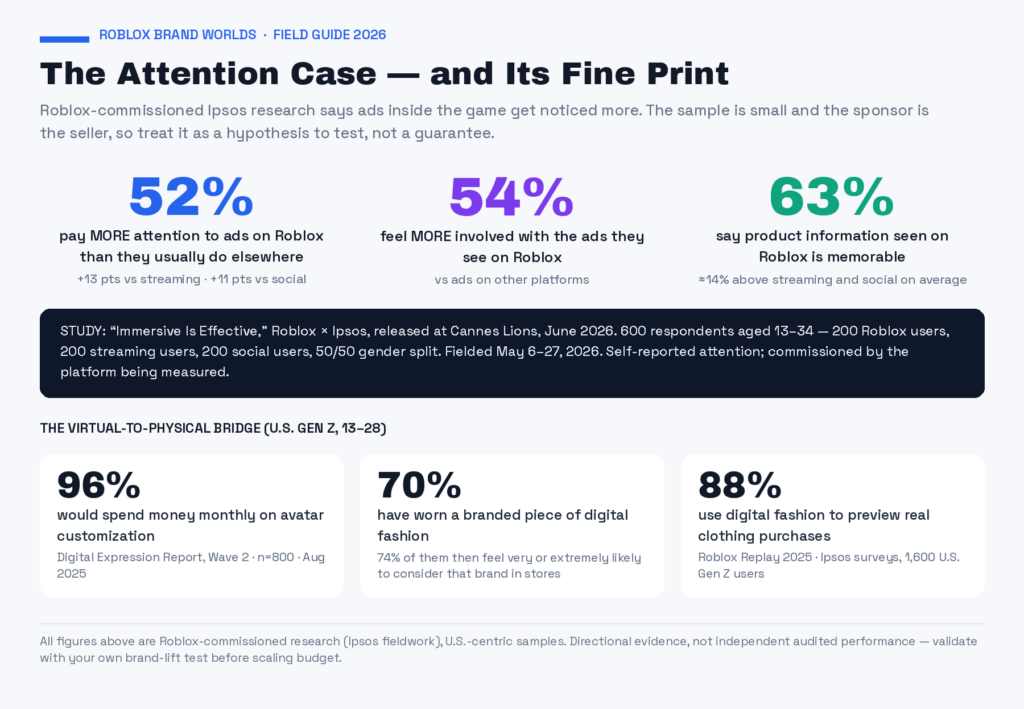
Now the fine print, because it matters. The study surveyed 600 people — 200 per platform group — over three weeks in May 2026. Attention was self-reported. And Roblox commissioned the research about Roblox. None of that makes the data wrong; Ipsos is a serious firm and the methodology is disclosed. But a commissioned survey of 200 users is a hypothesis, not an audited benchmark. Treat it the way you would treat any vendor efficacy claim: interesting enough to test, never sufficient to scale on.
The same discipline applies to the digital-expression numbers you will see in every Roblox pitch deck. In the 2025 Digital Expression Report (Ipsos, US Gen Z aged 13–28, 800 respondents per wave), 96% said they would spend money monthly on avatar customization, and 70% had worn branded digital fashion. In the year-end Replay report, 88% said they use digital fashion to preview real-world clothing purchases. These are US samples, platform-commissioned, and directional. They are also, honestly, the most interesting argument for Roblox: the avatar is a fitting room, and the fitting room feeds the store.
Measurement Grew Up Too
The quietest but most consequential development is measurement. Since the April 2025 Google partnership, Roblox has worked with DoubleVerify and IAS on media quality, fraud and viewability; Kantar and Cint on brand lift; and Nielsen on cross-platform reach and frequency. At Cannes 2026 it added EDO — the TV-and-streaming engagement measurement firm — as its first gaming partner, meaning a Roblox campaign can now be benchmarked against a linear TV spot on the same yardstick.
Agencies spent 2024 and early 2025 complaining that Roblox ads were a black box: platform-reported numbers, no outside verification, 3D viewability that nobody could define. That complaint is now substantially answered on paper. Your job is to make it true in your contract: attach third-party verification to every flight, commission an independent brand-lift study, and refuse to evaluate a six-figure immersive build on last-click attribution. Judge worlds by attention, retention and branded-search lift — the metrics the format can actually move.
The Brand-World Playbook: Utility First, Billboard Never
H&R Block and Universal teach and entertain inside gameplay; Sam’s Club ties its world to real member deals; the NBA runs playable basketball, not a banner. The custom worlds that work share one trait: a player would visit even if the logo were removed.
Three rules follow. Lead with play or utility — a game, a social space, a drop — and let the brand be the host, not the interruption. Buy retention, not launch spikes: ask any creator partner for day-7 and day-30 retention curves, plus their moderation and update history, before you sign. And wire the virtual-to-physical bridge: avatar items, try-ons and redemptions that connect to real products, because that is where the expression data suggests the commercial value lives. The failure mode is expensive and common: a beautiful billboard-world nobody visits twice.
Child Safety Is a Business Risk, Not a PR Footnote
Roblox’s audience skews young, and 2026 proved that safety is now a P&L item. The company cut its full-year guidance — revenue growth to 20–25%, bookings growth to 8–12% — explicitly citing safety-related friction from global age checks and communication restrictions, alongside lawsuits from state attorneys general. Age verification reached 64% of global DAU by the end of Q3.
For advertisers this cuts two ways. The friction shrinks near-term reach — that is part of what you are buying into. But the same age infrastructure is what makes adult targeting credible and what lets brands appear in age-appropriate contexts at all. Non-negotiables before any flight: confirm the age gating of your surfaces, keep creative age-appropriate, follow disclosure rules for sponsored content, apply frequency caps, and review Roblox’s advertising standards and any creator partner’s safety history. Compliance is not the legal team’s problem at the end of the brief. It is the first line of the media plan.
The Economics Behind the Pitch
Why is Roblox pushing ads so hard while users decline? Because it needs a second revenue engine. Bookings — the Robux economy — fell 12% and are guided down again, while the company spends heavily on AI infrastructure and adult acquisition. Advertising diversifies that risk, and the creator economics make it sticky: Roblox disclosed that over 70% of its top 100 games by Robux spend ran sponsored ads, and more than 20% of games using rewarded video earned over 10% of their in-game revenue from advertising. Note the nuance: those are Roblox’s own disclosures (relayed by eMarketer), and they describe creator earnings — not Roblox’s booked ad revenue, which remains small.
Read that incentive structure and the CES announcements make sense. Roblox is lowering every barrier — programmatic pipes, familiar CPMs, third-party measurement — because ad dollars now fund the ecosystem’s next phase. For buyers, the implication is negotiating leverage: a platform courting your budget is a platform that will co-fund tests, share data and tolerate small pilots. Use that window.
The 60-Day Pilot
Here is the plan we would actually run.
Weeks 1–2 — set up. Pick one lane: a rewarded video test or a Homepage Feature beta slot. Target the value core — age-checked adults, or growth markets like India, Japan, or LATAM through Aleph. Clear compliance before creative.
Weeks 3–6 — run and log. Flight the campaign with IAS or DoubleVerify attached. Commission a brand-lift study through Cint or Kantar. If you sponsor or build an experience, log day-7 and day-30 retention from day one.
Weeks 7–8 — decide. Score value per reached user: completion, measured lift, branded-search movement, virtual-item redemption where relevant. Then make the call — scale, iterate, or walk. A small, honest loss now beats a year of defending a world nobody visits.
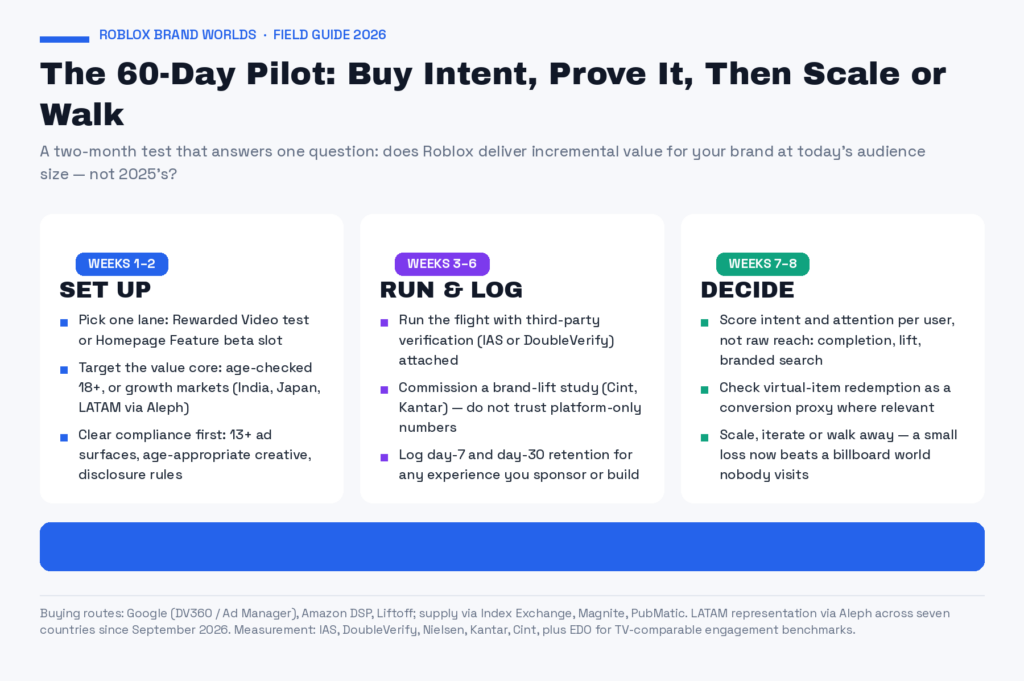
One rule above all: judge Roblox by intent and per-user value at today’s audience size — never by the headline DAU on a sales deck.
Four Failure Modes to Avoid
Buying the 151 million homepage headline while the reachable audience is 138 million and falling — you overpay for shrinking reach. Building a billboard-world with no reason to return — the most expensive banner in media. Treating commissioned attention studies as audited guarantees — then wondering why your brand-lift came back flat. And skipping the child-safety review — the one mistake that can end a campaign, a partnership, or a news cycle you never wanted.
The Bottom Line
Roblox in late 2026 is a paradox worth understanding: the ad stack matured exactly as the audience normalized. Rewarded video posts completion above 90% because it buys consent, not impressions. Homepage Feature makes premium brand-building purchasable like any other CPM line. Programmatic pipes and third-party measurement removed the excuses. Meanwhile DAU fell 9%, hours fell 15%, and the growth migrated to adults, India, Japan and Latin America. Buy the intent and the high-value core, build worlds people want to revisit, measure lift independently, treat safety as a business constraint — and let the 60-day pilot, not the keynote, decide your next budget line.