Open your company blog and scroll back six months. Be honest about what you see. A hot take that expired with its news cycle. A festival poster that was worthless the next morning. Three product announcements nobody outside the company remembers. You have been busy, sure. But busy is not the same as building.
Here is the uncomfortable distinction this article is about: content is one-time, knowledge assets are reusable. And that distinction used to be a matter of internal efficiency. Now it has a price tag, because the biggest new reader of your library is not a person. It is a retrieval system deciding whose answer to repeat.
The Audience Moved Faster Than the Content
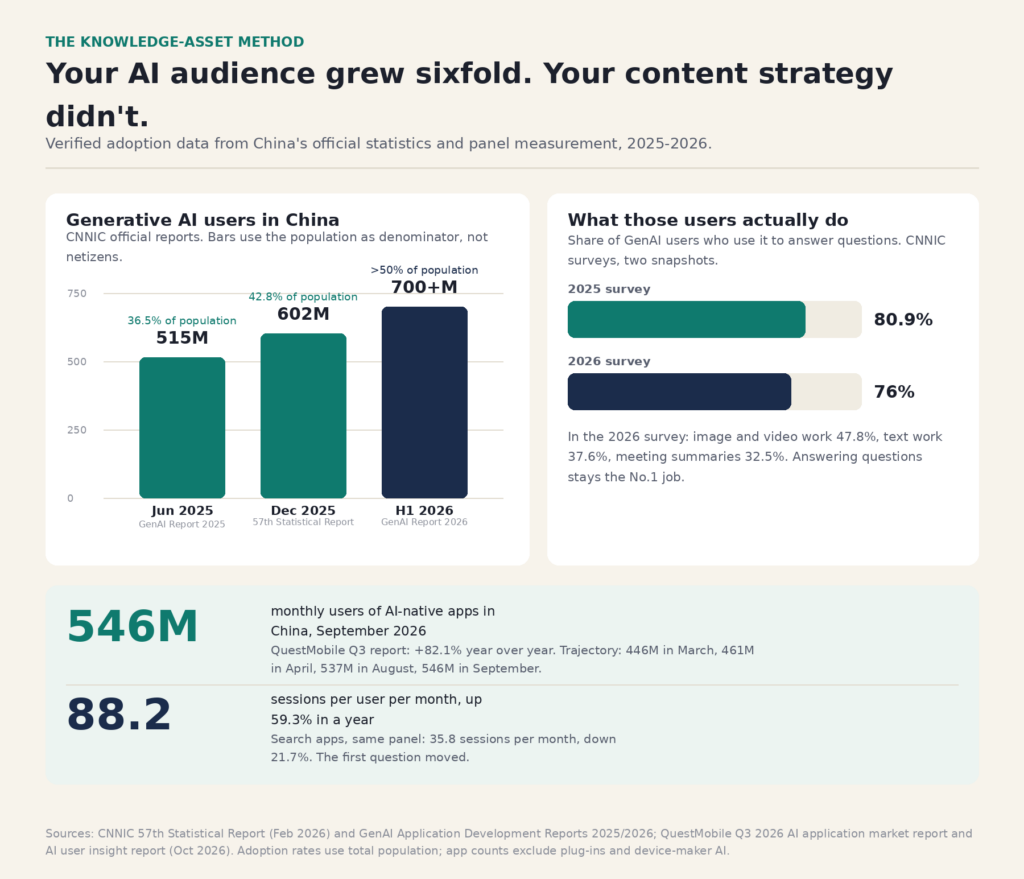
Let’s size the shift with numbers that survive scrutiny. China’s official internet statistics body, CNNIC, reported in its 57th Statistical Report, released in February 2026, that generative AI users reached 602 million by December 2025 — up 141.7 percent in a single year. The adoption rate hit 42.8 percent of the total population, not of netizens; measured against internet users alone, more than half were already on board. By the first half of 2026, CNNIC’s Generative AI Application Development Report put the user base above 700 million, past 50 percent of the population.
What do those people do with AI? The same report series answers plainly. In the 2025 survey, 80.9 percent of generative AI users said they use it to answer questions. In the 2026 survey, 76 percent. Asking questions is the No.1 job people give these tools — the job your content library was supposed to do.
The panel data shows the migration is not hypothetical. QuestMobile measured 546 million monthly active users of AI-native apps in September 2026, up 82.1 percent year over year, with the average user opening an app 88.2 times a month. Search apps, in the same panel, fell to 35.8 sessions per user per month, down 21.7 percent. The first question moved from the search box to the conversation box. Your content either travels with it or stays behind.
A Pile of Files Fails the Six-Dimension Test
Before converting anything, you need a test that separates assets from noise. Run your last 20 published pieces through six dimensions:
- Lifecycle. Does the piece still answer a live question, or did it die with an event?
- Structure. Can a reader — or a machine — extract a complete answer from one section, without reading the whole page?
- Reusability. Can sales, support or product reuse it without rewriting?
- Trust basis. Does it rest on verifiable evidence, or on adjectives?
- AI-friendliness. Would a retrieval system find a clean, self-contained claim to quote?
- Value decay. Does it appreciate with maintenance, or rot on contact with time?
Most publishing calendars produce pieces that fail four of the six. That is not a moral failing; news and culture posts have their own job. But if everything you make fails the test, you don’t have a content library. You have a pile of files with URLs.
The Five Asset Types That Compound
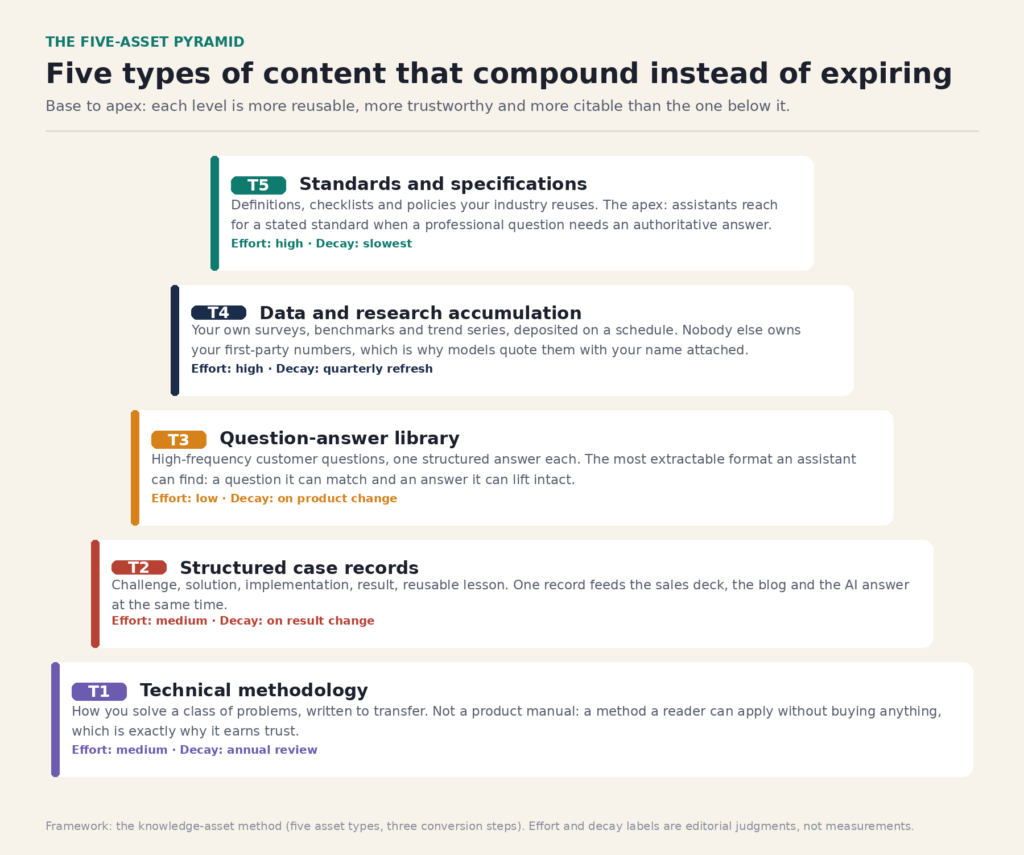
The fix is not “write better posts.” It is to deliberately build five types of content, stacked like a pyramid, each level more reusable and more citable than the one below.
T1 — Technical methodology
How you solve a class of problems, written so a reader can apply it without buying anything. Not a product manual — a transferable method. This is the trust foundation, and it decays slowly: review it annually.
T2 — Structured case records
Challenge, solution, implementation, result, reusable lesson — in that order, every time. One well-built case record feeds a sales deck, a blog section and an AI answer simultaneously. That triple duty is the whole point.
T3 — Question-answer library
Your customers’ high-frequency questions, one structured answer each. This is the most extractable format in existence: a question the model can match and an answer it can lift intact. Low effort, immediate payoff, refreshed whenever the product changes.
T4 — Data and research accumulation
Your own surveys, benchmarks and trend series, deposited on a schedule. Nobody else owns your first-party numbers, which is why models quote them with your name attached. Refresh quarterly or watch them become liabilities.
T5 — Standards and specifications
The apex: definitions, checklists and policies your industry adopts. When a professional question needs an authoritative answer, assistants reach for a stated standard. Becoming the source of that standard is the highest-leverage content move a company can make — and the slowest to build.
Why Citations Reward Assets, Not Rankings
You might assume your SEO work already covers this. The data says otherwise. Ahrefs ran 15,000 long-tail prompts through four AI assistants in 2025 and found that, on average, only 12 percent of cited URLs ranked in Google’s top ten for the original prompt. Roughly 80 percent of cited pages didn’t rank for that prompt at all. Assistants retrieve through multiple rewritten variations of a question — query fan-out — and favor pages that appear consistently across variations. A page built as a clean answer to a question family beats a page built to rank for one keyword.
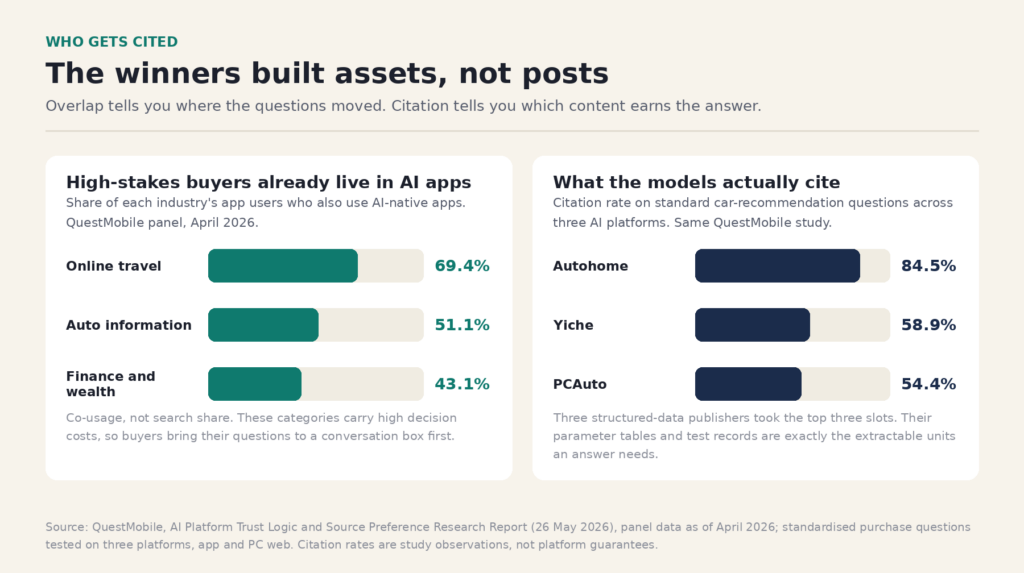
Who wins in practice? QuestMobile’s source-preference study, published in May 2026, tested standardized purchase questions across three major AI platforms. In the auto category, the top three cited sources — Autohome at 84.5 percent, Yiche at 58.9 percent, PCAuto at 54.4 percent — were structured-data publishers. Their parameter tables and test records are precisely the extractable units an answer needs. The study also found that 69.4 percent of online travel app users, 51.1 percent of auto-information users and 43.1 percent of finance app users already use AI-native apps. High-stakes buyers bring their questions to the conversation box first.
And the commercial gap is real. Seer Interactive’s November 2025 analysis of 3,119 informational queries across 42 organizations found organic click-through on AI-summary queries fell 61 percent in fifteen months — but brands cited inside those summaries earned 35 percent more organic clicks and 91 percent more paid clicks than uncited brands. The researchers are careful: citation may reflect brand authority rather than cause the clicks. Either way, cited brands win. Adobe Analytics, covering over a trillion US retail visits, found AI-referred traffic grew 693 percent in the 2025 holiday season and converted 31 percent better than other sources. Adobe sells analytics and AI-optimization tools, so weigh its enthusiasm accordingly — but the direction matches every independent dataset.
Step One: Structure — From Prose to Extractable Units
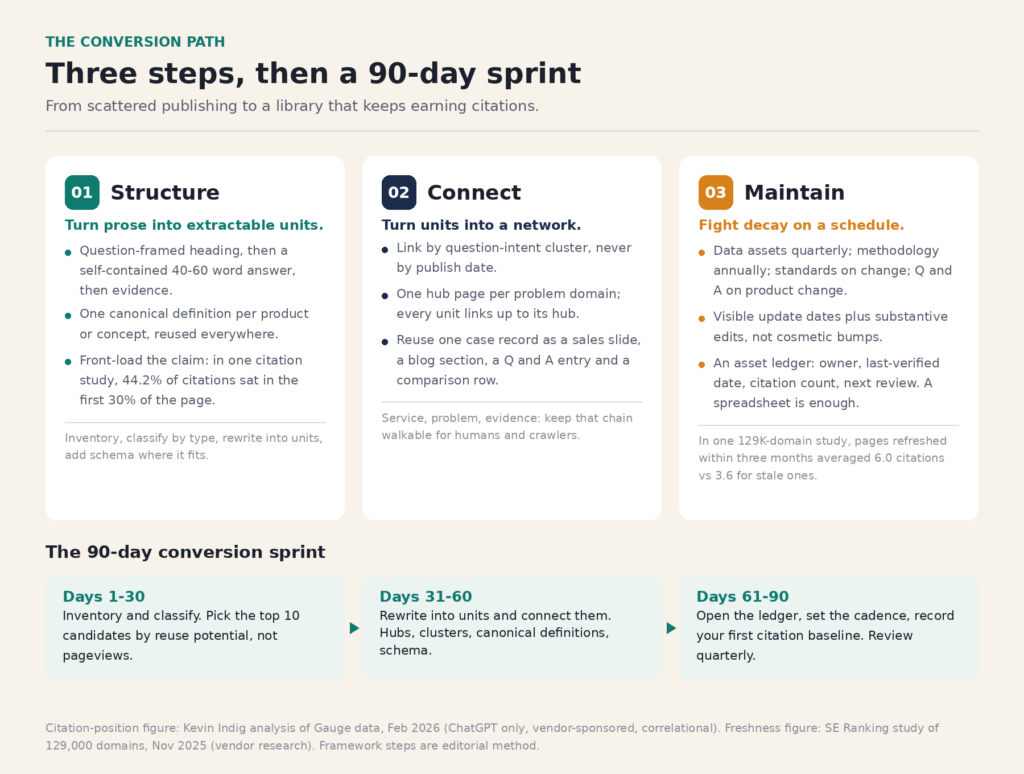
Conversion starts with surgery on your existing prose. The unit of work is the answer capsule: a question-framed heading, a self-contained answer of roughly 40 to 60 words, then the evidence supporting it. Each capsule must survive being lifted out of context — no “as mentioned above,” no dangling pronouns.
Position matters more than most writers think. Kevin Indig’s February 2026 analysis of citation data from Gauge found 44.2 percent of citations sat in the first 30 percent of a page, and within paragraphs, 53 percent came from the middle — the sentence that carries the actual claim, not the wind-up or the wrap-up. The study is vendor-sponsored and correlational, but its practical instruction is cheap to follow: front-load the answer, and make the middle sentence of every paragraph do real work.
Then enforce entity consistency. One canonical definition per product and concept, reused word-for-word everywhere. If three pages define your product three ways, the retrieval layer sees three weak candidates instead of one strong one. The workflow: inventory everything, classify by pyramid type, rewrite into capsules, add schema markup where it genuinely describes the content. One honest caveat from SE Ranking’s study of 129,000 domains: FAQ schema alone showed no positive citation effect. Markup helps machines parse; it is not a citation lever by itself.
Step Two: Connect — From Units to a Network
Isolated capsules are trivia. Connected capsules are a knowledge base. Link by question-intent cluster, never by publish date — your reader’s problem, not your calendar, is the organizing principle. Build one hub page per problem domain and point every unit at its hub.
Keep the relationship chain walkable: service → problem → evidence. A visitor (or a crawler) should move from what you offer, to the problem it solves, to the proof it works, without dead ends. Then exploit the network effect internally: one structured case record becomes a sales slide, a blog section, a Q&A entry and a comparison-table row. You wrote it once. It works four jobs. That is what compounding looks like in a content operation.
Step Three: Maintain — Assets Decay Without Upkeep
An unmaintained asset is a slow-motion liability: the model quotes your outdated number with your name on it. Set the cadence by type. Data assets: quarterly. Methodology: annually. Standards: whenever the underlying rule changes. Q&A: whenever the product changes.
Freshness is measurable. In SE Ranking’s November 2025 dataset, pages updated within three months averaged 6.0 citations versus 3.6 for stale ones — vendor research, correlational, but consistent with how retrieval systems hedge against expired facts. Two rules make maintenance real: visible update dates paired with substantive edits (cosmetic date bumps fool nobody, including crawlers), and an asset ledger — owner, last-verified date, citation count, next review. A spreadsheet is enough to start. The discipline matters more than the tooling.
Measure Assets, Not Pageviews
Pageviews measure the old game. An asset’s scorecard has four lines: AI citation count and share on your target questions; search entrances per asset; sales reuse count; assisted conversions. Keep the reframe handy for the next budget meeting: an asset with 200 views, 30 AI citations and five sales reuses outperforms a 10,000-view post that decayed in a week.
One measurement trap deserves warning. AI-referred visits often arrive without a clean referrer and get bucketed as direct traffic, so click-based attribution systematically undercounts your fastest-growing channel. Add a self-reported “how did you hear about us” field and watch branded-search lift. Neither is precise. Both beat pretending the traffic doesn’t exist.
Who Owns the Library
Asset libraries die of orphanhood. Assign four roles explicitly: the content lead owns structure, subject-matter experts own truth, the SEO/GEO owner owns extractability, and sales owns reuse feedback — they are your earliest signal that an asset stopped matching reality. Run a quarterly review ritual with three verbs: prune what no longer answers a live question, refresh what decayed, promote what earned citations into more prominent positions. Thirty minutes with the ledger beats a year of good intentions.
The 90-Day Conversion Sprint
You don’t need a re-platform. You need one quarter of focused conversion.
- Days 1–30: inventory and classify everything against the pyramid. Pick the top 10 candidates by reuse potential, not pageviews. Run a baseline prompt audit: write the 20 questions your buyers actually ask, in their phrasing, and record what the major assistants answer today.
- Days 31–60: rewrite the ten into answer capsules. Connect them: hubs, clusters, canonical definitions, schema where it fits.
- Days 61–90: open the ledger, set the refresh cadence, re-run the prompt audit and record your first citation baseline. Now you have a trend line, which is the only thing worth managing.
Honest Boundaries
Three confessions keep this method honest. First, not every piece should be an asset. News reactions, jokes and culture posts do a different job, and forcing them into the pyramid wastes effort. Build the compounding layer alongside the disposable layer, not instead of it. Second, citation counts are platform-dependent and noisy; a single screenshot proves nothing. Trends across a fixed question set matter more than absolutes. Third, the academic evidence is promising but bounded: the original GEO paper from Princeton and collaborators, published at KDD 2024, showed optimization tactics lifting visibility by up to 40 percent — in a lab benchmark, not your market. Treat the direction as settled and the magnitude as yours to measure.
The Short Version
Your buyers’ first question now lands in a conversation box — 700 million people in China alone, and the same mechanism running on every major assistant worldwide. Retrieval systems quote extractable, connected, maintained knowledge, not expired posts. The five-type pyramid tells you what to build; structure, connect and maintain tell you how; the ledger and the 90-day sprint keep it honest. Publishing is an event. Assets are a position. Start accumulating.