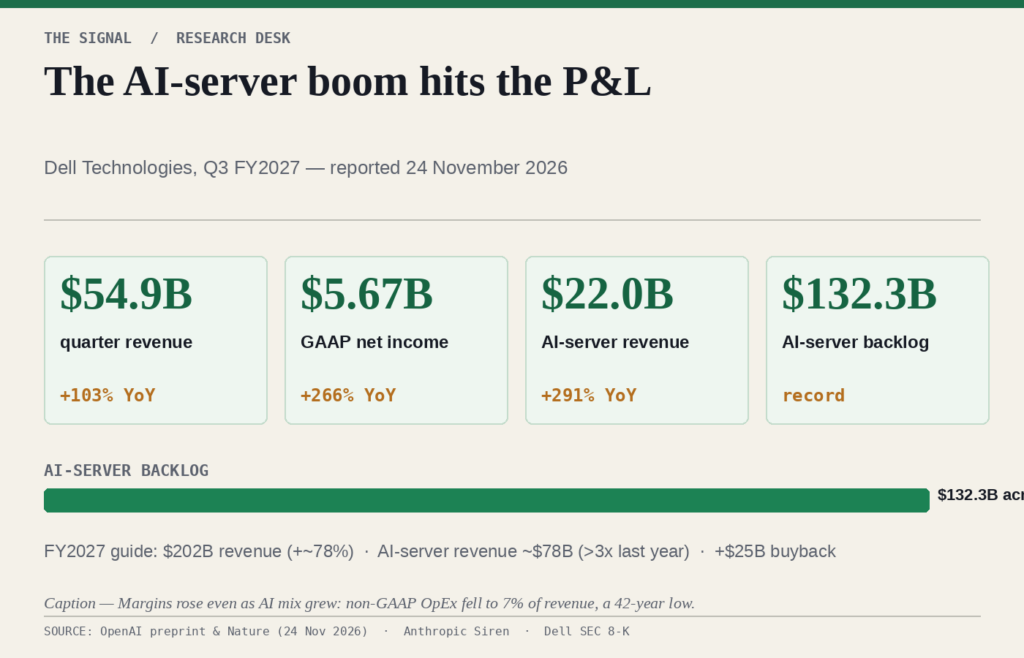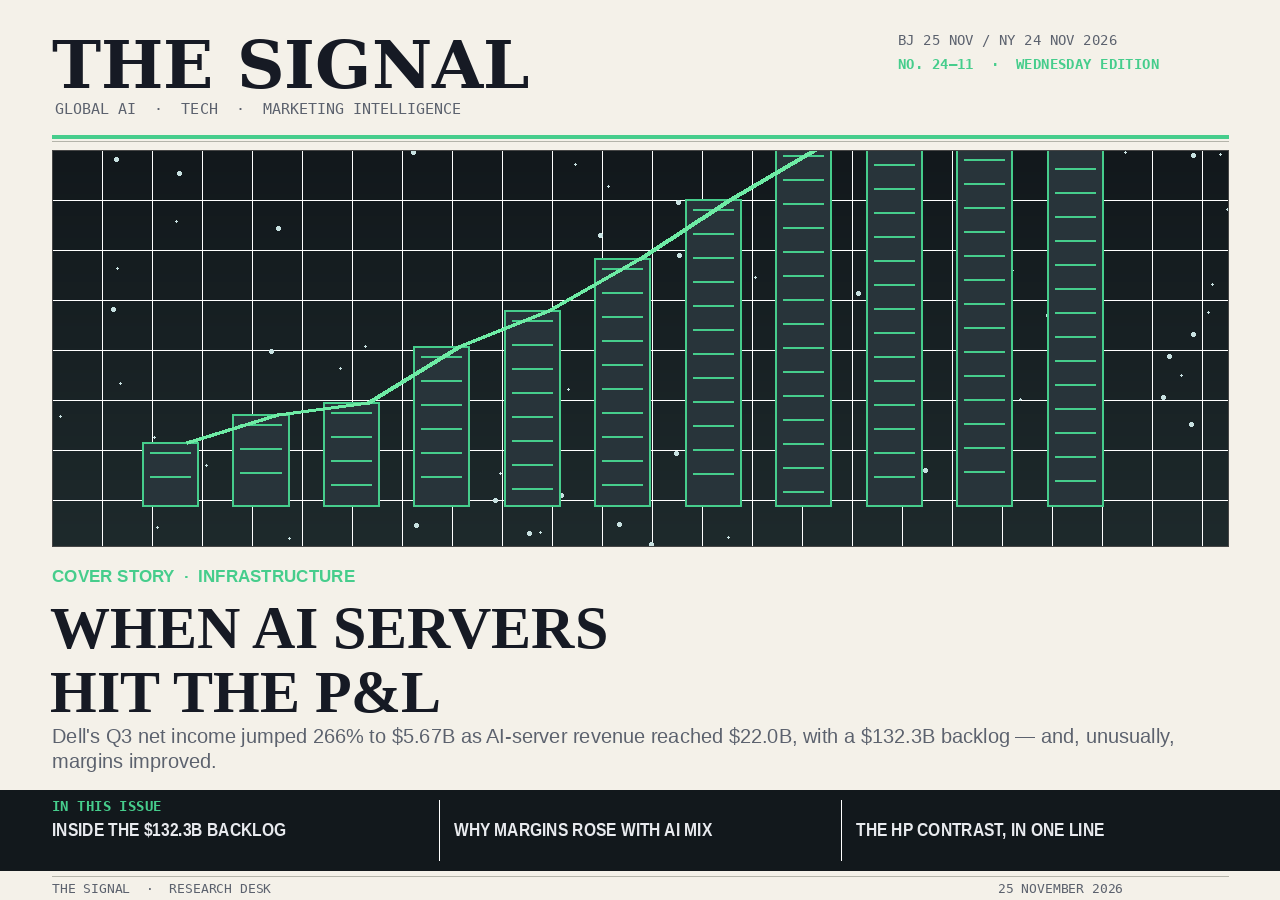
Quarter revenue doubled to $54.9B, AI-server sales hit $22.0B, and the backlog reached $132.3B — with margins going up, not down.
Dell reported third-quarter fiscal 2027 results on November 24, and the numbers are hard to misread. Revenue was $54.94 billion, up 103% year over year and 17% sequentially. GAAP net income was $5.67 billion, up 266%. Diluted EPS came in at $8.82, up 287%; on a non-GAAP basis, $9.45, up 265%. Every one of those is a company record.
Infrastructure Solutions Group carried it. ISG revenue was $41.97 billion, up 198%, with operating income of $7.12 billion, up 308%, at a 17% margin. Inside that, AI-optimized server revenue reached $22.03 billion, up 291%. Traditional servers and networking were not left behind — $15.01 billion, up 235% — as an aging installed base got refreshed for inference work. Storage was the quiet one, up 24% to $4.93 billion.
The figure investors will keep returning to is the $132.3 billion AI-server backlog, described as fully vetted across nearly 100 sites and spread roughly evenly inside and outside the US. Dell raised full-year revenue guidance by $10 billion to $202 billion, about 78% growth, and now expects roughly $78 billion of AI-server revenue for the year — more than three times last year’s $24.7 billion. The board added $25 billion to the buyback authorization. Nine-month net income was $13.24 billion, up 260%.
The part that is genuinely unusual is the margin. Mixing more low-margin AI servers into a product line usually drags profitability down. Here non-GAAP operating expenses fell to 7% of revenue — the lowest in Dell’s 42-year history — and operating margin rose to 13.5% from 7.8% a year ago. CFO David Kennedy’s line was that growth is now decoupled from operating expense. COO Jeff Clarke said demand is shifting from training toward inference and agentic workloads, and that demand in calendar 2027 is further ahead of supply than it was in 2026.
Set it next to HP, which reported full-year net income of $2.425 billion, down 4.1%, on the same news cycle. Same PC-and-print-and-servers industry, opposite result. The split is not subtle: exposure to AI infrastructure is now the single biggest determinant of whether a legacy hardware company is growing or shrinking.
The risk sits in that backlog rather than in the quarter. Dell says every order has been credit-checked and vetted for power, land and capital, and that racks are tested before shipping and deployed within six hours of arrival. With that much revenue scheduled across so many sites, the question for 2027 is execution — whether those deployments get powered and paid for on the timeline the guidance assumes.