Every enterprise AI pilot eventually hits the same wall, and it is almost never the model. The agent can write, code, and reason — it just doesn’t know that your revenue metric excludes refunds, that the Q3 numbers live in a renamed BigQuery column, or that legal review is mandatory before anything ships. In a blog post published November 21, LangChain CEO Harrison Chase gave that wall a name and a blueprint: the missing piece is not better models, and not just more context — it is better knowledge. The system for producing it, he argues, is a “knowledge factory.”
The distinction at the core is between context and knowledge. Context is whatever the agent happens to see while doing a task. Knowledge is the reusable understanding that makes the task correct: what a metric means, which source to trust, how your company handles a particular situation. Most of it is tacit — living in your best employees’ heads, passed coworker to coworker, never written down. Agents cannot read minds, and the scattered documents that do exist are usually incomplete or wrong. Chase’s argument is that this knowledge, not model capability, is now the binding constraint on enterprise AI — and that maintaining it manually is a “herculean effort” no team will sustain.
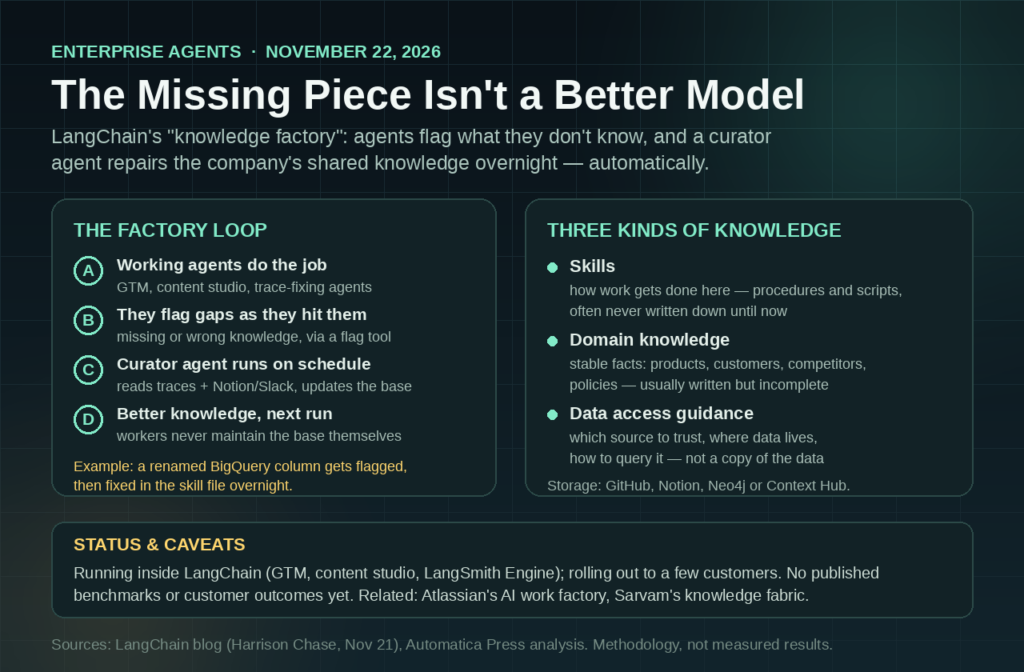
The factory design is deliberately boring, which is its strength. Working agents get a flagging tool: when they cannot find information, or find information that turns out to be wrong, they raise a flag instead of guessing or silently fixing things. A separate curator agent then processes those flags on a schedule — inspecting the agents’ session traces and the raw sources in Notion or Slack — and updates the knowledge base overnight. Chase’s example: an agent preparing a revenue report notices a renamed BigQuery column and flags it; after the finance lead corrects the formatting in-session, the curator reads the traces that night and updates the skill file so every future report gets it right. Crucially, working agents never maintain the knowledge themselves — LangChain found that makes the base unruly.
The taxonomy is where marketing and operations teams should pay attention. Three kinds of knowledge get maintained: skills (the procedures and scripts for doing work your company’s way — the stuff that was never written down), domain knowledge (stable facts about products, customers, competitors and policies — usually written but incomplete), and data access guidance (which source to trust and how to query it — explicitly not a copy of the data, which should stay in your warehouse). Storage can be GitHub, Notion, a Neo4j graph, or LangSmith’s Context Hub. Chase notes the industry has converged on “skills” as a format for procedural memory, but no standard exists yet for semantic memory — an open formatting question the whole ecosystem will need to settle.
The honest caveat, flagged by independent coverage from Automatica Press: this is a methodology post, not a results post. No benchmarks, no customer outcomes, no third-party validation — LangChain says the system runs its own GTM and content-studio agents and is rolling out to a few customers, and that is the extent of the evidence. Similar concepts are converging elsewhere (Atlassian’s “AI work factory,” Sarvam’s “knowledge fabric”), which suggests the pattern is real even if the numbers are pending. For teams whose agents keep disappointing, though, the diagnostic value is immediate and free: audit what your agents actually know about how your company works. If the answer is “whatever fits in the prompt,” you have found your bottleneck — and it was never the model.