Ask five well-read colleagues the same question and you will get five different reading lists. One quotes an encyclopedia. Another swears by a trade magazine. A third forwards a forum thread where practitioners argue in the comments. Strangely, they often land on the same recommendation anyway.
That is exactly how AI search works in 2026 — and most GEO strategies are built as if it doesn’t.
If your team treats “AI search” as one channel with one playbook, the data has bad news: the engines pull from strikingly different parts of the web. The good news, which almost nobody talks about, is that their brand recommendations converge far more than their sources do. This article maps the divergence, explains where it comes from, teaches you to read the conflicting statistics without getting fooled, and ends with an allocation plan you can actually run.
One Question, Five Worldviews
Picture a buyer typing “What’s the best project management tool for a 20-person agency?” into five engines.
ChatGPT builds its answer from a wide bench of references — Wikipedia, publishers, review sites. The 2026 AI Visibility Index from Semrush (now an Adobe company) measured an average of 15.4 sources per ChatGPT response, against 11.4 for Google AI Mode, 9.2 for AI Overviews, and just 3.3 for Gemini. That study analyzed 126 million real US prompts from January through April 2026. Same question, five different evidence diets.
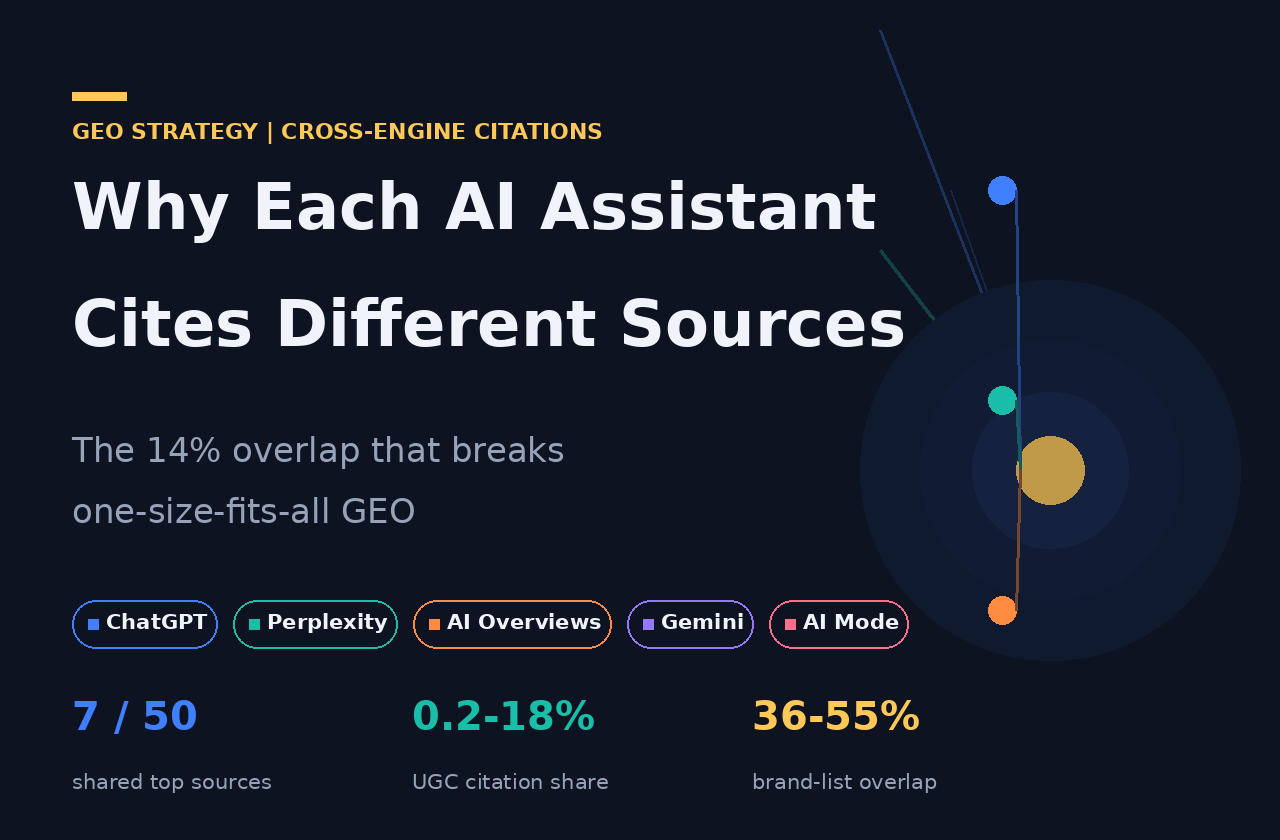
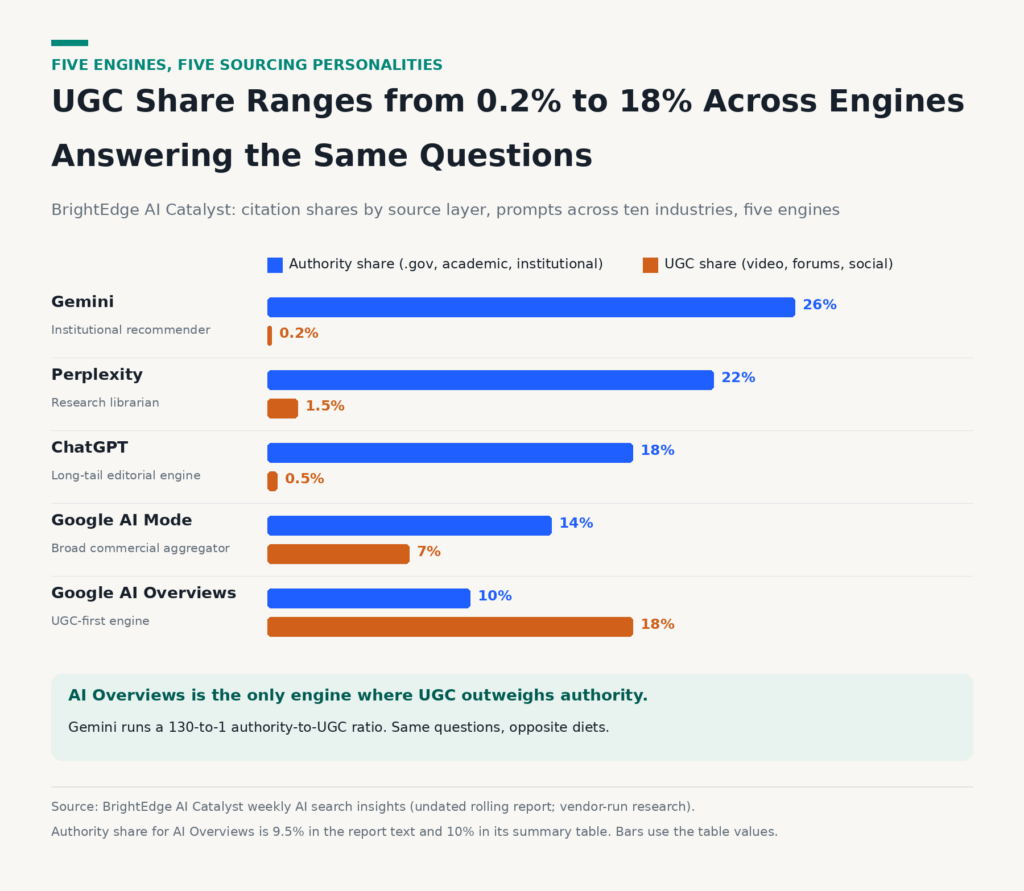
The citation panels look different too. Google AI Overviews leans on YouTube, Reddit, and Quora. Gemini behaves like a formal reference desk, favoring institutional sources. Perplexity quotes sources line by line, like a researcher who shows their work. BrightEdge’s AI Catalyst analysis of prompts across ten industries found the share of citations coming from user-generated content ranges from 0.2% on Gemini to roughly 18% on AI Overviews — about a 90-fold spread for the same categories of questions.
One caveat before we go further: Ahrefs, Semrush, BrightEdge, and Similarweb all sell AI-visibility tooling. Their studies are large and useful, but they are vendor-run measurements on proprietary prompt panels, not platform logs. Read the direction of each finding as solid; treat exact percentages as snapshots.
Start With the Number: Only 14% of Top Sources Overlap
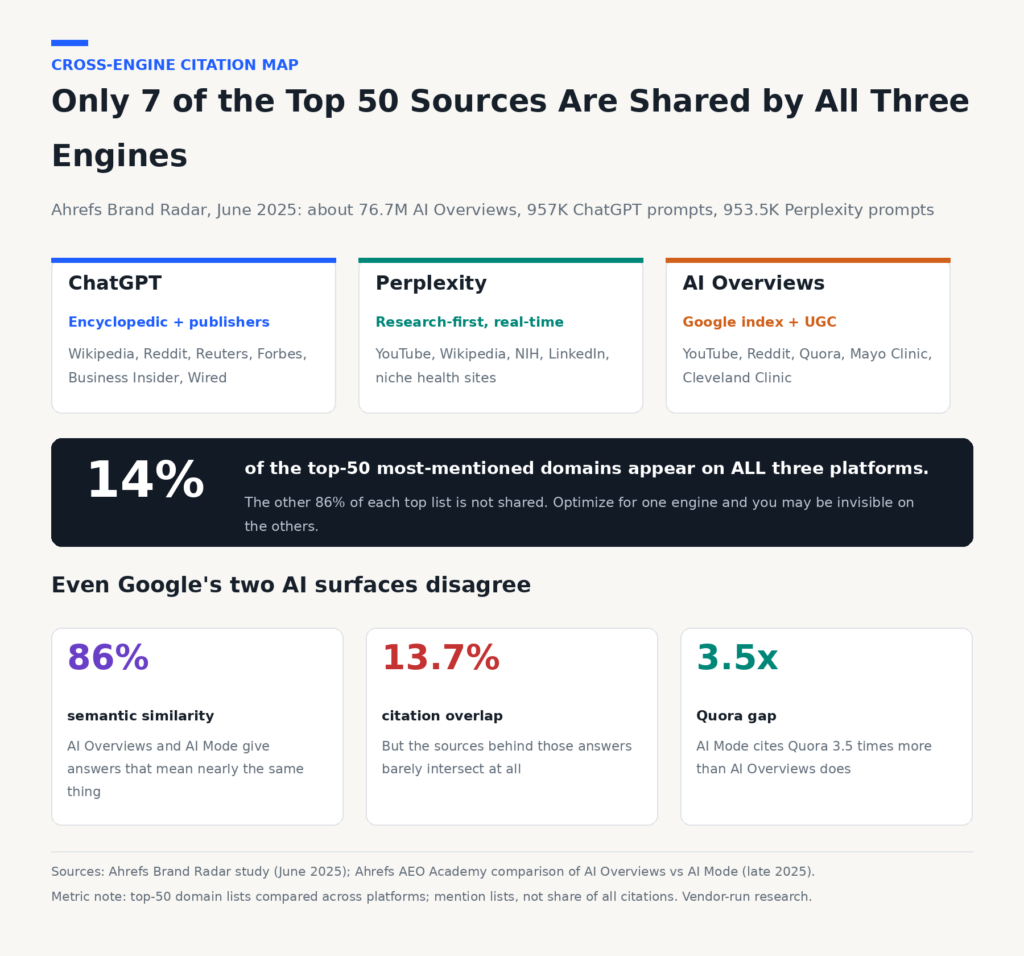
In June 2025, Ahrefs compared the 50 most-mentioned domains on ChatGPT, Perplexity, and Google AI Overviews. The dataset was substantial: roughly 76.7 million AI Overviews, 957,000 ChatGPT prompts, and 953,500 Perplexity prompts.
Only seven domains appeared in the top 50 on all three platforms. That is a 14% overlap. The other 86% of each list was not shared.
Sit with that for a second. If you optimize only for the engine where you already show up, you may be effectively invisible on the others — not because your content is bad, but because those engines never reach for the sites where your content lives.
The shared seven are the giants: Wikipedia, YouTube, Reddit, and their peers. Similarweb’s US data from January–February 2026 found ChatGPT and Google AI Mode shared 13 of their top 20 cited domains. So the very top of the web overlaps. Below the giants, the lists split fast — and that middle zone is precisely where most businesses compete.
Why Both 12% and 91% Can Be Right: The Measurement Trap
Here is where most articles on this topic quietly mislead you, so let’s do the opposite.
A September 2026 structured review posted on Zenodo — “Who Does AI Cite?” — traced 30 published studies and statements back to their originals. It is a self-published, non-peer-reviewed preprint by a commercial GEO analytics firm (IndexCraft), so weigh it accordingly. But its arithmetic is checkable, and it exposes three traps.
Trap one: same data, different denominators. In one widely shared Profound dataset, Wikipedia accounts for 7.8% of all ChatGPT citations — and 47.9% of the top-ten sources’ share. Both numbers are “true.” They answer different questions.
Trap two: presence rates dressed up as shares. Semrush’s frequently quoted Reddit figures, added across domains, sum to 208%. That is arithmetically impossible for citation shares — because they never were shares. They measure the percentage of answers in which a domain appears at least once. When someone tells you “Reddit is 40% of AI citations,” they are almost certainly quoting a presence rate through a broken telephone.
Trap three: URLs versus domains. Estimates of how much AI citations overlap with Google’s rankings range from 12% to 91% across studies — largely because comparing exact URLs and comparing whole domains are different sports. Ahrefs’ own 15,000-prompt test found only 12% of AI-cited URLs sit in Google’s top ten for the same prompt, while domain-level comparisons run far higher.
The rule this article follows, and you should too: never quote a citation statistic without its metric definition, time window, and prompt set.
Three Roots of Divergence: Indexes, Deals, and Product Design
The differences are structural, not random. Three forces produce them.
First, indexes. Google’s AI features draw on Google’s own search index. Its Search Central documentation is explicit: to appear as a supporting link in AI Overviews or AI Mode, a page must be indexed and eligible to show with a snippet — and there are no additional requirements or special markup. ChatGPT and Perplexity run their own retrieval setups, which we’ll unpack below.
Second, commercial relationships. OpenAI has licensing deals with publishers, and Ahrefs links ChatGPT’s appetite for news and entertainment sources partly to those agreements. Google’s AI surfaces lean on Google-owned properties. Business relationships shape which sources are cheap and easy for each engine to use.
Third, product design. Perplexity was built to cite nearly every claim. ChatGPT searches selectively and filters toward trusted or licensed domains. AI Overviews curates a short citation list from search results. Different plumbing, different output.
The Google Surfaces: One Index, Two Personalities — Plus a Third That Behaves Like a Stranger
Google AI Overviews is the UGC-first engine. BrightEdge measured roughly 18% of its citations coming from user-generated platforms against about 10% from authoritative institutions — the only engine in that dataset where UGC outweighs authority. A single video platform accounts for roughly a tenth of all its citations. Ahrefs’ June 2025 data put YouTube at about 5.6% of AI Overview citations, with Reddit and Quora also ranking high.
Now the twist: AI Mode is not AI Overviews with a new coat of paint. Ahrefs found the two surfaces’ answers are 86% semantically similar — they say nearly the same things — yet their citation overlap is just 13.7%. AI Mode cites Quora 3.5 times more than AI Overviews and pulls harder from social platforms.
And Gemini, despite the Google badge, behaves like neither. BrightEdge measured its authority-to-UGC citation ratio at roughly 130 to 1, with about 26% of citations from government, academic, and institutional domains. Its top-100 source overlap with ChatGPT (39%) is higher than with AI Mode (27%) or AI Overviews (34%). “Google AI” is not one thing.
ChatGPT: Encyclopedias, Publishers, and a Reported Index of Its Own
ChatGPT reads like a formal editorial assistant with an enormous long tail. BrightEdge found its top ten domains capture only 18.5% of its citations — the flattest distribution of any engine studied. Wikipedia, Reuters, Forbes, Business Insider, and Wired recur across studies.
Does that mean you need a mega-authority domain to get cited? The nuance matters. Ahrefs analyzed ChatGPT’s top 1,000 cited pages from September 2025. Among the cited pages that rank in Google at all, the median Domain Rating is 90 — but 67.3% of those pages have a page-level rating of 10 or below. Meanwhile 28% of the most-cited pages have zero organic search visibility, and only about a third of top citations are realistically influenceable by outreach. Translation: ChatGPT borrows domain trust, then quotes whichever specific page answers the question — sometimes a page Google has never rewarded.
Under the hood, the architecture is shifting. OpenAI officially documents that ChatGPT search uses its own “indexed and cached web content,” crawled by OAI-SearchBot — a separate crawler from GPTBot, which handles training. Third-party researchers have gone further. A July 2026 analysis covered by Search Engine Land found internal source-selection labels in ChatGPT’s traffic, including one called Labrador; researcher Chris Green captured 9,946 search runs across 1,000 prompts and saw Labrador serve as the primary source in 88.1% of them. Peec AI’s September 2026 research describes a family of specialized internal indexes and live experiments preferring them over external results. Two honesty flags: Labrador is the researchers’ label, not an OpenAI-confirmed name, and these findings come from outside observation, not company documentation. What is confirmed: when Green’s prompts switched retrieval pipelines, URL overlap between runs dropped by roughly 45%. The engine you measured last month may not be the engine answering today.
The practical move is unglamorous: be indexed in Google, be indexed in Bing, and let OAI-SearchBot crawl you. Blocking it removes you from ChatGPT search regardless of your training-data preferences.
Perplexity: An Independent Index Built for Sourcing
Perplexity runs its own crawler and index, searches in real time, and commits to a short, authoritative shortlist. BrightEdge found 86% of its brand mentions land at position five or earlier — the tightest shortlist in the dataset.
It is also the most SEO-aligned assistant. In Ahrefs’ 15,000 long-tail-prompt test (data collected in early July 2025), 28.6% of Perplexity’s cited URLs ranked in Google’s top ten for the same prompt — roughly one in three, against about 8% for the other assistants, whose citations mostly didn’t rank in Google at all. If your Google rankings are strong, Perplexity is where that equity converts fastest.
One myth to retire while we’re here: domain-level link strength is a weak predictor of AI mentions everywhere. In Ahrefs’ correlation study, Perplexity showed the strongest relationship — and it was still weak (Spearman −0.34); ChatGPT showed essentially none. Links help you get retrieved; they don’t decide who gets quoted.
Sources Diverge, Brands Converge: The Finding That Saves Your Budget
Now the finding that should reshape your planning doc.
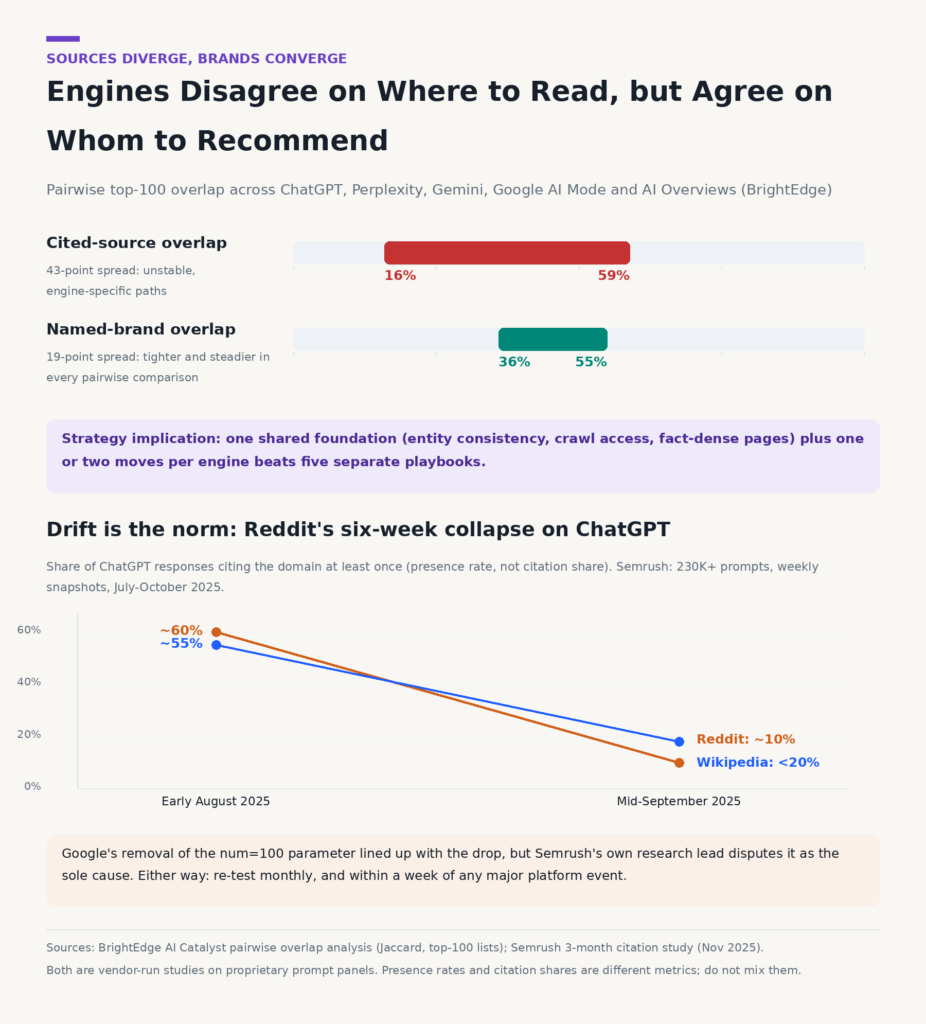
BrightEdge compared all five engines pairwise: top-100 cited-source overlap ranges from 16% to 59% — a wild 43-point spread. Top-100 named-brand overlap ranges from 36% to 55% — a 19-point band, tighter and steadier in every single comparison. The engines disagree loudly about where to read. They agree, much more consistently, about whom to recommend.
The Semrush–Adobe index tells the same story from the brand side. Patagonia stays visible across ChatGPT, Gemini, AI Mode, and AI Overviews because dozens of outdoor-specialist sites describe it consistently — a coherent cross-channel narrative, not one viral page. (Disclosure: Adobe acquired Semrush for about $1.9 billion in a deal announced in November 2025 and closed in April 2026, and both sell visibility products. The pattern is still corroborated by BrightEdge’s independent panel.)
One more distinction worth burning into memory: being mentioned and being cited are different games. The same index found the overlap between mentioned brands and cited domains can be as low as 30% on Gemini. AI can talk about you constantly while quoting someone else’s page as evidence. You need both: enough authority to be named, and enough structured, quotable content to be the source.
One Foundation Plus Platform Moves: An Allocation Plan That Works
So do you need five content strategies? No — and the convergence data is your license to refuse that budget request. Think one foundation, a few engine-specific moves, and per-engine measurement.
The shared foundation, where most of your effort belongs:
- Entity consistency: the same brand name, category, and facts everywhere AI reads — your site, Wikipedia/Wikidata if you qualify, review platforms, trade press.
- Crawl access: indexed in Google and Bing, OAI-SearchBot and PerplexityBot allowed, content in the initial HTML rather than JavaScript-only.
- Fact-dense, chunkable pages: clear headings, self-contained answers, real numbers, comparison tables. AI reads blocks, not brochures.
- Presence on the shared giants: honest participation on Reddit and LinkedIn, useful YouTube content.
Then layer one or two moves per engine, weighted by where your buyers actually ask:
| Engine | Bias to exploit | Highest-leverage moves |
|---|---|---|
| ChatGPT | Publishers, reference sites, long tail | Digital PR in trusted trade media; get listed on the reference and comparison pages it already cites |
| Perplexity | Fresh, quotable, SEO-aligned pages | Keep key pages updated and fact-dense; YouTube explainers; niche and regional authorities |
| AI Overviews | Google index + UGC | Classic SEO as the entry ticket; genuine Reddit/YouTube presence in your category |
| AI Mode | Commercial + social mix | Review-site coverage, comparison content, social presence |
| Gemini | Institutional authority | Coverage from associations, standards bodies, academic and government-adjacent sources in your vertical |
Authority is category-relative, by the way. If you sell payroll software, your “authority layer” is HR trade bodies and analyst firms — not the NIH.
Drift Is the Default: Reddit’s Fall From 60% to 10% in Six Weeks
Any snapshot you read today — including this article — has a shelf life.
Semrush tracked more than 230,000 prompts weekly from July to October 2025, over 100 million citations. In early August, Reddit appeared in close to 60% of ChatGPT responses. By mid-September: around 10%. Wikipedia fell from roughly 55% to under 20% in the same window. Note the metric: these are presence rates — the share of answers citing the domain at least once — not citation shares.
The timing lined up with Google’s removal of the num=100 search parameter, which broke many tools’ access to deep results. But Semrush’s own head of organic and AI visibility, Sergei Rogulin, publicly disputed that as the root cause, arguing the drop looked more like deliberate de-biasing against over-cited domains. The cause is contested; the lesson is not. A single retrieval change can reprice your entire channel mix in six weeks, and it will not hit every engine at once — Reddit and Wikipedia stayed stable on Perplexity and AI Mode throughout.
The Per-Engine Monitoring Checklist
Turn all of this into a routine, not a one-off audit:
- Fix one prompt panel: 30–50 real buyer questions, unchanged month to month.
- Run it on every engine that matters — minimum ChatGPT, Perplexity, AI Overviews, AI Mode; add Gemini for B2C. Fresh sessions, and run key prompts twice because answers vary between runs.
- Log three things per answer: is your brand named, is your page cited, and which third-party domains are cited.
- Keep one column per engine. Never average them into a single “AI visibility score” — a blended number can sit flat while you win on one engine and vanish from another.
- Convert each engine’s cited-domain list into that engine’s outreach and content targets.
- Re-test monthly, and within a week of any major platform event: a licensing deal, a crawler policy change, a model release.
- Join the panel to GA4 AI-referral traffic so visibility connects to visits.
Thirty questions by hand is an afternoon. Beyond that, tooling earns its keep — just remember whose panel you’re buying.
The Bottom Line
The engines’ top sources overlap by as little as 14%, their UGC appetites differ by 90-fold, and their citation mixes can collapse in six weeks. Yet the brands they recommend converge in a steady 36–55% band. That combination dictates the strategy: build one foundation of entity consistency, crawl access, and fact-dense content; add one or two targeted moves per engine; measure every engine in its own column; and distrust any citation statistic that arrives without its measurement definition. One-size-fits-all GEO is dead. One-foundation, many-tuned GEO is very much alive.